Mitchell, John N.
John N. Mitchell served as the 67th Attorney General of the United States from January 1969 until February 1972. He transitioned from the Justice Department to manage Nixon's reelection campaign, serving as the Director of the Committee for the Re-Election of the President (CRP) from March 1972 until his resignation in July 1972 shortly after the Watergate break-in. During the White House taping period, Mitchell was frequently recorded discussing campaign intelligence operations, the ITT antitrust settlement, and the early stages of the Watergate cover-up.
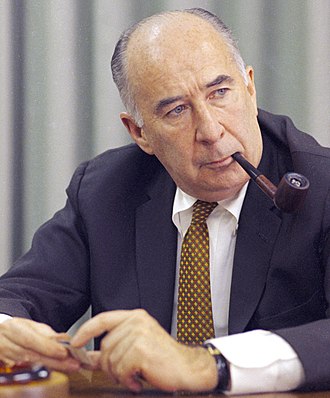
President Nixon and John Mitchell engage in a brief, informal discussion focused on the aesthetics of portraiture displayed within the White House. The conversation centers on the President's critique of specific photographs and paintings, particularly his dissatisfaction with a bland portrait of Dwight D. Eisenhower currently in the Cabinet Room. Nixon expresses a clear preference for portraits that preserve facial character and requests that the current depiction be replaced with a better-lit version seen at the Kennedy Center.
President Nixon and John Mitchell discuss potential candidates for a Supreme Court appointment, specifically focusing on the hesitancy of Lewis F. Powell, Jr., and the viability of Howard H. Baker, Jr., and William H. Mulligan. Mitchell outlines Powell's concerns regarding his health and eyesight, though Nixon insists that securing Powell is a priority due to his prestige and the Court's urgent needs. The two agree that Mitchell will personally press Powell to reconsider and that they will keep Baker and Mulligan as contingency options should Powell decline.
President Richard Nixon and Attorney General John Mitchell discuss the recent volatility in the stock market and the public perception of the administration's economic policies, specifically regarding monetary tightening and inflation. The two men dismiss concerns over market fluctuations, noting that housing starts remain strong and that the current economic indicators should eventually lead to a market recovery. Additionally, they discuss personnel matters and potential political appointments, briefly touching upon the qualifications of candidates for judicial or administrative positions.
President Nixon and Attorney General John Mitchell discuss strategy for filling Supreme Court vacancies, specifically focusing on persuading Lewis F. Powell, Jr. to accept an appointment. The two also evaluate the candidacy of Senator Howard H. Baker, Jr. and debate the merits of considering William H. Mulligan, noting that an appointment from a school like Fordham would challenge elitist preferences for top-tier institutions. Mitchell is instructed to consult with John Ehrlichman and Richard Moore regarding Mulligan's suitability while leveraging the endorsement of Warren E. Burger.
President Nixon and John Mitchell discuss strategies for recruiting a high-level candidate for a prestigious appointment, emphasizing the need to appeal to the individual's sense of duty to the country. They evaluate potential candidates, specifically dismissing Howard Baker due to concerns over his legal practice and political vulnerability in the Senate. Ultimately, Nixon instructs Mitchell to handle the outreach independently to maintain distance from the White House staff and ensure the recruitment process remains confidential.
President Nixon and Attorney General John Mitchell discussed the selection process for upcoming Supreme Court appointments, specifically noting difficulties in reaching preferred candidate Lewis F. Powell, Jr. Mitchell proposed William H. Rehnquist as a potential alternative, highlighting his legal background, conservative credentials, and performance as an Assistant Attorney General. The pair further evaluated the political optics and professional standing of various candidates, including William French Smith and William H. Mulligan, while affirming the need to finalize a decision with Howard Baker.
President Richard Nixon met with Attorney General John Mitchell in the Old Executive Office Building for a brief consultation. While the transcript remains unavailable, the discussion focused on high-level administrative or legal strategy during a period of intense activity for the Justice Department. No specific policy decisions were finalized during this five-minute encounter.
President Nixon and John Mitchell discuss efforts to secure Lewis F. Powell, Jr. as a Supreme Court nominee, with the President instructing Mitchell to press Powell aggressively to accept. They also coordinate their strategy regarding the American Bar Association and potential opposition to other candidates like Mildred L. Lillie. Additionally, Mitchell reports difficulty in contacting Howard H. Baker, Jr. and outlines efforts to manage the political fallout and appointment timeline.
President Nixon met with H. R. Haldeman and Frederic V. Malek to discuss the recruitment and appointment of women to high-level legal and judicial positions. Following this, Nixon consulted with Attorney General John N. Mitchell regarding specific candidate vetting, the political necessity of increasing female representation in the federal judiciary, and strategies for managing potential appointments. The participants aimed to identify qualified female prospects to address public pressure and project a commitment to gender diversity in government.
President Nixon and Attorney General John Mitchell discuss ongoing efforts to appoint conservative judges to the Supreme Court, specifically focusing on the status of Senator Howard Baker and Lewis Powell. They discuss plans to bypass the American Bar Association (ABA) review process for these candidates to avoid political obstacles and public scrutiny. Additionally, the two explore strategies to improve the administration's image regarding female judicial appointments by identifying potential candidates like Sylvia Bacon for future openings in the federal district or appellate courts.
President Nixon and Attorney General John Mitchell discuss political strategies and upcoming Supreme Court nominations. They express frustration with Senator Edward M. Kennedy's criticism of the administration, agreeing that his rhetoric has been damaging to his own political standing. The conversation focuses on securing candidates for the Supreme Court, with Nixon pushing for a swift resolution from Howard Baker while evaluating the political optics of potential nominees William French Smith and William H. Mulligan.
President Nixon and Attorney General John Mitchell discuss potential candidates for upcoming Supreme Court vacancies, weighing the political implications and qualifications of various prospects. The conversation centers on navigating the vetting process for nominees like Powell, Rehnquist, and others, while specifically debating the optics of appointing corporate lawyers versus academic figures. Nixon emphasizes the importance of strategic appointments to balance legal expertise with political viability.
President Nixon met with Richard Moore, John Mitchell, and Alexander Butterfield to discuss the selection process for upcoming Supreme Court vacancies. Nixon expressed frustration with the American Bar Association's influence and affirmed his intention to bypass them to avoid leaks and public criticism of his nominees' ideologies. The group evaluated several candidates, including Lewis Powell, Howard Baker, William Rehnquist, and William French Smith, ultimately favoring a strategy to nominate highly qualified conservatives to preempt opposition. Additionally, the President discussed concerns regarding negative press coverage of his personal finances involving Charles Rebozo and strategized on managing political messaging regarding the Vietnam War and POW issues.
President Nixon and John Mitchell discuss potential Supreme Court nominees, confirming Lewis F. Powell, Jr.'s acceptance and weighing the qualifications and political implications of appointing William H. Rehnquist and Howard H. Baker, Jr. The two men deliberate on the strategic timing of public announcements and the management of the American Bar Association committee's review process. Throughout the discussion, they evaluate the professional reputation and perceived political benefits of their candidates, while briefly joking about Rehnquist’s religious background.
President Nixon and John Mitchell coordinate the final strategy for upcoming Supreme Court nominations, specifically discussing candidates Lewis F. Powell, Jr., Howard H. Baker, Jr., and William H. Rehnquist. Mitchell briefs the President on the American Bar Association’s negative evaluations of other potential nominees, prompting Nixon to decide to publicly challenge the ABA's influence. Nixon directs Mitchell to finalize the selection of either Baker or Rehnquist to pair with Powell, and concludes that he will make a primetime televised announcement the following evening to control the narrative.
President Nixon and John Mitchell discussed the final selection process for upcoming Supreme Court nominations, specifically weighing the qualifications of potential candidates Howard Baker, Lewis Powell, and William Rehnquist. Nixon expressed frustration with the deliberative pace and instructed Mitchell to prepare strong, positive statements for the chosen nominees. The President decided to finalize and announce his selections the following evening to preempt leaks and control the narrative surrounding the appointments.
President Nixon consulted with Press Secretary Ronald Ziegler and Attorney General John Mitchell to strategically manage the media coverage and timing of his upcoming Supreme Court nominations. Nixon decided to delay his public announcement until the following evening to create media confusion and effectively control the narrative. The participants also discussed the necessity of withholding information from the American Bar Association and coordinated messaging regarding the President's upcoming schedule, including a Veterans Day speech and price control initiatives.
President Nixon consulted with Attorney General John Mitchell regarding the strategic timing of an upcoming Supreme Court appointment announcement. Nixon instructed Mitchell to coordinate the release to coincide with prime-time network coverage, while issuing an ultimatum to a candidate who had not yet arrived in Washington. Additionally, Nixon directed Mitchell to compile favorable background dossiers emphasizing the academic credentials of potential nominees to ensure a strong public presentation.
President Nixon and John Mitchell discuss political messaging and strategic communications regarding upcoming remarks, specifically concerning the vetting or qualification of a female appointee. The conversation reflects concerns over potential information leaks and the potential political fallout from public statements. The two agree on the need for caution, ultimately deciding to hold off on addressing certain controversial topics until the following morning.
President Nixon and Attorney General John Mitchell discuss strategy for upcoming Supreme Court nominations, focusing on managing political fallout and public perception. They evaluate potential candidates like Lewis F. Powell, Jr. and address the ABA's negative reception toward Herschel Friday due to civil rights concerns. To ensure a controlled rollout, Nixon plans to utilize William Safire to draft his announcement remarks only hours before the official disclosure to prevent premature leaks.
President Nixon and John Mitchell discuss the strategy for upcoming Supreme Court appointments, specifically weighing the candidacy of Senator Howard H. Baker, Jr. against William H. Rehnquist. Nixon expresses significant concern regarding Baker’s academic credentials and insists on verifying his law school record before making a final commitment. Ultimately, they decide to decline Baker for the current vacancy based on political considerations and the strength of Rehnquist’s superior academic record, while leaving the door open for Baker’s future appointment.
President Richard M. Nixon and Attorney General John N. Mitchell engaged in a brief meeting to discuss the status and management of specific White House recordings. The conversation primarily concerns the importance of securing and reviewing these records to determine their potential implications or utility. No definitive administrative action was finalized during this brief exchange.
President Nixon and John Mitchell discuss the finalization and strategic rollout of two forthcoming Supreme Court appointments. Nixon emphasizes maintaining strict confidentiality—excluding even top staff—until a coordinated notification process begins to inform key Congressional leaders. They finalize communication plans, including how to address potential opposition from the American Bar Association and how to manage the media narrative surrounding the nominees, William Rehnquist and Lewis F. Powell, Jr.
President Nixon and John Mitchell conferred to coordinate strategy regarding upcoming personnel appointments and communications with key political figures, including Robert Byrd and John Connally. The discussion focused on managing the public rollout of these nominations and ensuring staff discretion to avoid premature leaks. Nixon emphasized the necessity of finalizing these details promptly to maintain control over the political narrative.
President Nixon and John Mitchell discuss the positive reception and strategic impact of Nixon's recent Supreme Court nominations, specifically highlighting William H. Rehnquist and Lewis F. Powell, Jr. The two emphasize the effectiveness of blindsiding the press with these appointments and discuss the necessity of maintaining a firm stance during the upcoming Senate confirmation process. They also address the political complications surrounding potential female nominees, noting the rejection of Mildred L. Lillie by the American Bar Association.
President Nixon met with his budget and domestic policy advisors, including John Ehrlichman and John Mitchell, to evaluate the political and economic feasibility of a proposed Value Added Tax (VAT) as a mechanism to fund public and private education. The primary objectives of the plan were to provide federal relief for local property taxes, address the California Supreme Court’s school funding ruling, and extend aid to parochial schools to appeal to blue-collar Catholic voters. The participants debated the political risks of proposing a new federal tax in an election year versus the potential benefits of offering tangible relief to homeowners and securing support from key constituencies.
President Nixon, H.R. Haldeman, and John Ehrlichman coordinated with Attorney General John Mitchell to discuss scheduling for an upcoming trip to Florida. The group reviewed recent election results, specifically analyzing the political implications of mayoralty races for national coalitions. Mitchell agreed to align his schedule to join the President in Florida following his commitment to attend a dinner for Senator Robert P. Griffin.
President Nixon and Attorney General John Mitchell discuss the possibility of the Department of Justice intervening in a Grand Rapids, Michigan, school busing case following concerns raised by Representative Gerald Ford and Senator Robert Griffin. The President urges Mitchell to signal administration opposition to busing during upcoming appearances with Michigan lawmakers and to investigate similar intervention potential in Detroit. Additionally, the pair reviews the positive results of the recent November 2nd mayoral elections, specifically noting the strong support from Philadelphia's Frank Rizzo and the successful reelection of mayors in Cleveland, Indianapolis, and San Diego.
President Nixon and Attorney General John Mitchell discuss the potential appointment of Earl L. Butz to lead the Department of Agriculture, with Mitchell expressing confidence in Butz's suitability for the role. The two men also review political feedback regarding recent speeches and endorsements from Ronald Reagan and Nelson Rockefeller. Additionally, they touch upon ongoing tensions between the administration and Governor Reagan regarding Department of Health, Education, and Welfare (HEW) programs, which Mitchell intends to address with John Ehrlichman.
President Nixon and John Mitchell engaged in a brief, informal discussion regarding the reception of a recent political appearance, possibly in Chicago. The conversation focused on evaluating the public perception and efficacy of an unnamed individual's performance and endorsements. The meeting concluded with instructions to relay a message to a third party, referred to as 'the doctor,' though the specific identity and strategic intent remain obscured by the vague transcript.
President Nixon and members of the National Security Council met to coordinate the United States' strategy regarding ongoing arms control negotiations with the Soviet Union. The discussion centered on the complexities of Anti-Ballistic Missile (ABM) systems, the status of Safeguard and hard site defenses, and the comparative capabilities of Soviet and American submarine-launched ballistic missiles (SLBMs) and ICBMs. Participants evaluated potential congressional reactions and internal administration messaging while addressing the strategic implications of Soviet negotiating positions.
President Nixon met with his Cabinet officers to discuss a variety of domestic and international issues, including transportation leadership, government funding through a continuing resolution, and the cultivation of opium poppies in Turkey. The conversation also touched upon administrative transitions, such as the departure of Secretary of Agriculture Clifford Hardin, and strategies for managing the national economy and price controls. Nixon emphasized the importance of maintaining clear leadership and coordination across departments to ensure the success of his domestic policy initiatives.
President Nixon met with John Mitchell and Henry Kissinger to coordinate Republican political strategy for the 1972 election cycle and discuss sensitive foreign policy matters. The participants evaluated the progress of local party organizations in key states and addressed personnel changes within the administration, including the potential reassignment of Peter Peterson. Nixon and Kissinger also reviewed the current state of Vietnam peace negotiations, determining to maintain a firm stance and continue troop withdrawals while preparing a public response should North Vietnamese negotiators break off talks.
President Nixon met with California Governor Ronald Reagan to discuss the governor's recent Far East diplomatic trip and the administration's ongoing domestic and foreign policy challenges. They reviewed Reagan's interactions with leaders in Taiwan, Singapore, Thailand, and Japan, focusing on reassuring these allies regarding U.S. treaty commitments and the President's planned visit to the People's Republic of China. Additionally, the pair coordinated strategies for negotiating welfare reform experiments in California, addressing anti-trust concerns for U.S. firms in Asia, and solidifying support among conservative Republicans ahead of the 1972 election.
President Nixon and John Mitchell met to discuss strategies for managing relations with conservative political factions and address the political standing of California Governor Ronald Reagan. They examined the challenges of integrating right-wing supporters into the 1972 campaign organization while tempering their expectations, specifically noting the need to keep campaign management professional. Additionally, the pair discussed potential vetoes for legislation concerning child care, with Nixon expressing ideological opposition to federal interventions he believed would undermine the traditional family structure.
President Nixon met with John N. Mitchell and Donald H. Rumsfeld to deliberate on pending legislation, specifically focusing on the potential veto of a tax check-off provision for political campaigns. The participants discussed legislative strategies involving Clark MacGregor and Senator Charles McC. Mathias, Jr., as well as coordination efforts with John B. Connally. Additionally, the group briefly reviewed polling data from Illinois and discussed updates to the President's upcoming schedule.
President Nixon met with William L. Waller, Senator James O. Eastland, and John N. Mitchell to discuss potential federal assistance for developing tourist, convention, and recreational facilities in Gulfport, Mississippi. The participants also reviewed recent Supreme Court nominations, comparing the qualifications and political challenges of nominees like William Rehnquist and Lewis F. Powell, Jr. to past justices. Throughout the discussion, Nixon emphasized his appreciation for the political support provided by Mississippi's senators on national security and defense issues.
President Nixon met with Henry Kissinger, H. R. Haldeman, George Shultz, and others to manage pressing foreign and domestic policy matters. Key discussions centered on the India-Pakistan conflict and U.S. strategy regarding the United Nations, as well as coordinating upcoming meetings with John Connally and Arthur Burns to address economic policy and budget planning. Additionally, the President reviewed his schedule, including travel arrangements and a potential appointment for the Council of Economic Advisers, while also discussing media relations and his desire to curb unnecessary foreign travel by staff and Cabinet members.
President Nixon met with John Mitchell, John Ehrlichman, Clark MacGregor, and William Timmons to discuss legislative strategy, primarily regarding a pending tax bill and the controversial Pastore amendment. The group deliberated whether the President should publicly signal his intention to veto the bill if it retained the amendment, weighing the potential impact on 1972 campaign financing against the desire to assert executive authority. Additionally, the participants reviewed the contentious confirmation process for Earl L. Butz as Secretary of Agriculture, ultimately deciding to maintain the nomination and reject calls for his withdrawal.
President Nixon and Attorney General John Mitchell briefly discuss political reputations and potential comparisons between various public figures, specifically mentioning Nelson Rockefeller and another associate referred to as K.O. The exchange focuses on evaluating the public perception and professional conduct of these individuals. No formal policy decisions or major administrative actions were finalized during this short interaction.
President Nixon consulted John Mitchell regarding whether to call New Jersey Governor William T. Cahill to commend his handling of a recent prison situation. Mitchell advised that the President avoid a direct call to prevent potential political friction with New York Governor Nelson Rockefeller, whose own handling of similar issues was frequently compared to Cahill's. Ultimately, they decided that Mitchell would contact Cahill instead to convey the President's approval of his judgment, thereby maintaining a low-key approach.
President Nixon consulted with John Mitchell regarding whether to reach out to W. Thacher Longstreth following his defeat in the Philadelphia mayoral election. Concerned about the political fallout regarding Frank Rizzo and the importance of Pennsylvania’s Italian American voters, Nixon sought to maintain positive party relations without inciting unwanted publicity. Ultimately, Mitchell advised that a private note of encouragement would be appropriate to preserve future Republican support in the region.
President Nixon consulted John Mitchell regarding whether he should reach out to certain Philadelphia-based Republicans who were hospitalized. Nixon expressed concern that a direct intervention or phone call might negatively influence a sensitive situation, prompting him to seek Mitchell's strategic advice on how to handle the interaction. Mitchell ultimately encouraged a personal touch, suggesting that the President send a letter to maintain personal connections without interfering in the political process.
President Nixon and the National Security Council met to coordinate U.S. strategy regarding European security, specifically focusing on the upcoming ministerial meetings in Brussels and the push for Mutual and Balanced Force Reduction (MBFR) talks. Participants discussed the complexities of navigating negotiations with Soviet counterparts, managing the varying interests of NATO allies, and addressing the political pressures surrounding troop levels and defense burden-sharing. The conversation concluded with a consensus on the need to maintain a unified diplomatic front while carefully managing the timing and scope of potential force reductions.
President Nixon and Attorney General John Mitchell coordinate a meeting to discuss the impending decision regarding James R. Hoffa. The President requests that Mitchell travel to the Executive Office Building to review the matter further before a later appointment. Mitchell confirms his availability and agrees to meet with the President shortly.
President Nixon and Attorney General John Mitchell coordinate a brief, in-person meeting at the Old Executive Office Building. The conversation primarily serves as a logistical arrangement for Mitchell to travel to the White House following a discussion regarding a "compliment" and administrative status updates. Due to the brevity of the call and interruptions, no substantive policy decisions were finalized beyond the immediate scheduling of their encounter.
President Nixon met with John Mitchell and Henry Kissinger to discuss two distinct issues: the potential commutation of Jimmy Hoffa's prison sentence and the escalating India-Pakistan war. Regarding Hoffa, the President sought a strategy to secure his release while minimizing political fallout, focusing on coordination with union leadership and managing public perception. The conversation shifted to the South Asian crisis, where Nixon and Kissinger expressed deep frustration with the State Department's perceived bureaucratic delays in enforcing sanctions against India. Consequently, Nixon directed his advisors to prepare aggressive diplomatic and military options to deter Indian aggression and mitigate the influence of Soviet-aligned forces in the region.
President Nixon met with John Mitchell, H.R. Haldeman, John Ehrlichman, and David Young to address the unauthorized removal of sensitive documents from National Security Council (NSC) briefcases by Yeoman Charles Radford. The participants discussed the extent of the security breach, its connection to potential intelligence leaks to columnist Jack Anderson, and the need to contain the fallout to protect the integrity of the White House and military services. Nixon ordered a controlled investigation into the breach while emphasizing the need to maintain security over his own briefcases, particularly during travel.
Vice President Spiro Agnew met with members of the Nixon Cabinet and congressional leadership to provide a detailed briefing on his recent diplomatic and trade-focused trip to the Soviet Union. The discussion centered on potential economic collaboration, the strategic importance of trade with the Soviets, and the ongoing international monetary negotiations regarding the devaluation of the dollar. Participants debated the risks of transferring technology to the Soviet Union, the necessity of bipartisan congressional support for upcoming trade and fiscal legislation, and the impact of the U.S. surcharge on global trade relations.
President Nixon held an Oval Office meeting with Attorney General John N. Mitchell to discuss unspecified administrative business. The conversation was interrupted by a White House operator, leading to a brief discussion regarding an incoming call. No significant policy decisions or substantive developments are documented in this brief interaction.
President Nixon met with John Mitchell, H.R. Haldeman, and John Ehrlichman to discuss a serious security breach involving a Navy yeoman who was systematically stealing and duplicating classified documents from the National Security Council (NSC) for the Joint Chiefs of Staff. The participants determined that the yeoman had been acting under the instruction of military superiors, specifically Admirals Robinson and Welander, to funnel sensitive foreign policy information to the Pentagon. To address this compromise without triggering a public scandal or a damaging confrontation with the military establishment, they decided to move the military liaison office out of the NSC, replace it with a new security officer, and have the officials involved reassigned.
Following a formal ceremony in the Oval Office to recognize the commissions of new Supreme Court Justices Lewis F. Powell, Jr. and William H. Rehnquist, President Nixon transitioned into a private session with his staff. The discussion focused on national security concerns, specifically the ongoing investigation into intelligence leaks involving Navy Yeoman Charles E. Radford, the Joint Chiefs of Staff, and Henry Kissinger. Nixon and his advisors resolved to neutralize the threat posed by Radford by utilizing the legal pressure of potential criminal prosecution to ensure his silence, while simultaneously using the incident as a pretext to restructure security operations within the Joint Chiefs and the National Security Council.
President Richard Nixon and Attorney General John Mitchell exchanged holiday greetings before transitioning to a discussion on the recent release of Jimmy Hoffa and the political handling of the Pentagon surveillance scandal involving Yeoman Charles Radford. Nixon emphasized the need to keep the Radford matter under close control to avoid discrediting the military, while expressing concern over Henry Kissinger’s emotional volatility and tendency to view the situation through a purely personal lens. Ultimately, Nixon directed Mitchell to restrain Kissinger from impulsive personnel decisions, such as firing Admiral Thomas Moorer, and advocated for keeping Radford under surveillance at the Pentagon to mitigate potential leaks.
President Nixon, Secretary of State William P. Rogers, and Attorney General John N. Mitchell discuss potential candidates for the U.S. Ambassadorship to Japan. The group decides to reject Fredrick M. Eaton for the position due to concerns over his age and the likelihood of a contentious confirmation process during an election year, while agreeing to offer him a future appointment. The participants pivot to vetting Robert S. Ingersoll, with the President tasking Rogers with evaluating whether Ingersoll’s professional background and personal toughness are suitable for the diplomatic post.
President Nixon met with John Mitchell and H.R. Haldeman to manage several administrative and political crises, most notably the escalating conflict between National Security Advisor Henry Kissinger and Secretary of State William Rogers. The discussion focused on controlling leaks regarding the India-Pakistan War, resolving bureaucratic friction ahead of the upcoming Moscow summit, and managing the political fallout from Jack Anderson’s columns. Additionally, the participants addressed personnel appointments, including the search for a new Deputy Secretary of Defense and the handling of various regional primary elections.
President Nixon met with George Romney, John Ehrlichman, and John Whitaker to discuss the administration's new "Operation TACLE" initiative, a national growth policy designed to address urban and rural decay through decentralized, competitive consortia. The President and Romney also addressed sensitive political matters, including the upcoming departures of cabinet members Maurice Stans and John Mitchell, as well as the need for coordination between Secretary of State William Rogers and National Security Advisor Henry Kissinger. Nixon emphasized his desire for Romney to remain in the cabinet while encouraging him to maintain a low-profile approach to sensitive housing issues during an election year.
President Nixon met with his Vice President and Cabinet to discuss the state of the U.S. economy, the administration's fiscal policy, and the upcoming 1973 budget. Key areas of focus included interpreting unemployment data—specifically the impact of new entrants to the workforce—and managing inflation through Phase II price and wage controls. Nixon urged his department heads to aggressively implement approved spending programs to stimulate the economy, while simultaneously directing them to more effectively communicate and promote the administration's economic achievements and social policy investments to the public.
President Nixon and John Mitchell discuss political strategies for the 1972 campaign, focusing on the administration’s forthcoming Vietnam speech and the public disclosure of secret peace negotiation offers. They review efforts to secure support from key political figures, including Philadelphia Mayor Frank Rizzo and Illinois Governor Richard Ogilvie, through federal funding and policy coordination. The conversation also touches upon military strategy in South Vietnam and the administration's intent to pressure domestic opponents by highlighting the generous terms offered to North Vietnam regarding prisoner releases and troop withdrawal.
President Nixon and John Mitchell discuss political strategy for the upcoming election cycle, including managing federal funding for municipal support and monitoring the Democratic primary field. The conversation covers the political viability of various candidates, specifically mentioning George Wallace and Hubert Humphrey, while addressing concerns about party loyalty and public perception. The two also evaluate the necessity of maintaining consistent engagement with key local political figures like Frank Rizzo to secure future electoral support.
Henry Kissinger and John Mitchell discuss the positive public and political reception of President Nixon’s recent speech on Vietnam. Mitchell reports that anti-war critics like J. William Fulbright have failed to offer substantive rebuttals, while internal polling indicates overwhelming public approval. Kissinger credits a recent strategic meeting with White House staff and department heads for successfully aligning the administration’s messaging and suppressing dissent.
President Nixon and John Mitchell discussed the positive reception of the President's recent Vietnam speech, agreeing that media coverage was unexpectedly favorable compared to the hostile reaction from some congressional leaders. The pair also coordinated the integration of Maurice Stans into administration activities to boost his morale and affirmed the strategic appointment of Kenneth Rush to the Defense Department. The conversation concluded with Nixon confirming their upcoming Friday meeting despite his temporary departure for Camp David.
President Nixon met with John N. Mitchell to offer well wishes following Mitchell's recent surgery and recovery. Beyond these personal pleasantries, the two discussed administrative confidence in their current political and legislative strategy, specifically referencing cabinet and legislative leadership meetings. The conversation concluded with Nixon emphasizing his reliance on Mitchell's continued involvement in the administration.
President Nixon met with administration officials, including Myles J. Ambrose, John N. Mitchell, and Dr. Jerome H. Jaffe, to formalize the launch of a comprehensive federal drug enforcement initiative. The discussion focused on a three-pronged strategy involving international supply control, treatment and prevention programs, and intensified law enforcement efforts against drug traffickers. Nixon formally appointed Ambrose to lead these consolidated enforcement activities, emphasizing the administration's commitment to aggressively pursuing drug pushers as a top priority.
President Nixon, John Mitchell, and H.R. Haldeman met to coordinate the transition of the Attorney General’s office, specifically timing Mitchell’s resignation to coincide with the President's upcoming trip to the People's Republic of China. Mitchell advocated for the simultaneous Senate confirmation of Richard Kleindienst as his successor and L. Patrick Gray as Deputy Attorney General, expressing confidence in their approval despite potential political opposition. The participants also discussed administrative matters, including the presentation of the Encyclopedia Judaica to Martha Mitchell and the political outreach efforts involving Max Fisher.
President Nixon held a wide-ranging meeting with H.R. Haldeman and several other key staff members to discuss political strategy, personnel matters, and public relations. Key topics included the appointment of Marina von Neumann Whitman to the Council of Economic Advisors, the political fallout and press handling of a protest at a recent White House dinner, and the administration’s strategy regarding potential 1972 Democratic presidential challengers. Additionally, Nixon and his staff reviewed polling data and preparations for his upcoming trip to the People’s Republic of China, emphasizing the positive reception of his recent Vietnam peace proposals.
President Nixon and Attorney General John Mitchell discuss the fallout from a protest during a recent White House dinner, where singer Carol Feraci made anti-war statements praising Daniel Ellsberg and the Berrigan brothers. The two men analyze whether the outburst was a deliberate political plant and express relief that the incident was not captured by television cameras. They ultimately conclude that the performer's poor manners and radical remarks will likely turn public opinion against her rather than the administration.
President Nixon met with California Governor Ronald Reagan and various administration officials to discuss domestic policy challenges, specifically addressing stalled welfare reform legislation and the ongoing West Coast dock strike. The group explored the economic implications of federal spending and potential strategies to bypass congressional inaction regarding labor disputes, with Reagan sharing his past experience managing strike negotiations. Additionally, the participants discussed the political and ethical complexities surrounding abortion access through Medicaid and the legal status of the unborn.
President Nixon convened this meeting of the National Security Council to assess the potential for a major North Vietnamese military offensive and to coordinate U.S. support for South Vietnam. The participants, including Henry Kissinger, Melvin Laird, and Admiral Thomas Moorer, discussed enemy troop movements, the effectiveness of Vietnamization, and the need for enhanced military authorities for field commanders. Nixon directed the council to provide robust support while ensuring that South Vietnamese forces receive the primary public credit, emphasizing that the U.S. must remain committed to a successful outcome despite domestic political pressures.
President Nixon met with his Cabinet and senior staff to debrief them on the results and implications of his recent diplomatic trip to the People's Republic of China. The President emphasized that the primary success of the visit was the establishment of a new communication channel between the two nations, which he argued was essential for managing long-term stability and reducing the potential for future conflict. Nixon shared his impressions of Chinese leadership, particularly his discussions with Chou En-lai, noting the stark ideological differences while highlighting common strategic interests, such as peace in the Pacific and balancing influence against the Soviet Union. The discussion concluded with a focus on how this opening could be leveraged to reshape international relations and manage regional tensions across Asia.
President Nixon held an Oval Office meeting with Peter G. Peterson, his family, and members of the Cabinet to commemorate Peterson's recent Senate confirmation. The event served primarily as a formal ceremony for the administration of the oath of office and a subsequent photograph session with White House photographer Ollie Atkins. The interaction concluded with informal social conversation regarding Camp David and scheduling logistics.
President Nixon met with his inner circle and advisors, including Henry Kissinger, John Mitchell, and H.R. Haldeman, to discuss the intensifying North Vietnamese offensive and the resulting requirements for U.S. military response, specifically air strikes. The conversation covered the necessity of maintaining national resolve and foreign policy credibility amidst political pressure and the upcoming 1972 election. They also addressed the ITT political controversy, with Mitchell advising the President to handle it with caution, and briefly touched upon diplomatic staffing changes and the upcoming Soviet summit.
President Nixon met with John Mitchell and H.R. Haldeman to discuss the deepening political crisis surrounding the International Telephone and Telegraph (ITT) case and the confirmation hearings for Richard Kleindienst. The group evaluated the strategic necessity of withdrawing Kleindienst’s nomination as Attorney General to mitigate further damage to the administration, while simultaneously vetting Caspar Weinberger as a potential replacement. They also reviewed broader political strategies, including how to handle Democratic criticism regarding the Vietnam War and how to manage the transition if Kleindienst were to resign.
President Nixon and John N. Mitchell discuss the positive public reception to the President’s recent televised address regarding Vietnam, specifically focusing on the new blockade strategy and peace offers. Nixon reaffirms his resolve to maintain the pressure despite potential diplomatic fallout with the Soviet Union, emphasizing the psychological impact on North Vietnam. Additionally, the two men coordinate efforts to pressure Republican candidate John M. Ashbrook to withdraw from the 1972 presidential nomination race, with Nixon approving a European trip for Ronald Reagan to ensure his cooperation.
President Nixon consulted with John Mitchell and Patrick Buchanan regarding domestic political reactions to the recent naval blockade of North Vietnam. The discussion focused on securing public support from influential figures, including Supreme Court Justice Lewis F. Powell Jr., Secretary of State William P. Rogers, and Kenneth Rush. Nixon also coordinated logistics for an upcoming Duke Law School reunion dinner, emphasizing a controlled press photo opportunity to maintain an appropriate public image during the military escalation.
President Nixon met with Ambassador Walter H. Annenberg, John N. Mitchell, and John D. Ehrlichman to discuss diplomatic relations, the 1972 Republican National Convention, and political strategy for the upcoming election. The participants focused on local campaign support in Pennsylvania—specifically regarding Frank Rizzo—and potential political endorsements from influential figures like Norton Simon. Nixon and Annenberg reaffirmed their strong personal and political alliance, with Nixon explicitly requesting Annenberg's continued service as Ambassador to the Court of St. James's following the 1972 election.
President Nixon met with John Mitchell and Ray Bliss to discuss party political strategy, specifically regarding the upcoming Ohio election and the need for Bliss to coordinate closely with Mitchell. Throughout the conversation, Nixon encouraged Bliss to balance his private insurance business with Republican National Committee work while offering him future prospects, such as presidential representative trips or commission appointments, as a reward for his service. The group also briefly touched upon political optics, including the President's recent public walk to the Treasury and the importance of favorable photographic coverage.
President Nixon and John Mitchell discuss the 1972 Democratic primary developments, specifically George McGovern's momentum following the Michigan primary and the implications of the shooting of George Wallace. The conversation highlights busing as a potent symbolic issue and the strategic importance of the upcoming California primary. Additionally, Nixon and Mitchell review the success of the recent mining and bombing campaign in North Vietnam, expressing confidence that the blockade is effectively crippling enemy logistics despite military or intelligence skepticism.
President Nixon and John Mitchell discuss current political developments, including Democratic primary trends and the potential impact of busing as a campaign issue. The conversation shifts to the administration's military strategy in Vietnam, with Nixon justifying the blockade and bombing campaigns as necessary measures despite the risk of canceling the Moscow summit. Nixon expresses confidence that these actions have improved domestic and South Vietnamese morale, maintaining that securing a favorable outcome in Vietnam is his overriding priority.
President Nixon met with John N. Mitchell and an unidentified individual to dictate a memorandum regarding administrative matters and coordinate the delivery of specific books to Camp David. The discussion touched upon domestic policy and the handling of personal items or recordings, involving staff members like H.R. Haldeman, Charles Colson, and Alexander Butterfield. This brief administrative session focused primarily on logistical arrangements for the President's upcoming schedule.
President Nixon and John Mitchell discussed the political climate following the President’s recent trip to Moscow and its influence on congressional behavior. The conversation centered on the favorable outcome of a recent legislative vote, noting that even political opponents like Senator Charles Percy had shifted their stance. Nixon expressed a desire to maintain a firm, aggressive posture in his administration's dealings, emphasizing that he should not become overly conciliatory or 'tender' following tough confirmation processes.
President Nixon and John Mitchell discussed political strategy for the 1972 election, focusing on the ongoing Democratic primary contests and the rise of George McGovern. They evaluated the political viability of various Democratic candidates and analyzed internal party fractures, particularly noting the resistance from party elites against McGovern's campaign. Nixon and Mitchell decided to maintain an aggressive stance by framing McGovern as an unpredictable extremist, aiming to exploit his perceived lack of credibility and foster further defections within the Democratic ranks.
President Nixon and John Mitchell discuss the 1972 Democratic primary, focusing on the "stop-McGovern" movement and the potential political fallout from George McGovern's candidacy. They analyze Edmund Muskie's recent critique of McGovern as an opportunity to portray McGovern as an extremist and note that internal Democratic division serves the Nixon campaign's interests. The two also coordinate strategic efforts to recruit Democrats and independents for Nixon in key states, including California and Texas, while brainstorming tactical campaign theater such as using veterans to protest McGovern’s defense policies.
President Richard Nixon met with John N. Mitchell at Camp David to consult on matters regarding the administration's political strategy and ongoing challenges. While specific details of the discussion remain withheld, the meeting underscores the close advisory relationship between the President and his former Attorney General during a sensitive period of the Nixon presidency. No definitive outcomes are recorded, as the conversation remains largely closed to public documentation.
H. R. Haldeman and John Mitchell consulted on campaign strategies, specifically discussing Patrick Buchanan's recent book detailing attack methodologies and step-by-step political planning. The conversation also served as a preparatory briefing for Mitchell’s upcoming television appearance on June 11. Additionally, the pair coordinated logistics regarding a scheduled visit to Camp David to focus on administrative catch-up work.
President Nixon and H.R. Haldeman conducted an extensive review of political strategy for the 1972 presidential campaign, focusing on the vulnerability of Democratic candidate George McGovern. They discussed the administration's public relations efforts, including the effective use of television to reach voters and the development of strategies to undermine McGovern's appeal among Middle American voters. Furthermore, they coordinated schedules for official events, reviewed foreign policy milestones like the Moscow summit, and managed administrative staffing to ensure maximum responsiveness to political objectives.
President Nixon and John Mitchell engaged in a wide-ranging discussion primarily focused on the political landscape of the 1972 presidential campaign. They analyzed the electoral prospects of George McGovern, assessed the implications of primary results and Gallup polling, and reviewed the activities of various campaign staff members, including Charles Colson and Patrick Buchanan. Additionally, the pair touched upon scheduling logistics, including Mitchell’s upcoming media appearance on 'Face the Nation.'
President Nixon consulted with John Mitchell regarding the transition of Mitchell’s professional status and the broader operational dynamics of the Committee for the Re-Election of the President. The two men discussed administrative personnel changes and strategic coordination in the lead-up to the 1972 campaign. No definitive policy actions were finalized, but the discussion focused on managing campaign leadership roles.
President Nixon met with John Mitchell, H. R. Haldeman, and Henry Kissinger in the Oval Office to address critical administrative and foreign policy matters. The discussion prioritized strategic coordination among top advisors regarding ongoing domestic issues and international diplomatic initiatives. This meeting served to align the President's key inner circle on sensitive executive priorities during a period of intense political and global pressure.
President Nixon consulted with H.R. Haldeman, who was meeting with John Mitchell, to coordinate the administration's stance on ongoing federal and state prosecutions in New Jersey. They expressed concern that the prosecutors involved were Republicans, lamenting this instance of political "cannibalism" within the party. Nixon ultimately decided to maintain a "no comment" position regarding the pending legal matters during his upcoming press conference.
President Nixon met with John Mitchell, H.R. Haldeman, George Shultz, and John Ehrlichman to discuss political strategy and personal staffing matters. A significant focus of the meeting was the potential resignation of John Mitchell and the mounting pressures on his wife, Martha Mitchell, regarding their public life and the 1972 campaign. The participants also discussed administrative policy, specifically welfare reform, and the ideological leanings of recent Supreme Court appointees.
President Nixon met with H. R. Haldeman, Vice President Spiro Agnew, and John Mitchell to coordinate political strategy for the 1972 reelection campaign. The group discussed campaign logistics, including the use of chartered aircraft, and framed messaging on key issues such as foreign policy, draft-dodgers, and amnesty. Additionally, they reviewed plans for Agnew’s formal renomination announcement, strategies for managing legislative hurdles in Congress, and the importance of engaging with lawmakers to maintain party unity.
President Nixon and John Mitchell discuss strategies to neutralize Republican opposition against influential Democratic senators John McClellan and James O. Eastland. Recognizing the strategic importance of these chairmen to the administration's legislative agenda, Nixon and Mitchell agree to pressure their Republican challengers to withdraw from their respective races. As an incentive, they consider offering qualified candidates alternative government positions to facilitate their exit from the campaigns.
President Nixon and John N. Mitchell discuss political strategy regarding Republican primary opposition and the potential role of Nelson Rockefeller. The conversation focuses on securing a clear path for the President's reelection campaign by neutralizing potential internal rivals and managing party financial support. Nixon emphasizes the importance of consolidating influence within the party to ensure his program remains unchallenged throughout the campaign cycle.
President Nixon and H.R. Haldeman discussed the content and purpose of films being produced for the Republican National Convention. They reviewed various segments, including footage of the President's trip to the Soviet Union, his family, and his interactions with foreign leaders, debating the effectiveness and potential use of specific scenes, such as the Tanya Savicheva story. The conversation also touched upon campaign budget controls, the General Accounting Office investigation, and the Watergate affair, with Mitchell expressing concerns about Martha Mitchell's behavior and potential treatment options.
H. R. Haldeman and John Mitchell coordinate a dinner meeting between President Nixon, John Connally, Herbert Brownell, and Mitchell himself. Haldeman emphasizes the President's desire for Mitchell’s attendance, noting that the event should be rescheduled if Mitchell is unavailable. Mitchell agrees to contact Brownell to verify their schedules and determine the feasibility of holding the meeting that evening.
President Nixon met with his senior advisors to coordinate campaign strategy for his re-election, specifically addressing the tone of his upcoming acceptance speech and public appearances. The group discussed countering Senator George McGovern's policies, particularly regarding Vietnam and welfare, while also devising a public relations strategy to address the ongoing Watergate investigation. Nixon emphasized the need for a strong, combative campaign posture that avoids defensive positioning and effectively utilizes his cabinet members to attack political opponents.
President Nixon met with his senior staff and campaign advisors to assess his 1972 reelection strategy, focusing on framing the debate against George McGovern around key issues like Vietnam, welfare, busing, and national defense. The group discussed the necessity of moving from a defensive posture to an aggressive offense by highlighting the radical nature of McGovern's positions to the general public. Additionally, the President met with James Hodgson and other officials to review progress on veterans' benefits and education programs, confirming plans to maintain support among Vietnam-era veterans as part of the broader campaign effort.
President Nixon met with H.R. Haldeman, John Connally, and other advisors to discuss campaign messaging, the effectiveness of recent political television broadcasts, and the President's upcoming schedule. The group evaluated the impact of Nixon’s defense and foreign policy messaging, deciding to forgo the release of a new tax plan to avoid unnecessary controversy. Nixon and his team also strategized on the handling of upcoming legislative vetoes, particularly a water bill, while weighing the benefits of presidential travel versus remaining in Washington to maintain a 'presidential' public image.
President Nixon met with his senior advisors and campaign staff to coordinate strategy for the final weeks of the 1972 presidential election, focusing heavily on the political ramifications of ongoing Vietnam peace negotiations. The President expressed a firm commitment to securing a durable peace that ensured the survival of South Vietnam, while advisors discussed how to counter George McGovern’s criticisms regarding the war and economic issues. The conversation also covered campaign media tactics, including radio and television appearances, and touched upon concerns regarding press coverage of Watergate-related controversies like the Segretti activities.
President Nixon met with John Dean, John Ehrlichman, H.R. Haldeman, and John Mitchell to strategize on managing the escalating Watergate investigation. The group discussed how to assert executive privilege regarding FBI files and staff testimony to limit the scope of congressional inquiries. They reached a decision to have legal counsel open a dialogue with Senators Ervin and Baker to establish a controlled format for cooperation that avoids public confrontations while protecting presidential authority.