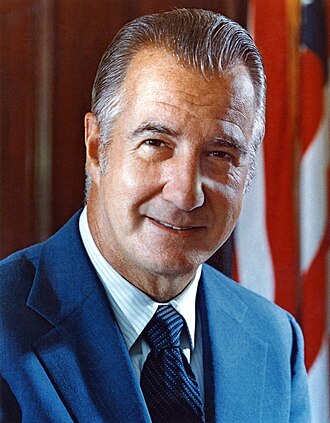
Agnew, Spiro T. (Vice President)
Spiro T. Agnew served as the 39th Vice President of the United States throughout the entirety of the Nixon White House taping period, holding the office from January 1969 until his resignation in October 1973. During the administration, Agnew frequently acted as the White House's vocal surrogate, delivering polarizing speeches aimed at political opponents, anti-war protesters, and the news media. Despite his high public profile and re-election on the 1972 ticket, Agnew was largely excluded from Nixon's inner circle and major policy decisions before ultimately resigning in disgrace due to a bribery and tax evasion scandal.
President Nixon and his Cabinet met to discuss the ongoing military operations in Indochina and the development of the administration's national health reform agenda. Regarding the war, officials reviewed the progress of South Vietnamese incursions into Laos and Cambodia, noting that the strategy was successfully disrupting enemy supply lines while shifting the burden of ground operations away from American forces. The conversation then transitioned to a detailed proposal from Secretary of Health, Education, and Welfare Elliot Richardson regarding healthcare reform, with the group debating the costs, tax implications, and administrative feasibility of implementing Health Maintenance Organizations (HMOs) and national health insurance standards.
President Nixon met with his national security team, including Vice President Agnew, Henry Kissinger, and William Rogers, to review the status of ongoing military operations in Southeast Asia and the complex diplomatic situation in the Middle East. Military leadership provided a detailed briefing on Operation Lam Son 719 and related efforts to interdict the Ho Chi Minh Trail, emphasizing that while the fighting is intense, the operations are effectively disrupting enemy logistics and protecting American withdrawal interests. The discussion subsequently shifted to the Middle East, where the President expressed frustration over Israel's reluctance to offer a concrete negotiating position despite Egypt's concessions. Nixon concluded by stressing the importance of maintaining a firm stance, noting that while the U.S. remains a reliable ally, it will not offer unconditional support without a reciprocal commitment to a serious peace process.
President Nixon met with his National Security Council and key cabinet officials to receive a high-level briefing on developments in Soviet strategic capabilities, particularly concerning new ICBM silo construction and ballistic missile test programs. The participants evaluated the implications of these technological advancements for U.S. defense posture, including the necessity of maintaining a robust anti-ballistic missile (ABM) system. Discussions emphasized the need for a coordinated approach to strategic negotiations and the potential impact of Soviet military growth on current arms limitation efforts.
President Nixon met with Vice President Agnew and Republican Congressional leaders to secure support for two of his primary initiatives: the Supersonic Transport (SST) program and a major government reorganization plan. Secretary of Transportation John Volpe advocated for the SST by addressing environmental, economic, and technological concerns, arguing that the project was essential for U.S. aviation preeminence and long-term economic growth. Subsequently, John Connally detailed the work of the Ash Council, urging the legislators to embrace a fundamental restructuring of the executive branch to improve government efficiency, accountability, and public trust. Nixon emphasized that these measures were critical for ensuring that his administration could effectively manage federal programs and maintain the nation's competitive edge.
President Nixon met with a group of dairy industry representatives to discuss economic concerns regarding milk price supports and industry productivity. The participants, including legal and industry advisors, argued that current production trends were not indicative of a permanent surge and that an increase in price support was necessary for the survival of family-owned dairy farms. Nixon expressed interest in their self-help strategies and the goal of maintaining the economic viability of rural communities while weighing the inflationary risks of price adjustments.
President Nixon and the National Security Council met to evaluate U.S. policy options regarding the People's Republic of China's potential admission to the United Nations and the status of Taiwan. Attendees debated the risks of a potential diplomatic defeat, weighing the benefits of "dual representation" versus maintaining the current, increasingly untenable policy of excluding the PRC. The President emphasized the need to manage domestic American public opinion carefully while assessing tactical shifts, ultimately seeking a strategy that minimizes political fallout while addressing the evolving geopolitical reality of China's status.
President Nixon and Vice President Spiro Agnew discuss the public and media reception of the President's recent television address regarding the Vietnam War. Agnew offers praise for the speech's effectiveness and highlights an uncharacteristically positive analysis from CBS regarding the administration's withdrawal commitments. Nixon expresses frustration with congressional critics and reaffirms his commitment to his Vietnam policy, while instructing Agnew to relay to Bob Hope that a specific segment of the speech was inspired by their previous conversation.
President Nixon and a wide-ranging group of Cabinet members, advisors, and Congressional representatives met to discuss the growing national energy crisis and the necessity of transitioning to nuclear power. AEC Chairman Glenn Seaborg and other experts detailed the technological, environmental, and economic advantages of the liquid metal fast breeder reactor, emphasizing its ability to maximize fuel efficiency and provide long-term, pollution-free energy. The participants concluded that a strong national commitment, including significant federal funding and industry collaboration, is essential to accelerate the development of demonstration reactors and ensure future energy independence.
President Nixon met with Vice President Agnew and Republican Congressional leaders to discuss the administration's legislative and economic agenda. The participants analyzed current economic indicators, including inflation and productivity, and evaluated the implementation of the Task Force for International Development's recommendations regarding foreign and military aid. Additionally, the group addressed the future of the military draft, focusing on pay increases and the transition toward an all-volunteer force while assessing potential legislative hurdles in Congress.
President Nixon, Vice President Agnew, and H. R. Haldeman discuss the recent disruptions by anti-war demonstrators in the Senate galleries and the media's biased coverage of the event. The group analyzes the tactical behavior of protesters, including their plans to target Selective Service offices and train for future demonstrations. Nixon expresses frustration with the news media's portrayal of Republican senators' roles in clearing the galleries while Agnew updates the President on protest activity near government facilities.
President Nixon met with his Cabinet and key staff to coordinate legislative strategies and manage domestic policy agendas. The discussion focused on securing passage for welfare reform and other administration priorities by engaging directly with congressional leadership and balancing competing interests within the labor market. Participants assessed the challenges of mobilizing support among both Democrats and Republicans and emphasized the necessity of persistent lobbying and effective communication with legislative committees.
President Nixon and his Cabinet met to receive a briefing on international affairs and domestic policy, with a focus on Secretary of State William P. Rogers' recent diplomatic travels to the Middle East and the feasibility of desalinization technology. Rogers reported on his efforts to stabilize the Middle East through ceasefire maintenance and discussed the geopolitical concerns of various regional leaders. Dr. Edward E. David Jr. and other experts presented a detailed plan to advance domestic water desalinization and nuclear power capabilities, with the President calling for a major, accelerated federal effort to ensure American technological leadership. The meeting concluded with a brief status report from Treasury Secretary David M. Kennedy regarding the current international monetary situation and the fluctuations of the dollar.
President Nixon met with his Cabinet and key advisors to announce a major breakthrough in Strategic Arms Limitation Talks (SALT) with the Soviet Union, culminating in a joint statement to be released simultaneously in both nations. The agreement establishes a framework to prioritize limiting anti-ballistic missile (ABM) systems while pursuing parallel measures for offensive weapons. Nixon emphasized that the breakthrough was achieved by maintaining a strong U.S. defense posture, and he urged his administration to avoid public speculation or detailed commentary that could complicate sensitive ongoing negotiations.
President Nixon met with Vice President Agnew and a bipartisan group of Congressional leaders to announce a significant diplomatic breakthrough in the Strategic Arms Limitation Talks (SALT). Nixon informed the attendees of a forthcoming joint statement with the Soviet Union pledging to focus on limiting anti-ballistic missile (ABM) systems and certain offensive strategic weapons. While some lawmakers advocated for immediate unilateral U.S. defense cuts to demonstrate good faith, the President and his advisors successfully urged the leaders to maintain existing defense programs during the negotiations to avoid losing vital bargaining leverage.
President Nixon and Henry Kissinger met to discuss the logistics and political implications of Vice President Spiro Agnew's upcoming foreign trip, focusing on concerns that Agnew's planned stop in Greece would become an emotional focal point for his critics. The conversation also covered broader foreign policy objectives, including sensitive negotiations regarding China, Vietnam, and the Soviet Union, while managing the President's personal schedule and image. Nixon ultimately directed Kissinger to coordinate a breakfast meeting to finalize Agnew's itinerary, emphasizing the need to steer the Vice President away from controversial stops while maintaining discretion regarding ongoing geopolitical initiatives.
President Nixon, Vice President Agnew, and a large group of Cabinet members and senior staff met to establish a strategic framework for domestic policy, budget planning for the 1973 fiscal year, and the development of the 1972 Republican legislative and election platform. Participants reviewed polling data regarding national, community, and family concerns, noting that the economy, inflation, and unemployment are primary public priorities while other issues like pollution and consumerism are often driven by media visibility. The President and attendees emphasized the need for better communication to receive credit for administration accomplishments, focusing on a limited number of 'gut issues' rather than overextending on too many programs. Ultimately, the group discussed the necessity of coordinating policy initiatives and messaging to ensure visible progress on key economic and social concerns ahead of the 1972 election.
President Nixon met with his National Security Council to discuss strategy for Mutual and Balanced Force Reduction (MBFR) negotiations with the Soviet Union, emphasizing the importance of verification and maintaining allied unity. The President and his advisors examined how to use these potential force reductions to counter domestic congressional pressure for unilateral troop withdrawals. Additionally, the group addressed the ongoing crisis surrounding the publication of the Pentagon Papers, with Nixon expressing a need to strengthen penalties for leaking classified information and to defend the executive branch's ability to maintain secure communications.
President Nixon and Vice President Agnew met with a group of Appalachian governors and key administration advisors to discuss the legislative strategy for extending the Appalachian Regional Commission (ARC) and managing regional political concerns. The discussion shifted toward the administration's aggressive response to the leaking of the Pentagon Papers, which Nixon characterized as a threat to national security and a move by political opponents to damage his administration. Nixon and Agnew coordinated on the narrative for Agnew's upcoming international trip, with the President tasking his team with countering domestic criticism and emphasizing the administration's commitment to ending the Vietnam War through established diplomatic channels.
President Nixon met with his Cabinet members to discuss the delicate political landscape surrounding the administration's efforts to open communications with the People's Republic of China. The conversation centered on the necessity of maintaining strict discretion to avoid premature public speculation, which could jeopardize sensitive diplomatic negotiations and create political vulnerabilities. Nixon emphasized the importance of a unified front among Cabinet members to manage domestic and international expectations as the policy shift progressed.
President Nixon, Vice President Agnew, and Secretary of State Rogers met to debrief on Agnew's recent diplomatic tour of Africa and the Middle East, while also discussing the administration's ongoing initiative to open relations with the People's Republic of China. The participants expressed frustration with press coverage—specifically in Newsweek—regarding the Vice President's trip and the China policy, and they strategized on how to manage the ensuing public and congressional reactions. Additionally, the President and his staff discussed personnel changes, including the potential replacement of Ambassador Joseph Farland in Pakistan, and reviewed the broader geopolitical implications of the unfolding China initiative.
President Nixon met with Vice President Agnew and his Cabinet to discuss the administration's foreign policy objectives and the state of the national economy. Agnew briefed the attendees on his recent international tour, highlighting the global reception of the Nixon Doctrine and the challenges posed by the Arab-Israeli conflict, East Pakistan, and the increasing Soviet and Chinese presence in various regions. Nixon and his advisers subsequently addressed the economic outlook, emphasizing the need for an aggressive, unified defense of administration policies regarding inflation and unemployment, while dismissing the viability of permanent wage and price controls. Finally, the President mandated a strict reduction in government personnel and grade-level escalation to improve budget management across executive departments.
President Nixon met with the Joint Chiefs of Staff, Vice President Agnew, and key defense officials to review the military’s fiscal year 1973 budget and strategic posture. The Joint Chiefs presented briefings on the shifting global military balance, particularly the expansion of Soviet strategic and conventional forces, and argued that current fiscal constraints threatened the effectiveness of the Nixon Doctrine. The President emphasized the need to build a compelling public and congressional case for defense requirements to counter an anti-military climate, while acknowledging the severe domestic fiscal pressures he faced.
President Nixon and members of the National Security Council met to review the Fiscal Year 1973 defense budget and evaluate U.S. strategic capabilities relative to the USSR. The discussion centered on balancing budgetary constraints with the requirements of the Nixon Doctrine, specifically regarding troop deployments in Europe, East Asia, and the need for flexible "swing forces." The participants assessed the modernization of strategic forces, naval requirements, and the political implications of U.S. military presence abroad in the context of ongoing diplomatic negotiations with China and the Soviet Union.
President Nixon convened a large meeting with Vice President Agnew and his Cabinet to discuss the national economy and the "New Economic Policy" he had announced the previous day. Key topics included the wage-price freeze, import surcharges, tax relief, budget cuts, and the convertibility of the dollar. The administration sought Cabinet support for these initiatives and discussed their potential impact on international trade and domestic employment.
President Nixon convened a meeting with Vice President Agnew and a bipartisan group of Congressional leaders to discuss the national economy and his administration's "New Economic Policy." Key topics included the wage-price freeze, investment tax credits, the international monetary situation, and an import surcharge. The discussion focused on the necessity of Congressional cooperation for implementing these measures and their potential impact on inflation, trade, and specific industries like automobiles.
President Nixon and Vice President Agnew met with a bipartisan group of state and local officials, including governors and mayors, to discuss the implementation of 'Phase II' of the administration’s economic stabilization program. The discussion centered on balancing the need for continued wage-price restraints with the financial pressures facing local governments, specifically regarding public employee salaries, teacher contracts, and revenue-sharing legislation. Nixon addressed concerns regarding corporate profit limitations, emphasizing the need for productivity and investment in new equipment to ensure international competitiveness, while agreeing to establish a formal mechanism for ongoing dialogue between local officials and the administration.
President Nixon met with the National Security Council and senior advisors to conduct an extensive assessment of the deteriorating political and military situation in South Vietnam, focusing on the stability of the Nguyen Van Thieu administration and the threat posed by opposition factions and communist forces. The discussion covered strategic military planning for the upcoming dry season in Cambodia and Laos, the progress of Vietnamization, and the implications of U.S. troop withdrawal timelines on both the battlefield and domestic public opinion. Participants also evaluated the potential impact of diplomatic initiatives, including the President's announcement regarding Henry Kissinger’s trip to Peking, on North Vietnam's strategic calculations and internal morale.
President Nixon, Vice President Agnew, and members of his Cabinet met to coordinate a unified administration strategy ahead of critical International Monetary Fund (IMF) meetings and ongoing global trade negotiations. The discussion emphasized the necessity of maintaining the recently imposed 10% import surcharge and a firm bargaining stance to address the nation's economic balance of payments and reshape the international monetary system. Nixon and his advisors agreed that while foreign partners would likely criticize U.S. policy, maintaining domestic political support and correcting long-standing trade imbalances remained the administration's primary objective.
President Nixon met with Vice President Spiro Agnew, H. R. Haldeman, and various staff members to coordinate strategy for upcoming foreign and domestic challenges. Key discussions focused on preparations for the President’s trip to the People’s Republic of China, managing media coverage, and ongoing frustrations regarding the recent United Nations vote on Taiwan. The participants also reviewed the administration's judicial appointments, the economic outlook, and strategies for handling dissent within Congress and the press.
President Nixon and members of the National Security Council met to coordinate the United States' strategy regarding ongoing arms control negotiations with the Soviet Union. The discussion centered on the complexities of Anti-Ballistic Missile (ABM) systems, the status of Safeguard and hard site defenses, and the comparative capabilities of Soviet and American submarine-launched ballistic missiles (SLBMs) and ICBMs. Participants evaluated potential congressional reactions and internal administration messaging while addressing the strategic implications of Soviet negotiating positions.
President Nixon, Henry Kissinger, and various senior advisors met to discuss the escalating India-Pakistan conflict, focusing on the potential for a U.N. ceasefire, the status of American civilians, and the management of regional military actions. Concurrently, the President consulted with George H.W. Bush regarding U.N. strategy and coordinated with John Ehrlichman and Vice President Agnew on domestic legislative priorities, specifically tax bills and revenue sharing. The President also spoke with Wilbur Mills to foster a spirit of cooperation between the Administration and Congress regarding economic and tax legislation, emphasizing the need for a unified approach to ensure key bills advance.
Vice President Spiro Agnew met with members of the Nixon Cabinet and congressional leadership to provide a detailed briefing on his recent diplomatic and trade-focused trip to the Soviet Union. The discussion centered on potential economic collaboration, the strategic importance of trade with the Soviets, and the ongoing international monetary negotiations regarding the devaluation of the dollar. Participants debated the risks of transferring technology to the Soviet Union, the necessity of bipartisan congressional support for upcoming trade and fiscal legislation, and the impact of the U.S. surcharge on global trade relations.
President Nixon consulted with various administration officials and advisors, including Billy Graham, Melvin Laird, and Raymond Price, to discuss personnel appointments, campaign strategy, and foreign policy communication. Key subjects included potential roles for Edward Korry and Kenneth Rush, the public relations strategy regarding First Lady Pat Nixon's Africa trip, and managing the perceived credibility issues surrounding Henry Kissinger's influence on Middle East and India-Pakistan policy. Additionally, Nixon and Laird deliberated on Vietnam troop withdrawal levels, finalizing a strategy to manage public expectations while maintaining administration control over national security messaging.
President Nixon and Vice President Agnew briefly exchanged pleasantries regarding a gift before turning to the pressing issue of unauthorized leaks of secret government documents. Agnew proposed a meeting with the President to discuss a potential legislative strategy intended to counter recent court rulings that restricted the executive branch's ability to define national security risks. The two agreed to coordinate a meeting for Thursday, allowing the President to balance the discussion with his upcoming work on the State of the Union address.
President Nixon and Vice President Spiro Agnew met to discuss strategies for addressing media leaks and the "right to know" movement within the liberal intellectual community, which they viewed as a threat to national security and executive authority. Agnew proposed legislation that would simplify the declassification of documents to gain public favor while establishing strict, legally shielded classification powers for the President that would be immune to judicial review. The two also coordinated Agnew’s upcoming campaign schedule, emphasizing a public relations approach that would allow him to critique the press and Democratic challengers in a controlled, non-abrasive manner, while also touching upon the ongoing Vietnam War and the political challenges of the upcoming election year.
President Nixon met with Vice President Spiro Agnew and staff member Stephen Bull to coordinate administrative scheduling and internal communications. The discussion centered on organizing a series of briefings involving John Ehrlichman, John Dean, and others to align key personnel on policy priorities. Nixon directed the participants to facilitate these discussions to ensure that the individuals involved were properly prepared for upcoming consultations.
President Nixon met with Vice President Agnew and members of the McElroy Commission and the Advisory Commission on Intergovernmental Relations (ACIR) to discuss the pressing issue of school finance reform. The discussion focused on the potential shift toward state-level funding to reduce reliance on regressive local property taxes, as well as the feasibility of implementing a Value Added Tax (VAT) as a federal revenue source to support educational equalization. Nixon directed both the McElroy Commission and the ACIR to prioritize the study of these funding models and their implications for intergovernmental relations and local school control.
President Nixon met with his Vice President and Cabinet to discuss the state of the U.S. economy, the administration's fiscal policy, and the upcoming 1973 budget. Key areas of focus included interpreting unemployment data—specifically the impact of new entrants to the workforce—and managing inflation through Phase II price and wage controls. Nixon urged his department heads to aggressively implement approved spending programs to stimulate the economy, while simultaneously directing them to more effectively communicate and promote the administration's economic achievements and social policy investments to the public.
President Nixon met with Vice President Agnew and Republican congressional leaders to discuss strategy regarding his recent speech on Vietnam and the administration's upcoming FY 1973 budget. The President and Henry Kissinger briefed the attendees on the Vietnam peace negotiations, emphasizing that the U.S. had made comprehensive offers while denouncing North Vietnamese intransigence and political maneuvering. Economic advisors, including George Shultz and Herbert Stein, presented the administration's fiscal plans, highlighting the importance of balancing the budget while supporting a transition to a peacetime economy through controlled spending and wage-price stabilization. Participants agreed on the necessity of maintaining a firm stance on defense and economic policy to solidify public support and improve the administration's negotiating leverage.
President Nixon convened this meeting of the National Security Council to assess the potential for a major North Vietnamese military offensive and to coordinate U.S. support for South Vietnam. The participants, including Henry Kissinger, Melvin Laird, and Admiral Thomas Moorer, discussed enemy troop movements, the effectiveness of Vietnamization, and the need for enhanced military authorities for field commanders. Nixon directed the council to provide robust support while ensuring that South Vietnamese forces receive the primary public credit, emphasizing that the U.S. must remain committed to a successful outcome despite domestic political pressures.
President Nixon met with a bipartisan group of Congressional leaders to discuss his upcoming historic trip to the People's Republic of China. The President sought to build support for the mission, briefing the group on communication protocols with Peking and his strategy for managing the international and domestic implications of the visit. The discussion emphasized the goal of establishing a new dialogue with the PRC to foster long-term global stability and balance regional power dynamics.
President Nixon met with the Cabinet Committee on Education and the Council of Black Appointees to discuss the final report of the President’s Commission on School Finance. Participants examined the challenges of educational equity, focusing on funding disparities between urban and rural districts, the role of federal and state responsibilities, and the contentious issues of busing and support for non-public schools. The President expressed appreciation for the committee's research, and the discussion concluded with a commitment to further reviewing the commission's recommendations for legislative and policy implementation.
President Nixon met with Vice President Agnew and Republican Congressional leaders to coordinate legislative strategy on key domestic priorities, specifically revenue sharing, welfare reform, and Social Security legislation. The discussion focused on overcoming legislative stalemates in the Ways and Means Committee and the Senate, particularly regarding the influence of Chairman Wilbur Mills and the need for a unified Republican stance. The President urged the leadership to maintain pressure for compromise bills that align with administration goals while avoiding fiscally irresponsible mandates during an election year.
President Nixon and members of the National Security Council met to evaluate strategic options for the ongoing Strategic Arms Limitation Talks (SALT), focusing on ABM site deployments and the potential inclusion of submarine-launched ballistic missiles (SLBMs). Nixon emphasized the political necessity of securing an agreement that prevents Soviet strategic superiority, while participants debated the relative merits of "hard-site" defense versus current safeguard proposals and the impact of these negotiations on Congressional support. The discussion underscored a shared concern regarding the erosion of U.S. bargaining leverage and established a firm directive to pursue an agreement based on the principle of strategic equivalency.
President Nixon met with Republican congressional leadership to coordinate administration talking points on sensitive domestic and foreign policy issues. The discussion focused primarily on the ongoing military situation in Vietnam, emphasizing the success of Vietnamization, the importance of maintaining public support, and the necessity of keeping political opposition from undermining the war effort. Additionally, the President and his advisors briefed members on key legislative priorities, specifically the administration's stance against forced busing and efforts to address rising food prices and drug-related crime. The participants discussed strategies for distributing these fact sheets and maintaining a unified front to influence public perception and legislative outcomes.
President Nixon convened his National Security Council to weigh critical military options regarding the ongoing North Vietnamese offensive and the potential collapse of South Vietnamese forces. Key participants, including Henry Kissinger, Melvin Laird, and John Connally, debated the strategic risks of maintaining the status quo versus implementing a naval blockade and intensified air strikes on North Vietnam. While acknowledging the potential for a diplomatic crisis and the likely cancellation of the upcoming Moscow summit, the President and his advisors emphasized the necessity of demonstrating resolve to protect U.S. credibility and avoid a catastrophic military defeat. Ultimately, the discussion centered on whether a more aggressive military posture could provide the leverage required to salvage the situation in South Vietnam and secure the release of American prisoners of war.
President Nixon met with Vice President Agnew, Cabinet members, and senior staff to discuss the administration's recent escalation in Vietnam, specifically the blockade of North Vietnamese ports. The President articulated his rationale for the decision and sought unified support from his team to manage potential congressional and public opposition. He emphasized the necessity of leadership during difficult times and urged his Cabinet to present a cohesive front in defending the policy to the public.
President Nixon met with H. R. Haldeman, Vice President Spiro Agnew, Henry Kissinger, and Admiral Thomas Moorer to coordinate administration responses to the Vietnam War and manage the public narrative surrounding the conflict. The discussion focused on the effectiveness of recent bombing campaigns and the blockade of North Vietnam, as well as the need to address internal military resistance regarding bombing targets. Nixon also received a briefing from Agnew on his recent diplomatic trip to Japan, Thailand, and South Vietnam, and coordinated plans for the Vice President to visit the recently wounded George Wallace.
President Nixon and Vice President Spiro Agnew met to coordinate logistics for an upcoming public event, specifically focusing on an escort to the press room. Stephen B. Bull and Ronald Ziegler participated in the discussion, which involved arrangements concerning Tricia Nixon Cox. The meeting served as a continuation of prior deliberations regarding administrative preparations for these individuals.
President Nixon met with Vice President Agnew and key Republican Congressional leaders to coordinate legislative strategy on critical administration priorities, specifically revenue sharing, the defense procurement bill, and Vietnam-related war powers resolutions. The discussion focused on overcoming Democratic resistance to the President’s revenue-sharing program and maintaining a firm legislative stance on maintaining military strength. Nixon emphasized that American foreign policy, including negotiations with the Soviet Union, remains contingent upon the credibility of U.S. defenses and a unified national commitment.
President Nixon met with Vice President Agnew and Republican Congressional leaders to analyze the current political landscape and formulate electoral strategies heading into the 1972 campaign. A significant portion of the discussion focused on the perceived bias of the media in their treatment of Democratic candidate George McGovern compared to historical GOP figures like Barry Goldwater. Nixon encouraged leadership to coordinate closely on legislative and campaign messaging, noting that the Republican party must remain disciplined to capitalize on the internal divisions within the Democratic party.
President Richard Nixon and Vice President Spiro Agnew discuss the President's recent press conference, specifically focusing on his handling of questions regarding recent Supreme Court decisions on capital punishment. Agnew praises the President's performance, while they both express frustration over the media's lack of depth and understanding regarding the legal nuances of the Court's rulings. Additionally, the conversation touches upon administrative scheduling and the political implications of a lawsuit filed by the Press Club against the Administration.
President Richard M. Nixon met with Vice President Spiro T. Agnew in the Oval Office to discuss internal political matters and high-level administration business. While specific details remain restricted due to the withdrawal of material from the official record, the discussion focused on executive strategy during a pivotal period in the Nixon presidency. The brief meeting concluded without a publicly available transcript, leaving the exact nature of their deliberations obscured.
President Nixon met with his Cabinet and senior staff to discuss strategies for achieving a balanced federal budget by 1975, emphasizing the necessity of immediate spending cuts and potential vetoes of congressional legislation to curb inflation. Budget Director George Shultz outlined the administration’s plan to issue "ceiling letters" to agency heads to enforce strict fiscal guidelines and reduce government deficits. The participants also reviewed recent positive economic indicators, including growth in the Gross National Product and declining unemployment, while noting that the public generally views government spending as a primary driver of inflation.
President Nixon met with H. R. Haldeman, Vice President Spiro Agnew, and John Mitchell to coordinate political strategy for the 1972 reelection campaign. The group discussed campaign logistics, including the use of chartered aircraft, and framed messaging on key issues such as foreign policy, draft-dodgers, and amnesty. Additionally, they reviewed plans for Agnew’s formal renomination announcement, strategies for managing legislative hurdles in Congress, and the importance of engaging with lawmakers to maintain party unity.
President Nixon met with various staff members and officials to discuss a wide array of administrative, foreign policy, and political matters. The President reviewed his upcoming schedule and foreign affairs, including a review of the House Foreign Affairs Committee's narrow vote to mandate a U.S. military withdrawal from Vietnam. Additionally, H. R. Haldeman coordinated with the President and Vice President Agnew to enforce a strict no-comment policy regarding the personal affairs of Thomas Eagleton, while discussions also touched on campaign strategy and potential coordination with George Wallace's associates.
H. R. Haldeman coordinated with Vice President Spiro Agnew to establish a unified White House stance regarding the news of Senator Thomas Eagleton’s health issues. The President issued explicit instructions for all campaign associates, including Robert Dole and Clark MacGregor, to refrain from making any public comments on the matter. Haldeman confirmed that the administration would avoid involvement, allowing the Democratic campaign to manage the emerging crisis independently.
President Nixon met with Vice President Agnew and Republican Congressional leaders to coordinate legislative strategy ahead of the upcoming election, specifically focusing on the status of pending bills and the management of the Congressional schedule. Key priorities included securing a federal spending ceiling, advancing revenue sharing, and emphasizing anti-busing legislation as a must-pass measure to counter Democratic-led policies. The President urged the leadership to maintain a unified front on fiscal restraint, framing opposition to Republican economic proposals as reckless and warning that Democrats should bear the political cost for failing to curb government spending.
President Nixon and H.R. Haldeman met to review 1972 election polling data, discuss campaign strategy against George McGovern, and coordinate the administration's response to negative press coverage concerning campaign practices. They assessed the political impact of McGovern’s Vietnam peace proposals and determined that the President should distance himself from allegations of political sabotage by keeping the campaign focused on substantive issues like welfare and foreign policy. Additionally, they reviewed Vice President Spiro Agnew’s upcoming schedule and finalized plans for Agnew to represent the President at the Al Smith dinner.
President Nixon and Vice President Spiro Agnew discussed the strategy for the final weeks of the 1972 presidential campaign, emphasizing a focus on foreign policy, national defense, and the credibility of opponent George McGovern. They coordinated Agnew's upcoming schedule, including a revenue sharing event in Philadelphia and his attendance at the Alfred E. Smith dinner, where Nixon suggested Agnew deliver a speech highlighting the historical nature of political attacks. Nixon also provided guidance on how to deflect domestic issues while maintaining an aggressive stance against McGovern’s positions on welfare and amnesty.
President Nixon, Henry Kissinger, and Vice President Spiro Agnew met to coordinate their strategy regarding stalled Vietnam peace negotiations and the accompanying Congressional pressure to cut off war funding. The participants discussed the intransigence of South Vietnamese President Nguyen Van Thieu and the tactical duplicity of North Vietnam, which had hindered a finalized settlement agreement. Nixon and Kissinger decided that Kissinger would publicly brief the press on the status of the talks, aiming to shift blame for the delays onto North Vietnam while maintaining a firm stance on continued military support for the South.
President Nixon and H. R. Haldeman met to coordinate key administrative personnel appointments, specifically prioritizing the exclusion of unauthorized intermediaries in the decision-making process. The discussion focused on strategies for managing press relations, particularly regarding negative coverage from the Washington Post and CBS, and leveraging potential influence over political figures like Lyndon B. Johnson. They also touched upon staffing roles for figures like Charles Colson and H. R. Haldeman, ensuring tighter control over news summaries and organizational responses to political pressure.
President Nixon met with members of the Council on Environmental Quality and key administration advisors to discuss the content and delivery of his upcoming State of the Union messages. Nixon emphasized a desire for a positive, forward-looking tone regarding the environment and population growth, while shifting from a single speech to a series of ten installments to maintain sustained media interest. The conversation also touched upon the restructuring of intelligence and resource management, as well as complex diplomatic maneuvers involving Vietnam negotiations and potential Middle East initiatives.
In this meeting, President Nixon met with his Vice President, Cabinet, and senior staff to provide a briefing on the impending Vietnam cease-fire agreement, scheduled for signing on January 27, 1973. National Security Advisor Henry Kissinger detailed the arduous negotiation process, emphasizing that the agreement achieved key U.S. objectives including the return of POWs, the withdrawal of American forces, and the right of South Vietnamese self-determination. Following the Vietnam discussion, the President transitioned to a briefing on the fiscal year 1974 budget, where Director Caspar Weinberger presented plans for spending cuts and program terminations designed to maintain a full-employment balance and avoid tax increases.
President Nixon met with bipartisan Congressional leadership, Vice President Agnew, and Henry Kissinger to discuss the imminent Vietnam peace settlement and the subsequent withdrawal of U.S. forces. The participants reviewed key provisions of the agreement, including cease-fire terms, the release of prisoners of war, and the complexities surrounding continuing conflicts in Laos and Cambodia. Nixon coordinated with the congressional delegation regarding the distribution of briefings to broader legislative members and finalized plans for his public address announcing the agreement.
President Nixon met with his Vice President, Cabinet members, and senior staff to conduct a briefing on the upcoming federal budget. The discussion focused on the necessity of fiscal restraint, including the reduction and termination of certain government programs, to avoid tax increases and curb inflationary pressures while maintaining an expanding economy. Cabinet members analyzed projections for the 1974 and 1975 budgets, emphasizing the shift in spending priorities from defense toward human resources and the importance of presenting the budget to Congress and the public as a responsible alternative to higher taxation.
President Nixon and his Cabinet members strategized on how to promote the administration’s 1974 budget and defend proposed spending cuts against inevitable Congressional and lobbying opposition. The participants emphasized shifting from a constituency-based political strategy to a national message centered on fiscal responsibility, specifically using the themes of 'jobs' and 'taxes' to appeal to working-class voters. Nixon underscored the necessity of forcing Congress to accept accountability for spending, ultimately positioning the administration to blame Democrats if tax increases become required to fund legislative priorities.
President Nixon met with Republican congressional leadership to outline his fiscal strategy for the 1974 budget, emphasizing the necessity of expenditure control to avoid tax increases and curb inflation. Nixon and his advisors discussed the use of budget impoundments to maintain a spending ceiling of $269 billion, framing this approach as a critical move for economic prosperity despite the anticipated pushback from special interest groups. The meeting concluded with a call for Republican leaders to unify behind the administration's fiscal restraint and to clearly communicate that budget cuts are essential for maintaining national economic stability.
President Nixon met with Vice President Agnew and a broad bipartisan group of Congressional leaders to outline the administration's 1974 federal budget and economic strategy. Economic advisors Herbert Stein and George Shultz presented data highlighting a strong 1972 economy and stressed the necessity of fiscal discipline to curb inflation and maintain growth. The President urged Congress to support his proposed spending ceilings, emphasizing the need to avoid the inflationary deficits experienced during the late 1960s, while briefly acknowledging progress toward a Vietnam peace settlement.
President Nixon met with bipartisan Congressional leaders, cabinet members, and staff to outline the administration’s strategy for the 1973 and 1974 federal budgets, emphasizing a commitment to avoiding tax increases. The President defended his use of impoundment to control spending and curb inflation, arguing that Congress must share the responsibility of fiscal discipline or face the political consequences of tax hikes. The discussion also addressed the economic impact of the Vietnam cease-fire, defense budget priorities, and the need for greater cooperation between the executive and legislative branches to manage spending levels.
President Nixon met with Vice President Agnew, Cabinet members, and key staff to discuss recent foreign policy developments and economic strategy. Vice President Agnew briefed the group on his recent tour of Southeast Asian nations, while Treasury officials and Cabinet members deliberated on international monetary policy, trade barriers, and the need for a more competitive U.S. industrial posture. The President emphasized the importance of maintaining international engagement, securing legislative tools for trade negotiations, and justifying reconstruction aid for Vietnam as a strategic security necessity rather than purely humanitarian relief.
President Nixon met with members of the National Security Council and other senior officials to discuss the strategic balance of power between the U.S. and the USSR, specifically in anticipation of the SALT II negotiations. The discussion focused on the impact of qualitative and quantitative disparities in throw-weight, bombers, and MIRV technology on U.S. and Soviet first- and second-strike capabilities. Nixon emphasized the importance of maintaining an appearance of strategic equivalence to preserve the confidence of U.S. allies and domestic support, directing his team to refine their negotiating strategy without rushing into a premature moratorium on weapons testing.
President Nixon and his Cabinet met to launch a strategic public relations campaign, titled the Presidential Spokesmen program, aimed at pressuring Congress to support his budget priorities and oppose spending-heavy legislation. Nixon urged his officials to frame the budget debate not as a constitutional conflict, but as a direct choice between the economic interests of the 'New American Majority' and the fiscal irresponsibility of the opposition. The session included briefings on foreign policy, defense spending, and law enforcement, emphasizing the need for administration spokesmen to maintain a positive, disciplined narrative while avoiding defensive posturing on 'false issues.'
President Nixon met with Vice President Agnew and a bipartisan group of Congressional leaders to outline the administration's proposed foreign trade legislation. The discussion focused on securing presidential authority to negotiate trade agreements, implementing safeguards for domestic industries, and establishing pension and unemployment insurance reforms. Nixon emphasized the necessity of shifting away from a 'one-way street' trade policy to protect American workers and leverage better terms with international partners, while urging caution against attaching human rights conditions to Most Favored Nation (MFN) status for the Soviet Union to avoid jeopardizing broader diplomatic and arms control initiatives.
Secretary of State William P. Rogers and Vice President Spiro T. Agnew spoke to coordinate scheduling adjustments regarding a planned meeting or social engagement. Rogers notified the Vice President that he had to cancel their previous plans due to a last-minute request from President Nixon to join him for a discussion aboard the presidential yacht, the Sequoia. The two agreed to postpone their interaction and discussed the inclusion of Adele Rogers in the rescheduled arrangements.
President Nixon met with Secretary of State William P. Rogers and later consulted with John D. Ehrlichman to strategize on the mounting Watergate crisis. The discussions focused on the unfolding allegations involving John Dean, H.R. Haldeman, John Mitchell, and Jeb Magruder, specifically addressing the disbursement of hush money and the handling of sensitive materials from E. Howard Hunt’s safe. Nixon and his advisors sought to manage the legal and political fallout by coordinating with Assistant Attorney General Henry Petersen while distancing the White House from the increasingly damaging testimony regarding the cover-up.
President Nixon met with Vice President Agnew and a bipartisan group of Congressional leaders to address the nation's growing energy needs and proposed legislative solutions. The discussion focused on mitigating potential future shortages by balancing environmental protections with domestic production efforts, including natural gas deregulation, expanded offshore oil leasing, and the completion of the Alaska pipeline. The President and his cabinet members emphasized the importance of developing a cohesive national energy strategy to maintain independence and discussed the foreign policy implications of relying on foreign oil exports. The administration sought Congressional cooperation for pending energy legislation and signaled an intent to increase research and development funding for alternative fuel sources like coal and nuclear power.
President Nixon and Vice President Agnew discussed a contentious meeting with congressional leaders regarding Soviet Jewry and its impact on U.S.-Soviet relations. Agnew expressed shock at the confrontational stance taken by Senators Jackson, Ribicoff, and Javits, arguing that linking Jewish emigration to arms control policy was an unreasonable burden. They collectively agreed that such tactics threatened foreign policy, and Agnew offered to publicly champion the administration’s position should the President choose to take the issue to the American people.
President Nixon and Vice President Agnew discussed the growing domestic political pressure to link U.S. foreign policy toward the Soviet Union with the emigration of Soviet Jews. Agnew expressed frustration over the confrontational attitudes of specific individuals, while the President asserted that the public would not permit a minority to undermine broader national security objectives. The conversation emphasized the administration's determination to resist congressional efforts to use trade and war policy as leverage for Soviet emigration demands.
President Nixon met with Vice President Agnew, Secretary of State Rogers, USAID Administrator John A. Hannah, and a bipartisan group of Congressional leaders to secure support for the administration's foreign aid and security assistance requests. The discussion covered the implementation of the Nixon Doctrine, the strategic importance of military and development aid to maintain stability in Southeast Asia, the Middle East, and Latin America, and the necessity of burden-sharing with allies. Nixon emphasized that maintaining U.S. strength and diplomatic engagement was vital for ongoing negotiations regarding arms reduction and global peace, warning against unilateral reductions that could weaken the U.S. negotiating position.
In this meeting, President Nixon addressed his Cabinet and senior staff regarding the recent departures of top aides H.R. Haldeman and John Ehrlichman, framing the transition as a necessary move to restore stability amidst the escalating Watergate investigation. Nixon emphasized the importance of maintaining public trust, directed the staff to cooperate fully with investigators, and insisted that the White House avoid any appearance of a cover-up. Cabinet members and staff discussed the administration’s focus on governance, foreign policy, and economic management, reaffirming their collective commitment to the President's agenda despite the political crisis.
President Nixon met with Vice President Spiro Agnew to discuss insulating the Vice President from the growing Watergate scandal and to strategically realign his role within the administration. Nixon explicitly instructed Agnew to remain silent regarding the investigation to avoid being ensnared by the press or the special prosecutor. To enhance Agnew's standing and involvement, Nixon decided to appoint him as Vice Chairman of the Domestic Council and include him in 'Quadriad' economic meetings, while tasking Kenneth Cole with facilitating these new intergovernmental responsibilities.
President Nixon met with Vice President Agnew and his key economic advisors to assess the national economy, focusing on rising inflation and the status of the Phase III wage and price control program. The group evaluated the success of recent industrial wage settlements, particularly in the meatpacking industry, and discussed the potential necessity of fiscal and monetary restraint to avoid a future recession. The President and his team ultimately decided against implementing a new price freeze while considering the political feasibility of a variable investment tax credit with Congressional leaders.
President Nixon met with Vice President Agnew and his Cabinet to discuss the ongoing impact of the Watergate scandal on the administration, personnel changes, and the need to maintain governmental stability. Key topics included the appointment of a special prosecutor, the selection of Elliot Richardson, and the importance of professional coordination between the White House and Cabinet departments to ensure the administration's 1972 election mandate remained the primary focus. Nixon emphasized the necessity of improving Congressional relations and maintaining morale within the bureaucracy despite the political distractions caused by the Ervin Committee hearings.
President Nixon met with his Vice President, Cabinet members, and senior staff to receive departmental updates and reinforce the administration's policy goals. The discussion spanned a wide array of topics, including minority recruitment, the status of the Watergate special prosecutor search, energy policy, and the administration's foreign policy record. Nixon emphasized the importance of maintaining a strong national defense and a unified front against political challenges while encouraging his team to continue their work with confidence.
President Nixon and Vice President Agnew met with the Cabinet and senior staff to discuss major foreign and domestic policy priorities and internal administration management. The discussion centered on upcoming diplomatic summits with Leonid Brezhnev and Georges Pompidou, negotiations with North Vietnam regarding the ceasefire, and economic challenges including inflation and energy policy. Additionally, General Alexander Haig briefed the Cabinet on the administration's efforts to stabilize internal governance, improve relations with Congress, and manage the ongoing political fallout from the Watergate scandal.
President Nixon met with bipartisan Congressional leaders, Vice President Agnew, and key cabinet members to discuss U.S. foreign policy developments in Latin America, Southeast Asia, and Europe. Secretary of State William Rogers briefed the group on his recent tour of eight Latin American nations, emphasizing improved diplomatic relations despite complex issues regarding oil, inflation, and expropriation. Henry Kissinger provided an update on ongoing negotiations in Paris aimed at reinforcing the Vietnam ceasefire, while he and the President outlined a new strategy for strengthening Atlantic alliances, stressing the need to link economic, political, and defense policies to ensure future international stability.
President Nixon met with Vice President Agnew and Republican congressional leadership to solidify legislative strategy and enhance communication between the White House and Capitol Hill. Key discussions included Henry Kissinger’s briefing on recent negotiations in Iceland regarding the 'Year of Europe' and the progress of the Vietnam Peace Accord. The group also addressed the need for improved coordination on pending legislation, political appointments, and the management of vetoes to maintain party unity in the face of domestic challenges.
President Nixon met with his Cabinet and key legislative leaders to discuss the restructuring of domestic policy operations, the appointment of Clarence M. Kelley as FBI Director, and strategies for improving congressional cooperation. Nixon emphasized a team-based approach to policy formulation, delegating significant oversight to Mel Laird, and urged Cabinet members to actively engage with Congress to pass the administration's legislative agenda. The discussion also addressed the administration's response to inflation, the importance of maintaining public morale amidst the Watergate crisis, and the necessity of presenting a unified, forward-looking policy front to the American people.
President Nixon met with his Vice President, Cabinet members, and senior staff to announce the implementation of a 60-day price freeze as part of a strategy to combat inflation. He explained that this measure, aimed at stabilizing food and gasoline prices, was a necessary pragmatic step to preempt more extreme, mandatory controls favored by Congress. Nixon emphasized his commitment to maintaining a free-market economy and tasked his Cabinet with actively promoting this policy to the public and opinion makers. He also highlighted the administration's broader accomplishments in foreign policy, including the end of the draft and the upcoming U.S.-Soviet summit.
President Nixon met with Vice President Agnew, cabinet members, and a bipartisan group of Congressional leaders to announce an upcoming economic policy address and discuss the administration's new strategy to combat inflation. The President detailed a 60-day price freeze—excluding wages and raw agricultural products—and sought legislative assistance regarding export controls on food and gasoline supply allocations. Additionally, the President arranged for key Congressional leaders to receive ongoing briefings from administration officials during the upcoming summit with Soviet leader Leonid Brezhnev to ensure better oversight of the resulting agreements.
President Nixon met with his senior advisors and Vice President Spiro Agnew to discuss foreign policy, the recent national price control address, and the growing political fallout from the Watergate and Baltimore County investigations. Nixon and his team strategized on how to manage the public perception of the Watergate hearings while considering ways to pivot toward an aggressive political defense. Additionally, they reviewed Vice President Agnew's role in the administration, including future travel and the need for him to maintain a visible and high-profile presence to support the President's agenda.
President Nixon met with Vice President Agnew, Secretary of State William Rogers, Henry Kissinger, and bipartisan congressional leaders to discuss recent foreign policy breakthroughs and the administration's ongoing diplomatic strategy. The discussion focused on the significance of newly negotiated agreements with the Soviet Union, specifically regarding the prevention of nuclear war and the management of bilateral relations. Nixon emphasized that these diplomatic efforts represent a move toward global stability and stressed the necessity of maintaining bipartisan support as his administration continues these critical negotiations with Soviet leadership.
President Nixon met with Vice President Agnew, top economic advisors, and a large group of Republican Congressional leaders to discuss the administration's current 60-day economic freeze and the development of a subsequent "Phase IV" program. The primary challenge identified was managing inflation and supply shortages—particularly in food—while avoiding the long-term economic damage of permanent price and wage controls. The President and his advisors sought Congressional support for a balanced budget and specific legislative measures, such as the release of strategic stockpiles, while acknowledging the significant political difficulty of passing unpopular fiscal reforms. Participants emphasized the need for a careful balance between short-term political relief and long-term economic stability to avoid the pitfalls of past rationing and supply-side distortions.
President Nixon met with Vice President Agnew and his Cabinet to discuss the transition from the current wage and price freeze to a "Phase IV" economic policy. The President emphasized the need to balance controlling inflation with maintaining domestic production, while acknowledging the political difficulty of removing controls due to congressional and public pressure. Key developments included the administration's resolve to move toward a free-market economy as quickly as possible, coupled with a renewed commitment to fiscal austerity and a balanced federal budget to bolster economic confidence.