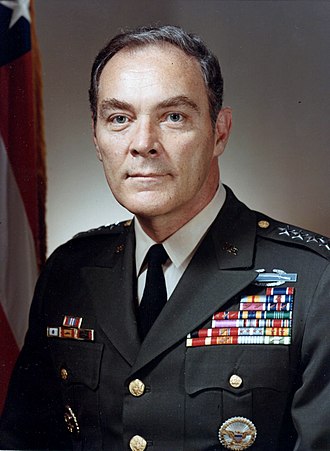
Haig, Alexander M., Jr.
Alexander M. Haig, Jr. began his service in the Nixon administration as a military assistant to National Security Advisor Henry Kissinger from January 1969 to June 1970, before being promoted to Deputy Assistant to the President for National Security Affairs. He held this deputy role for the majority of the White House taping period, from June 1970 until January 1973, when he transitioned to the Pentagon to become Vice Chief of Staff of the U.S. Army. As the Watergate scandal forced the resignation of H.R. Haldeman, Nixon recalled Haig to serve as White House Chief of Staff from May 1973 until the president's resignation in August 1974.
What Haig talks about on the tapes
Vietnam War 179Watergate 172Foreign Policy 125Henry Kissinger 112Public relations 81Executive privilege 58Congressional relations 54National Security 53Military Strategy 50Nguyen Van Thieu 46Watergate scandal 39Peace negotiations 37
Conversations (700)
— Page 6 of 7President Nixon met with Alexander Haig and J. Fred Buzhardt to strategize on the burgeoning Watergate scandal, specifically focusing on John Dean's possession of sensitive documents and the potential for a damaging investigation into domestic intelligence operations. The participants discussed controlling the narrative surrounding CIA and NSA involvement, maintaining the loyalty of White House staff, and managing the political fallout of ongoing testimony. Additionally, Haig briefed the President on his recent discussions with John Connally regarding potential White House personnel changes, the appointment of a special prosecutor, and the necessity of presenting a strong, defiant front against congressional and legal pressures.
President Nixon and Alexander M. Haig, Jr. met briefly in the Oval Office to coordinate their upcoming daily schedules. The discussion focused on logistical planning, specifically regarding a planned engagement with John B. Connally. No major policy decisions were recorded during this brief administrative exchange.
President Nixon and Alexander Haig met to discuss the escalating pressures of the Watergate scandal, specifically focusing on the resignation of G. Bradford Cook and the potential legal exposure of William J. Casey. The President emphasized his refusal to resign, dismissed impeachment concerns, and stressed the need for the White House staff to remain resilient. They also evaluated potential personnel changes, including roles for Ron Ziegler and John Scali, and monitored Elliot Richardson's progress in selecting a Special Prosecutor.
President Nixon and Alexander Haig met to discuss urgent personnel changes, the management of the ongoing Watergate scandal, and strategies to stabilize the administration's public and congressional standing. The conversation focused on potential replacements for high-level positions, including the FBI director and congressional liaison staff, while evaluating the performance of White House staff like Ronald Ziegler. Nixon emphasized a need for steady decision-making and resistance to panic as they navigated mounting political pressure and potential legal vulnerabilities surrounding Watergate.
President Nixon met with J. Fred Buzhardt, Jr. and Alexander Haig, Jr. to discuss the legal and political implications of recently surfaced documents, specifically those related to the "Huston Plan" and its potential connection to the Watergate burglary. They analyzed how to manage the release of this sensitive, high-level intelligence information while attempting to separate the President's role from illegal activities, such as surreptitious entries. The participants concluded that they needed to identify the exact scope of past intelligence operations and develop a strategic communication plan—possibly a white paper—to justify the programs as necessary for domestic security during a period of civil unrest.
President Nixon and Alexander Haig discuss the urgency of consulting Tom C. Huston regarding his knowledge of sensitive matters. Nixon instructs Haig to have J. Fred Buzhardt, Jr. contact Huston immediately to consolidate information and potentially preempt additional calls. The conversation concludes with a plan for a follow-up briefing in thirty minutes.
President Nixon met with Alexander Haig and J. Fred Buzhardt to discuss the potential fallout from the 'Huston Plan,' a controversial domestic intelligence program. The participants assessed the extent to which the plan was implemented and whether any illegal activities, such as domestic wiretapping or the break-in of Daniel Ellsberg's psychiatrist's office, could be legally linked to it. Nixon directed his team to gather facts from intelligence agencies while simultaneously attempting to keep the sensitive documents out of the hands of the Ervin Committee, fearing that public exposure would lead to a damaging narrative of a massive government conspiracy.
President Nixon directed Alexander Haig to contact H.R. Haldeman regarding his recent meeting with Richard Helms, Vernon Walters, and John Ehrlichman. Nixon expressed frustration over the perception of a cover-up and instructed Haig to reassure Haldeman that their actions were based on presidential directives to investigate the matter. The discussion highlights Nixon’s effort to manage the fallout of the Watergate scandal by ensuring his staff remained firm in their defense against the ongoing investigation.
President Nixon and Alexander Haig met to strategize a defense against potential political damage stemming from the Watergate investigation, specifically focusing on the 1970 Huston Plan. They debated how to frame the plan—which authorized aggressive domestic surveillance tactics like surreptitious entry—as a necessary, albeit unimplemented, contingency response to civil unrest by radical groups. The participants aimed to distance the President from any association between the Huston Plan and the Watergate burglary while planning to utilize J. Fred Buzhardt to coordinate with relevant figures like Robert Mardian and clarify that the program was superseded and never operational.
President Nixon met with Alexander Haig and J. Fred Buzhardt to strategize their defense against emerging congressional inquiries related to the Watergate scandal and past national security operations. The participants focused on establishing that a controversial domestic intelligence plan—which had been recommended to the President—was formally suspended by White House officials shortly after its approval. They determined that they should let the Ervin Committee overreach on this issue, planning to use the resulting national security arguments to discredit the committee’s investigation while preparing witnesses to testify that the proposed operation was never implemented.
President Nixon and Alexander Haig met to discuss ongoing Watergate-related pressures, specifically focusing on the handling of the Huston Plan and the potential public release of sensitive national security documents. They strategized on how to frame the history of the Huston Plan—emphasizing that it was a discontinued interagency effort that was never fully implemented—to mitigate political fallout. Additionally, they reviewed tactics for managing the administration's public relations response, including potential testimonies by officials like Vernon Walters, while maintaining a firm stance against prematurely surrendering privileged information.
President Nixon met with Ronald Ziegler, Alexander Haig, and J. Fred Buzhardt to strategize the administration's response to escalating Watergate-related inquiries, specifically regarding CIA involvement, the 'Huston Plan,' and leaked documents. A central focus was managing the upcoming press briefings and public narrative to distance the President from illicit activities by framing actions as legitimate national security initiatives. They also addressed personnel moves, deciding to remove H.R. Haldeman and John Ehrlichman from the White House payroll to mitigate political optics while ensuring they remained restricted from sensitive files.
President Nixon and Alexander Haig met to discuss managing the escalating fallout from the Watergate scandal, specifically focusing on reports linking White House staff to negative stories about Thomas Eagleton. They reviewed personnel moves, including relocating Lawrence Higby and Tod Hullin to the Old Executive Office Building to protect them from public scrutiny. Nixon explored the potential for a national security-focused speech regarding the Huston Plan and requested a thorough Department of Justice investigation into suspicious claims involving a doctor's letter and alleged government interference.
President Nixon and Alexander Haig consult regarding a suspicious letter sent to Haig from New York, which the President dismisses as a "phony" crank communication. The two speculate that the letter may be part of a deliberate setup designed to manipulate or implicate individuals involved in the Watergate scandal. Nixon ultimately instructs Haig to handle the matter as he sees fit, deferring to his Chief of Staff's judgment on how to dispose of the document.
President Nixon met with Alexander M. Haig, Jr. and Ronald L. Ziegler to coordinate the White House's defense and messaging strategy regarding the escalating Watergate scandal. The discussion focused on discrediting the 'hoax' nature of allegations against the President, preparing affidavits to clarify national security activities, and countering potential testimony from John W. Dean III. Nixon emphasized the need to stand by staff members caught in the investigation while maintaining a firm, unified front against the press and the Ervin Committee.
President Nixon and Alexander Haig discuss concerns regarding an unsolicited letter sent to Haig by an unidentified doctor in New York, specifically questioning the potential motivations and implications of such correspondence. The President expresses deep suspicion toward John W. Dean III, suggesting that Dean may be capable of manipulative or damaging behavior. Nixon emphasizes the need for absolute discretion and precision in how the administration handles these external communications to mitigate further political risk.
President Nixon and Alexander Haig discuss the strategic public release of information regarding Senator Thomas Eagleton’s medical history at the Barnes Hospital and the Mayo Clinic. Nixon directs Haig to ensure Henry Petersen pursues the investigation immediately to shape public perception. The two also touch upon the career status and potential culpability of Richard Helms, with Nixon expressing a desire to support him while distancing him from wrongdoing.
President Nixon consulted with Alexander Haig regarding his afternoon schedule, specifically his plan to visit Julie Nixon Eisenhower. Haig provided an update on Henry Kissinger’s optimistic report regarding ongoing diplomatic efforts. The two agreed to meet immediately afterward to discuss guidance for the President’s upcoming speech.
President Nixon and Alexander Haig briefly confer to coordinate a forthcoming speech and review a report. The discussion focuses on the administration's messaging strategy, with Nixon seeking Haig's input on the substance of his planned public remarks. The exchange serves as a preliminary touchpoint to prepare for the President's immediate agenda.
President Nixon and Alexander Haig met to discuss defensive strategies regarding the ongoing Watergate investigation, including managing leaks and potential legal exposure. The President focused on reframing the Watergate scandal within the context of national security and foreign policy achievements to counter domestic critics. Additionally, they reviewed personnel concerns, including the status of FBI leadership and the potential implications of the grand jury investigation involving Vice President Spiro Agnew.
President Nixon and Alexander Haig discussed the negative public perception surrounding the opening days of the Ervin Committee hearings and the ongoing witness testimony. They reviewed the progress of J. Fred Buzhardt’s document preparations, setting a goal to have materials finalized by Sunday. Additionally, Haig provided an update on Elliot Richardson’s confirmation process and they coordinated the agenda for an upcoming Cabinet meeting intended to boost administration morale.
President Nixon met with his Vice President, Cabinet members, and senior staff to receive departmental updates and reinforce the administration's policy goals. The discussion spanned a wide array of topics, including minority recruitment, the status of the Watergate special prosecutor search, energy policy, and the administration's foreign policy record. Nixon emphasized the importance of maintaining a strong national defense and a unified front against political challenges while encouraging his team to continue their work with confidence.
President Nixon met with Alexander Haig and Ronald Ziegler to develop a rigorous "battle plan" for addressing the expanding Watergate scandal and ongoing investigations. The participants strategized on how to manage the release of sensitive White House records, including memoranda of conversation and materials related to the Huston Plan and CIA involvement. A primary focus was establishing a unified defense against accusations involving John Dean, H.R. Haldeman, and John Ehrlichman, while firmly asserting executive privilege over presidential papers.
President Nixon and Alexander Haig met to discuss strategic responses to mounting political pressure from the Watergate scandal and ongoing Senate committee investigations. They evaluated the potential benefits of releasing specific documents, including General Vernon Walters’s memoranda, to preemptively control the narrative regarding the President's directives to the FBI and CIA. The two considered whether a proactive, public disclosure—framed as an effort to protect institutional integrity rather than a cover-up—might mitigate long-term damage or potential impeachment proceedings.
President Nixon, Alexander Haig, and Ronald Ziegler met to strategize a public "full disclosure" initiative aimed at managing the fallout from the Watergate scandal and countering potential impeachment efforts. The participants discussed the timing and content of a proposed televised speech and a accompanying "White Paper," focusing on explaining the Huston Plan, national security wiretaps, and the rationale for previous efforts to limit FBI investigations. Nixon emphasized the necessity of framing these actions within a national security context while asserting his ownership over presidential memoranda and internal records to prevent them from becoming ammunition for political adversaries.
President Nixon met with Alexander M. Haig, Jr. to discuss internal administrative matters amidst the escalating pressure of the Watergate investigation. While the transcript remains largely unintelligible, the meeting reflects the ongoing reliance on Haig for managing White House operations and personnel during a critical period of staff turnover. No definitive policy decisions were recorded during this brief exchange.
President Nixon and Alexander M. Haig, Jr. met to coordinate the White House strategy regarding the escalating Watergate investigation. The discussion focused on framing the administration's response within the context of national security to maintain public and institutional support. This session reflects the urgent efforts of top officials to manage political fallout and define a defensive narrative for the executive branch.
President Nixon met with Alexander M. Haig, Jr. in the Old Executive Office Building to coordinate scheduling and internal communications. The brief interaction focused on the President's previous discussion with H. R. Haldeman and the logistical management of Haig's agenda. No substantive policy decisions were reached during this short preliminary exchange.
President Nixon and Alexander Haig met to strategize the White House response to the escalating Watergate scandal, specifically focusing on the necessity of total disclosure and the preparation of a definitive 'White Paper.' The conversation centered on protecting the President from allegations by framing the events as a national security issue orchestrated by subordinates without his authorization. Nixon and Haig evaluated the merits of a formal speech versus the White Paper to address public perception and provide a cohesive defense against potential impeachment proceedings.
President Nixon and Alexander Haig discussed strategy for responding to the Watergate scandal, specifically focusing on the creation of a 'white paper' to address allegations regarding national security, the Huston Plan, and wiretapping. They agreed that a comprehensive written document would be more effective than a high-stakes televised presidential address, which Nixon feared would appear defensive or suggest guilt. Furthermore, they reviewed the status of personnel issues, including the pressure on William Ruckelshaus and the anticipated appointment of Archibald Cox as Special Prosecutor.
President Nixon and Alexander Haig discuss the strategic timing of a potential presidential televised address amidst the escalating Watergate scandal and upcoming Ervin Committee hearings. Nixon expresses concern that frequent appearances would diminish his authority, arguing that he should wait until indictments are finalized to provide a definitive, once-and-for-all statement. The two men agree to prioritize the release of a White Paper to establish the facts and provide supporters with a coherent narrative, while also debating whether Haig or Press Secretary Ron Ziegler should lead the briefings to maximize credibility.
President Nixon, Alexander Haig, and Alexander Butterfield met to strategize the White House response to the escalating Watergate scandal, focusing on the upcoming Ervin Committee hearings and potential impeachment proceedings. Nixon expressed a desire to present a 'White Paper' to Congressional leaders to clarify the administration's position and distance himself from the scandal, rather than addressing the public on prime-time television. They also discussed the status of CIA involvement, potential testimony from Richard Helms and Vernon Walters, and the need for a unified defense against political opponents.
President Nixon met with Ronald Ziegler and Alexander Haig to strategize the White House response to the Watergate scandal, specifically focusing on the preparation of a forthcoming White Paper and the management of sensitive documents. The participants discussed the potential impact of Lieutenant General Vernon Walters’s testimony, the handling of executive privilege regarding presidential conversations, and the necessity of preventing staff members from surrendering their notes to congressional investigators. Nixon emphasized the importance of maintaining presidential authority and public morale, ultimately deciding that the White House must remain unified and proactive while avoiding premature television speeches or concessions.
President Nixon and Alexander Haig met to discuss managing the ongoing Watergate crisis, focusing on the need for a non-defensive, proactive White House response through a forthcoming White Paper. They reviewed the political and economic implications of potential new wage and price controls, with Nixon stressing the need for decisive action to restore public confidence despite resistance from his economic advisors. Additionally, the two discussed the status of a potential Vietnam ceasefire communiqué and coordinated the release timing to align with POW developments.
President Nixon and Alexander Haig discussed the preparation of a White House 'White Paper' intended to frame the administration's past actions—including wiretaps and security measures—around the necessity of national security rather than Watergate-related controversies. The two assessed the political landscape, emphasizing the need to maintain support among key Congressional leaders like John Stennis and Barry Goldwater to resist pressures for resignation or impeachment. They also touched on economic policy strategy, including potential wage and price controls, and agreed to position John Connally to lead on energy policy to avoid political risks associated with other potential appointees.
President Nixon and Alexander Haig discuss the ongoing development of a White House White Paper intended to address the Watergate scandal and associated controversies. Nixon emphasizes that the document must move away from a defensive tone, focusing instead on national security justifications and a more aggressive political posture. They agree to involve Patrick Buchanan in refining the draft's specifics while setting a firm strategy to reject talk of impeachment and confront political critics directly.
President Nixon met with Ronald Ziegler and Alexander Haig to strategize the White House response to the escalating Watergate scandal and manage public perception of his embattled administration. They discussed the tactical release of a forthcoming White Paper, the management of congressional and press relations, and the necessity of distancing the President from staff members implicated in the investigation, such as H. R. Haldeman and John Ehrlichman. Nixon and his advisors resolved to maintain a posture of command by focusing on national policy, specifically upcoming economic initiatives and the summit with Leonid Brezhnev, to project stability while weathering the ongoing controversy.
President Nixon and Alexander Haig met in the Old Executive Office Building to review upcoming scheduling priorities and administrative coordination. The discussion focused on managing the President's calendar and addressing immediate logistical concerns for the White House staff. No major policy shifts were recorded, as the dialogue primarily centered on routine executive branch management and time allocation.
President Nixon and Alexander Haig met to strategize the drafting of a White House White Paper intended to shape public perception of the Watergate scandal and address mounting allegations. The discussion focused on carefully framing the President's past communications with figures like L. Patrick Gray and Henry Petersen to emphasize that his actions were rooted in protecting national security rather than facilitating a cover-up. Nixon directed Haig to ensure the document explicitly addressed unauthorized activities involving the CIA and the Plumbers, while maintaining that the President had no prior knowledge of specific illegal acts like the break-in at the office of Daniel Ellsberg’s psychiatrist.
President Nixon and Alexander Haig coordinate the framing of the President’s involvement in the Watergate scandal and its intersection with national security matters for a forthcoming speech. They discuss specific linguistic choices, such as using the term "illegal" rather than "criminal," and outline how to explain Nixon's interactions with L. Patrick Gray and Henry Petersen. The conversation emphasizes justifying the President’s actions regarding the Ellsberg case and the Plumbers by presenting these activities as legitimate national security protections.
President Nixon and Alexander Haig discuss the management of information and materials related to ongoing investigations, specifically focusing on what should be disclosed to prosecutors versus what falls under security protections. Nixon expresses concern over the handling of CIA-related information and the legal implications of providing specific directives to the agency. The conversation underscores the administration's efforts to navigate the tension between cooperative transparency and the protection of sensitive executive branch records.
President Nixon and Alexander Haig coordinate the preparation of a statement regarding the Watergate scandal, specifically focusing on the inclusion of details concerning the President's interactions with Louis Patrick Gray and Vernon A. Walters. The participants discuss whether J. Fred Buzhardt, Jr. has sufficient information to draft these specific points and determine how to integrate them into the upcoming document. They agree to finalize their strategy during a planned 2:00 pm meeting, while remaining available for further consultation if new questions arise.
President Nixon and Alexander Haig coordinate the strategic presentation of specific information to an unnamed individual, emphasizing the need to provide factual support for a desired narrative. The pair discusses the timing and methodology for releasing this material, balancing the preference for a structured timeline versus a continuous flow of communication. Nixon underscores his desire to guide the approach without appearing to rigidly dictate the final execution.
President Nixon and Alexander M. Haig, Jr. coordinated a brief, unscheduled meeting to discuss internal matters. Haig confirmed that preparations were in order, prompting the President to move immediately to his office. The discussion functioned as a logistical bridge to facilitate an upcoming face-to-face consultation.
President Nixon and Alexander M. Haig, Jr. briefly coordinated their schedules to transition to a follow-up meeting. This exchange served as a logistical precursor to a more substantive discussion, as evidenced by the President's prompt to proceed to the next location. The conversation was limited to moving the executive agenda forward.
President Nixon and Alexander Haig met to refine the strategic framing and content of an upcoming White House "White Paper" intended to address the burgeoning Watergate scandal. They focused on drafting language that would insulate the President from culpability regarding the break-in, the payment of funds to defendants, and "dirty tricks," while emphasizing national security concerns to justify his actions and administration policies. The discussion centered on balancing public transparency with the assertion of executive privilege to protect presidential papers and staff testimony from congressional investigators.
President Nixon met with Alexander Haig and Ronald Ziegler to coordinate the White House's public relations and legal strategy regarding the upcoming release of a Watergate "White Paper." The participants discussed the drafting of the document, the importance of controlling the narrative, and how to brief Congressional leaders on its contents to clear the air. A significant portion of the conversation focused on crafting the President’s official account of his knowledge—specifically regarding the Daniel Ellsberg break-in and the roles of H.R. Haldeman, John Ehrlichman, and John Dean—to ensure the documentation presented him in a favorable light.
President Nixon, Ronald Ziegler, and Alexander Haig met to refine the language of a forthcoming White House "White Paper" intended to address the ongoing Watergate investigation. The President focused on carefully phrasing his lack of prior knowledge regarding illegal activities or hush-money payments, while simultaneously attempting to frame his actions within the context of protecting national security operations. They discussed the necessity of maintaining a firm public stance against the congressional inquiries, with Nixon emphasizing the importance of "fighting" back to avoid the political and international consequences of appearing weak.
President Nixon and Alexander Haig coordinate the release of a forthcoming White House statement intended to leverage recent leaks from the Ervin Committee regarding national security concerns. The pair decides to delay the statement until the following morning to ensure the draft emphasizes the committee’s unanimous recommendations and to allow for further legislative consultations. Haig confirms that key personnel, including Bryce Harlow, J. Fred Buzhardt, and himself, will manage outreach to congressional leaders like Hugh Scott, John Stennis, and Henry Jackson to bolster their political position. Additionally, they agree that Press Secretary Ronald Ziegler should avoid a morning briefing to build anticipation for the President's scheduled afternoon statement.
President Nixon and Alexander Haig held a brief, late-evening meeting to coordinate scheduling and discuss internal administrative preferences. The participants reviewed potential recommendations or materials, with Nixon expressing skepticism regarding the effectiveness of a specific graph or presentation. The discussion concluded with a decision to reconvene at 9:00 am the following day.
Alexander M. Haig, Jr. briefed President Nixon on his recent discussions with Republican congressional leaders, including Gerald Ford, Hugh Scott, and Robert Griffin. The leadership group expressed strong support for the President and sought to refute an Evans and Novak report that suggested a lack of professional party backing regarding the Watergate crisis. To address these concerns and maintain morale, they arranged a meeting with the President to reaffirm their commitment and requested more frequent consultations during the unfolding scandal.
President Nixon and Alexander Haig met to discuss the administration's strategic response to the Watergate scandal, specifically focusing on the composition and release of a forthcoming White Paper intended to address public and congressional concerns. They reviewed the status of internal staff morale and the necessity of maintaining stable government operations amidst the political turmoil. Additionally, the pair coordinated an upcoming economic meeting with key advisors to address the need for decisive action regarding national economic policy.
President Nixon met with Alexander Haig and J. Fred Buzhardt to strategize the drafting of a White House 'White Paper' intended to manage public and legal fallout from the Watergate investigation. The discussion focused heavily on refining the document's phraseology regarding the President's knowledge of the Huston Plan, the break-in at Daniel Ellsberg's psychiatrist's office, and other controversial intelligence activities. Nixon sought to craft a narrative that assumed generalized responsibility for the actions of 'overzealous' staff members to protect the administration while distancing himself from specific authorization of illegal acts.
President Nixon consulted Alexander Haig regarding the specific language of a forthcoming White House statement concerning the Watergate scandal. The President reviewed a draft containing replacements for a sentence involving his authorization of "any means" and requested that the revised text be brought to him for final approval. This exchange ensured that the administration's official position on the matter was carefully vetted prior to public release.
President Nixon and Alexander Haig held a brief meeting to coordinate the review of specific documents related to authorized actions. Nixon requested that Haig prepare and deliver these materials for his personal inspection before they were finalized. The discussion focused on ensuring the President had oversight of documentation before further administrative progress was made.
President Nixon met with Alexander Haig, Rose Mary Woods, and Marjorie Acker to draft and edit a White House statement regarding the Watergate scandal and national security activities. The primary focus was refining the language used to describe the President’s role, potential prior knowledge, and the activities of the 'Plumbers' while balancing the necessity of maintaining presidential authority. Additionally, the group discussed strategies for managing public perception, economic policy concerns, and the political implications of upcoming congressional hearings.
President Nixon and Alexander Haig met to coordinate the development of a Watergate White Paper, specifically focusing on the drafting of a cover memorandum. They reviewed the collaborative contributions of Raymond K. Price, Jr. and J. Fred Buzhardt, Jr. regarding the document's structure. The discussion centered on finalizing the strategy for this formal response to ongoing political pressures.
President Nixon met with Raymond Price, Alexander Haig, and J. Fred Buzhardt to strategize the content and presentation of a White House White Paper regarding the Watergate scandal. The group focused on drafting a cover statement that addressed specific controversies, including the funding of defendants, the Ellsberg break-in, and the involvement of key aides like H.R. Haldeman and John Ehrlichman. They also discussed plans to brief influential Congressional leaders, such as Henry Jackson and Barry Goldwater, to ensure consistent messaging regarding prior statements and wiretaps.
President Nixon and Alexander Haig met to coordinate the White House strategy regarding the escalating Watergate scandal and the administration's public relations response. The discussion centered on managing communications through Press Secretary Ronald Ziegler and preparing for a critical meeting with Republican congressmen. Haig also briefed the President on recent consultations with William J. Baroody and addressed concerns regarding national security implications of the unfolding investigation.
President Nixon met with Alexander Haig to discuss the nature and implications of Patrick Buchanan’s recent interactions with Vice President Spiro Agnew. The brief consultation focused on assessing the political fallout and potential risks associated with these communications. No major policy decisions were recorded during this short exchange regarding the internal dynamics of the administration.
President Nixon met with key Republican congressional leaders and White House staff to discuss strategies for containing the political fallout from the Watergate scandal. The participants debated the timing and content of a forthcoming White House "White Paper" and discussed the potential benefits of a presidential press conference to restore public confidence. They also reviewed legislative management, specifically the importance of maintaining congressional support for administration initiatives amidst ongoing committee investigations and allegations of intelligence-gathering activities.
President Nixon and Alexander Haig met to strategize on managing the ongoing Watergate scandal, specifically focusing on the White House's public relations response through the release of statements and "White Papers." The conversation centered on discrediting testimony from John Dean, reframing the "plumbers" unit activities as national security necessities, and consolidating a strong defensive posture to prevent panic within the administration. Additionally, they discussed shifting personnel roles, including the appointment of Bryce Harlow to manage Congressional relations and political matters to insulate the President, and coordinating the White House response with other officials.
President Nixon and Alexander Haig met to coordinate the President's upcoming schedule and prepare remarks for a planned trip to Camp David. Nixon expressed concerns regarding his physical fatigue and the necessity of readying his notes for the excursion. They further discussed logistics involving General Brent Scowcroft's participation in the trip and broader administrative matters concerning Congressional relations.
President Nixon met with Alexander Haig to discuss the ongoing fallout from the Watergate scandal, specifically focusing on managing the White House staff's morale, press relations, and the administration's strategic response. They coordinated the upcoming swearing-in ceremony for Attorney General Elliot Richardson and discussed utilizing cabinet members like Henry Kissinger to handle press briefings to shield the President from direct confrontation. Additionally, the President reviewed his schedule, including planned meetings with Congressional leaders and potential public appearances to project stability and strength during the crisis.
President Nixon and Alexander Haig discussed managing the White House's public image regarding the Watergate scandal, specifically focusing on the necessity of government secrecy. Nixon emphasized using the protection of sensitive foreign policy initiatives, such as diplomatic breakthroughs with China and Russia, to justify withholding information from the media. The pair also explored strategies to initiate public controversy to deflect criticism from the New York Times and considered potential government roles for Peter G. Peterson.
President Nixon and Alexander Haig discuss the success of a recent White House dinner honoring former prisoners of war (POWs), using the event to contrast the genuine patriotism of the attendees with the negativity of the press. Despite the positive morale boost, Nixon expresses significant anxiety regarding the intensifying Watergate scandal and the potential for congressional opponents to force his resignation or obstruct his foreign policy agenda. Haig urges the President to maintain his resolve, arguing that the administration has already weathered the worst of the crisis and that support from key constituencies remains strong.
President Nixon and Vice President Agnew met with the Cabinet and senior staff to discuss major foreign and domestic policy priorities and internal administration management. The discussion centered on upcoming diplomatic summits with Leonid Brezhnev and Georges Pompidou, negotiations with North Vietnam regarding the ceasefire, and economic challenges including inflation and energy policy. Additionally, General Alexander Haig briefed the Cabinet on the administration's efforts to stabilize internal governance, improve relations with Congress, and manage the ongoing political fallout from the Watergate scandal.
President Nixon and Alexander Haig met to discuss the positive public reception of a recent dinner honoring returning prisoners of war (POWs), noting how the event helped frame the administration's stance on national security. The two men reviewed the favorable reactions from both attendees and celebrities, as well as the event's television coverage. Additionally, they briefly addressed personnel and logistical matters, including Haig’s upcoming travel to Florida and the potential role of Bryce Harlow as a White House advisor while navigating concerns regarding conflicts of interest.
President Nixon and Alexander Haig coordinate the logistics for an upcoming Cabinet meeting to ensure the session is managed efficiently. Nixon directs Haig to arrange for the members to remain for a brief, additional period after the meeting concludes at noon. The discussion focuses primarily on scheduling protocol and ensuring the President has adequate time to address the group without feeling rushed.
President Nixon and Alexander Haig discussed administrative reorganization, economic strategy, and the ongoing Watergate scandal. They assessed the potential for upcoming presidential press conferences, emphasizing the need to focus on substantive issues like energy and the economy rather than reacting to prosecutorial pressures. Nixon and Haig expressed frustration with the leaked reports regarding a potential grand jury appearance, characterizing such leaks as politically motivated 'gunfights' that they intended to resist.
President Nixon met with bipartisan Congressional leaders, Vice President Agnew, and key cabinet members to discuss U.S. foreign policy developments in Latin America, Southeast Asia, and Europe. Secretary of State William Rogers briefed the group on his recent tour of eight Latin American nations, emphasizing improved diplomatic relations despite complex issues regarding oil, inflation, and expropriation. Henry Kissinger provided an update on ongoing negotiations in Paris aimed at reinforcing the Vietnam ceasefire, while he and the President outlined a new strategy for strengthening Atlantic alliances, stressing the need to link economic, political, and defense policies to ensure future international stability.
President Nixon and Alexander M. Haig, Jr. met briefly in the Oval Office to coordinate their respective calendars. The conversation focused on the President's availability and the scheduling of Haig's upcoming commitments. No substantive policy decisions were reached during this short interaction.
President Nixon and Alexander Haig met to discuss strategies for stabilizing the administration amidst the ongoing Watergate crisis and internal personnel challenges. They reviewed the results of Nixon's recent meeting with Congressional leaders and debated necessary shifts in White House staff organization, particularly concerning the influence of Roy Ash and the role of the Office of Management and Budget. A significant focus of the discussion was managing the departure of Secretary of State William P. Rogers and neutralizing the perceived lack of public confidence, with Nixon emphasizing a plan to increase his own public profile through frequent travel to engage directly with labor, farm, and industry stakeholders.
President Nixon met with his economic advisors and staff to discuss growing concerns over inflation, the stock market, and the public's perception of the economy. The group analyzed the potential effectiveness of various measures, including a possible excise tax on gasoline, an investment tax credit, and a compulsory savings plan, while considering the political challenges of implementing such a package with Congress. Ultimately, the President decided against immediate, piecemeal action, opting instead to have his advisors develop a comprehensive economic package for review at a follow-up meeting.
President Nixon and Alexander Haig discuss ongoing personnel changes within the administration, specifically regarding the planned departure of Secretary of State William P. Rogers and the recruitment of Melvin R. Laird for a senior White House role. Haig confirms that Rogers prefers to delay the announcement of his exit to avoid complications related to the Watergate scandal. Meanwhile, the two coordinate a strategy to persuade Laird to accept a position as a domestic policy advisor, scheduling a meeting at Camp David to finalize the offer with support from Bryce Harlow.
President Nixon and Alexander Haig discuss a public relations strategy to control the narrative regarding historical government wiretaps of newsmen. Nixon instructs Haig to orchestrate a methodical, staged release of this information to make the disclosure appear deliberate and formal rather than spontaneous. The President emphasizes the need to secure specific names and data from Secret Service Director James J. Rowley, threatening his position if he fails to produce the files quickly, in order to use the information to intimidate political opponents and critics.
President Nixon and Alexander Haig met to coordinate White House strategy regarding ongoing political scandals, including the Watergate investigation and the Ervin Committee hearings. They discussed organizational changes to improve staff efficiency, the management of upcoming bipartisan congressional briefings, and efforts to uncover past wiretap records involving Robert F. Kennedy. Additionally, they strategized on how to counter potential indictments against top aides and discussed ways to dissuade political figures from publicly suggesting the President testify before the Senate committee.
President Nixon and Alexander Haig discuss the administration's strategic response to ongoing Watergate allegations and the public's waning interest in the scandal. They agree to refrain from a direct White House rebuttal to John Dean's claims, favoring instead a focus on positive policy achievements, such as new economic initiatives and key personnel appointments, to project stability. Nixon expresses confidence that the administration has moved past the threat of impeachment or resignation and emphasizes that maintaining a busy, productive agenda is the best way to ensure political survival.
President Nixon and Alexander Haig discuss the ongoing efforts to secure an appointment for Melvin Laird, noting Laird’s reluctance and the administration's use of political leverage, including the potential influence of John Connally. The conversation then shifts to the Watergate scandal, specifically regarding John Dean's notes on his meetings with the President. Nixon expresses a desire to secure and personally review these notes to assess the extent of Dean's allegations and plan a strategic response, including potential involvement from Hugh Scott.
President Nixon, Alexander Haig, and Ronald Ziegler met to discuss the mounting political pressure surrounding the Watergate scandal, specifically focusing on the allegations made by John Dean. They reviewed the status of evidence, including Dean’s personal records and meeting logs, and discussed the necessity of obtaining the original documents to challenge the veracity of Dean's claims. The President emphasized his desire to clarify the timeline of his interactions with Dean and directed staff to secure relevant files immediately to prepare a coherent White House response.
President Nixon and Alexander Haig held a brief telephone conversation to coordinate an urgent, in-person meeting regarding the handling of sensitive materials. The discussion specifically concerned the status of John W. Dean III’s files as they related to the ongoing Watergate investigation. The call concluded with the President directing Haig to come to his office immediately to finalize their strategy.
President Nixon and Alexander Haig met briefly in the Old Executive Office Building for a short, informal consultation. The dialogue was minimal and lacks substantial policy substance, serving primarily as a brief check-in between the President and his Chief of Staff. No significant decisions or action items were recorded during this one-minute interaction.
President Nixon and Alexander Haig coordinated efforts to manage internal documentation related to the Watergate scandal, specifically focusing on John W. Dean III’s files. Nixon instructed Haig to ensure J. Fred Buzhardt provided access to the original documents to facilitate a comprehensive review of the ongoing investigation. The conversation concluded with Haig arranging a follow-up meeting with Stephen B. Bull to further address these administrative requirements.
President Nixon and Alexander Haig met to strategize a defense against John Dean’s potential allegations by securing and auditing White House materials. Haig recommended that the President personally review relevant White House tapes to determine exactly what information Dean might possess and how to counteract his claims. The discussion also addressed the physical security of Dean’s files, with plans for J. Fred Buzhardt to examine the materials and retrieve personal papers.
President Nixon and Alexander Haig discussed the administration's economic policy strategy, specifically critiquing current proposals for being insufficiently prepared for a formal briefing. Nixon expressed strong opposition to implementing a price freeze or a gas tax, directing Haig to remove these items from the economic package and separate energy issues from the broader policy plan. Additionally, the pair touched upon the President's schedule and the status of J. Fred Buzhardt's ongoing review of John Dean's Watergate-related files.
President Nixon met with Alexander Haig to discuss personnel matters regarding Melvin Laird and to set firm parameters for an upcoming economic meeting. Nixon directed Haig to ensure the economic team finalized a plan that excluded both a wage-price freeze and a gas tax. Furthermore, the President ordered that all energy-related proposals be separated from the primary economic package to prevent policy overlap.
President Nixon contacted Alexander M. Haig, Jr. to request an immediate, in-person meeting at the White House. The President indicated that he had specific materials or matters he needed to address with Haig directly. Haig acknowledged the request and agreed to head over to the President's location to discuss these urgent items.
President Nixon met briefly with Alexander M. Haig, Jr. to coordinate an unscheduled visit or briefing. The discussion served as a logistical arrangement for Haig to meet with the President in his office immediately following a short break. No substantive policy matters were recorded during this brief administrative exchange.
President Nixon and Alexander Haig met to strategize their public relations and legal defense regarding the ongoing Watergate scandal. The discussion focused on coordinating a 'game plan' to mitigate political damage, including managing sensitive information about FBI wiretaps and comparing the administration's actions to past practices under the Kennedy and Johnson presidencies. The participants also addressed the potential risks posed by John Dean's testimony, discussed necessary personnel changes at the FBI, and planned to leverage forthcoming documents to challenge their political opponents.
President Nixon and Alexander Haig discuss the progress of J. Fred Buzhardt's examination of John Dean's files, specifically looking for evidence related to the Watergate scandal. Haig reports that Buzhardt has found nothing incriminating in the files, leading the President to speculate that Dean may have removed materials or that the collection is unexpectedly clean. The President reaffirms his commitment to personally reviewing the White House tapes to continue the investigation despite the significant time investment required.
President Nixon and Alexander Haig held a brief discussion regarding the status of a specific individual, likely a source or operative, and the retrieval of sensitive files. The President questioned Haig on whether the individual had been successfully contacted and if they had yet discovered any pertinent information. The exchange concludes with Haig confirming the individual’s current lack of progress in the ongoing inquiry.
President Nixon and Alexander Haig discuss updates on economic policy planning and the ongoing Watergate investigation. Haig reports that J. Fred Buzhardt, Jr. has thoroughly searched John Dean's files and found no evidence of documentation, leading them to believe Dean is bluffing or being manipulated by his legal counsel. Meanwhile, Nixon details his personal review of the White House tapes, noting that he is methodically analyzing his past meetings with Dean to understand the extent of staff involvement and potential cover-up efforts.
President Nixon and Alexander Haig met to discuss ongoing administrative tasks and the review of documentation related to Watergate-era investigations. The conversation reflects the President's preoccupation with the mounting volume of material and the difficulty of identifying potential involvement or culpability within the administration. They ultimately resolved to proceed with the laborious process of analyzing these records to better understand the scope of the events in question.
President Nixon and Alexander Haig discuss the successful recruitment of Melvin Laird to the White House staff and strategies for managing John Connally's potential departure and future role. Haig provides an update on his recent meetings, noting that the administration is preparing to announce several major initiatives concerning Vietnam, energy, and the economy, as well as a new FBI director. Additionally, Nixon and Haig address the ongoing Watergate investigation, with the President reporting that his review of recordings has convinced him that allegations involving John Dean are fraudulent.
President Nixon and Alexander Haig met briefly to discuss administrative personnel, travel arrangements, and the status of ongoing internal investigations. The conversation centers on staff management, including the travel policies for certain individuals, and an assessment of tape recordings related to internal probes. The pair also acknowledged the confirmation of Elliot Richardson as Attorney General as a significant positive development for the administration.
President Nixon and Alexander Haig met to strategize the administration's public response to ongoing Watergate controversies, focusing on Senator Hugh Scott’s planned statement regarding wiretap statistics. The discussion also addressed staff management issues, specifically John Connally’s future role and concerns regarding internal communication failures surrounding John Dean’s recent statements. Nixon emphasized the need for better legal coordination and expressed frustration with press coverage and the perceived incompetence of his press team in managing damaging narratives.
President Nixon met with Vice President Agnew and Republican congressional leadership to solidify legislative strategy and enhance communication between the White House and Capitol Hill. Key discussions included Henry Kissinger’s briefing on recent negotiations in Iceland regarding the 'Year of Europe' and the progress of the Vietnam Peace Accord. The group also addressed the need for improved coordination on pending legislation, political appointments, and the management of vetoes to maintain party unity in the face of domestic challenges.
President Nixon and Alexander Haig discuss public relations strategies regarding the Watergate scandal, specifically emphasizing the need to frame the ongoing investigations as a politically motivated attack on the presidency. They evaluate the effectiveness of Gerald Warren's press briefings and coordinate on the legal nuances of executive privilege and the Brady rule in relation to evidence disclosure. Additionally, the President clarifies the use of government transportation by Julie Nixon Eisenhower, dismissing concerns by highlighting Secret Service security mandates and cost efficiencies.
President Nixon and Alexander Haig discuss internal administrative management and the broader political strategy regarding ongoing investigations. The President emphasizes the importance of avoiding unnecessary confrontations and instructs Haig to ensure White House staff refrain from answering legal questions during press briefings. They also touch upon the political nature of the opposition's efforts to target the presidency and the complications surrounding executive privilege and document disclosure.
President Nixon met with his economic advisors and John Connally to evaluate potential policy responses to the national economy, specifically focusing on the impact of food prices and the potential implementation of an export freeze. The group debated the efficacy of a 60-day price freeze versus alternative measures to curb inflation and addressed the political risks associated with such interventions. Additionally, Nixon and Connally discussed Connally's ongoing advisory role, navigating the potential for public speculation regarding his conflict of interest and the administration's need to maintain a strong, proactive image amid the escalating Watergate scandal.