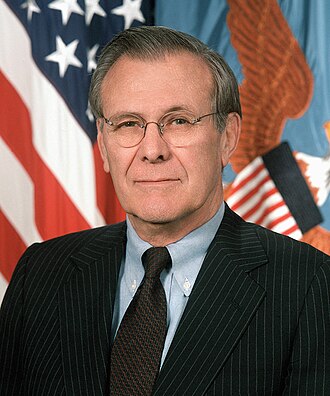
Rumsfeld, Donald H.
Donald H. Rumsfeld, a Republican congressman from Illinois, resigned his seat to join the Nixon administration as Director of the Office of Economic Opportunity from May 1969 to December 1970. At the onset of the White House taping period in February 1971, he was serving as Counselor to the President, a role he held from December 1970 until October 1971. He then transitioned to Director of the Cost of Living Council from October 1971 to February 1973, where he was tasked with managing President Nixon's wage and price controls. In February 1973, Rumsfeld left Washington to become the U.S. Ambassador to NATO, serving in Brussels until September 1974.
President Nixon met with Donald Rumsfeld to discuss Rumsfeld's future role within the administration, emphasizing the need for him to gain experience in foreign policy through a high-profile position such as Special Trade Representative or a diplomatic posting in Japan. Nixon stressed that Rumsfeld should prioritize positions that offer significant responsibilities and international travel to prepare him for potential future political roles, such as a Senate run in Illinois. The conversation also touched upon the political necessity of projecting strong leadership and effective communication, particularly in light of the Vice President's struggles to connect with younger voters and the public's perception of the administration's economic management.
President Nixon met with several astronauts and staff members to review their recent visits to college campuses across the country. The participants discussed student attitudes toward the space program, the Vietnam War, and the current political climate, noting a divide between the idealism of the student body and the perceived negative influence of the "Establishment" and faculty. Nixon and the astronauts debated strategies for engaging youth, emphasizing the importance of space exploration as a vital expression of national spirit and greatness.
President Nixon met with his Cabinet and key staff to discuss the status of the administration's revenue sharing legislative agenda and receive briefings on various international developments. Administration officials reported on their outreach efforts to build public and Congressional support for revenue sharing while addressing opposition from labor and minority groups. Additionally, Cabinet members provided updates on their recent foreign travels, emphasizing the geopolitical successes of the Nixon Doctrine in Southeast Asia and the strengthening of international cooperation on transportation and environmental safety.
President Nixon and his Cabinet met to discuss the ongoing challenge of inflation and rising construction costs, focusing on the administration's strategic options for economic stabilization. Dr. Paul McCracken reviewed current inflationary trends and labor market data, outlining a spectrum of potential responses ranging from maintaining current fiscal policies and targeted interventions to implementing more aggressive measures like wage and price controls. The meeting served as a forum to evaluate the efficacy of various regulatory mechanisms, such as the National Commission on Productivity and the suspension of the Davis-Bacon Act, while weighing the political and practical risks of further government intervention in the economy.
President Nixon met with H.R. Haldeman, Leonard Garment, Robert Finch, and Nancy Hanks to discuss arts policy, including appointments to the Hirshhorn Museum Board of Trustees and the President's upcoming speech at an Associated Councils of the Arts conference. The participants also explored strategies to support the struggling American film industry through tax incentives and antitrust relief while emphasizing the need for higher-quality, story-driven domestic productions. Additionally, the President reviewed positive public opinion polling data following his recent speech on Southeast Asia and decided against a televised question-and-answer session with the American Society of Newspaper Editors to avoid overexposure and continued debate on the Vietnam War.
President Nixon and a wide-ranging group of Cabinet members, advisors, and Congressional representatives met to discuss the growing national energy crisis and the necessity of transitioning to nuclear power. AEC Chairman Glenn Seaborg and other experts detailed the technological, environmental, and economic advantages of the liquid metal fast breeder reactor, emphasizing its ability to maximize fuel efficiency and provide long-term, pollution-free energy. The participants concluded that a strong national commitment, including significant federal funding and industry collaboration, is essential to accelerate the development of demonstration reactors and ensure future energy independence.
President Nixon met with Robert H. Finch and Donald H. Rumsfeld to discuss the potential appointment of John A. McCone, the status of anti-ballistic missile (ABM) policy, and racial discrimination within the armed forces. A primary focus of the meeting was preparing Finch and Rumsfeld for an extensive international diplomatic tour, including attendance at a World Health Organization meeting and high-level engagements regarding US policy toward the People's Republic of China, international drug control, and the POW issue. The group also coordinated on sensitive political matters, including soliciting overseas campaign contributions and managing relations with various European and Mediterranean leaders.
President Nixon directs Donald Rumsfeld to contact Congressman Charles Rangel before Rumsfeld’s upcoming European trip to demonstrate the administration's commitment to addressing the international drug trade. Nixon instructs Rumsfeld to frame the trip—which includes attendance at the World Health Conference—as a direct response to Rangel’s concerns, tasking the congressman with providing any relevant intelligence or suggestions for the mission. Furthermore, Rumsfeld briefs the President on the successful coordination of their strategy with Henry Kissinger.
President Nixon directs Donald Rumsfeld to contact Ted Husky, a community leader from Central Harlem, to cultivate a line of communication regarding local intelligence and feedback. Nixon instructs Rumsfeld to emphasize that the President personally values Husky’s input and wants him to report any significant developments directly. This outreach serves as an effort to gather grassroots political information and maintain a channel for community insights.
President Nixon and his Cabinet met to receive a briefing on international affairs and domestic policy, with a focus on Secretary of State William P. Rogers' recent diplomatic travels to the Middle East and the feasibility of desalinization technology. Rogers reported on his efforts to stabilize the Middle East through ceasefire maintenance and discussed the geopolitical concerns of various regional leaders. Dr. Edward E. David Jr. and other experts presented a detailed plan to advance domestic water desalinization and nuclear power capabilities, with the President calling for a major, accelerated federal effort to ensure American technological leadership. The meeting concluded with a brief status report from Treasury Secretary David M. Kennedy regarding the current international monetary situation and the fluctuations of the dollar.
President Nixon and Donald Rumsfeld met briefly to discuss the swearing-in of Ellen McConnell and the performance of the Cabinet. They specifically reviewed the contributions of cabinet members John A. Volpe, George W. Romney, John B. Connally, and Clifford M. Hardin. Additionally, they coordinated on the President's upcoming schedule, including remarks to be delivered at a tree-planting ceremony involving Senator Charles H. Percy.
In this Oval Office meeting, President Nixon met with H.R. Haldeman, Henry Kissinger, and other key staff to coordinate the rollout of a major breakthrough in the Strategic Arms Limitation Talks (SALT) with the Soviet Union. The President emphasized the need to maintain secrecy regarding the specific channels used to achieve this diplomatic progress while ensuring that the public message highlighted his personal initiative and the transition to simultaneous negotiations on offensive and defensive weapons. Additionally, Donald Rumsfeld and Robert Finch reported on their recent foreign tour, discussing European perceptions of U.S. foreign policy, the status of U.S. ambassadors, and the challenge of managing drug usage among military personnel abroad.
President Nixon met with his Cabinet and key advisors to announce a major breakthrough in Strategic Arms Limitation Talks (SALT) with the Soviet Union, culminating in a joint statement to be released simultaneously in both nations. The agreement establishes a framework to prioritize limiting anti-ballistic missile (ABM) systems while pursuing parallel measures for offensive weapons. Nixon emphasized that the breakthrough was achieved by maintaining a strong U.S. defense posture, and he urged his administration to avoid public speculation or detailed commentary that could complicate sensitive ongoing negotiations.
President Nixon, Vice President Agnew, and a large group of Cabinet members and senior staff met to establish a strategic framework for domestic policy, budget planning for the 1973 fiscal year, and the development of the 1972 Republican legislative and election platform. Participants reviewed polling data regarding national, community, and family concerns, noting that the economy, inflation, and unemployment are primary public priorities while other issues like pollution and consumerism are often driven by media visibility. The President and attendees emphasized the need for better communication to receive credit for administration accomplishments, focusing on a limited number of 'gut issues' rather than overextending on too many programs. Ultimately, the group discussed the necessity of coordinating policy initiatives and messaging to ensure visible progress on key economic and social concerns ahead of the 1972 election.
President Nixon met with his Cabinet members to discuss the delicate political landscape surrounding the administration's efforts to open communications with the People's Republic of China. The conversation centered on the necessity of maintaining strict discretion to avoid premature public speculation, which could jeopardize sensitive diplomatic negotiations and create political vulnerabilities. Nixon emphasized the importance of a unified front among Cabinet members to manage domestic and international expectations as the policy shift progressed.
President Nixon met with Council of Economic Advisers Chairman Paul W. McCracken to discuss the administration's economic policy, including the challenges of high unemployment and inflation. The President expressed frustration with the sluggish economy and explored the potential for dramatic fiscal interventions, such as shifting tax structures or modifying the international value of the dollar to improve competitiveness. Following this, Nixon consulted with John B. Connally to coordinate a strategic response, emphasizing the need for decisive action and unity between the Council of Economic Advisers and the Treasury Department.
President Nixon and Donald Rumsfeld met to discuss Rumsfeld's future career options within the administration, balancing his interest in Illinois politics with potential high-level federal appointments. They evaluated several possibilities, including a role as NATO ambassador, an Under Secretary position at the State Department, or a specialized roving envoy role focused on Latin America and other regions. The conversation also touched upon broader administration goals, the necessity of strengthening the State Department's internal administration, and political assessments of various Republican figures, including Iowa's Lieutenant Governor Roger Jepson.
President Nixon met with Vice President Agnew and his Cabinet to discuss the administration's foreign policy objectives and the state of the national economy. Agnew briefed the attendees on his recent international tour, highlighting the global reception of the Nixon Doctrine and the challenges posed by the Arab-Israeli conflict, East Pakistan, and the increasing Soviet and Chinese presence in various regions. Nixon and his advisers subsequently addressed the economic outlook, emphasizing the need for an aggressive, unified defense of administration policies regarding inflation and unemployment, while dismissing the viability of permanent wage and price controls. Finally, the President mandated a strict reduction in government personnel and grade-level escalation to improve budget management across executive departments.
President Nixon hosted back-to-back swearing-in ceremonies in the Oval Office for Ezra Solomon, as a member of the Council of Economic Advisors, and Frank C. Carlucci III. The sessions included formal oaths of office, family photographs, and the presentation of commemorative Presidential gifts, such as cufflinks and pins. During the meetings, Nixon engaged in informal conversation with the participants, reflecting on past professional associations and discussing the careers of the appointees, including Carlucci's previous work in Brazil and at the Office of Economic Opportunity.
President Nixon met with Donald Rumsfeld and H.R. Haldeman to discuss domestic political strategy, upcoming speaking engagements, and the administration’s approach to college campuses and youth outreach. The group evaluated Republican standing in key states like Illinois, emphasizing the importance of managing public perceptions of incumbent governors and party unity. Furthermore, they coordinated the logistical planning for the President's upcoming trip to the People's Republic of China, specifically addressing press access, media coverage, and the size of the official delegation.
President Nixon met with Charlotte T. Reid and her family, along with several officials including Donald Rumsfeld and Dean Burch, to conduct a swearing-in ceremony for Reid. During the proceedings, the President offered formal congratulations and presented gifts to commemorate the occasion. Nixon also took the opportunity to explain his rationale for Reid's appointment, emphasizing that it was based on merit and capability rather than gender.
President Nixon met with George P. Shultz and Donald H. Rumsfeld to discuss economic strategy and the administration's ongoing efforts to manage wage and price controls. The participants focused on navigating labor relations, specifically managing expectations regarding the Pay Board and the Cost of Living Council, while avoiding direct political confrontation with labor leadership. Nixon and his advisors agreed on the necessity of maintaining the appearance of a cooperative, non-partisan approach to combat inflation and promote economic expansion while preparing for potential future labor unrest.
President Nixon met with his Cabinet and key staff members to review the administration’s domestic and foreign policy priorities, primarily focusing on the economic transition to 'Phase II' and the announcement of a 1972 Soviet summit. Officials discussed the successful implementation of the wage-price freeze and the strategy for securing organized labor's cooperation on the newly formed Pay Board and Price Commission to curb inflation. Additionally, the President addressed the importance of linking economic policy to job growth through his pending tax proposals, while Secretary of State Rogers and the President emphasized that international diplomatic overtures toward the Soviet Union and China were part of a cohesive, long-term strategy for global peace.
Donald Rumsfeld briefs President Nixon on a private discussion with pollster George Gallup, who indicated that Nixon’s approval ratings are expected to see a significant rise. The two also discuss economic strategy, specifically addressing volatility in the stock market and public uncertainty regarding the upcoming Phase II wage and price controls. Nixon emphasizes the necessity of uncertainty in the transition toward free-market controls while tasking Rumsfeld with finalizing appointments to the pay and price commissions, including the potential addition of Robert Ellsworth.
President Nixon and Donald Rumsfeld discuss public perception and political strategy, specifically focusing on the reliability of Gallup polling data compared to Harris polls. The conversation also addresses economic concerns regarding the stock market and the inherent uncertainty surrounding the administration's Phase Two wage and price control policies. Nixon emphasizes the trade-off between economic control and bureaucratic growth, defending the necessity of flexibility in their approach to managing the national economy.
President Nixon and Donald Rumsfeld discussed the appointment of members to the newly formed Price Board and Pay Board, key components of the administration's economic stabilization program. Nixon suggested Hoyt Ammidon for a board position and emphasized the need for a strong, decisive chairman for the Pay Board to counter union leaders like George Meany. They also coordinated plans to finalize the announcements by Friday to ensure maximum media coverage in the Sunday papers.
President Nixon and Donald Rumsfeld discuss potential appointments for the administration, specifically focusing on candidates for the chairmanship of the Price Board. Nixon emphasizes the need for a strong, vigorous leader who can effectively manage business community concerns regarding economic policy. The two also coordinate the scheduling of a media announcement to ensure maximum impact in upcoming Sunday papers and news cycles.
President Nixon and Donald Rumsfeld met to discuss the administration's strategic management of the Pay Board, specifically addressing the contentious issue of wage retroactivity. They reviewed the President's recent interactions with Congress, including feedback from Clark MacGregor, and coordinated upcoming personnel meetings involving key cabinet members and foreign diplomats. The conversation centered on maintaining a firm stance regarding economic policy and ensuring that administration representatives on the Pay Board continued to exert influence to achieve desired outcomes.
President Nixon and the Cost of Living Council convened to discuss the efficacy of the administration's economic stabilization program, specifically the transition from Phase I to Phase II. Participants evaluated the success of existing price and wage controls and addressed the future of the Pay Board and Price Commission ahead of the 1972 calendar year. The meeting concluded with a formal vote to adopt an amendment to 'Option 2' regarding economic policy adjustments.
President Nixon met with Pay Board Chairman George H. Boldt and Price Commission Chairman C. Jackson Grayson to discuss the ongoing challenges of Phase II of his economic stabilization program. The discussion focused on the political and economic friction surrounding the issue of retroactivity for labor contracts and the necessity of prioritizing public policy over individual contract enforcement to curb inflation. The participants also coordinated their strategy for an upcoming public meeting with the Cost of Living Council, emphasizing the need for brief, unified messaging to demonstrate the stability and progress of their efforts to the American public.
President Nixon met with his Cabinet officers to discuss a variety of domestic and international issues, including transportation leadership, government funding through a continuing resolution, and the cultivation of opium poppies in Turkey. The conversation also touched upon administrative transitions, such as the departure of Secretary of Agriculture Clifford Hardin, and strategies for managing the national economy and price controls. Nixon emphasized the importance of maintaining clear leadership and coordination across departments to ensure the success of his domestic policy initiatives.
President Nixon, John Connally, Donald Rumsfeld, and a delegation of Republican Congressional leaders met to coordinate legislative strategy regarding the administration's domestic economic program and various foreign policy concerns. The discussion focused on the implementation of wage and price controls, pending tax legislation, and the management of international trade negotiations, particularly regarding Japan and the import surcharge. Participants also addressed the confirmation of Supreme Court nominees Lewis F. Powell and William Rehnquist, as well as ongoing legislative battles concerning the Vietnam War and Defense Department appropriations.
President Nixon met with John N. Mitchell and Donald H. Rumsfeld to deliberate on pending legislation, specifically focusing on the potential veto of a tax check-off provision for political campaigns. The participants discussed legislative strategies involving Clark MacGregor and Senator Charles McC. Mathias, Jr., as well as coordination efforts with John B. Connally. Additionally, the group briefly reviewed polling data from Illinois and discussed updates to the President's upcoming schedule.
Donald Rumsfeld instructs his staffer, Lee, to draft a recommendation for H.R. Haldeman or Dwight Chapin regarding a potential presidential appearance at a meeting of influential Midwest business and financial leaders. Rumsfeld emphasizes that a brief drop-by at the Roosevelt Room or the Old Executive Office Building would be a low-effort way to bolster political support for the administration's economic agenda. The task is to be finalized under the signature of Richard Cheney to facilitate the scheduling request.
President Nixon and Donald Rumsfeld discuss public perception and political strategy, specifically regarding the success of domestic economic policies and upcoming media appearances. They review the positive impact of wage and price controls while outlining plans to quietly decontrol rent in areas with high vacancy rates to avoid negative press. Additionally, the conversation touches on the President's upcoming international travel, his recent observations on the state of the U.S. economy, and his strong recommendation for Rumsfeld to watch the film 'Brian's Song' for its positive message on race relations.
President Nixon met with a large delegation of health industry leaders and administrators to acknowledge their contributions to his administration's economic initiatives, specifically regarding cost containment during Phase I. During the session, the President emphasized the importance of maintaining a balance between government oversight and the uniquely American tradition of volunteer-led health services. The meeting concluded with informal remarks about White House staff and services, followed by the presentation of commemorative gifts to the attendees.
President Nixon met with his Vice President and Cabinet to discuss the state of the U.S. economy, the administration's fiscal policy, and the upcoming 1973 budget. Key areas of focus included interpreting unemployment data—specifically the impact of new entrants to the workforce—and managing inflation through Phase II price and wage controls. Nixon urged his department heads to aggressively implement approved spending programs to stimulate the economy, while simultaneously directing them to more effectively communicate and promote the administration's economic achievements and social policy investments to the public.
President Nixon met with the Construction Industry Collective Bargaining Commission to review the progress of labor-management relations and wage stabilization efforts in the construction sector. The discussion focused on the success of the Commission's voluntary approach to curbing inflation, the role of craft boards in fostering industry cooperation, and the broader integration of productivity goals. Nixon commended the participants for their responsible leadership and collaborative efforts, emphasizing the importance of keeping the industry's management in the hands of construction professionals while continuing to modernize labor practices.
President Nixon met with his senior advisors and cabinet members to finalize strategy for an upcoming press conference and address recent developments regarding the Pay Board. The discussion focused on responding to the withdrawal of AFL-CIO leadership from the Pay Board, managing public perception of inflation and economic policy, and formulating official stances on contentious social issues including busing, abortion, marijuana legalization, and Social Security increases. The group debated the optimal timing and format for the President to announce the administration's economic adjustments to ensure maximum impact and clarity while minimizing political vulnerability.
President Nixon and his senior advisors, including John Ehrlichman, H.R. Haldeman, and John Connally, met to formulate an aggressive administrative response to the resignation of George Meany and other labor leaders from the Pay Board. The group discussed the timing and format of a public statement intended to demonstrate decisive presidential action and secure political leverage against Democratic opponents. They also debated potential replacements for the labor positions, reviewed strategies for handling the national economy, and coordinated the President's upcoming press conference to ensure it effectively overshadowed current controversies like the IT&T investigation.
President Nixon met with members of the Cost of Living Council and other key economic advisors to assess the efficacy of Phase II wage and price controls. The discussion focused on controlling inflation, managing food prices, and navigating political pressures from organized labor and Congress. Participants evaluated the impact of economic policies on the public interest and discussed strategies for future price stability across various sectors.
John B. Connally, George P. Shultz, Donald H. Rumsfeld, and Richard B. Cheney met to discuss economic stabilization policies and the operational status of key administrative bodies. The participants reviewed the activities of the Price Commission and the Cost of Living Council, including ongoing hearings and the impact of price controls on specific commodities like steer hides. The discussion also addressed the economic distribution of price increases between farmers and other industry stakeholders, as well as the administrative coordination between the Pay Board and various government agencies.
President Nixon met with Vice President Agnew, Cabinet members, and senior staff to discuss the administration's recent escalation in Vietnam, specifically the blockade of North Vietnamese ports. The President articulated his rationale for the decision and sought unified support from his team to manage potential congressional and public opposition. He emphasized the necessity of leadership during difficult times and urged his Cabinet to present a cohesive front in defending the policy to the public.
President Nixon met with his Cabinet and key staff to discuss the upcoming departure of Secretary of the Treasury John B. Connally and to address broader administration matters. The discussion covered the timing of administrative changes, the transition of economic policy responsibilities to George Shultz, and the status of ongoing federal investigations following the recent shooting of George C. Wallace. Connally reflected on his tenure as Treasury Secretary and his future plans, while the President reaffirmed his commitment to his current economic program and leadership agenda.
President Nixon met with his economic advisors, including George Shultz, Caspar Weinberger, and Herbert Stein, to address public and political concerns regarding rising food and beef prices. The group analyzed potential government interventions, such as suspending import quotas, utilizing government food stockpiles, and the political implications of implementing price controls. Following this, the President consulted with Kermit Gordon regarding the administration's economic policies and engaged in a broader discussion concerning the political orientation of intellectuals and the Brookings Institution.
President Nixon met with Donald Rumsfeld, H. R. Haldeman, Herbert Stein, and a production crew from the Wolper Organization to coordinate the filming of an upcoming documentary. The discussion focused on logistical instructions regarding the President's movements and camera placement within the White House. Additionally, the group touched upon the President’s past interactions with the Brookings Institution and his upcoming schedule at Camp David.
President Nixon held a wide-ranging series of meetings with advisors and staff to discuss economic policy, pending legislation, and emergency disaster responses. Key discussions included plans to reduce government stockpiles, the political implications of food prices and busing legislation, and the federal government's mobilization efforts following Hurricane Agnes and the Rapid City flooding. The session also incorporated administrative coordination for upcoming film projects involving the President and members of the Wolper Organization.
President Nixon met with his Cabinet and senior staff to discuss strategies for achieving a balanced federal budget by 1975, emphasizing the necessity of immediate spending cuts and potential vetoes of congressional legislation to curb inflation. Budget Director George Shultz outlined the administration’s plan to issue "ceiling letters" to agency heads to enforce strict fiscal guidelines and reduce government deficits. The participants also reviewed recent positive economic indicators, including growth in the Gross National Product and declining unemployment, while noting that the public generally views government spending as a primary driver of inflation.
President Nixon met with various administration officials to review the progress of the Property Review Board, focusing on the management and transfer of federal lands for public use. The President expressed frustration with bureaucratic inertia, citing a specific case at Camp Pendleton where beach access was hindered by poor facility planning and lack of oversight. Additionally, the President urged his staff to better publicize positive economic trends, such as inflation reduction and job growth, to provide congressional candidates with a more effective campaign narrative.
President Nixon met with the Cost of Living Council to review the performance of his administration's economic stabilization program, including successes in lowering inflation and fostering rapid economic growth. The discussion emphasized the necessity of maintaining fiscal discipline through a proposed $250 billion federal spending ceiling to prevent future inflationary pressure. Participants also addressed specific challenges, particularly rising food prices and the potential impact of government spending on tax rates, while strategizing on how to communicate these economic gains to the public ahead of the election.
President Nixon met with the Cost of Living Council to review the administration’s economic performance and coordinate strategy regarding inflation, labor relations, and food prices ahead of the 1972 election. Council members, including George Shultz and Donald Rumsfeld, discussed measures to protect Social Security recipients from illegal rent increases and highlighted the relative success of U.S. wage and price controls compared to foreign nations. The President directed his team to maintain an affirmative, disciplined public messaging campaign, emphasizing that the U.S. was achieving growth and reduced inflation without the reliance on wartime spending seen in the 1960s.
President Nixon met with his economic advisors and staff, including George Shultz, Arthur Burns, and Caspar Weinberger, to coordinate administration messaging and planning for the post-election period. The discussion focused on maintaining a firm stance on congressional spending, specifically concerning upcoming vetoes of water and education legislation, and establishing a strategy for economic policy, including the transition of wage and price controls. Nixon emphasized the need for long-term domestic initiatives and urged his team to use the post-election period for deep reflection and strategic planning rather than immediate political reaction.
President Nixon met with the Pay Board to express his appreciation for their efforts in curbing inflation and managing wage-price controls established by his August 1971 economic initiatives. The conversation focused on the effectiveness of these controls, the importance of maintaining cooperation between labor and business, and the broader context of economic stability in the United States compared to Great Britain. Nixon emphasized that while the Pay Board's regulatory work was essential, long-term economic health would ultimately depend on market forces and the discipline of the American public.
President Nixon met with members of the Committee on the Health Services Industry, along with administration officials including Herbert Stein and Donald Rumsfeld, to address the escalating costs of medical care. The discussion centered on balancing price controls with the need to maintain quality, specifically debating how to curb the proliferation of unnecessary services and the duplication of facilities without stifling the voluntary health system. Nixon emphasized the administration's goal of fostering cooperation with the medical profession to ensure federal health spending remains efficient and avoids a shift toward socialized medicine.
Herbert Stein, Donald Rumsfeld, and George Shultz met with prominent labor union leaders to discuss the state of the economy and federal productivity initiatives. The discussion touched upon current economic indicators, including farm prices, and featured planning for an upcoming productivity exhibit at the Smithsonian Institution. The meeting served as a consultative session between the administration and labor representatives regarding ongoing economic policy and the Productivity Commission's objectives.
President Nixon met with the National Commission on Productivity, including various labor union leaders and administration officials, to express his appreciation for their voluntary service and to emphasize the necessity of labor-management cooperation in national economic policy. Nixon encouraged the members to offer input beyond labor issues and reaffirmed that his door remains open for direct engagement between the White House and organized labor. The discussion also touched on specific policy concerns, including maritime programs, grain exports, and the challenges faced by local unions.
President Nixon met with members of the Pay Board and Price Commission to review the accomplishments of the Economic Stabilization Program's Phase II and discuss the transition into Phase III. The group evaluated the program's success in curbing inflation and managing the economy, while addressing challenges such as rising food prices, the global energy crisis, and the necessity of maintaining labor and business cooperation. Nixon expressed his appreciation for the board members' service and dedication, formally signaling the shift in responsibility for the next phase of economic policy.
President Nixon met with John T. Dunlop and several senior administration officials to formalize Dunlop’s appointment as the new chair of the Cost of Living Council. The discussion centered on the challenges of implementing Phase III of the administration's economic policy, specifically emphasizing the necessity of fiscal restraint and cooperation from labor and management to combat inflation. Nixon expressed his confidence in Dunlop’s unique ability to bridge the gap between business and labor interests to stabilize food prices and the broader economy.
President Nixon met with Donald Rumsfeld to confirm his travel arrangements for a commercial flight to Europe, with specific attention paid to his departure schedule from National Airport. Following this logistical check, Stephen Bull joined the discussion to coordinate a photo opportunity for Rumsfeld in the Rose Garden. The meeting concluded with the participants preparing to head outside for the scheduled photographs before Rumsfeld's departure.
President Nixon and Donald Rumsfeld met to discuss U.S. foreign policy challenges, particularly the strain on NATO and European allies' criticism of American actions in Vietnam and recent diplomatic overtures to the Soviet Union and China. The President expressed frustration with the lack of European self-sufficiency and the necessity of convincing allies that the U.S. is indispensable to their security. Following this, the conversation shifted to domestic politics, with Nixon offering his support for Rumsfeld’s potential Senate candidacy and criticizing the perceived weakness and lack of leadership in both the U.S. Senate and the House of Representatives.
President Nixon and members of the National Security Council met to discuss the strategic importance of Mutual Balanced Force Reductions (MBFR) amidst growing congressional pressure for unilateral U.S. troop cuts. The discussion focused on maintaining a credible conventional defense posture in Europe to avoid a reliance on "tripwire" nuclear escalation, which Nixon and his advisors agreed would be untenable given the current parity in nuclear capabilities between the U.S. and the Soviet Union. Participants ultimately reached a consensus to pursue negotiations that link force improvements with potential reductions while resisting domestic isolationist trends and preserving NATO's operational cohesion.
President Nixon met with NATO Secretary General Joseph M. A. Luns, accompanied by Donald Rumsfeld and Henry Kissinger, to conduct diplomatic discussions regarding the North Atlantic Treaty Organization. The meeting commenced with a formal photograph session and included an exchange of gifts, specifically cufflinks. While the majority of the policy discussions remain classified, the interaction served as a high-level engagement to maintain relations with the NATO leadership.