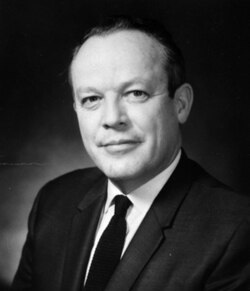
Kleindienst, Richard G.
Richard G. Kleindienst began his service in the Nixon administration as Deputy Attorney General in January 1969, a position he held until he was elevated to Attorney General in June 1972 after John Mitchell resigned to run Nixon's re-election campaign. During the White House taping period, Kleindienst oversaw the Justice Department's initial handling of the Watergate break-in and faced significant controversy regarding the administration's interference in an ITT antitrust settlement. As the Watergate scandal escalated and allegations of a cover-up consumed the administration, Kleindienst resigned his cabinet post in April 1973 on the same day as top White House aides H.R. Haldeman and John Ehrlichman.
President Nixon and a wide-ranging group of Cabinet members, advisors, and Congressional representatives met to discuss the growing national energy crisis and the necessity of transitioning to nuclear power. AEC Chairman Glenn Seaborg and other experts detailed the technological, environmental, and economic advantages of the liquid metal fast breeder reactor, emphasizing its ability to maximize fuel efficiency and provide long-term, pollution-free energy. The participants concluded that a strong national commitment, including significant federal funding and industry collaboration, is essential to accelerate the development of demonstration reactors and ensure future energy independence.
President Nixon directed Deputy Attorney General Richard G. Kleindienst to halt the Department of Justice's antitrust proceedings against IT&T. Nixon explicitly ordered that no legal brief be filed in the case and threatened to fire Assistant Attorney General Richard McLaren if he failed to comply with the directive to drop the matter. The conversation reflects Nixon's intense frustration with the Justice Department’s aggressive pursuit of conglomerates and his desire to personally dictate the administration's antitrust strategy.
President Nixon convened an extensive afternoon meeting in the Oval Office with his key economic advisors, including George Shultz, John Connally, Arthur Burns, and Paul Volcker, to deliberate on pressing fiscal and monetary policy issues. The discussion focused on addressing the nation's ongoing economic instability, involving high-level strategy sessions with administration officials and cabinet members. These deliberations were critical in shaping the Nixon administration's approach to inflation and international monetary concerns, ultimately informing the direction of domestic economic policy.
President Nixon and Deputy Attorney General Richard Kleindienst discussed the ongoing mass anti-war protests in Washington, D.C., and the government's strategy for managing demonstrators. Kleindienst reported on the successful, orderly arrest of thousands of protesters for unlawful assembly, noting that the coordinated effort between police and military forces allowed for improved identification procedures. The President praised the government's operational cohesion and expressed his intention to formally commend the police department and National Guard for their handling of the situation.
President Nixon held a series of wide-ranging meetings with senior administration officials to discuss legislative priorities, economic policy, and institutional management. Key topics included advancing revenue sharing and welfare reform through strategic cooperation with Representative Wilbur Mills, managing federal aid to higher education, and reorganizing desalinization research. Additionally, the President and his advisors examined anti-trust policy, the financial struggles of the railroad industry, and the positive implications of a revised upward tick in first-quarter Gross National Product (GNP) figures.
President Nixon met with his Cabinet members to discuss the delicate political landscape surrounding the administration's efforts to open communications with the People's Republic of China. The conversation centered on the necessity of maintaining strict discretion to avoid premature public speculation, which could jeopardize sensitive diplomatic negotiations and create political vulnerabilities. Nixon emphasized the importance of a unified front among Cabinet members to manage domestic and international expectations as the policy shift progressed.
President Nixon met with United States Attorneys and Justice and Treasury Department officials to emphasize that drug enforcement was the administration's top priority. He urged the attorneys to prioritize the aggressive prosecution of drug peddlers and pushers while improving their public relations efforts to demonstrate the federal government's commitment to the cause. The President encouraged these officials to coordinate more effectively with local law enforcement and to reassure their respective constituencies that the administration was actively tackling the national drug problem.
In this meeting, President Nixon confers with Henry Kissinger regarding the upcoming China trip, focusing on the handling of sensitive issues like Taiwan and the importance of maintaining a firm stance on security commitments. Following this, Nixon meets with Richard Kleindienst and George Shultz to discuss Kleindienst’s transition into the Attorney General role, emphasizing the necessity of political pragmatism, staff discipline, and maintaining a unified front with John Connally on economic matters. The President also directs his team to manage volatile domestic issues—specifically busing and integrated housing—by prioritizing political strategy and controlled communication to avoid alienating key voter bases during the re-election campaign.
President Nixon met with his Cabinet Committee on Education and a group of prominent private attorneys to develop a legislative and constitutional strategy for addressing federal court-ordered school busing. The participants debated the merits of proposing a temporary moratorium on new busing orders while Congress pursued longer-term, systemic solutions focused on improving educational quality. The meeting resulted in a consensus to refine these legislative proposals and maintain strict confidentiality regarding the involvement of the private counsel to protect the administration's political and legal standing.
President Nixon met with bipartisan Congressional leaders, administration officials, and cabinet members to advocate for a legislative moratorium on court-ordered busing to achieve racial balance in schools. Nixon argued that current judicial mandates were causing societal turmoil and urged Congress to act immediately to stop new busing orders while advancing his broader 'Equal Educational Opportunities Act.' The administration proposed a two-pronged strategy involving an immediate legislative moratorium followed by a long-term commitment to compensatory education funding to improve school quality, specifically for low-income and minority students.
President Nixon met with the Cabinet Committee on International Narcotics Control to evaluate the administration's progress and strategies in combating the global drug trade. The participants discussed international trafficking routes, the effectiveness of law enforcement efforts in countries like Turkey and Southeast Asia, and the need for improved coordination between federal agencies. The meeting served to reinforce the priority of drug interdiction and treatment programs while addressing inter-agency conflicts that hindered unified action.
H. R. Haldeman coordinated a discreet meeting between President Nixon and Attorney General Richard G. Kleindienst to review the current political landscape. Following a brief exchange regarding a recent concert Kleindienst attended, the two men arranged for the Attorney General to enter the White House via the South Grounds and Diplomatic Entrance to avoid press attention. Haldeman emphasized the need for total discretion regarding the meeting, a protocol Kleindienst agreed to follow to avoid public speculation.
President Nixon and H. R. Haldeman met to discuss the precarious Senate confirmation of Richard G. Kleindienst as Attorney General, which was being jeopardized by ongoing hearings regarding the International Telephone and Telegraph (ITT) case. They analyzed the political strategies of key figures, including Senator James Eastland and John Mitchell, and evaluated the potential risks of forcing a floor vote versus withdrawing the nomination. The President ultimately decided to meet with Kleindienst to coordinate a strategy for handling the confirmation proceedings and managing political optics.
President Nixon met with his senior advisors and officials to manage the leadership transition at the FBI following J. Edgar Hoover’s death and to strategize regarding the upcoming Soviet summit amid the North Vietnamese invasion. The group discussed the political implications of L. Patrick Gray’s nomination as acting FBI director and debated whether to proceed with the summit given potential domestic backlash and the ongoing conflict. Ultimately, Nixon signaled his intent to project strength and maintain leadership, emphasizing that he would only cancel the summit if it demonstrably improved the prospects for ending the war in Vietnam.
President Nixon met with Vice President Agnew, Cabinet members, and senior staff to discuss the administration's recent escalation in Vietnam, specifically the blockade of North Vietnamese ports. The President articulated his rationale for the decision and sought unified support from his team to manage potential congressional and public opposition. He emphasized the necessity of leadership during difficult times and urged his Cabinet to present a cohesive front in defending the policy to the public.
President Nixon, H. R. Haldeman, Charles Colson, and other staff members met to discuss the immediate aftermath and implications of the assassination attempt on Governor George Wallace. The President expressed intense frustration with the lack of information and the perceived incompetence of the Secret Service, repeatedly ordering his staff to bypass them and mobilize the FBI to take control of the investigation. Nixon specifically emphasized the need to determine the assailant's identity and political motivations—particularly any potential ties to anti-Vietnam War sentiments—to prevent media speculation or a repeat of the perceived failures following the John F. Kennedy assassination.
H. R. Haldeman and President Nixon separately contacted Attorney General Richard G. Kleindienst to coordinate the federal response to the attempted assassination of George C. Wallace. Expressing deep concern over potential intelligence gaps and negative media influence, the President urged Kleindienst to ensure the FBI secured immediate access to the suspect for interrogation. Kleindienst confirmed the suspects were in local custody and provided updated information regarding the identity of the assailants, ultimately agreeing to the President's directive to establish federal jurisdiction and expedite the transfer of custody to federal authorities.
President Nixon, H.R. Haldeman, and Charles Colson consulted with Attorney General Richard Kleindienst to receive updates on the investigation into the attempted assassination of George Wallace. The participants reviewed the status of the assailant, Arthur Bremer, and discussed FBI assignments regarding his custody, interrogation, and isolation. Officials expressed significant concern over potential public perception, specifically aiming to avoid any resemblance to the controversy surrounding the John F. and Robert F. Kennedy investigations.
Following the assassination attempt on Governor George Wallace, President Nixon and his aides, including H. R. Haldeman and Charles Colson, discussed strategies to manipulate public perception of the assailant's political affiliations. They explicitly directed staff to leak a story portraying the gunman as a supporter of Democratic candidates George McGovern and Edward Kennedy to associate the act with the political left. Additionally, the President reviewed the security implications for his own public appearances and coordinated with John Connally regarding future travel assignments.
Attorney General Richard Kleindienst and H.R. Haldeman discuss the aftermath of the attempted assassination of George Wallace. They review the status of Arthur Bremer’s medical examinations, interrogation progress, and a report from W. Mark Felt. The conversation focuses on coordinating the investigation and determining the appropriate scope of federal involvement following the shooting.
President Nixon met with his Cabinet and key staff to discuss the upcoming departure of Secretary of the Treasury John B. Connally and to address broader administration matters. The discussion covered the timing of administrative changes, the transition of economic policy responsibilities to George Shultz, and the status of ongoing federal investigations following the recent shooting of George C. Wallace. Connally reflected on his tenure as Treasury Secretary and his future plans, while the President reaffirmed his commitment to his current economic program and leadership agenda.
President Nixon and Attorney General Richard G. Kleindienst discussed recent political developments, including the search for a new Deputy Attorney General and the logistical planning for upcoming national conventions. They evaluated the potential political fallout of a proposed clean water bill veto and the merits of potential candidates for the deputy position, such as William D. Ruckelshaus. Additionally, they reviewed recent political trends, specifically speculating on the chaotic nature of the Democratic National Convention and the presidential campaign of George McGovern.
President Nixon and Attorney General Richard Kleindienst discuss administrative appointments, political strategy, and legislative obstacles at Camp David. The conversation centers on finding an alternative to William Ruckelshaus for a position due to concerns over environmental spending bills and political optics. They also review the success of recent confirmation processes and express satisfaction with the performance of the Supreme Court.
President Nixon met with H.R. Haldeman, Richard Kleindienst, and Caspar Weinberger to address a wide-ranging agenda including Social Security legislation, death penalty policy following Supreme Court rulings, and security preparations for the upcoming national political conventions. The discussion also covered the health of George C. Wallace and administrative personnel matters. Finally, the group engaged in a detailed dialogue regarding the burgeoning Watergate investigation, specifically focusing on the contents of E. Howard Hunt’s safe, FBI involvement, and potential strategies to manage the political fallout and legal ramifications of the break-in.
President Nixon met with Richard Kleindienst and John Ehrlichman to discuss personnel matters for the second term, specifically the potential nomination of L. Patrick Gray as FBI Director and the political risks associated with his confirmation hearings regarding the Watergate scandal. The participants also evaluated potential government reorganizations, including the consolidation of narcotics enforcement resources and a proposed restructuring of the Customs, Border Patrol, and FBI investigative functions. Additionally, Nixon directed Kleindienst to pressure NFL Commissioner Pete Rozelle to end television blackouts for sold-out playoff games, viewing it as a popular policy move that would benefit the public.
President Nixon and Attorney General Richard G. Kleindienst coordinate a strategy to persuade NFL Commissioner Pete Rozelle to lift the television blackout on upcoming playoff games. The administration proposes a compromise where regular-season games retain broadcast protection while postseason games are made available to the public, similar to the World Series model. Nixon directs Kleindienst to publicly announce his involvement in these negotiations and personally promises to veto any congressional legislation that would mandate the end of all professional football blackouts.
In this meeting, President Nixon met with his Vice President, Cabinet, and senior staff to provide a briefing on the impending Vietnam cease-fire agreement, scheduled for signing on January 27, 1973. National Security Advisor Henry Kissinger detailed the arduous negotiation process, emphasizing that the agreement achieved key U.S. objectives including the return of POWs, the withdrawal of American forces, and the right of South Vietnamese self-determination. Following the Vietnam discussion, the President transitioned to a briefing on the fiscal year 1974 budget, where Director Caspar Weinberger presented plans for spending cuts and program terminations designed to maintain a full-employment balance and avoid tax increases.
President Nixon met with his Vice President, Cabinet members, and senior staff to conduct a briefing on the upcoming federal budget. The discussion focused on the necessity of fiscal restraint, including the reduction and termination of certain government programs, to avoid tax increases and curb inflationary pressures while maintaining an expanding economy. Cabinet members analyzed projections for the 1974 and 1975 budgets, emphasizing the shift in spending priorities from defense toward human resources and the importance of presenting the budget to Congress and the public as a responsible alternative to higher taxation.
President Nixon and his Cabinet members strategized on how to promote the administration’s 1974 budget and defend proposed spending cuts against inevitable Congressional and lobbying opposition. The participants emphasized shifting from a constituency-based political strategy to a national message centered on fiscal responsibility, specifically using the themes of 'jobs' and 'taxes' to appeal to working-class voters. Nixon underscored the necessity of forcing Congress to accept accountability for spending, ultimately positioning the administration to blame Democrats if tax increases become required to fund legislative priorities.
President Nixon met with Republican congressional leadership to outline his fiscal strategy for the 1974 budget, emphasizing the necessity of expenditure control to avoid tax increases and curb inflation. Nixon and his advisors discussed the use of budget impoundments to maintain a spending ceiling of $269 billion, framing this approach as a critical move for economic prosperity despite the anticipated pushback from special interest groups. The meeting concluded with a call for Republican leaders to unify behind the administration's fiscal restraint and to clearly communicate that budget cuts are essential for maintaining national economic stability.
President Nixon met with Vice President Agnew, Cabinet members, and key staff to discuss recent foreign policy developments and economic strategy. Vice President Agnew briefed the group on his recent tour of Southeast Asian nations, while Treasury officials and Cabinet members deliberated on international monetary policy, trade barriers, and the need for a more competitive U.S. industrial posture. The President emphasized the importance of maintaining international engagement, securing legislative tools for trade negotiations, and justifying reconstruction aid for Vietnam as a strategic security necessity rather than purely humanitarian relief.
President Nixon met with Attorney General Richard Kleindienst and Stephen Bull to discuss potential post-government career options for Kleindienst, including offers from law firms and international business ventures. The conversation also touched upon the strategy for handling investigations, particularly concerning the Watergate affair and the handling of FBI documents, with Nixon emphasizing a hard-line approach and the importance of executive privilege. Nixon also instructed Kleindienst to take action regarding Jimmy Hoffa's parole if he attempted to run for office.
President Nixon and Attorney General Richard Kleindienst discuss the confirmation hearings of L. Patrick Gray for FBI Director, specifically focusing on the dangers of providing Congress with access to sensitive FBI files. Nixon emphasizes the need to maintain executive control over these documents, drawing parallels to the Alger Hiss case to argue that broad congressional access would set a harmful precedent. Additionally, Nixon instructs Kleindienst to guide Gray toward maintaining the image of a firm 'lawman' rather than seeking validation from the press, while also designating John Dean as the primary White House contact for the ongoing Watergate investigation.
President Nixon and Attorney General Richard Kleindienst discuss strategies for handling congressional oversight and the handling of sensitive investigative files, specifically concerning L. Patrick Gray's confirmation process. Nixon emphasizes the importance of protecting the executive branch's confidentiality and warns against succumbing to pressure from the press or individual congressmen to surrender sensitive records. The President stresses that while officials should appear cooperative, they must avoid establishing precedents that would allow Congress to bypass executive privilege in future investigations.
President Nixon and his Cabinet met to launch a strategic public relations campaign, titled the Presidential Spokesmen program, aimed at pressuring Congress to support his budget priorities and oppose spending-heavy legislation. Nixon urged his officials to frame the budget debate not as a constitutional conflict, but as a direct choice between the economic interests of the 'New American Majority' and the fiscal irresponsibility of the opposition. The session included briefings on foreign policy, defense spending, and law enforcement, emphasizing the need for administration spokesmen to maintain a positive, disciplined narrative while avoiding defensive posturing on 'false issues.'
President Nixon hosted a meeting with family members of Frank Tummillo and federal agent Thomas Devine to present the Henry L. Manfredi Award and honor the service of law enforcement officers in the war on narcotics. During the ceremony, Nixon drew parallels between the fight against drug traffickers and the war in Vietnam, emphasizing the importance of legislative measures, including potential death penalty provisions for drug pushers. Following the departure of the families, Nixon and Attorney General Richard Kleindienst transitioned to a brief discussion regarding upcoming administrative scheduling and the status of pending crime legislation.
President Nixon and Attorney General Richard Kleindienst discuss the need for Kleindienst to serve as the primary point of contact for Senator Howard Baker, who has expressed frustration over communication lapses regarding the Watergate investigation. Nixon explicitly directs Kleindienst to "babysit" Baker to ensure he receives proper guidance and stays aligned with White House strategy. Additionally, they discuss the confirmation prospects of L. Patrick Gray as FBI Director, considering potential alternatives like a judicial appointment if his Senate support falters, and confirm the details of a limited policy regarding the release of raw FBI files to the Ervin Committee.
John D. Ehrlichman briefs Attorney General Richard G. Kleindienst on his internal investigation into the Watergate scandal, specifically noting that Jeb Stuart Magruder has decided to cooperate with federal prosecutors. Ehrlichman reports that Magruder's new testimony implicates multiple high-level figures and contradicts previous statements, significantly altering the legal landscape of the case. They discuss the necessity of maintaining proper legal boundaries in information gathering, the potential appointment of a special counsel, and plans to coordinate with Assistant Attorney General Henry Petersen to ensure ongoing investigations proceed without procedural errors.
President Nixon met with H.R. Haldeman and John Ehrlichman to discuss the escalating legal and political fallout surrounding the Watergate scandal. The participants weighed the risks of ongoing investigations, particularly focusing on potential obstruction of justice charges against key figures like John Mitchell and the strategy of preempting further disclosures by "beating them to the punch." Nixon expressed urgency regarding the need to conclude the scandal quickly to prevent it from dominating his administration, contemplating potential resignations and the necessity of managing the public narrative.
President Nixon and Attorney General Richard G. Kleindienst coordinated to place an urgent telephone call to Assistant Attorney General Henry E. Petersen. The primary purpose of this interaction was to facilitate direct communication between the Attorney General and Petersen regarding the ongoing Watergate investigation. Nixon provided Petersen's contact information to the White House operator to ensure the call could be completed immediately.
President Nixon arranges a meeting with Attorney General Richard G. Kleindienst to discuss specific instructions for Assistant Attorney General Henry E. Petersen. Kleindienst requests permission to bring Petersen along to the White House for this briefing. The conversation serves as a brief logistical coordination to facilitate direct communication between the President and the lead investigator regarding the Watergate matter.
President Nixon and Attorney General Richard Kleindienst discuss the escalating Watergate investigation, specifically focusing on the emerging testimony of Jeb Stuart Magruder and the potential legal jeopardy of top White House officials H.R. Haldeman and John Ehrlichman. They weigh the necessity of appointing a special prosecutor or delegating oversight to Assistant Attorney General Henry Petersen to avoid conflicts of interest, particularly given Kleindienst's close personal association with John Mitchell. The conversation highlights the administration's concern over obstruction of justice allegations and the need to restore public confidence in the Justice Department without preemptively assuming guilt or forcing resignations.
President Nixon met with his Cabinet and key staff to coordinate messaging and strategy on pressing administration priorities, specifically energy policy, economic inflation, and the ongoing Watergate investigations. Nixon urged his officials to actively support the administration's legislative agenda, particularly in the face of rising economic concerns and energy supply challenges. He emphasized the necessity of a unified, firm stance against political pressure, framing the current crises as manageable problems rather than catastrophic failures. Additionally, Nixon underscored his commitment to a thorough investigation into Watergate, stressing the need to maintain public order and confidence while the legal process unfolded.
Attorney General Richard G. Kleindienst urgently requested an immediate meeting with President Nixon to discuss the legal implications of John W. Dean III’s recent statements to prosecutor Earl J. Silbert regarding the Daniel Ellsberg case. Kleindienst emphasized that the gravity of the situation required prompt action and legal consultation. The President instructed Kleindienst to report to the White House alone to address the matter.
President Nixon and Attorney General Richard G. Kleindienst exchanged brief pleasantries while coordinating an immediate in-person meeting. The conversation served primarily as a logistics check to confirm that Kleindienst was en route to the President's office. No substantive policy matters or legal issues were addressed during this short exchange.
President Nixon and Attorney General Richard Kleindienst met to discuss the legal and political fallout surrounding the discovery that E. Howard Hunt and G. Gordon Liddy had burglarized the office of Daniel Ellsberg’s psychiatrist. Kleindienst, citing advice from Assistant Attorney General Henry Petersen and Judge Roger Robb, urged the President to immediately disclose this information to the judge overseeing the Ellsberg trial to avoid a cover-up scandal. Nixon expressed deep frustration with John Dean, whom he viewed as self-serving and potentially willing to blackmail the administration to secure personal immunity, and agreed that the Justice Department must follow the legal protocol of disclosure to preserve the integrity of the presidency.
President Nixon directs Attorney General Richard G. Kleindienst to ensure that the prosecutor and judge in the Daniel Ellsberg case understand the extreme sensitivity of the underlying national security investigation. Nixon emphasizes that information regarding these sensitive sources and methods should be handled with restraint to prevent public exposure. This directive seeks to protect classified intelligence gathering operations by framing the scope of the legal proceedings accordingly.
President Nixon met with Attorney General Richard G. Kleindienst to briefly discuss urgent matters, though the brevity and lack of a full transcript obscure the specific nature of their exchange. This encounter occurred during the height of the Watergate investigation, suggesting the discussion centered on legal strategies or the mounting political pressure facing the administration. No concrete decisions were recorded, leaving the ultimate purpose of this brief consultation a matter of historical speculation.
President Nixon and Attorney General Richard Kleindienst discuss legal tactics regarding the ongoing Daniel Ellsberg trial, specifically focusing on how prosecutor David Nissen should handle Judge William R. Byrne, Jr. The two men strategize on emphasizing the national security implications of the case to the court while pushing for a post-trial hearing to address concerns regarding tainted evidence. Additionally, the conversation briefly touches upon political anxieties regarding the potential for presidential impeachment and the vice presidency of Spiro T. Agnew.
President Nixon and Attorney General Richard Kleindienst held a brief, late-night discussion regarding the status of a national security investigation. They touched upon the complexities of obtaining a judicial decision and the political implications of how the public perceives the case. The exchange concluded with the President dismissing Kleindienst, leaving the specific procedural next steps unresolved.
President Nixon and Attorney General Richard G. Kleindienst discussed the status of the ongoing Watergate-related Ellsberg break-in trial, confirming that the prosecution would disclose sensitive information to the judge while attempting to avoid a mistrial. The pair also addressed the escalating Wounded Knee standoff, with Kleindienst expressing concerns over law enforcement risks and potential violence. They agreed to hold a formal meeting the following week with key advisors to decide on a definitive course of action, noting that even Senator George McGovern was now advocating for government intervention.
President Nixon met with Attorney General Richard G. Kleindienst to discuss tax policy resolutions and address ongoing legal concerns regarding the Watergate scandal. The two men reviewed the administration's stance on the investigation, emphasizing the need to demonstrate the lack of prior knowledge among senior officials. Additionally, they touched upon personnel matters within the Department of the Interior and coordinated future meetings to resolve pending departmental issues.
President Nixon and Attorney General Richard G. Kleindienst discuss the evolving legal strategies regarding John W. Dean III and the ongoing Watergate investigations. They focus on the risks of granting Dean immunity, emphasizing that his credibility is already compromised, and agree that the administration must avoid being blackmailed by his potential allegations. Nixon asserts that any criminal activity, such as the break-in related to the Daniel Ellsberg case, was unauthorized and insists that the Justice Department must proceed with gathering facts without appearing to cover up for senior staff.
President Nixon met with Attorney General Richard Kleindienst to strategize on the burgeoning Watergate scandal and manage the legal and political liability posed by White House Counsel John Dean. The discussion focused on the necessity of portraying unauthorized activities—specifically the break-in—as independent actions while expressing deep skepticism regarding Dean's credibility and his potential to use damaging information as leverage against the administration. Nixon emphasized his desire to avoid a cover-up while simultaneously debating how to handle immunity and the risks of Dean testifying before the Senate.
In this extensive series of meetings and phone calls, President Nixon consults with H. R. Haldeman, John Ehrlichman, Richard Kleindienst, and Henry Petersen to manage the worsening political and legal fallout of the Watergate scandal. The participants deliberate on how to handle the impending revelations concerning the destruction of sensitive documents by FBI Director L. Patrick Gray, which had been previously held in the White House. Faced with intense media scrutiny and the potential for staff resignations, Nixon weighs the risks of maintaining his current team against the necessity of distancing his administration from criminal liability, ultimately deciding to project a posture of responsibility while preparing to weather further disclosures.
President Nixon consulted with Attorney General Richard G. Kleindienst regarding the status and procedural developments of the Daniel Ellsberg case on the West Coast. The President expressed urgency in receiving a report on the matter, noting that he needed to be kept informed as the legal situation evolved. Kleindienst agreed to monitor the situation and provide the President with an update later that evening.
President Nixon and Attorney General Richard G. Kleindienst discuss pending legal developments in the Daniel Ellsberg case and the potential resignation of FBI Director L. Patrick Gray. The conversation focuses on a damaging New York Times report regarding Gray's destruction of sensitive documents from E. Howard Hunt’s safe. Nixon emphasizes his commitment to transparency, tasking Kleindienst and Assistant Attorney General Henry E. Petersen with evaluating the political and legal implications of the situation overnight.
President Nixon and Attorney General Richard Kleindienst discuss the need to address L. Patrick Gray III regarding his conflicting public statements about the destruction of sensitive documents linked to E. Howard Hunt. Nixon insists that Gray’s claim—that he was ordered by John Ehrlichman and John Dean to destroy the files—is untrue and potentially damaging. The President directs Kleindienst to contact Gray immediately to ensure he clarifies the account and avoids appearing as if he were following specific orders to destroy evidence.
President Nixon consulted with Attorney General Richard Kleindienst and Assistant Attorney General Henry Petersen regarding the potential fallout from reports that acting FBI Director L. Patrick Gray destroyed sensitive documents provided to him by John Dean. The group discussed how Gray should handle media inquiries and his upcoming grand jury testimony, ultimately agreeing that Gray should not resign in response to press reports but should instead wait to address the matter before the grand jury. Nixon expressed strong opposition to granting immunity to Dean, whom he blamed for the ongoing leaks and misinformation regarding the administration's involvement in the Watergate cover-up.
President Nixon met with William D. Ruckelshaus, John D. Ehrlichman, and Ronald L. Ziegler to finalize Ruckelshaus's appointment as Acting Director of the FBI following the resignation of L. Patrick Gray III. The President emphasized the need for a thorough, unbiased investigation into the Watergate scandal and directed Ruckelshaus to reorganize the Bureau and restore its integrity while a permanent director was sought. Ruckelshaus agreed to serve on an interim basis, with the participants coordinating the public announcement and strategy for fielding press inquiries regarding the transition.
President Nixon and Attorney General Richard Kleindienst discuss the selection of a new acting FBI director following the resignation of L. Patrick Gray. Nixon rejects W. Mark Felt as a candidate, opting instead for William D. Ruckelshaus to ensure a clean break from the Bureau's internal conflicts. They finalize a plan for the White House to announce that the President has directed the Attorney General to appoint Ruckelshaus to the position.
President Nixon and newly appointed Attorney General Elliot Richardson spoke to discuss the fallout of the Watergate scandal and Richardson's upcoming confirmation. Richardson expressed strong support for the President’s recent televised address, while Nixon reaffirmed his confidence in Richardson's ability to handle the investigation. The two touched upon the sensitive issue of appointing a special prosecutor, with Nixon granting Richardson full autonomy to decide how to proceed while promising his complete backing in the pursuit of the truth.
In this meeting, President Nixon addressed his Cabinet and senior staff regarding the recent departures of top aides H.R. Haldeman and John Ehrlichman, framing the transition as a necessary move to restore stability amidst the escalating Watergate investigation. Nixon emphasized the importance of maintaining public trust, directed the staff to cooperate fully with investigators, and insisted that the White House avoid any appearance of a cover-up. Cabinet members and staff discussed the administration’s focus on governance, foreign policy, and economic management, reaffirming their collective commitment to the President's agenda despite the political crisis.
President Nixon met with Attorney General Richard Kleindienst to coordinate their accounts regarding the Justice Department's handling of evidence related to the break-in at Daniel Ellsberg's psychiatrist's office. They focused on establishing that the administration had acted appropriately by investigating John W. Dean III’s allegations for nine days before reporting the findings to the judge, and they emphasized that no usable evidence was ever obtained from the break-in. Nixon directed Kleindienst to assure incoming Attorney General Elliot Richardson that the President had no prior knowledge of the break-in and had consistently instructed officials to cooperate fully with investigations.