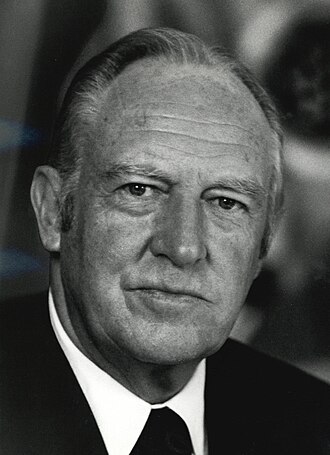
Rogers, William P.
William P. Rogers served as the United States Secretary of State from January 1969 to September 1973, encompassing the entirety of the Nixon White House taping period. Despite his senior cabinet rank, Rogers was frequently sidelined by President Nixon and National Security Advisor Henry Kissinger, who routinely bypassed the State Department to conduct secret back-channel negotiations regarding China, Vietnam, and the Soviet Union. Nevertheless, Rogers remained a key diplomatic figure during this era, focusing on Middle East peace initiatives and officially signing the Paris Peace Accords in January 1973.
In this meeting, President Nixon met with his Vice President, Cabinet, and senior staff to provide a briefing on the impending Vietnam cease-fire agreement, scheduled for signing on January 27, 1973. National Security Advisor Henry Kissinger detailed the arduous negotiation process, emphasizing that the agreement achieved key U.S. objectives including the return of POWs, the withdrawal of American forces, and the right of South Vietnamese self-determination. Following the Vietnam discussion, the President transitioned to a briefing on the fiscal year 1974 budget, where Director Caspar Weinberger presented plans for spending cuts and program terminations designed to maintain a full-employment balance and avoid tax increases.
President Nixon met with his Vice President, Cabinet members, and senior staff to conduct a briefing on the upcoming federal budget. The discussion focused on the necessity of fiscal restraint, including the reduction and termination of certain government programs, to avoid tax increases and curb inflationary pressures while maintaining an expanding economy. Cabinet members analyzed projections for the 1974 and 1975 budgets, emphasizing the shift in spending priorities from defense toward human resources and the importance of presenting the budget to Congress and the public as a responsible alternative to higher taxation.
President Nixon and his Cabinet members strategized on how to promote the administration’s 1974 budget and defend proposed spending cuts against inevitable Congressional and lobbying opposition. The participants emphasized shifting from a constituency-based political strategy to a national message centered on fiscal responsibility, specifically using the themes of 'jobs' and 'taxes' to appeal to working-class voters. Nixon underscored the necessity of forcing Congress to accept accountability for spending, ultimately positioning the administration to blame Democrats if tax increases become required to fund legislative priorities.
President Nixon and Secretary of State William P. Rogers discuss the guest list and scheduling logistics for an upcoming state dinner honoring King Hussein of Jordan. The dialogue focuses on clarifying potential timing conflicts and verifying that controversial or inappropriate invitees are excluded from the event. The conversation concludes with a consensus that the proposed scheduling concerns are likely unfounded.
President Nixon and Secretary of State William Rogers discussed the finalization of a memorandum of understanding with Cuba to combat aircraft hijacking, emphasizing that the agreement would merely codify existing legal obligations without signaling a shift toward diplomatic normalization. The conversation transitioned to the domestic reception of returning American POWs, with Nixon commending the bravery of the servicemen and their families. Finally, the two men addressed their public relations strategy regarding the media and Congress, with Nixon encouraging Rogers to remain firm and avoid capitulating to critical press coverage or historical revisionism concerning the Vietnam War.
President Nixon and Secretary of State William P. Rogers discuss sensitive public relations and foreign policy matters, specifically cautioning against any premature move toward normalizing relations that might alienate the American Jewish community. The President also expresses deep admiration for recently released prisoners of war, contrasting their resilience with the critical stance of the news media. Nixon urges Rogers to maintain a firm position regarding the administration's Vietnam policy, advising him not to be rattled by hostile press coverage or political critics.
President Nixon met with Vice President Agnew, Cabinet members, and key staff to discuss recent foreign policy developments and economic strategy. Vice President Agnew briefed the group on his recent tour of Southeast Asian nations, while Treasury officials and Cabinet members deliberated on international monetary policy, trade barriers, and the need for a more competitive U.S. industrial posture. The President emphasized the importance of maintaining international engagement, securing legislative tools for trade negotiations, and justifying reconstruction aid for Vietnam as a strategic security necessity rather than purely humanitarian relief.
President Nixon and Secretary of State William Rogers consulted regarding Rogers' upcoming congressional testimony concerning the Vietnam settlement and proposed economic aid. Nixon advised Rogers to defend the administration’s record by framing the aid as part of a global, multilateral effort while emphasizing the success of previous reconstruction efforts in Germany and Japan. The two also discussed strategies to counter partisan domestic criticism and coordinate upcoming White House outreach to members of Congress.
President Nixon and Secretary of State William P. Rogers discuss strategies for defending administration policies and military spending against domestic political opposition, particularly from Congressional Democrats and the media. The President emphasizes the need to frame these policies as essential for peace and national interest, drawing parallels to post-World War II reconstruction efforts in Germany and Japan. To build support, Nixon outlines plans for upcoming White House outreach events with members of Congress to cultivate key allies.
Henry Kissinger and Secretary of State William Rogers coordinate a breakfast meeting with President Nixon to discuss the upcoming international conference, involving key diplomats William J. Porter and William H. Sullivan. Kissinger also provides a status report on his recent press conference, noting that his briefings on foreign aid were well-received. Furthermore, both men express confidence that political opposition, specifically from George McGovern, will remain ineffective as they anticipate minimal resistance to their foreign policy agenda.
President Nixon met with his staff and Secretary of State William P. Rogers to coordinate legislative strategy regarding White House social events and foreign policy initiatives. The discussion focused on managing congressional relations, particularly concerning aid to North Vietnam and the framing of the recent peace settlement, with Kissinger briefing the President on his recent press engagement. The group emphasized the need to build public and congressional support for reconstruction aid by drawing parallels to past U.S. efforts in Japan and Germany while navigating hostility from liberal critics.
President Nixon and Secretary of State William P. Rogers discussed the administration's strategy for finalizing the Vietnam settlement and securing Congressional support for economic aid to North Vietnam. They also addressed the recent killing of U.S. diplomats in Sudan, with Nixon emphasizing a firm, no-ransom policy and planning a symbolic visit to the State Department to boost morale and show support for the Foreign Service. Additionally, the President reflected on the success of a recent White House performance by Sammy Davis, Jr., noting its historical significance regarding racial integration at the executive mansion.
President Nixon and Secretary of State William P. Rogers coordinate logistics for the President's upcoming visit to the State Department. They agree that Nixon will unveil a memorial plaque honoring fallen State Department employees rather than delivering a traditional auditorium address, a decision intended to symbolize respect for both civilian and military service. Additionally, they plan an intimate luncheon where Nixon will be accompanied only by Henry Kissinger to foster an informal, positive interaction with staff and counter perceptions of departmental antagonism.
President Nixon and Secretary of State William P. Rogers discuss the logistical planning for an upcoming event, specifically focusing on the unveiling of a plaque and a commemorative flag. Nixon emphasizes the symbolic importance of the unveiling over traditional speeches and provides guidance on guest selection for an associated luncheon. The two coordinate the involvement of State Department personnel to ensure the event projects an image of professional decorum and effective public relations.
H. R. Haldeman coordinated with Secretary of State William P. Rogers to schedule a one-on-one briefing with President Nixon and to arrange for Rogers to deliver a presentation at an upcoming Cabinet meeting. The discussion focused on preparing the administration to defend the budget and the surrogate program while establishing the case for providing economic aid to North Vietnam. Additionally, the participants reflected on the positive reception and leadership praise generated during a recent dinner with presidential supporters.
President Nixon met with members of the National Security Council and other senior officials to discuss the strategic balance of power between the U.S. and the USSR, specifically in anticipation of the SALT II negotiations. The discussion focused on the impact of qualitative and quantitative disparities in throw-weight, bombers, and MIRV technology on U.S. and Soviet first- and second-strike capabilities. Nixon emphasized the importance of maintaining an appearance of strategic equivalence to preserve the confidence of U.S. allies and domestic support, directing his team to refine their negotiating strategy without rushing into a premature moratorium on weapons testing.
President Nixon and his Cabinet met to launch a strategic public relations campaign, titled the Presidential Spokesmen program, aimed at pressuring Congress to support his budget priorities and oppose spending-heavy legislation. Nixon urged his officials to frame the budget debate not as a constitutional conflict, but as a direct choice between the economic interests of the 'New American Majority' and the fiscal irresponsibility of the opposition. The session included briefings on foreign policy, defense spending, and law enforcement, emphasizing the need for administration spokesmen to maintain a positive, disciplined narrative while avoiding defensive posturing on 'false issues.'
President Nixon hosted the recipients of the 1972 Management Improvement Award in the Cabinet Room to coordinate the logistics for a formal ceremony. Brian Usilaner facilitated a briefing for award winners and cabinet members, including William P. Rogers and Caspar Weinberger, to establish the specific order of presentation and photography arrangements. The session focused on streamlining the proceedings to manage the large group effectively while ensuring individual recognition for the agency and department representatives.
President Nixon held a ceremony in the Oval Office to present awards to various federal employees and government agency representatives for their public service. Accompanied by H. R. Haldeman and several cabinet members, the President recognized individuals from departments including Agriculture, Treasury, Defense, and the Atomic Energy Commission. During his remarks, Nixon praised the recipients for prioritizing public service over private financial gain, emphasizing that the intrinsic rewards of their work provided a satisfaction that private enterprise could not match.
President Nixon met with key advisors, including John Dean, H.R. Haldeman, and John Ehrlichman, to develop a strategic defense against the escalating Watergate scandal and the formation of the Senate's Ervin Committee. The participants debated whether to issue a formal presidential statement or commission an internal investigation to preempt Senate hearings and maintain control over the narrative. The conversation focused heavily on the need to distance the White House from the scandal, manage public perception, and potentially utilize a grand jury or a targeted disclosure to limit the scope of external investigations.
President Nixon and Secretary of State William P. Rogers discuss political strategy, specifically focusing on building congressional and public support for aid to North Vietnam. They review the potential for support from key Democrats like Hubert Humphrey and George McGovern, noting the importance of framing the aid within the defense budget to minimize domestic backlash. Additionally, they touch upon historical precedents for handling executive staff controversies and manage the President’s upcoming schedule of diplomatic meetings and receptions.
President Nixon consulted Secretary of State William P. Rogers regarding the most effective way to persuade Canadian Prime Minister Pierre E. Trudeau to keep Canada in the International Commission of Control and Supervision (ICCS). The two agreed that Nixon would send a personal letter to Trudeau followed by a telephone call to emphasize that global leadership depends on continued Canadian participation, while avoiding the appearance of undue American pressure. Rogers also cleared a joke with the President regarding executive privilege to be used during an upcoming social event with the diplomatic corps.
President Nixon and Secretary of State William P. Rogers consult on the appropriate method for communicating a sensitive recommendation, debating whether a formal letter or a direct phone call is more suitable. Nixon expresses hesitation regarding the timing and nature of the call, ultimately seeking Rogers’s advice on the matter. Following their brief exchange, the President decides to proceed with the communication.
President Nixon briefed Secretary of State William P. Rogers on a telephone conversation with Canadian Prime Minister Pierre E. Trudeau regarding Canada’s participation in the International Commission of Control and Supervision (ICCS). Nixon pressed for Canada to remain in the commission for at least a few more months to avoid the appearance that their departure caused the mission’s collapse. Rogers was instructed to follow up with Canadian Foreign Minister Mitchell Sharp to finalize this commitment after the Canadian cabinet reviewed the matter.
President Nixon briefed Secretary of State William P. Rogers on the conclusion of a lengthy telephone conversation he had just held with Canadian Prime Minister Pierre Trudeau. The exchange served primarily as a status update regarding the diplomatic communication, with no further substantive details recorded. The interaction concluded quickly after this brief notification.
H. R. Haldeman and Secretary of State William P. Rogers coordinated a meeting to facilitate a briefing for the President. Haldeman instructed Rogers to meet with him first to provide necessary background information before Rogers proceeded to a scheduled appointment with the President. They strategically finalized the timing of these meetings and discussed the formal recording of Rogers's visit to the White House to ensure an accurate official record.
President Nixon and Secretary of State William P. Rogers met to discuss the mounting political pressures of the Watergate scandal and the administration's strategy for managing public perceptions. Nixon sought counsel on how to address allegations of a White House cover-up, specifically exploring the possibility of using the judicial system, such as a special grand jury, to handle investigations rather than submitting to an independent congressional committee. The two men also discussed the importance of full disclosure, the potential waiver of executive privilege to maintain credibility, and the necessity of distinguishing legitimate campaign intelligence activities from criminal conduct.
President Nixon and members of the National Security Council met to discuss the strategic importance of Mutual Balanced Force Reductions (MBFR) amidst growing congressional pressure for unilateral U.S. troop cuts. The discussion focused on maintaining a credible conventional defense posture in Europe to avoid a reliance on "tripwire" nuclear escalation, which Nixon and his advisors agreed would be untenable given the current parity in nuclear capabilities between the U.S. and the Soviet Union. Participants ultimately reached a consensus to pursue negotiations that link force improvements with potential reductions while resisting domestic isolationist trends and preserving NATO's operational cohesion.
Secretary of State William P. Rogers and Vice President Spiro T. Agnew spoke to coordinate scheduling adjustments regarding a planned meeting or social engagement. Rogers notified the Vice President that he had to cancel their previous plans due to a last-minute request from President Nixon to join him for a discussion aboard the presidential yacht, the Sequoia. The two agreed to postpone their interaction and discussed the inclusion of Adele Rogers in the rescheduled arrangements.
Secretary of State William P. Rogers consults his wife, Adele Rogers, regarding a conflict between his social commitments and a last-minute request from President Nixon. After explaining that the President has asked him to join him for an evening engagement, Rogers discusses the logistics of attending a dinner with Vice President Spiro Agnew. The couple mutually decides that Adele should proceed with attending the planned dinner while William adjusts his schedule to accommodate the President.
President Nixon met with Secretary of State William P. Rogers and later consulted with John D. Ehrlichman to strategize on the mounting Watergate crisis. The discussions focused on the unfolding allegations involving John Dean, H.R. Haldeman, John Mitchell, and Jeb Magruder, specifically addressing the disbursement of hush money and the handling of sensitive materials from E. Howard Hunt’s safe. Nixon and his advisors sought to manage the legal and political fallout by coordinating with Assistant Attorney General Henry Petersen while distancing the White House from the increasingly damaging testimony regarding the cover-up.
President Nixon met with William P. Rogers, H.R. Haldeman, and John Ehrlichman to discuss the deepening Watergate scandal and potential legal strategies for the administration. The conversation focused on managing the fallout from emerging testimony, the necessity of forcing the resignation of compromised staff members, and the strategic importance of legal representation and public image. The President expressed significant concern regarding the loyalty of his staff and the risk of being implicated in obstruction of justice, ultimately leaning toward a policy of full disclosure and cooperation with investigators to mitigate further political damage.
President Nixon consulted with Secretary of State William P. Rogers to coordinate a strategy for responding to the escalating Watergate scandal and to arrange a meeting at Camp David. Nixon informed Rogers that H.R. Haldeman and John Ehrlichman were preparing to resign and that he intended to remove John Dean from his position. The President further outlined his plan to deliver a televised address to assure the public that his administration was actively investigating the matter and remaining in control.
Secretary of State William P. Rogers utilized the Camp David operator to assist in locating Elliot L. Richardson. The primary objective of the call was to reach Richardson, who was reportedly attending to matters at his children’s school. The operator was instructed to continue efforts to establish contact with him.
President Nixon consulted Secretary of State William P. Rogers regarding the strategic management of the Watergate scandal, specifically focusing on the necessary resignations of H.R. Haldeman and John Ehrlichman. Nixon sought Rogers's advice on how to handle the duo's apparent reluctance to leave, ultimately concluding that their continued presence hindered government operations and that full resignations were unavoidable. Additionally, they discussed the upcoming public announcement regarding the appointment of a new FBI director and the oversight of the ongoing investigation.
President Nixon consulted with Secretary of State William P. Rogers regarding the impending resignations of H.R. Haldeman and John Ehrlichman amid the deepening Watergate scandal. Rogers advised Nixon against attending the meeting with his aides to maintain distance and credibility, recommending instead that the President present the resignations as a firm, unilateral decision rather than a matter for negotiation. The conversation concluded with an agreement that the two aides should resign voluntarily to maintain the 'high ground' while John W. Dean would be dismissed separately, allowing Nixon to distance himself from the scandal's fallout.
President Nixon requested Secretary of State William P. Rogers to travel to Camp David to review and provide editorial feedback on a draft of his forthcoming address regarding the Watergate scandal. Nixon tasked speechwriter Raymond K. Price, Jr. with preparing the draft and sought Rogers's input, explicitly referencing Rogers's prior assistance during the 1952 Checkers fund crisis. The two agreed that Rogers would arrive at 5:00 p.m. to review the document and offer suggestions to strengthen the President's public response.
Secretary of State William P. Rogers calls President Nixon to offer praise and support following the President's televised address regarding the Watergate scandal. The two discuss the effective delivery and tone of the speech, as well as the difficult resignations of H.R. Haldeman and John Ehrlichman. Additionally, Rogers updates the President on positive feedback from congressional leaders regarding a potential role for David Packard and expresses his commitment to supporting the administration. Tricia Nixon Cox also joins the call to reiterate the family's appreciation for Rogers's loyalty during the crisis.
President Nixon met with Vice President Agnew, Secretary of State Rogers, USAID Administrator John A. Hannah, and a bipartisan group of Congressional leaders to secure support for the administration's foreign aid and security assistance requests. The discussion covered the implementation of the Nixon Doctrine, the strategic importance of military and development aid to maintain stability in Southeast Asia, the Middle East, and Latin America, and the necessity of burden-sharing with allies. Nixon emphasized that maintaining U.S. strength and diplomatic engagement was vital for ongoing negotiations regarding arms reduction and global peace, warning against unilateral reductions that could weaken the U.S. negotiating position.
In this meeting, President Nixon addressed his Cabinet and senior staff regarding the recent departures of top aides H.R. Haldeman and John Ehrlichman, framing the transition as a necessary move to restore stability amidst the escalating Watergate investigation. Nixon emphasized the importance of maintaining public trust, directed the staff to cooperate fully with investigators, and insisted that the White House avoid any appearance of a cover-up. Cabinet members and staff discussed the administration’s focus on governance, foreign policy, and economic management, reaffirming their collective commitment to the President's agenda despite the political crisis.
President Nixon met with Secretary of State William P. Rogers to discuss the handling of sensitive files belonging to departing aides H.R. Haldeman and John Ehrlichman amid the ongoing Watergate investigation. Nixon expressed strong disapproval of the presence of FBI guards outside the aides' offices, characterizing the optics as unprofessional and damaging. The participants discussed ensuring the security and custody of these records to prevent unauthorized access by figures like John Dean, while also touching upon the political silence of Vice President Spiro Agnew.
President Nixon and Secretary of State William P. Rogers discussed the recruitment of David Packard for an appointment, agreeing that Nixon should personally call Packard to address his reluctance and concerns regarding potential stock conflicts. Rogers confirmed that congressional leaders, including Mike Mansfield and George Mahon, strongly supported Packard as the best candidate for the position. Additionally, Nixon briefed Rogers on a recent meeting with Vice President Spiro Agnew, during which he instructed Agnew to refrain from making public political statements.
President Nixon and Secretary of State William P. Rogers discuss the status of David Packard and potential strategies for addressing his outstanding stock holdings and political involvements. Nixon expresses frustration over Packard’s recent public statements and instructs that he must remain silent regarding sensitive political matters. To resolve the uncertainty, Nixon decides to contact Packard directly to invite him for a meeting to clarify his position and future role.
President Nixon and Secretary of State William P. Rogers discuss how incoming Attorney General Elliot Richardson should respond to Senate pressure regarding the appointment of a special prosecutor for the Watergate investigation. Rogers advises that Richardson should proactively propose consulting with congressional leaders rather than appearing forced by a Senate resolution, a strategy intended to defend Richardson's integrity. Nixon agrees with this approach, noting that the pressure from figures like Senator Charles Percy unfairly undermines the new Attorney General's credibility.
President Nixon consulted Secretary of State William P. Rogers regarding the political pressure to appoint a special prosecutor for the Watergate investigation. Nixon expressed concern over how to advise incoming Attorney General Elliot Richardson on handling the potential Senate resolution. The two agreed to approach the issue cautiously, viewing the push for a special prosecutor as a tactical challenge to the administration’s authority.
President Nixon consults with Secretary of State William P. Rogers to manage the escalating Watergate crisis and the appointment of a special prosecutor. Nixon asks Rogers to coordinate with Elliot Richardson to ensure the executive branch retains control over the appointment process, specifically countering public criticism from Senator Charles H. Percy. Rogers agrees to take charge of the situation and guide administration messaging on the matter while also commending the President’s performance at a recent state dinner.
President Nixon and Secretary of State William P. Rogers discuss how to manage Senate pressure regarding the appointment of a special prosecutor for the Watergate scandal, particularly focusing on Senator Charles Percy's legislative resolution. Rogers reports that he confronted Percy to ensure support for Elliot Richardson and suggests that the White House should neutralize the resolution by securing endorsements from senior senators rather than forcing a floor vote. Additionally, the two men discuss the need to find a new, experienced, and low-profile White House Counsel to replace Leonard Garment and briefly consider potential candidates like Bryce Harlow.
President Nixon met with Secretary of State William P. Rogers to discuss the need for a new legal counsel to handle mounting administrative and legal pressures. The conversation centered on the importance of expressing confidence in Attorney General Elliot Richardson regarding his dealings with the Senate, as well as the search for a seasoned, trusted individual to serve as a personal legal advisor. Nixon expressed urgency in finding a candidate who could operate independently of White House staff to navigate these sensitive government matters.
President Nixon met with West German Chancellor Willy Brandt, along with their respective foreign ministers and advisors, to discuss geopolitical strategy, international trade, and energy policy. The participants engaged in a detailed review of East-West relations, focusing on Soviet adherence to the Four Power Agreement regarding Berlin, strategies for the Conference on Security and Cooperation in Europe (CSCE), and West Germany’s upcoming entry into the United Nations. Additionally, the group addressed the necessity of coordinating energy and oil policies with Japan and the European Community, while exploring diplomatic paths for a Middle East peace settlement despite the complexities surrounding Israeli elections and Soviet involvement.
President Nixon and William P. Rogers met to discuss the staffing of the White House Counsel position following the resignations of H. R. Haldeman and John Ehrlichman, as well as the ongoing management of the Watergate scandal. The two evaluated potential candidates for Counsel—including George H. W. Bush, John W. Byrnes, and others—emphasizing the need for a candidate with legal expertise who could effectively manage Cabinet and Congressional relations. Furthermore, they reviewed the search for a Special Prosecutor to handle the difficult legal proceedings involving high-level administration officials, ultimately favoring individuals with strong integrity and non-partisan backgrounds.
President Richard Nixon and Secretary of State William P. Rogers discussed potential personnel appointments, including the recruitment of David Packard and E. Barrett Prettyman as White House Counsel, while navigating complex conflicts of interest and personal reservations. The two men also reviewed the political fallout of John Connally’s party switch and tensions regarding Vice President Spiro Agnew’s role on the Domestic Council. Finally, they addressed the ongoing Watergate scandal, agreeing that while the disclosure of the Daniel Ellsberg break-in would be unpleasant, the administration must focus on maintaining government functionality.
President Nixon and Secretary of State William P. Rogers discuss the difficulty of finding qualified personnel for an unspecified position, weighing the challenges of legal and financial complications against the need for a mature, capable candidate. The conversation touches on the frustrations of delegating authority to individuals who attempt to overreach their roles, specifically mentioning a candidate who demanded control over staff appointments. Nixon ultimately expresses a desire to avoid hasty decisions regarding these personnel matters and briefly confirms Rogers’s upcoming diplomatic trip to Latin America.
President Nixon met with Vice President Agnew and his Cabinet to discuss the ongoing impact of the Watergate scandal on the administration, personnel changes, and the need to maintain governmental stability. Key topics included the appointment of a special prosecutor, the selection of Elliot Richardson, and the importance of professional coordination between the White House and Cabinet departments to ensure the administration's 1972 election mandate remained the primary focus. Nixon emphasized the necessity of improving Congressional relations and maintaining morale within the bureaucracy despite the political distractions caused by the Ervin Committee hearings.
President Nixon and Secretary of State William P. Rogers discuss the administration's strategy to navigate the Watergate crisis, specifically exploring the potential appointment of former Chief Justice Earl Warren to lead an independent commission. The two men also review personnel matters, with Nixon confirming his intent to appoint Alexander Haig to a permanent White House role and expressing confidence in the appointments of James Schlesinger and William Colby. Additionally, the President emphasizes his desire to improve information flow to Rogers and maintain stable governance to bolster public morale.
President Nixon and Secretary of State William P. Rogers discuss potential appointments and personnel strategies intended to demonstrate administrative stability during a period of political turmoil. The conversation touches upon the selection of a career official to fill a specific position, emphasizing the need to move forward with staffing despite external pressures. Additionally, Nixon prepares Rogers for an upcoming briefing with Henry Kissinger regarding recent diplomatic developments following Kissinger's return from Russia.
President Nixon and Secretary of State William P. Rogers discuss the possibility of appointing Earl Warren or Tom Clark to head a commission regarding the Watergate scandal, weighing the political sensitivities against the necessity for institutional legitimacy. Nixon expresses deep frustration over the recent indictments of John Mitchell and Maurice Stans in the Vesco case, comparing their conduct unfavorably to the Sherman Adams scandal. Additionally, the two coordinate their upcoming schedules to meet with Henry Kissinger and manage public communications regarding an impending U.S.–Soviet Union summit.
In this meeting, President Nixon, Henry Kissinger, and Secretary of State William Rogers discussed the administration's foreign policy strategy amidst the growing pressure of the Watergate scandal. The participants focused on preparing for an upcoming Soviet summit, managing ongoing negotiations regarding the Paris Peace talks and Cambodia, and evaluating personnel changes within the State Department. Despite concerns about domestic distractions and Congressional opposition, they emphasized the necessity of maintaining a firm stance in international negotiations, particularly regarding nuclear arms control and Southeast Asian stability.
President Nixon, Secretary of State William P. Rogers, and Assistant Secretary Joseph J. Sisco discussed the development of a statement for U.S. Ambassador to the UN John A. Scali regarding Security Council operations. The participants coordinated how Scali should address the press following his meeting with the President. Additionally, the conversation touched upon the ongoing Paris peace negotiations, with Nixon suggesting that Henry Kissinger personally brief Rogers on the latest developments.
President Nixon met with Secretary of State William Rogers, UN Ambassador John Scali, and National Security Advisor Henry Kissinger to discuss international affairs and the mounting pressure of the Watergate scandal. The conversation covered progress on foreign relations, including Rogers's recent trip to Latin America and planned diplomatic messaging for the Middle East, while Nixon expressed frustration with the administration's political paralysis and persistent negative media coverage. Nixon analyzed the unfolding Watergate investigations, including the role of former aides, the potential for grand jury testimony, and the necessity of managing public perceptions and congressional hearings to protect the presidency.
President Nixon met with bipartisan Congressional leaders, Vice President Agnew, and key cabinet members to discuss U.S. foreign policy developments in Latin America, Southeast Asia, and Europe. Secretary of State William Rogers briefed the group on his recent tour of eight Latin American nations, emphasizing improved diplomatic relations despite complex issues regarding oil, inflation, and expropriation. Henry Kissinger provided an update on ongoing negotiations in Paris aimed at reinforcing the Vietnam ceasefire, while he and the President outlined a new strategy for strengthening Atlantic alliances, stressing the need to link economic, political, and defense policies to ensure future international stability.
President Nixon met with his Cabinet and key legislative leaders to discuss the restructuring of domestic policy operations, the appointment of Clarence M. Kelley as FBI Director, and strategies for improving congressional cooperation. Nixon emphasized a team-based approach to policy formulation, delegating significant oversight to Mel Laird, and urged Cabinet members to actively engage with Congress to pass the administration's legislative agenda. The discussion also addressed the administration's response to inflation, the importance of maintaining public morale amidst the Watergate crisis, and the necessity of presenting a unified, forward-looking policy front to the American people.
President Nixon met with Secretary of State William P. Rogers and the Board of Trustees of the Council of the Americas to discuss the status of United States relations with Latin America following Rogers's recent diplomatic tour of the region. The conversation addressed challenges such as political anti-Americanism, foreign expropriation of assets, and the need for a coherent long-term strategy for the Western Hemisphere. To foster closer cooperation, the participants agreed to form a study group tasked with developing an integrated economic and political program for the next decade, with Nixon emphasizing the necessity of maintaining strong national defense to support these foreign policy goals.
President Nixon met with Soviet General Secretary Leonid Brezhnev in the Oval Office to discuss the strengthening of U.S.-Soviet relations following their historic 1972 Moscow summit. The conversation centered on the necessity of building personal trust and confidence between the two leaders to facilitate long-term peace and cooperation, moving beyond historical Cold War tensions. Both leaders committed to a regular schedule of future summits and discussed the importance of expanding economic and cultural ties to solidify a new, stable era of superpower diplomacy.
President Nixon and General Secretary Leonid Brezhnev met in the Oval Office to conduct high-level diplomatic discussions during Brezhnev's state visit to the United States. The participants focused on strengthening bilateral relations, with extensive dialogue regarding the expansion of economic and trade ties, including potential large-scale energy cooperation and agricultural trade. They also addressed pressing international issues, such as the situation in the Middle East, the implementation of the Paris Accords regarding Vietnam, and preparations for a forthcoming nuclear agreement.
President Nixon, Soviet General Secretary Leonid Brezhnev, and key members of their diplomatic and economic teams met to discuss the expansion of U.S.-Soviet trade and the challenges of integrating two distinct economic systems. The conversation focused on large-scale, long-term projects in the energy sector—specifically oil and gas—and the necessity of institutionalizing economic cooperation through trade missions and working groups. Participants acknowledged that while political will is high, practical implementation requires navigating complex issues of financing, pricing, and administrative differences between American private enterprise and the Soviet state-controlled economy.
President Nixon met with Vice President Agnew, Secretary of State William Rogers, Henry Kissinger, and bipartisan congressional leaders to discuss recent foreign policy breakthroughs and the administration's ongoing diplomatic strategy. The discussion focused on the significance of newly negotiated agreements with the Soviet Union, specifically regarding the prevention of nuclear war and the management of bilateral relations. Nixon emphasized that these diplomatic efforts represent a move toward global stability and stressed the necessity of maintaining bipartisan support as his administration continues these critical negotiations with Soviet leadership.
President Nixon met with Ronald Ziegler, William P. Rogers, and others to strategize regarding the ongoing Ervin Committee hearings and the credibility of witnesses like John N. Mitchell and John W. Dean III. The discussion focused on Mitchell's testimony, which presented a narrative favorable to the President by claiming Nixon lacked prior knowledge of the Watergate cover-up or the break-in. The participants analyzed the effectiveness of the White House's decision to remain publicly silent rather than launching an aggressive counter-campaign against Dean, concluding that this restrained approach enhanced Mitchell's credibility. The group also touched upon upcoming testimonies from other key figures and potential legislative or legal implications concerning Presidential authority and the Ellsberg break-in.
President Nixon met with Vice President Agnew and his Cabinet to discuss the transition from the current wage and price freeze to a "Phase IV" economic policy. The President emphasized the need to balance controlling inflation with maintaining domestic production, while acknowledging the political difficulty of removing controls due to congressional and public pressure. Key developments included the administration's resolve to move toward a free-market economy as quickly as possible, coupled with a renewed commitment to fiscal austerity and a balanced federal budget to bolster economic confidence.