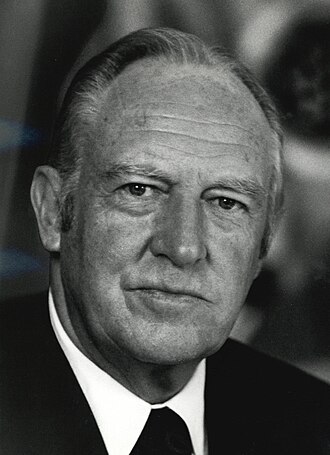
Rogers, William P.
William P. Rogers served as the United States Secretary of State from January 1969 to September 1973, encompassing the entirety of the Nixon White House taping period. Despite his senior cabinet rank, Rogers was frequently sidelined by President Nixon and National Security Advisor Henry Kissinger, who routinely bypassed the State Department to conduct secret back-channel negotiations regarding China, Vietnam, and the Soviet Union. Nevertheless, Rogers remained a key diplomatic figure during this era, focusing on Middle East peace initiatives and officially signing the Paris Peace Accords in January 1973.
President Nixon consulted with Secretary of State William Rogers and AFL-CIO leader George Meany to gauge their reactions to his recent Supreme Court nominations of Lewis F. Powell, Jr. and William H. Rehnquist. The conversations emphasized the nominees' commitment to law and order and their lack of anti-labor bias, which helped secure Meany’s preliminary support. Nixon also reflected on the authorship of his October 21 speech and discussed the ongoing challenges of finding qualified female candidates for judicial appointments.
President Nixon and Secretary of State William P. Rogers coordinate with U.S. Ambassador to Argentina John D. Lodge to secure a critical vote regarding the status of Taiwan at the United Nations. Nixon emphasizes the personal nature of the request, urging Lodge to meet immediately with Argentine President Alejandro Augustin Lanusse to pressure the country to support the U.S. position on the "important question" resolution. Both Nixon and Rogers stress that an Argentine vote in favor of this procedural motion is essential to prevent Taiwan's expulsion from the UN, dismissing counterarguments regarding the UN charter as irrelevant to the strategic priority.
President Nixon met with his senior advisors, including H. R. Haldeman, Secretary of State William Rogers, and UN Ambassador George H. W. Bush, to coordinate a final, high-pressure diplomatic push regarding the United Nations vote on Chinese representation. The participants strategized on how to secure decisive votes from key nations, including Italy, Mexico, Argentina, and Malta, while weighing the political risks of direct presidential intervention and the potential impact of Henry Kissinger's upcoming return from China. They concluded by establishing a list of targeted countries and specific action items, such as arranging presidential phone calls and leveraging foreign aid dependencies, to bolster support for the U.S.-backed position.
President Nixon and Secretary of State William Rogers discussed the precarious vote count regarding the admission of the People's Republic of China to the United Nations. They reviewed the effectiveness of the President's personal appeals to various foreign leaders, expressing frustration over uncooperative nations and the limitations of multilateral foreign aid. Ultimately, the two agreed that if the U.S. failed to secure the vote, they would avoid direct presidential involvement in the aftermath, prioritizing a pivot toward bilateral diplomacy that rewards supportive nations and penalizes those that oppose U.S. interests.
President Nixon and Secretary of State William P. Rogers discuss the implications of recent international voting, specifically focusing on the lack of alignment between the United States and various foreign nations within multilateral organizations like the United Nations and the World Bank. The pair expresses frustration regarding the lack of U.S. control over international financial institutions and suggests a strategic shift toward rewarding nations that support American interests while potentially withholding aid from those that do not. They conclude by acknowledging the political difficulty of these setbacks, particularly regarding domestic support, and emphasize a need to reevaluate foreign policy priorities to better serve American objectives.
President Nixon and Secretary of State William P. Rogers discuss the urgent, high-stakes U.S. diplomatic effort to secure votes against the seating of the People's Republic of China at the United Nations. Frustrated by the lack of loyalty from allies like Belgium and Peru, Nixon and Rogers agree that countries voting against U.S. interests should face future repercussions, specifically regarding bilateral visits and foreign aid funding. The two decide to leverage congressional allies like Otto Passman and John Rooney to slash funding for multilateral organizations and the UN in retaliation for the lack of international support.
President Nixon and Secretary of State William P. Rogers discuss foreign policy challenges, focusing on U.S. relations with international organizations and foreign nations following recent legislative setbacks. They evaluate the shifting allegiances of countries like China and European allies, expressing frustration with Congressional opposition to foreign aid and trade surcharges. The President concludes that the administration must re-examine its reliance on multilateral organizations and pursue a more independent approach to foreign diplomacy.
President Nixon and H. R. Haldeman met to review scheduling matters, including preparations for the President’s upcoming trip to the People's Republic of China and a meeting with John Connally. The discussion focused on the logistics of the China delegation, specifically regarding staff appointments, press representation, and the President's personal approval of all personnel traveling with the First Lady. Nixon emphasized his desire to keep the entourage minimal, avoid unnecessary backgrounders with the press, and maintain a disciplined schedule during the visit.
President Nixon and Secretary of State William P. Rogers discussed strategies for handling the proposed European Security Conference, with Nixon emphasizing the need to maintain a cautious, cool public posture to avoid Soviet leverage. They also coordinated talking points regarding the UN's admission of the People's Republic of China and the resulting expulsion of Taiwan, agreeing that Rogers should publicly frame the outcome as a negative precedent for the United Nations while maintaining a diplomatic tone. Additionally, the President updated Rogers on his upcoming scheduling priorities, noting that he needed to focus on economic and budget discussions with John Connally before meeting with Henry Kissinger.
President Nixon and Secretary of State William P. Rogers discuss the administration's public response to the United Nations vote to admit the People's Republic of China while expelling the Republic of China (Taiwan). Nixon advises Rogers to draft a statement that acknowledges the UN decision while clearly expressing American disappointment and noting that congressional support and future UN financing are at an all-time low. They weigh the delicate political balance of maintaining diplomatic composure while addressing widespread domestic outrage, exemplified by Ronald Reagan’s strong opposition to the outcome.
President Nixon and Secretary of State William P. Rogers discuss the public and political fallout following the United Nations' vote regarding Taiwan, specifically addressing California Governor Ronald Reagan's outrage over the proceedings. The two men agree on the importance of framing the U.S. position as a principled defense and mitigating domestic frustration by emphasizing ongoing efforts to reduce U.S. financial support for the UN. Nixon directs Rogers to call Reagan to explain the administration's exhaustive lobbying efforts, including personal appeals, while cautioning that withdrawing from the UN would be impractical due to urgent diplomatic needs like the escalating India-Pakistan conflict.
President Nixon and Secretary of State William P. Rogers discuss the public and political fallout from a recent United Nations vote, specifically focusing on the negative emotional impact of televised footage depicting delegates celebrating the outcome. The conversation centers on how to manage public perception and formulate an official administration response that expresses dissatisfaction without unnecessarily escalating tensions or embarrassing the country. Nixon instructs Rogers to frame the narrative by emphasizing that the U.S. is strategically boxed in regarding its UN involvement, directing the criticism toward the institution rather than the presidency.
President Nixon directs Secretary of State William P. Rogers to emphasize during an upcoming call with Governor Ronald Reagan that the United States remains committed to recognizing Taiwan as a member of the international community. The President highlights that Reagan was recently impressed by a meeting with Chiang Kai-shek and seeks to ensure the Secretary's public stance on the impending United Nations vote aligns with this support. This guidance serves to manage Reagan's potential reaction to shifts in U.S. policy regarding Taiwan's status at the UN.
President Nixon instructed Secretary of State William P. Rogers to emphasize in an upcoming statement that a specific individual should remain regarded as a member of the international community. The brief discussion served to align the State Department’s official rhetoric with the President's preferred diplomatic stance. Rogers acknowledged the directive, confirming he would incorporate the requested language into his departmental communications.
President Nixon directed H. R. Haldeman to arrange a breakfast meeting with Secretary of State William P. Rogers and Henry Kissinger to debrief on Kissinger’s recent travels. Haldeman subsequently coordinated the logistics with Rogers while also addressing the urgent need to finalize a nomination for the U.S. representative to NATO. The discussion highlighted the administration’s internal debate between selecting Walter J. Stoessel, Jr. or Charles D. Thornton for the vacancy ahead of an upcoming summit.
President Nixon and Secretary of State William P. Rogers discussed intelligence regarding recent, strained diplomatic meetings between Yugoslav President Josip Broz Tito and Soviet leader Leonid Brezhnev. Rogers conveyed a confidential message from Tito, delivered via the Yugoslav foreign minister, emphasizing that the encounter with Brezhnev had gone poorly and expressing deep concern regarding future Soviet interference in Yugoslavia after Tito's departure. The two leaders agreed that the intelligence highlighted Yugoslavia's vulnerability and vulnerability to the Brezhnev Doctrine, and they reached an understanding to maintain a policy of encouraging regional independence through continued, discreet military cooperation.
President Nixon and Secretary of State William P. Rogers discuss intelligence gathered regarding the geopolitical anxieties of Yugoslavian officials. The conversation centers on Yugoslavia's fear of Soviet encroachment following the eventual departure of President Josip Broz Tito. Nixon reaffirms his commitment to respecting Yugoslavian independence and leveraging U.S. influence to deter external interference in the region.
President Nixon and Secretary of State William Rogers met to address the administration's strategy following a recent defeat of the foreign aid bill in the Senate, which threatened national security programs in Southeast Asia and beyond. They discussed the necessity of securing a continuing resolution to sustain foreign operations while avoiding a full-scale authorization battle with a recalcitrant Senate. Additionally, the President reviewed his plans for accelerated troop withdrawals from Vietnam and his upcoming diplomatic schedule, including potential summits with foreign leaders and his trip to the People's Republic of China.
Secretary of State William P. Rogers briefed President Nixon on his recent discussion with Australian Prime Minister William McMahon regarding confidential plans for future U.S. troop withdrawals in Vietnam. Rogers emphasized that he shared these sensitive details under the condition of strict secrecy, ensuring the President could reference this information during his own upcoming engagement with the Prime Minister. Furthermore, the two discussed positive reactions from press secretary Ronald Ziegler and correspondent John Scali regarding a recent public statement made by Rogers.
President Nixon and Secretary of State William P. Rogers met to coordinate their strategy ahead of the President's upcoming summit with Indian Prime Minister Indira Gandhi. Rogers briefed the President on his prior discussions with Gandhi regarding rising tensions between India and Pakistan, specifically focusing on the necessity of a political solution, the reduction of arms shipments, and the potential for mutual troop withdrawals. The two agreed on the importance of maintaining a firm but cordial stance to discourage military escalation while ensuring the administration’s efforts to mediate the conflict were clearly understood.
President Nixon, William Rogers, H.R. Haldeman, and Alexander Haig met to discuss international travel logistics, foreign policy, and domestic political strategy. The President explored the viability of a Latin American trip, weighing its potential for strengthening alliances against the challenges of scheduling and security. They also reviewed pending foreign aid legislation and deliberated on the timing and content of upcoming Vietnam troop withdrawal announcements in the context of the forthcoming State of the Union address. The participants emphasized the need to balance international diplomatic engagements with domestic economic concerns and public expectations.
President Nixon and members of the National Security Council met to coordinate the United States' strategy regarding ongoing arms control negotiations with the Soviet Union. The discussion centered on the complexities of Anti-Ballistic Missile (ABM) systems, the status of Safeguard and hard site defenses, and the comparative capabilities of Soviet and American submarine-launched ballistic missiles (SLBMs) and ICBMs. Participants evaluated potential congressional reactions and internal administration messaging while addressing the strategic implications of Soviet negotiating positions.
President Nixon, William P. Rogers, and Henry Kissinger met to deliberate on the escalating military tension between India and Pakistan and the potential necessity for UN intervention. The President expressed concern that a conflict would jeopardize his upcoming trip to the People's Republic of China, leading the group to discuss the delicate balance of diplomatic timing and the constraints of working with the UN Security Council. They ultimately reached a consensus to defer immediate action until after key upcoming events, including a scheduled speech by Indira Gandhi and further consultations regarding Chinese interests.
President Nixon met with his Cabinet officers to discuss a variety of domestic and international issues, including transportation leadership, government funding through a continuing resolution, and the cultivation of opium poppies in Turkey. The conversation also touched upon administrative transitions, such as the departure of Secretary of Agriculture Clifford Hardin, and strategies for managing the national economy and price controls. Nixon emphasized the importance of maintaining clear leadership and coordination across departments to ensure the success of his domestic policy initiatives.
President Nixon met with William P. Rogers and Henry A. Kissinger to discuss the deteriorating military situation between India and Pakistan and to formulate a strategy that minimizes U.S. blame for the conflict. Nixon emphasized a policy of symbolic neutrality—tilting slightly toward Pakistan while maintaining official diplomatic efforts—and tasked his advisors with identifying symbolic actions, such as delaying export licenses, to exert pressure on India. They further discussed the potential use of the UN Security Council to advocate for a ceasefire and international observer presence, while acknowledging the limited leverage the U.S. held over the regional powers.
President Nixon and the National Security Council met to coordinate U.S. strategy regarding European security, specifically focusing on the upcoming ministerial meetings in Brussels and the push for Mutual and Balanced Force Reduction (MBFR) talks. Participants discussed the complexities of navigating negotiations with Soviet counterparts, managing the varying interests of NATO allies, and addressing the political pressures surrounding troop levels and defense burden-sharing. The conversation concluded with a consensus on the need to maintain a unified diplomatic front while carefully managing the timing and scope of potential force reductions.
President Nixon, Henry Kissinger, and William Rogers met to coordinate strategy ahead of an upcoming visit from Israeli Prime Minister Golda Meir, specifically focusing on maintaining regional military balances and encouraging diplomatic negotiations. The participants agreed that the U.S. must provide security assurances and potential future arms deliveries to Israel without creating public, provocative announcements that could derail peace efforts. Additionally, the group discussed the timing of a future European Security Conference and potential summitry with the Soviet Union, as well as managing international monetary policy and high-level diplomatic scheduling regarding Italy, Canada, and China.
President Nixon hosted a large gathering in the Oval Office, including Secretary of Agriculture Earl Butz, several members of Congress, and various agricultural officials, to discuss the state of the American agricultural sector. The President highlighted the efficiency of American farmers and the affordability of food for domestic consumers as a significant national achievement. The meeting served as a public relations event to underscore the importance of agriculture to the nation's overall well-being and to reinforce support for administration policies.
President Nixon and Secretary of State William P. Rogers discussed the ongoing India-Pakistan War, focusing on the deadlock at the UN Security Council and the deteriorating military situation in East Pakistan. The President reaffirmed the U.S. demand for a mutual withdrawal of forces as a condition for any resolution. They also coordinated the logistics for an upcoming high-level meeting at the Executive Office Building and scheduled follow-up communications with Ambassador George H.W. Bush.
President Nixon and Secretary of State William P. Rogers discussed the feedback from a legislative breakfast regarding the ongoing conflict between India and Pakistan. Rogers reported that Senate leaders Mike Mansfield and Hugh Scott advocated for a neutral U.S. position and noted that Congress would likely oppose further foreign aid to nations ignoring UN resolutions. The President instructed Rogers to follow up with these leaders later that day to provide a briefing on the situation and also discussed the upcoming favorable Senate confirmation votes for Supreme Court nominees Lewis F. Powell, Jr. and William H. Rehnquist.
President Nixon and Secretary of State William P. Rogers discuss the administration's legislative strategy following a breakfast meeting with congressional leaders. The conversation focuses on congressional support for the U.S. position at the United Nations regarding the Indo-Pakistani conflict. Nixon directs Rogers to follow up with House leaders after 4:00 pm to coordinate efforts on an upcoming vote.
President Nixon, Henry Kissinger, and various senior advisors met to discuss the escalating India-Pakistan conflict, focusing on the potential for a U.N. ceasefire, the status of American civilians, and the management of regional military actions. Concurrently, the President consulted with George H.W. Bush regarding U.N. strategy and coordinated with John Ehrlichman and Vice President Agnew on domestic legislative priorities, specifically tax bills and revenue sharing. The President also spoke with Wilbur Mills to foster a spirit of cooperation between the Administration and Congress regarding economic and tax legislation, emphasizing the need for a unified approach to ensure key bills advance.
President Nixon and Secretary of State William P. Rogers discuss the administration's strategy for managing congressional and public perceptions regarding the escalating India-Pakistan War. Nixon emphasizes the importance of highlighting the administration’s humanitarian record and maintaining strict neutrality to avoid domestic political fallout. They agree that Rogers will hold a limited briefing for key senators to keep them informed without escalating the situation into a perceived crisis, and Nixon encourages Rogers to attend the upcoming NATO meeting despite the regional conflict.
President Nixon met with H. R. Haldeman to coordinate the administration's response to the ongoing India-Pakistan conflict and review the performance of his cabinet, particularly Secretary of State William P. Rogers. They discussed managing congressional and media reactions to the war, specifically highlighting the favorable perspectives of some senators versus the criticism from others like Edward Kennedy. Additionally, the President and Haldeman reviewed upcoming polling strategies for the 1972 election and addressed concerns regarding the composition of entertainers invited to White House social events.
President Nixon and Secretary of State William P. Rogers coordinate their upcoming schedules and discuss the positive reception Rogers received from Senate leadership regarding U.S. policy in East Pakistan. Rogers reports that lawmakers, including Mike Mansfield and J. William Fulbright, supported the administration's firm stance toward India. The two also touch upon diplomatic relations in South America, strategies for NATO burden sharing, and preparations for an upcoming meeting with foreign ministers.
President Nixon and Secretary of State William P. Rogers exchanged holiday greetings and coordinated travel plans for an upcoming trip to Florida. The two discussed the positive press coverage surrounding Rogers's recent press conference, as reported by Charles Colson. Additionally, Nixon justified the release of Jimmy Hoffa as a humanitarian necessity, noting that the administration placed conditions on the release to restrict Hoffa's involvement in labor activities until 1983.
President Nixon and Secretary of State William P. Rogers discuss the positive reception and impact of the President's recent televised interview with Dan Rather. Rogers praises Nixon’s composed handling of Rather's antagonistic questioning, particularly regarding sensitive domestic and racial topics. The conversation concludes with administrative planning for upcoming meetings involving Gerard C. Smith regarding the Strategic Arms Limitation Treaty and trade discussions with Peter G. Peterson.
President Nixon and Secretary of State William P. Rogers coordinated their strategy for an upcoming trade initiatives meeting, emphasizing a need to appear supportive of free trade while avoiding actual legislative action during an election year. Nixon explicitly instructed Rogers to manage the presentation to ensure that controversial tariff proposals would be effectively stifled without political fallout. The two also discussed personnel matters, including the decision to decline an appointment for Frederick M. Eaton and the planned announcement of Willis C. Armstrong as Assistant Secretary of State.
President Nixon and Secretary of State William P. Rogers discuss the public perception and media handling of a recent administrative statement, specifically addressing clarification of past remarks in Time magazine. The President emphasizes the importance of precise messaging to ensure their policy stance remains clear and avoids political volatility. The brief meeting concludes with a procedural note regarding an upcoming departure announcement.
President Nixon met with Henry Kissinger, William Rogers, and Gerard C. Smith to coordinate strategy for the upcoming Strategic Arms Limitation Talks (SALT) in Vienna. The discussion focused on balancing domestic political pressures—specifically from conservative groups and Congress—against the objective of securing a verifiable arms control agreement with the Soviet Union. Nixon directed his team to treat the ABM agreement as a formal treaty while handling other components as executive agreements, and emphasized the need to project a position of strength to maintain public and legislative support.
President Nixon met with his economic advisors and cabinet members to strategize the administration's approach to pending trade legislation and international monetary negotiations. A central focus was delaying the introduction of a trade bill until February to allow for ongoing negotiations with European and Japanese partners while avoiding negative links to the price of gold in Congressional hearings. The President emphasized the need for a long-term economic strategy and directed advisors to prepare a comprehensive plan for future trade expansion that would appease domestic protectionist concerns without committing to immediate, politically risky legislative action.
President Nixon, Secretary of State William P. Rogers, and Attorney General John N. Mitchell discuss potential candidates for the U.S. Ambassadorship to Japan. The group decides to reject Fredrick M. Eaton for the position due to concerns over his age and the likelihood of a contentious confirmation process during an election year, while agreeing to offer him a future appointment. The participants pivot to vetting Robert S. Ingersoll, with the President tasking Rogers with evaluating whether Ingersoll’s professional background and personal toughness are suitable for the diplomatic post.
President Nixon met with John Mitchell and H.R. Haldeman to manage several administrative and political crises, most notably the escalating conflict between National Security Advisor Henry Kissinger and Secretary of State William Rogers. The discussion focused on controlling leaks regarding the India-Pakistan War, resolving bureaucratic friction ahead of the upcoming Moscow summit, and managing the political fallout from Jack Anderson’s columns. Additionally, the participants addressed personnel appointments, including the search for a new Deputy Secretary of Defense and the handling of various regional primary elections.
President Nixon met with his Vice President and Cabinet to discuss the state of the U.S. economy, the administration's fiscal policy, and the upcoming 1973 budget. Key areas of focus included interpreting unemployment data—specifically the impact of new entrants to the workforce—and managing inflation through Phase II price and wage controls. Nixon urged his department heads to aggressively implement approved spending programs to stimulate the economy, while simultaneously directing them to more effectively communicate and promote the administration's economic achievements and social policy investments to the public.
President Nixon met with UN Secretary-General Kurt Waldheim, Secretary of State William P. Rogers, and Ambassador George H.W. Bush to discuss the future of the United Nations and U.S.-UN relations. The President emphasized that the U.S. remains committed to the organization but noted that public and congressional support is currently strained due to financial issues and perceived failures. The group discussed administrative reforms, the need for the UN to play a role in global peacekeeping, and strategies for Waldheim to establish strong, fair leadership to restore international and domestic confidence in the UN.
President Nixon, Henry Kissinger, and Secretary of State William Rogers discuss positive domestic and international reactions to the President's recent speech on Vietnam, specifically noting favorable feedback from Mike Mansfield and the Prime Minister of the Netherlands. They shift to contingency planning regarding Vietnam, debating whether to initiate preemptive military strikes against North Vietnamese forces or wait for an attack. The participants agree to convene a high-level meeting involving military and intelligence leaders after Ambassador William Porter presents proposals in Paris to ensure the administration is prepared and protected from potential military blame.
President Nixon met with Vice President Agnew and Republican congressional leaders to discuss strategy regarding his recent speech on Vietnam and the administration's upcoming FY 1973 budget. The President and Henry Kissinger briefed the attendees on the Vietnam peace negotiations, emphasizing that the U.S. had made comprehensive offers while denouncing North Vietnamese intransigence and political maneuvering. Economic advisors, including George Shultz and Herbert Stein, presented the administration's fiscal plans, highlighting the importance of balancing the budget while supporting a transition to a peacetime economy through controlled spending and wage-price stabilization. Participants agreed on the necessity of maintaining a firm stance on defense and economic policy to solidify public support and improve the administration's negotiating leverage.
In this Oval Office meeting, President Nixon, H. R. Haldeman, and Henry Kissinger discussed the political strategy surrounding Nixon’s recent Vietnam peace proposal speech, focusing on managing congressional and media reaction to the offer of unilateral troop withdrawal. The group also coordinated a defense against critics, such as Senator George McGovern, by highlighting evidence of North Vietnamese intransigence. Later, the President met with Dutch Prime Minister Barend W. Biesheuvel to review international relations, the strategic landscape in Asia and Europe, and the geopolitical implications of Nixon's upcoming trips to the People's Republic of China and the Soviet Union.
President Nixon initiated this brief call to commend Secretary of State William P. Rogers for his recent performance and to vent frustrations regarding Vice President Spiro Agnew’s negativity during administration meetings. Nixon compared Agnew’s critical behavior unfavorably to his own loyal conduct while serving under President Eisenhower, noting that Agnew’s demeanor seemed to undermine the administration’s public messaging. The two also briefly touched upon Senator Barry Goldwater’s recent comments regarding North Vietnam.
President Nixon convened this meeting of the National Security Council to assess the potential for a major North Vietnamese military offensive and to coordinate U.S. support for South Vietnam. The participants, including Henry Kissinger, Melvin Laird, and Admiral Thomas Moorer, discussed enemy troop movements, the effectiveness of Vietnamization, and the need for enhanced military authorities for field commanders. Nixon directed the council to provide robust support while ensuring that South Vietnamese forces receive the primary public credit, emphasizing that the U.S. must remain committed to a successful outcome despite domestic political pressures.
President Nixon and Secretary of State William P. Rogers discuss how to balance US diplomatic relations with Great Britain and Ireland amidst rising domestic political pressure and violence in Northern Ireland. They agree to avoid formal mediation or public condemnation of the British, while signaling a willingness to offer 'good offices' to help resolve the conflict and managing requests for meetings from Irish officials. Additionally, the President confirms his strategy to bolster military forces in South Vietnam while deferring aggressive action against North Vietnam until after his upcoming trip to the People's Republic of China.
President Nixon met with Henry Kissinger, H. R. Haldeman, William Rogers, and Kenneth Keating to coordinate Administration responses to political challenges, specifically regarding Senator Edmund Muskie’s recent speeches and media criticism. The group discussed strategies to manage the fallout from the President's upcoming trip to China, focusing on framing the diplomatic effort as a necessary opening rather than a final conclusion. Additionally, they addressed the strained relationship between Treasury Secretary John Connally and David Kennedy, and prepared Ambassador Keating for upcoming Senate Foreign Relations Committee testimony regarding U.S. policy toward India, Pakistan, and Bangladesh.
President Nixon and Secretary of State William P. Rogers discuss the appropriate U.S. response to the escalating civil unrest in Ireland, emphasizing a statesmanlike, non-interventionist approach to avoid exacerbating tensions. Nixon advises Rogers to avoid making political capital out of the situation, noting the need to maintain diplomatic decorum with Great Britain. Additionally, Nixon cautions Rogers regarding a scheduled meeting with Russian poet Yevgeny Yevtushenko, warning him to be wary of the poet's intentions and to strictly limit photo opportunities.
President Nixon dictates a confidential memorandum to Secretary of State William P. Rogers to guide his upcoming discussions with Soviet Ambassador Anatoliy Dobrynin ahead of the Moscow summit. The President emphasizes a cautious approach toward the summit agenda, specifically regarding the Middle East, Vietnam, and SALT negotiations, while urging Rogers to avoid premature commitments or explicit references to linkage. Nixon further instructs that US trade and credit concessions should be utilized as strategic bargaining chips rather than early giveaways. Finally, the President mandates that these sensitive guidelines remain restricted to Rogers and Henry Kissinger to maintain tactical control over the diplomatic process.
President Nixon met with a bipartisan group of Congressional leaders to discuss his upcoming historic trip to the People's Republic of China. The President sought to build support for the mission, briefing the group on communication protocols with Peking and his strategy for managing the international and domestic implications of the visit. The discussion emphasized the goal of establishing a new dialogue with the PRC to foster long-term global stability and balance regional power dynamics.
President Nixon and Secretary of State William P. Rogers discuss their strategy for an upcoming briefing with Congressional leaders following Nixon's historic trip to the People's Republic of China. They coordinate their public messaging regarding the Nixon Doctrine, the U.S. commitment to Taiwan, and the necessity of maintaining a military presence in Japan and Europe to counter the Soviet threat. Additionally, Nixon decides to announce at the meeting that the Chinese government has extended an invitation to Senators Mike Mansfield and Hugh Scott to visit China, a move intended to bolster bipartisan support.
President Nixon met with a bipartisan group of Congressional leaders to provide a firsthand report on his recent diplomatic mission to the People's Republic of China (PRC). During the briefing, the President discussed his interactions with Chinese leadership, the strategic importance of establishing communication channels, and the complex geopolitical dynamics concerning Taiwan and the broader Pacific region. The meeting emphasized the necessity of maintaining trust and diplomatic dialogue to navigate future international relations and manage long-term foreign policy objectives.
President Nixon met with his Cabinet and senior staff to debrief them on the results and implications of his recent diplomatic trip to the People's Republic of China. The President emphasized that the primary success of the visit was the establishment of a new communication channel between the two nations, which he argued was essential for managing long-term stability and reducing the potential for future conflict. Nixon shared his impressions of Chinese leadership, particularly his discussions with Chou En-lai, noting the stark ideological differences while highlighting common strategic interests, such as peace in the Pacific and balancing influence against the Soviet Union. The discussion concluded with a focus on how this opening could be leveraged to reshape international relations and manage regional tensions across Asia.
President Nixon held an Oval Office meeting with Peter G. Peterson, his family, and members of the Cabinet to commemorate Peterson's recent Senate confirmation. The event served primarily as a formal ceremony for the administration of the oath of office and a subsequent photograph session with White House photographer Ollie Atkins. The interaction concluded with informal social conversation regarding Camp David and scheduling logistics.
President Nixon and H.R. Haldeman discussed concerns regarding low morale at the State Department and the perceived marginalization of Secretary of State William P. Rogers following the China summit. They addressed the need to improve Rogers' public image, the upcoming Moscow trip, and the importance of ensuring Rogers plays a visible, substantive role in foreign policy to counter press narratives. The President also discussed the need to manage bureaucratic resistance and maintain control over trip logistics and public announcements to ensure they remain centrally directed from the White House.
President Nixon hosted a signing ceremony in the Cabinet Room with key congressional leaders, administration officials, and representatives from international financial institutions to formalize contributions to the Inter-American Development Bank, the Asian Development Bank, and the International Development Association. The brief gathering served as an official expression of gratitude to the legislative and international participants involved in securing these development funds. The session concluded shortly after the signing, affirming the administration’s commitment to multilateral economic assistance.
President Nixon and members of the National Security Council met to evaluate strategic options for the ongoing Strategic Arms Limitation Talks (SALT), focusing on ABM site deployments and the potential inclusion of submarine-launched ballistic missiles (SLBMs). Nixon emphasized the political necessity of securing an agreement that prevents Soviet strategic superiority, while participants debated the relative merits of "hard-site" defense versus current safeguard proposals and the impact of these negotiations on Congressional support. The discussion underscored a shared concern regarding the erosion of U.S. bargaining leverage and established a firm directive to pursue an agreement based on the principle of strategic equivalency.
President Nixon met with the Cabinet Committee on International Narcotics Control to evaluate the administration's progress and strategies in combating the global drug trade. The participants discussed international trafficking routes, the effectiveness of law enforcement efforts in countries like Turkey and Southeast Asia, and the need for improved coordination between federal agencies. The meeting served to reinforce the priority of drug interdiction and treatment programs while addressing inter-agency conflicts that hindered unified action.
President Nixon met with Henry Kissinger, William Rogers, and several staff members to discuss the ongoing North Vietnamese offensive and the resulting military and diplomatic response. The participants reviewed the status of air strikes, the performance of the South Vietnamese military, and the necessity of maintaining a low-profile press strategy until military actions are clearly justified by enemy provocation. Additionally, the group coordinated logistics for upcoming presidential foreign travel, specifically focusing on the USSR trip and potential stopovers in Poland and Iran, while also briefly assessing the 1972 Democratic presidential primary landscape.
President Nixon and Henry Kissinger discussed the ongoing North Vietnamese offensive and the necessity of maintaining a firm, composed posture to ensure U.S. foreign policy credibility. They reviewed plans for a potential troop withdrawal, the administration's strategic response to Soviet and Chinese protests, and the military effectiveness of intensified bombing campaigns in North Vietnam. Nixon emphasized that he must act decisively regardless of domestic political consequences, viewing his leadership as essential to preventing future administrative weakness in foreign affairs.
President Nixon and Secretary of State William P. Rogers discuss the success of Rogers's recent appearance before the Senate Foreign Relations Committee regarding the Vietnam War. Nixon praises Rogers's performance and instructs Patrick Buchanan to prepare a summary of the testimony for broad distribution to bolster the administration's messaging. The two also coordinate the official response to questions concerning Soviet ships and plan for upcoming military testimony from Melvin Laird and Admiral Thomas Moorer. Finally, Nixon outlines his strategy to announce a significant troop withdrawal in June to demonstrate confidence in South Vietnam’s defense and shift the domestic narrative.
President Nixon and Secretary of State William P. Rogers discuss the administration's strategy for responding to North Vietnamese aggression amidst ongoing troop withdrawal plans. Nixon outlines his intent to announce a reduction in the U.S. troop ceiling to 50,000 within two months to manage domestic political pressure. The two men also discuss the importance of effectively communicating the administration's Vietnam policy to Congress and foreign missions through concise summaries of official transcripts.
President Nixon and Secretary of State William P. Rogers discuss the positive reception of Rogers's recent Senate Foreign Relations Committee testimony regarding Vietnam, noting commendations from Julie Nixon Eisenhower and Lady Bird Johnson. Rogers also recounts his attendance at a well-attended table tennis match accompanied by Tricia Nixon Cox, noting the presence of various protest groups among the crowd. The conversation concludes with a brief update on the improving military situation in Vietnam following a briefing from Admiral Thomas H. Moorer.
President Nixon, Henry Kissinger, and Secretary of Defense Melvin Laird met to evaluate the ongoing military situation in Vietnam and coordinate strategy ahead of Kissinger's upcoming summit preparations in Moscow. The participants expressed frustration over unauthorized press reports suggesting internal administration discord regarding air strikes, emphasizing the need for a unified front to project strength and pressure North Vietnam. Nixon sought to maintain leverage for his potential Moscow visit, specifically discussing the tactical efficacy of air campaigns, the strategic value of a potential naval blockade, and the importance of maintaining a firm stance against North Vietnamese aggression to ensure favorable negotiation outcomes.
President Nixon met with Charles Colson, William P. Rogers, and Caspar Weinberger to discuss strategies for managing the Vietnam War, congressional opposition, and the ITT investigation. A key focus was rallying public and congressional support for the President's military response to the North Vietnamese invasion by framing it as a necessary defense of U.S. troops and national integrity. The group also addressed the need to cut federal subsidies for higher education institutions as a budget austerity measure and considered tactics to discredit Democratic opponents who were viewed as defeatist. Additionally, the President received updates on economic figures and discussed the administration's defensive stance regarding ongoing congressional hearings.
President Nixon and Secretary of State William P. Rogers discuss arranging a Vietnam briefing for State Department staff by Alexander Haig, intended to bolster confidence in administration policy and demonstrate inter-agency cooperation. The two also address recent congressional developments regarding Vietnam, with Nixon emphasizing the political risks faced by anti-war critics. Additionally, they coordinate strategy for an upcoming American Society of Newspaper Editors (ASNE) event, specifically targeting key regional media figures and planning Cabinet attendance.
President Nixon met with his national security team, including Henry Kissinger, Admiral Thomas Moorer, and Secretary of Defense Melvin Laird, to receive a comprehensive military briefing on the ongoing North Vietnamese Easter Offensive. Admiral Moorer provided a detailed regional analysis of the conflict, noting that while South Vietnamese forces were facing intense pressure and heavy casualties, they were holding key positions with the crucial assistance of U.S. air power and naval support. The President emphasized that the conflict would remain difficult but reaffirmed his commitment to maintaining air support and striking military targets in North Vietnam until the offensive subsided.
President Nixon met with Henry Kissinger, William Rogers, and several senior staff members to coordinate U.S. strategy regarding the upcoming Soviet Summit, the Strategic Arms Limitation Talks (SALT), and the ongoing North Vietnamese offensive. The discussions focused on ensuring a firm stance against Soviet-backed North Vietnamese aggression while maintaining diplomatic progress toward a SALT agreement. Nixon directed staff to prepare specific messaging for Ambassador Gerard Smith to ensure that U.S. negotiating positions were clearly defined as presidential directives, and he emphasized the need for a decisive military response—including a significant B-52 strike—should the North Vietnamese fail to halt their offensive operations.
President Nixon convened his National Security Council to weigh critical military options regarding the ongoing North Vietnamese offensive and the potential collapse of South Vietnamese forces. Key participants, including Henry Kissinger, Melvin Laird, and John Connally, debated the strategic risks of maintaining the status quo versus implementing a naval blockade and intensified air strikes on North Vietnam. While acknowledging the potential for a diplomatic crisis and the likely cancellation of the upcoming Moscow summit, the President and his advisors emphasized the necessity of demonstrating resolve to protect U.S. credibility and avoid a catastrophic military defeat. Ultimately, the discussion centered on whether a more aggressive military posture could provide the leverage required to salvage the situation in South Vietnam and secure the release of American prisoners of war.
Secretary of State William P. Rogers met with unidentified individuals in the Cabinet Room for a brief exchange of social pleasantries. The conversation did not address substantive policy matters or official business, consisting primarily of greetings and general comments regarding travel. No decisions were made, and the interaction concluded shortly after it was captured by the taping system.
President Nixon met with Vice President Agnew, Cabinet members, and senior staff to discuss the administration's recent escalation in Vietnam, specifically the blockade of North Vietnamese ports. The President articulated his rationale for the decision and sought unified support from his team to manage potential congressional and public opposition. He emphasized the necessity of leadership during difficult times and urged his Cabinet to present a cohesive front in defending the policy to the public.
President Nixon met with William Rogers, Henry Kissinger, and H. R. Haldeman to discuss the administration's strategic posture regarding the Vietnam War, the upcoming Soviet Summit, and managing congressional relations. Amidst concerns over potential leaks and the risk of the Soviets canceling the summit, the President emphasized the importance of maintaining a firm, low-key public stance to maximize pressure on North Vietnam. The group also evaluated the political risks associated with congressional attempts to limit presidential war powers and reviewed the ongoing naval and military operations, including B-52 strikes.
President Nixon met with bipartisan Congressional leaders to discuss the upcoming Soviet summit and the administration's strategic approach to international relations. The discussion focused on complex issues including trade, Most Favored Nation (MFN) status for the Soviet Union, and the potential for bilateral cooperation despite ideological differences. Nixon emphasized the importance of maintaining a unified stance to ensure the success of the negotiations while managing domestic political expectations.
President Nixon, William P. Rogers, and Henry Kissinger met to coordinate a comprehensive foreign policy agenda, focusing heavily on the logistics of Secretary Rogers’s upcoming international tour and Congressional advocacy for the SALT I treaty. The participants discussed itinerary planning for Rogers's visits to Asia, the Middle East, and Europe, while simultaneously addressing personnel appointments and strategies to manage press and public perception. Additionally, the President engaged in outreach to Senator John L. McClellan to secure support for the defense budget and SALT-related military funding amidst potential opposition from other members of Congress.
President Nixon held a conference call with Secretary of State William P. Rogers and National Security Advisor Henry Kissinger to coordinate diplomatic or legislative strategy. Following this consultation, the President directed the White House operator to place a follow-up call to Senator John L. McClellan. This interaction suggests a high-level effort to align key administration officials and congressional leadership on sensitive policy matters.
President Nixon and Secretary of State William P. Rogers placed a joint congratulatory call to Senator John L. McClellan following his recent electoral victory. During the discussion, McClellan reflected on his successful campaign against organized labor efforts in his state while expressing a bipartisan commitment to cooperate with the administration. Both Nixon and Rogers emphasized their professional respect for the Senator and the importance of his continued service to the nation.
President Nixon hosted the family of John Paul Vann, a distinguished military and civilian advisor in Vietnam, to formally present the Presidential Medal of Freedom. During the meeting, which included key administration officials and journalist Joseph Alsop, the President lauded Vann’s dedication and selfless service, comparing his contributions to those of the Marquis de Lafayette. The event served to honor Vann's legacy following his recent death and to highlight his critical role in the efforts to secure South Vietnamese sovereignty.
President Nixon met with his Cabinet and senior staff to discuss strategies for achieving a balanced federal budget by 1975, emphasizing the necessity of immediate spending cuts and potential vetoes of congressional legislation to curb inflation. Budget Director George Shultz outlined the administration’s plan to issue "ceiling letters" to agency heads to enforce strict fiscal guidelines and reduce government deficits. The participants also reviewed recent positive economic indicators, including growth in the Gross National Product and declining unemployment, while noting that the public generally views government spending as a primary driver of inflation.
President Nixon met with Henry Kissinger, William Rogers, Alexander Haig, and other advisors to coordinate the administration’s response to the terrorist murder of Israeli athletes at the Munich Olympics. The discussion focused on balancing a display of international concern and U.S. empathy with the need to avoid politicizing the games or creating a precedent for national mourning that could be exploited. Nixon decided against a formal national day of mourning but agreed to monitor the situation closely, coordinate with Israeli officials, and seek potential international action against states that harbor terrorist organizations through the UN Security Council.
President Nixon met with the Council on International Economic Policy and senior advisors to discuss U.S. trade relations with an expanding European Community. The group debated four strategic options ranging from maintaining the status quo to aggressive confrontation, with the President ultimately directing that the administration maintain a firm, "tough" stance while avoiding specific, provocative threats until after the upcoming election. Nixon emphasized that trade policy should not be viewed in isolation but as a component of a broader strategy concerning global power balances and U.S. national security commitments in Europe.
President Nixon and H.R. Haldeman discussed political messaging and campaign strategy for the 1972 election, focusing on how to appeal to suburban voters and the Italian-American community by emphasizing values like hard work, family, and religion. They also reviewed agricultural messaging, with Nixon instructing Haldeman to have Earl Butz aggressively defend the administration's grain deals and attack George McGovern's policies. Finally, the President directed a shift in campaign optics, specifically requesting a reduction in public appearances with Black individuals to better align with the administration's political base.
President Nixon met with Polish Foreign Minister Stefan Olszowski, Witold Trampczynski, and U.S. officials to discuss strengthening bilateral trade, scientific cooperation, and Poland's role in European security. The conversation touched upon the upcoming 1972 U.S. election, with the Polish delegation expressing support for Nixon's reelection. Additionally, the participants discussed Olszowski's recent, difficult negotiations with North Vietnamese representatives and the potential impact of the U.S. election results on the Vietnam peace process.
President Nixon met with George H.W. Bush, William Rogers, and Henry Kissinger to coordinate strategy regarding upcoming United Nations General Assembly issues, specifically focusing on international terrorism, the grain deal with the Soviet Union, and Soviet-Jewish emigration. They discussed the complexities of managing foreign policy while considering domestic political ramifications ahead of the 1972 election. The participants also reviewed security protocols for diplomats in Washington and coordinated the President’s upcoming diplomatic schedule with various international leaders.
President Nixon met with Soviet Foreign Minister Andrei Gromyko and other high-ranking officials to review the state of U.S.-Soviet relations following the May 1972 Moscow summit. The discussion focused on progress in arms control, including the scheduling of upcoming SALT II talks, and the complexities of achieving peace in the Middle East and Vietnam. Nixon emphasized the constraints imposed by the ongoing U.S. election cycle, while both sides reaffirmed their commitment to maintaining the strategic course established during the Moscow summit despite lingering regional tensions.
President Nixon, Henry Kissinger, and William P. Rogers met to coordinate foreign policy strategy ahead of the 1972 election, focusing on the potential political backlash from the American Jewish community regarding Soviet exit visas and trade agreements. The participants discussed the 'linkage' of these issues and debated the necessity of maintaining a firm stance against congressional amendments that would tie trade status to Soviet emigration policies. Additionally, the President and Kissinger reviewed the status of Vietnam peace negotiations, with Nixon emphasizing his resolve to use a post-election mandate to finalize a settlement while refusing to halt bombing operations without a clear agreement on the release of prisoners of war.
President Nixon and Secretary of State William P. Rogers discussed strategies to counter George McGovern's recent foreign policy criticisms, particularly his rhetoric regarding Pacific military bases and the potential for a communist takeover in South Vietnam. Nixon determined that he would hold a press conference the following Tuesday to directly challenge McGovern's positions before the candidate's scheduled speech. Additionally, Rogers provided updates on his productive meetings with various foreign officials, highlighting improving diplomatic relations with Eastern European nations and positive, ongoing back-channel communications with representatives from the People's Republic of China.
President Nixon and Secretary of State William P. Rogers met to discuss foreign policy strategy, specifically focusing on the political implications of the Vietnam War and the administration's stance against a coalition government. The two leaders reviewed international relations involving Japan, Indonesia, and Europe, while emphasizing the importance of controlling the public narrative through media engagement. They also touched upon political optics and the necessity of maintaining a firm position regarding communist influence in South Vietnam ahead of upcoming diplomatic challenges.
President Nixon met with Soviet Minister of Foreign Trade Nikolai Patolichev, Ambassador Anatoliy Dobrynin, and senior U.S. officials to finalize and sign a major bilateral trade agreement. The discussion emphasized the importance of strengthening U.S.-Soviet economic ties, including the role of the Export-Import Bank and Most Favored Nation status, as a foundational element of long-term diplomatic relations. Following the departure of the Soviet delegation, the President consulted with his staff regarding the sensitive, ongoing negotiations to end the Vietnam War and secure a cease-fire.
President Nixon and Secretary of State William P. Rogers discussed the complex status of Vietnam peace negotiations, specifically addressing the recalcitrance of South Vietnamese President Nguyen Van Thieu and the need to manage public perceptions leading up to the 1972 election. They agreed on the strategic necessity of avoiding an announced bombing halt while keeping Henry Kissinger's negotiations alive to prevent the perception that the U.S. was forcing a hasty, politically motivated settlement. Ultimately, they decided to maintain pressure on Thieu while ensuring that any potential deal was perceived as substantive rather than an election-year tactic.
President Nixon briefed Secretary of State William P. Rogers on recent negotiations with North Vietnam following his return from New York and a meeting with Henry Kissinger. The discussion focused on the extreme paranoia and recalcitrance of South Vietnamese President Nguyen Van Thieu, who had accused the U.S. of conspiring against his administration. Nixon emphasized that securing a viable peace settlement was a long-term strategic necessity for U.S. foreign policy—not a campaign-driven deadline—and urged Rogers to remain calm in upcoming meetings to prevent the collapse of the negotiations.
President Nixon met with Henry Kissinger, William Rogers, and Ronald Ziegler to discuss the status of stalled Vietnam peace negotiations following a volatile meeting between Kissinger and South Vietnamese President Nguyen Van Thieu. Kissinger reported that Thieu, reacting with intense emotional outbursts, perceived the proposed peace terms as a betrayal and a threat to his government. Nixon and his advisors weighed the risks of proceeding with a settlement against the possibility of domestic political fallout if they pushed too hard before the upcoming election, ultimately deciding to maintain a posture of cautious progress while managing the erratic behavior of both North and South Vietnamese leadership.
President Nixon and Secretary of State William P. Rogers discuss how to frame ongoing Vietnam peace negotiations in response to political attacks from George McGovern ahead of the 1972 election. Nixon emphasizes that his administration has reached a breakthrough on key principles but refuses to rush into a flawed agreement, drawing historical parallels to the failed 1968 bombing pause. They agree that Rogers will characterize McGovern's criticisms as irresponsible and desperate when he appears on 'Meet the Press,' while maintaining a confident public stance regarding the inevitability of a final, durable settlement.
President Nixon and Secretary of State William P. Rogers met to discuss the status of ongoing peace negotiations regarding the Vietnam War just days before the 1972 presidential election. Nixon emphasized his commitment to achieving 'peace with honor' while ensuring that ceasefire terms were durable and enforceable. The discussion touched upon the necessity of maintaining a unified team approach to these diplomatic challenges and briefly addressed the President's upcoming campaign activities.
President Nixon met with Henry Kissinger, William Rogers, Melvin Laird, Admiral Thomas Moorer, and Colonel Richard Kennedy to coordinate the administration's public relations and congressional strategy regarding Vietnam. The participants discussed the military effectiveness of recent bombing campaigns, the necessity of countering negative media reports by highlighting North Vietnamese civilian destruction, and the importance of maintaining a unified front. Nixon directed his team to avoid a defensive posture and to provide briefings for key congressional allies using photographic evidence of military targets, while stressing that the administration must remain cautious about disclosures until upcoming negotiations conclude.
President Nixon hosted a ceremony in the Oval Office to honor General Alexander M. Haig, Jr. with the Defense Distinguished Service Medal. The event, attended by Haig’s family and high-ranking administration officials, served as a formal recognition of Haig’s significant contributions to national security and his diplomatic efforts, including his work supporting Henry Kissinger. The gathering concluded with photo opportunities and brief discussions regarding Haig's transition out of his White House role.