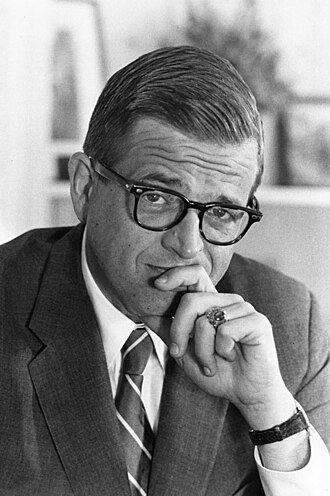
Colson, Charles W.
Charles W. Colson served as Special Counsel to the President from November 1969 to March 1973, and concurrently as the Director of the Office of Public Liaison from July 1970 to March 1973. During the White House taping period, Colson acted as Richard Nixon's ruthless political point man and "hatchet man," compiling the infamous "Enemies List" in 1971 and helping establish the White House Plumbers to discredit political opponents. He held both positions until his resignation in March 1973, when he transitioned out of the administration to return to private law practice just before the Watergate scandal fully erupted.
What Colson talks about on the tapes
Public relations 235Political strategy 233Vietnam War 191Economic policy 116George McGovern 97Media relations 901972 Presidential Campaign 82Public opinion 67Watergate 631972 election 60Congressional relations 59Press relations 58
Conversations (865)
— Page 5 of 9President Nixon and Charles Colson coordinated a brief, in-person meeting during a short telephone exchange. The President confirmed Colson's presence in the Executive Office Building and directed him to report to his office immediately. This logistical discussion served as a precursor to a more substantive, private consultation between the two men.
Charles Colson coordinates with Secretary of Defense Melvin Laird to address public reports of internal administration dissent regarding President Nixon’s decision to blockade Vietnam. The participants express frustration over media attempts to create division between the President and his staff, specifically involving John B. Connally. Colson informs Laird that the President is outraged by these leaks and instructs Press Secretary Ronald Ziegler to publicly debunk the claims, while also sharing favorable ORC poll results to bolster Laird’s confidence for his upcoming press conference.
President Nixon and Charles Colson discuss the positive performance of Secretary of Defense Melvin Laird during a recent televised press conference regarding the Vietnam War. Impressed by Laird’s intensity and effectiveness, the President directs Colson to coordinate a follow-up meeting with H. R. Haldeman. The brief call serves to facilitate immediate staff consultation on how to leverage the momentum from the press conference.
President Nixon and Charles Colson discuss an unidentified public statement or legal case that they both believe has been handled effectively. The conversation focuses on the strategic merits of this development and brief commentary on the political implications of recent diplomatic maneuvers involving China. No specific policy decisions were reached, as the brief exchange primarily centers on evaluating the public relations value of current events.
Charles W. Colson contacted his office to demand the immediate delivery of current public opinion polling data regarding the Vietnam War. He specifically requested results from the Albert E. Sindlinger and Opinion Research Corporation polls, along with relevant reaction fact sheets compiled by Steven S. Karalekas. The request indicates the administration's urgent efforts to monitor and utilize domestic sentiment data to manage the political narrative surrounding the conflict.
President Nixon met with his senior advisors and staff to strategize on managing public opinion and political messaging following his recent decision to blockade and mine North Vietnamese ports. The discussion centered on utilizing favorable polling data, countering media criticism, and coordinating consistent rhetoric among administration officials and Republican allies. Nixon also made key decisions to restrict access to government facilities like the Sequoia and Camp David, while rejecting a proposal to meet with liberal Republican senators to avoid being put in a politically compromising position.
President Nixon contacted Charles W. Colson to coordinate a follow-up meeting after Colson concluded a strategy session involving John N. Mitchell, H. R. Haldeman, and John D. Ehrlichman. The participants briefly discussed the status of their ongoing political deliberations at the Executive Office Building. Nixon instructed Colson and Haldeman to meet with him at the White House immediately after their current proceedings wrapped up to review specific action items.
President Richard Nixon met with Special Counsel Charles Colson in the Old Executive Office Building for a brief discussion. Due to the lack of a transcript for this minute-long engagement, the specific substance of their exchange remains unrecorded. Consequently, no definitive policy decisions or developments can be attributed to this particular meeting.
President Nixon met with H.R. Haldeman and Charles Colson to discuss strategies for bolstering public and congressional support for the recent escalation of the Vietnam War, specifically the blockade. The participants reviewed favorable polling data and analyzed the effectiveness of media messaging and public relations efforts led by allies like Senators Hugh Scott and Robert Griffin. The discussion focused on framing the blockade as a necessary, rational move and discrediting Democratic critics and anti-war protesters as being out of step with the American public.
H. R. Haldeman coordinated with Charles W. Colson via telephone to request his immediate attendance at the Oval Office. The primary purpose of this brief exchange was to facilitate a direct meeting between Colson and President Nixon. No substantive policy matters were discussed during this short logistical communication.
President Nixon, H. R. Haldeman, Charles Colson, and other staff members met to discuss the immediate aftermath and implications of the assassination attempt on Governor George Wallace. The President expressed intense frustration with the lack of information and the perceived incompetence of the Secret Service, repeatedly ordering his staff to bypass them and mobilize the FBI to take control of the investigation. Nixon specifically emphasized the need to determine the assailant's identity and political motivations—particularly any potential ties to anti-Vietnam War sentiments—to prevent media speculation or a repeat of the perceived failures following the John F. Kennedy assassination.
In the aftermath of the attempted assassination of Governor George C. Wallace, President Nixon, H. R. Haldeman, and Charles Colson utilized White House telephone lines to coordinate an information pipeline with Secret Service Director James J. Rowley. The discussion focuses on gathering immediate intelligence regarding the assailant, Arthur H. Bremer, and ensuring the White House receives critical details—such as the purchase of the weapon and the suspect's background—ahead of media reports. Parallel to these operational efforts, the participants also discussed the political impact of the administration's recent Vietnam policies and the President's upcoming summit in Moscow.
President Nixon, H.R. Haldeman, and Charles Colson discuss the investigation into the shooting of George Wallace, focusing on jurisdictional authority to involve the FBI. Nixon expresses a deep distrust of the Secret Service and directs that the FBI be ordered to take the lead in the investigation based on the federal nature of the victims. The participants explore legal justifications for this federal oversight, specifically citing the status of the officials targeted in the attack.
H. R. Haldeman coordinated with the White House operator to ensure that any incoming call from Secret Service Director James J. Rowley would be routed directly to his current telephone line. Simultaneously, President Nixon conferred with Charles Colson regarding unspecified administrative matters. This exchange serves as a logistical bridge, prioritizing urgent communication between the White House and federal security leadership.
Charles W. Colson contacted his office staff to coordinate logistics for his wife, Patricia Colson, to join him at the White House. He instructed his assistant, Holly Holm, to arrange transportation for his wife so she could arrive by 8:15 p.m. This adjustment was necessitated by a last-minute meeting with the President that prevented Colson from dining at home.
Charles W. Colson and Kenneth W. Clawson discuss the ongoing investigation into the attempted assassination of George C. Wallace. Clawson provides intelligence updates, noting that the FBI traced the perpetrator's gun to a recent purchase in Milwaukee by Arthur H. Bremer. Colson instructs Clawson to keep him updated every 15 minutes and to ensure any new findings are immediately relayed to him at the Oval Office.
President Nixon, H.R. Haldeman, and Charles Colson consulted with Attorney General Richard Kleindienst to receive updates on the investigation into the attempted assassination of George Wallace. The participants reviewed the status of the assailant, Arthur Bremer, and discussed FBI assignments regarding his custody, interrogation, and isolation. Officials expressed significant concern over potential public perception, specifically aiming to avoid any resemblance to the controversy surrounding the John F. and Robert F. Kennedy investigations.
Charles W. Colson contacted the White House operator to facilitate communication between key administration officials. The primary purpose of the exchange was to arrange a telephone call for John D. Ehrlichman. The discussion focused on coordinating this outreach in conjunction with a separate call involving H. R. Haldeman.
President Nixon, H. R. Haldeman, Charles Colson, and FBI Associate Director W. Mark Felt discussed the aftermath of the assassination attempt on George C. Wallace. The participants focused on the background of the assailant, Arthur H. Bremer, specifically exploring potential political motivations, his anti-war connections, and rumored ties to Edward M. Kennedy. The group coordinated on the FBI's investigation and the necessity of verifying these rumors to ensure accurate reporting to the President.
Charles W. Colson contacted the White House operator to facilitate a telephone connection with Joan Hall. During the subsequent brief exchange, the two discussed logistical details regarding the respective daily schedules of Charles and Patricia Colson. The conversation served primarily as a coordination effort for personal and professional calendar management.
Charles W. Colson initiated a series of telephone calls to coordinate a conversation between President Nixon and Kenneth W. Clawson. The purpose of these communications was to facilitate direct contact between the President and Clawson regarding undisclosed administrative matters. While the specific substance of their discussion remains undocumented due to the lack of a transcript, the administrative efforts reflect an urgent need to connect the President with his staff.
Following the assassination attempt on Governor George Wallace, President Nixon and his aides, including H. R. Haldeman and Charles Colson, discussed strategies to manipulate public perception of the assailant's political affiliations. They explicitly directed staff to leak a story portraying the gunman as a supporter of Democratic candidates George McGovern and Edward Kennedy to associate the act with the political left. Additionally, the President reviewed the security implications for his own public appearances and coordinated with John Connally regarding future travel assignments.
President Nixon and Charles Colson discuss the ongoing investigation into the assassination attempt on George Wallace following the shooting earlier that day. They address concerns regarding the FBI's handling of the probe and potential conflicts with the Secret Service's investigative efforts. The President emphasizes the need for careful management of the situation while monitoring reports on the shooter, Arthur Bremer, and Wallace's medical status.
President Nixon and Charles Colson briefly discussed the aftermath of the attempted assassination of Governor George Wallace, which had occurred earlier that same day. They exchanged remarks regarding the governor's medical condition and physical injuries, as well as the initial response to the incident. No major policy decisions were made during this short, informal check-in regarding the shooting.
President Nixon and Charles Colson discuss the investigation into Arthur Bremer, the assailant who shot George Wallace, with a particular focus on his potential political affiliations and motives. They assess the efficacy of FBI Director L. Patrick Gray’s investigation and strategize on how to manage public perception regarding the shooter's ideological leanings and the broader implications for gun control. Additionally, the pair reviews Wallace’s medical prognosis and evaluates the domestic political climate concerning the President's Vietnam policies and the upcoming Moscow summit.
President Nixon met with key advisors, including H. R. Haldeman, John Ehrlichman, and Charles Colson, to discuss the political and psychological fallout following the attempted assassination of George Wallace and the administration's military strategy in Vietnam. The group deliberated on how to leverage the shooting to push for tougher gun control legislation while managing the negative public perception of White House-led investigations. Additionally, the President issued firm instructions to General Alexander Haig regarding military promotions and leadership, emphasizing a policy of rewarding personnel who take risks over those who strictly adhere to bureaucratic caution.
President Nixon met with his Cabinet and key staff to discuss the upcoming departure of Secretary of the Treasury John B. Connally and to address broader administration matters. The discussion covered the timing of administrative changes, the transition of economic policy responsibilities to George Shultz, and the status of ongoing federal investigations following the recent shooting of George C. Wallace. Connally reflected on his tenure as Treasury Secretary and his future plans, while the President reaffirmed his commitment to his current economic program and leadership agenda.
President Nixon and Charles W. Colson discussed congressional voting patterns regarding the Vietnam War, specifically focusing on efforts to influence Republican senators on the Byrd amendment. The conversation also covered the political implications of the recent assassination attempt on George Wallace, the public response to Nixon's handling of the Vietnam blockade, and strategies for securing labor support, particularly from Frank Fitzsimmons, for the upcoming 1972 election. Additionally, the participants touched on the logistical management of John B. Connally’s departure and the public relations surrounding Nixon’s recent walk to the Treasury Department.
President Nixon and Charles Colson discussed political strategies regarding the stalling of administration nominees in the Senate, which Nixon proposed framing as an issue of congressional inaction. The two also reviewed foreign policy maneuvering, including Senate voting dynamics, and touched upon preparations for the President’s upcoming trip to the Soviet Union. Additionally, the conversation included a brief evaluation of George Wallace’s potential third-party threat in the 1972 election.
President Nixon and Charles Colson discuss the political fallout of the assassination attempt on George C. Wallace and how to frame the incident to benefit the administration. Nixon directs Colson to have his staff research and plant historical parallels—specifically regarding Franklin D. Roosevelt and Harry Truman—in the press to counter liberal narratives about societal violence. Additionally, they strategize on exploiting Democratic divisions by attacking George McGovern and Hubert Humphrey on contentious issues like busing, amnesty, marijuana, and abortion to alienate key Democratic voting blocs.
President Nixon and Charles Colson discussed strategies to counter liberal media narratives by highlighting historical precedents of political violence under Democratic administrations. The two focused on shifting public discourse regarding political unrest and social issues like busing by utilizing targeted mailers to opinion leaders and editors. Nixon encouraged a more aggressive communication approach to challenge liberal rhetoric and influence the upcoming political climate.
President Nixon and Charles Colson discuss strategies for maintaining public support for the administration's decision to blockade and mine North Vietnamese harbors, including coordinating favorable press coverage and speeches from allies. They review the political fallout of the attempted assassination of George Wallace, concluding it will not significantly shift voting patterns, and strategize on using the event to highlight issues like gun control and civil unrest. The conversation also shifts to the 1972 election, where they analyze primary results in Michigan and Maryland and affirm the importance of appealing to the "silent majority" over elite establishment interests.
President Nixon and Charles Colson discuss strategies for managing public and political opposition following a recent administration announcement. The pair focuses on pressuring Democratic critics and media network owners, concluding that the administration must aggressively confront its political opponents. Nixon emphasizes the need for continued, combative engagement to ensure the opposition remains out of step with the public.
President Nixon and Charles Colson discuss the 1972 election landscape, specifically noting Nixon's strong polling performance in the Michigan and Maryland primaries and the political vulnerability of Democratic candidates. They evaluate the importance of the busing issue, the potential impact of George Wallace's candidacy, and the positive public reception to the President’s handling of recent domestic and foreign crises, including the assassination attempt on Wallace and the Vietnam War. Nixon and Colson decide to maintain a hard line on the Vietnam bombing campaign leading into the upcoming Soviet summit while planning a focused media strategy to highlight the administration's global achievements upon the President's return.
President Nixon and Charles Colson discuss the political fallout and public relations surrounding the recent assassination attempt on George Wallace. They evaluate the administration’s response to Wallace’s injury, the impact of busing as a political issue, and strategies for maintaining a strong stance on the ongoing bombing campaign in Indochina. Nixon emphasizes his intent to avoid appearing to back down in the face of international criticism, reinforcing a firm diplomatic line regarding the Soviet Union.
President Nixon directed Charles Colson to reorganize administration lobbying efforts to better mirror the aggressive, direct-action tactics used by anti-war radicals. Nixon argued that congressional members were increasingly susceptible to pressure and instructed Colson to coordinate with Clark MacGregor to deploy proactive delegations to secure legislative commitments. The President emphasized that this shift from traditional mail and phone campaigns to face-to-face, intensive lobbying was essential to influence members of Congress effectively.
President Nixon directed Charles Colson to maintain daily coordination with Alexander Haig to manage the public relations strategy surrounding the Vietnam War. The President emphasized the need to leak confidential reports regarding North Vietnamese morale to the press without revealing their origin to bolster support for South Vietnamese efforts. Additionally, the pair discussed upcoming publicity for the President's Soviet trip and plans for his visit with George Wallace.
President Nixon and Charles Colson met to review the successful public relations outcomes of the President's recent trip to the Soviet Union and his handling of the Vietnam War. They discussed the positive media reception of the First Lady’s diplomatic appearances and the strategic effectiveness of the administration's recent military actions in Vietnam, including the mining of harbors and the use of precision-guided bombs. Additionally, the pair evaluated the decline in congressional support for anti-war legislation and received an update on the precarious health status of Governor George Wallace following his assassination attempt.
President Nixon and Charles Colson strategize on how to undermine Democratic presidential candidate George S. McGovern by capitalizing on his perceived political vulnerabilities. They discuss efforts to influence key labor leaders, specifically George Meany, to withhold support from the Democratic ticket, while evaluating the potential for securing backing from New York labor unions. The conversation focuses on leveraging institutional relationships and media narratives to frame McGovern as an extreme candidate and solidify labor support for Nixon's re-election campaign.
President Nixon and Charles W. Colson met to discuss strategic administrative and legislative priorities, including the confirmation schedules for Richard Kleindienst and George P. Shultz. The conversation covered personnel matters involving key cabinet officials and the political implications of the President’s recent appearance at a joint session of Congress. They also touched upon national defense policy and administrative planning for upcoming presidential travel.
President Nixon and Charles Colson discuss ongoing 1972 Democratic primary election returns, focusing specifically on George McGovern's performance and the strategic benefits of his perceived weaknesses. They evaluate the impact of the primary race on the broader political landscape, including potential labor and Catholic voter shifts in favor of the President. The conversation also touches on internal party dynamics, polling data, and the importance of keeping the campaign focused on foreign policy achievements rather than domestic policy disputes.
President Nixon and Charles Colson convened at the Aspen Lodge at Camp David to discuss ongoing political initiatives and administrative tasks. The participants reviewed the status of various projects and addressed logistical concerns regarding their current agenda. Due to the fragmentary nature of the recording, no significant policy decisions or actionable directives are clearly articulated in this brief exchange.
President Nixon and Charles Colson reviewed the early returns of the 1972 California Democratic primary, observing George McGovern's strong showing against Hubert Humphrey. The two discussed campaign strategies to exacerbate internal Democratic divisions, specifically focusing on feeding negative narratives about McGovern—such as his stances on amnesty, abortion, and defense spending—to party dissidents. Nixon and Colson also analyzed potential vice-presidential candidates, dismissed Edward Kennedy’s electoral viability, and reaffirmed their plans to use indirect methods to undermine the Democratic ticket.
President Nixon and Charles Colson met at Camp David to discuss personal matters, specifically the physical modification or maintenance of wood materials within the lodge study. The brief exchange focused on structural adjustments rather than policy or political strategy. No significant administrative decisions were recorded during this late-night interaction.
President Nixon and Charles Colson discuss the results of the June 7, 1972, Democratic primary in California, concluding that George McGovern's victory margin was significantly smaller than polls had predicted, thereby damaging his momentum. They analyze the relative weakness of McGovern's popular support compared to Hubert Humphrey and discuss the political vulnerability of the Democratic field. Nixon and Colson also deliberate on messaging strategies to contrast the President's recent international achievements with the radical political leanings of his potential opponents.
President Nixon and Charles Colson met at Camp David to confer on administrative matters and political strategy. Given the lack of a transcript for this specific exchange, the substance of their discussion remains classified or documented only through restricted materials. The meeting highlights the ongoing high-level coordination between the President and his special counsel during the summer of 1972.
President Nixon and Charles Colson discuss strategies to leverage recent Supreme Court decisions as part of the administration's broader political messaging. They agree to instruct PR staff and administration speakers to emphasize how Nixon’s judicial appointments have fundamentally reshaped the Court. This effort is intended to promote the President's vision of achieving peace both domestically and internationally.
President Nixon and Charles Colson confer on campaign strategy, focusing on leveraging the divisions within the Democratic Party to secure electoral advantages. They discuss efforts to keep Edmund Muskie in the race to disrupt George McGovern's momentum and analyze the political benefits of portraying McGovern as a radical. Additionally, they address domestic policy concerns, specifically planning to maintain a hardline stance against busing and discussing the potential for a veto of the Higher Education bill to differentiate the President's platform.
President Nixon and Charles Colson discuss the political fallout of the 1972 Democratic primaries, specifically focusing on the campaign of George McGovern. They analyze recent polling data, the failed attempt by Edmund Muskie to influence the nomination, and strategic efforts to exploit divisions within the Democratic Party. Nixon and Colson also deliberate on campaign messaging, including the use of political surrogates to highlight McGovern's perceived isolationism and vulnerability on social issues.
President Nixon met with special counsel Charles W. Colson at Camp David to discuss sensitive political strategy and personnel matters. The conversation focused on internal administration operations and the management of ongoing political concerns. No specific policy decisions were recorded during this brief exchange, though the dialogue underscored the President's reliance on Colson for discreet political maneuvering.
President Nixon and Charles W. Colson engaged in a brief telephone communication to coordinate scheduling or administrative details. The conversation remains incomplete in the official record, offering no substantive discussion on policy or political strategy. Consequently, no specific decisions or action items were documented during this short exchange.
President Richard M. Nixon and Charles W. Colson engaged in a brief one-minute meeting in the Old Executive Office Building to discuss current administrative matters. The lack of a transcript prevents specific identification of the subjects addressed during this encounter. No definitive decisions or policy directives were recorded for this session.
President Nixon and Charles W. Colson met to conduct an extensive strategic analysis of the 1972 presidential campaign, focusing on the Democratic primary contests and the political standing of George S. McGovern. They evaluated the media's influence on voter perception, discussed potential fractures within the Democratic Party involving Hubert Humphrey and Edmund Muskie, and assessed the voting patterns of various constituencies, including Jewish and labor groups. Throughout the discussion, the President emphasized the importance of maintaining a focus on his foreign policy accomplishments and long-term peace initiatives to bolster his reelection prospects.
President Nixon and Charles Colson engaged in a wide-ranging strategic assessment of the 1972 presidential campaign, focusing heavily on the political prospects of Democratic front-runner George McGovern. They analyzed McGovern's electoral strengths, ideological vulnerabilities, and potential weaknesses regarding his tax and welfare proposals. The discussion further evaluated voter demographics, polling data from the California primary, and the effectiveness of campaign organization as they formulated the administration's political strategy against the Democratic opposition.
President Nixon and Charles Colson reviewed a draft of a major policy document or speech, focusing on refining its language regarding foreign policy and political messaging. They discussed specific edits to sections on international relations, the arms race, and the Vietnam War to ensure the narrative emphasized traditional values and defensive motives. Nixon tasked Colson with preparing a summary sheet for administration speakers to help them effectively communicate these policy priorities to the public.
President Nixon met with Charles Colson, Donald Rodgers, and Michael Balzano to strategize on political messaging regarding busing, urban education, and the administration's broader domestic agenda. The participants discussed public relations efforts to counter liberal opposition and analyzed shifting American attitudes toward government roles, youth protest movements, and social values as explored in Irving Kristol's writing. They also examined potential outreach to labor leaders like Peter Brennan to build support for the President's policies among blue-collar voters.
H. R. Haldeman, Charles Colson, and W. Richard Howard coordinated efforts to monitor the 1972 presidential campaign of George McGovern. The participants discussed strategies for tracking McGovern's statements and activities, specifically focusing on the acquisition of transcripts and video footage from CBS. The primary objective of the discussion was to establish a system for collecting and archiving campaign materials for use by the Nixon administration.
President Nixon and Charles W. Colson engaged in a brief telephone conversation to coordinate their schedules. The primary focus of the exchange was to arrange a subsequent, more detailed meeting between the two men. No substantive policy matters were resolved, as the call served strictly as a logistical bridge to an upcoming discussion.
President Nixon summoned Charles W. Colson to his office in the Old Executive Office Building for a brief, direct consultation. The dialogue serves primarily as an administrative bridge, initiating a more substantive, follow-up meeting between the two men. No specific policy matters or strategic developments were addressed during this brief exchange.
President Nixon met with Charles Colson and H.R. Haldeman to discuss political strategy for the 1972 campaign, focusing specifically on undermining the candidacy of George McGovern. They evaluated methods to frame McGovern as an extremist on issues like defense, amnesty, and welfare, and considered how to leverage voter concerns regarding the Democratic platform to the President's advantage. Nixon also instructed his aides to ensure consistent messaging on key policies, such as the Vietnam War and legislative spending, while emphasizing the need for more aggressive and coordinated political operations.
President Nixon and Charles Colson strategized on campaign messaging and public relations ahead of the 1972 election. They discussed coordinating campaign appearances and speeches for administration officials, including William P. Rogers and Henry Kissinger, to emphasize foreign policy successes and contrast the administration's platform against George McGovern. Additionally, they analyzed electoral demographics, specifically focusing on the Jewish vote and the potential influence of Henry 'Scoop' Jackson on key states.
President Nixon and Charles Colson discussed strategic media appearances and speaking engagements for Secretary of State William Rogers. The President directed Colson to coordinate a schedule of prestigious public forums and evening talk shows for Rogers that would avoid sensitive political debates and conflict with the Democratic National Convention. Nixon emphasized the importance of controlling Rogers's public image and messaging, particularly regarding foreign policy and national defense, while ensuring he appeared in key electoral states.
President Nixon and Charles Colson held a brief telephone discussion concerning the evolving situation following the Watergate break-in. The primary focus of the dialogue involved assessing the political fallout and managing the narrative surrounding the incident. No specific long-term decisions were recorded during this brief exchange, which served as an initial touchpoint for coordinating the administration's response.
President Nixon and Charles Colson coordinate a brief, private meeting to discuss sensitive matters following the recent Watergate break-in. The participants verify the security of their current location before Colson is summoned to the President's office. This brief exchange serves primarily as a procedural arrangement to facilitate a confidential in-person consultation.
President Nixon and Charles W. Colson met to discuss campaign strategy for the 1972 election, focusing heavily on undermining Democratic candidate George McGovern by highlighting his radical policy positions and lack of mainstream appeal. The pair reviewed polling data, analyzed media coverage, and explored ways to exploit divisions within the Democratic Party and organized labor. Furthermore, they deliberated on a plan to develop an independent media analysis operation to systematically counter the influence of the New York Times and the Washington Post.
President Nixon and Charles Colson discuss administrative logistics regarding a specific task, cryptically referred to as dividing and retrieving "the ball." While the conversation remains highly informal and lacks explicit policy context, it serves as a brief check-in regarding ongoing operations. The exchange indicates a sense of urgency in securing or managing these materials.
President Nixon and Charles Colson discuss strategies for managing media coverage and public perception regarding ongoing administration pressures. The conversation touches on the difficulties of coordinating effective messaging, with Nixon expressing a sense of defensive frustration while encouraging Colson to aggressively counter opposing narratives. The exchange highlights the intense, often erratic atmosphere within the White House as they navigate public and political challenges.
President Nixon consulted with H.R. Haldeman and Charles Colson regarding the Democratic presidential nomination before initiating a call to Congressman John J. Rooney. The participants coordinated the outreach to Rooney as part of an effort to monitor or influence political developments. The conversation served primarily as a logistical step to facilitate direct communication with the Congressman.
President Nixon met with H.R. Haldeman, Ronald Ziegler, and other staff members to discuss political strategy for the 1972 election and administrative responses to ongoing controversies. The participants analyzed the candidacy of George McGovern, reviewed public relations tactics regarding the Watergate break-in, and evaluated the administration's contentious relationship with the news media. Nixon also addressed logistical planning for his upcoming schedule, potential campaign staffing, and the framing of his policies for future press conferences.
President Nixon and Charles Colson discussed the administration's efforts to cultivate political support from Democratic Representative John J. Rooney. Colson reported on the success of these outreach initiatives, specifically noting that recent federal assistance on housing projects had been well-received by Rooney. The participants also analyzed the shifting political landscape of the 1972 election, particularly the Democratic party's internal divisions regarding George McGovern's candidacy.
President Nixon initiated this brief telephone call to confirm Charles W. Colson’s location. The conversation served primarily as a logistics check to ensure Colson was reachable in his office for subsequent communication. No substantive policy matters or tactical decisions were discussed during this short exchange.
President Nixon initiated a brief, administrative inquiry with Charles W. Colson to determine his availability. The exchange served as a preparatory check to coordinate schedules for a subsequent discussion. No substantive policy matters or tactical decisions were reached during this short interaction.
President Nixon met with Charles W. Colson to review the political landscape in the immediate aftermath of the Watergate break-in. The discussion focused on managing public relations, specifically utilizing support from veterans' organizations, and addressing rising meat prices through potential administration intervention. They also discussed concerns regarding media reports linking Bebe Rebozo to the Watergate burglars and analyzed current polling data on the President’s handling of the Vietnam War.
President Nixon and H. R. Haldeman met to discuss various political strategies, focusing heavily on managing the public response to the Watergate break-in and minimizing perceived White House involvement. They coordinated efforts to frame the incident as a "comic" amateur operation while deflecting scrutiny toward Jack Anderson and the Democrats. Additionally, the President reviewed his schedule, addressed policy initiatives regarding school aid and Social Security, and evaluated the performance of key staff members like Ronald Ziegler.
H. R. Haldeman and Charles Colson consulted regarding the delivery of a letter from Caspar Weinberger. They also coordinated strategy concerning the President's upcoming press conference, specifically focusing on the administration's policy toward low and moderate income housing. The discussion served to align talking points and briefing materials for the President's public appearance.
President Nixon and Charles Colson consulted regarding strategy for an upcoming press conference, specifically focusing on how to address potential inquiries about Congressman Wilbur D. Mills. The discussion centered on managing the political optics surrounding Vietnam policy, particularly regarding troop withdrawal, as well as the administration's position on pending tax reform legislation. The participants aimed to formulate a cohesive public stance to effectively counter legislative opposition.
President Nixon and Charles Colson met to discuss strategic responses to the ongoing fallout from the Watergate break-in. They assessed the political implications of the scandal and considered potential methods to mitigate damage to the administration's public image. The discussion focused on coordinating efforts to control the narrative and manage the intensifying scrutiny surrounding the event.
President Nixon met with John Cardinal Krol, John Gurash, and White House aides to discuss mobilizing support for government aid to private religious schools. The participants strategized on generating backing from various religious groups, distributing reports to key business and political leaders, and navigating the legislative and judicial challenges surrounding education funding. They further analyzed the political importance of key states such as New York, Pennsylvania, and Ohio, ultimately emphasizing the need for broad public relations efforts and candidate commitments to advance their policy goals.
President Nixon met with H.R. Haldeman and various staff members to discuss media relations, scheduling, and public policy issues, including television appearances by the Nixon family. The participants reviewed strategies for upcoming press conferences and addressed concerns regarding beef price controls and meat quotas. Additionally, the President engaged in outreach, including a phone call with Richard J. Daley to discuss Vietnam, while staff members facilitated administrative tasks regarding personnel and correspondence.
H. R. Haldeman coordinates a communication chain involving President Nixon and Charles Colson to discuss matters concerning the Democratic Party. The discussion serves to facilitate a briefing or strategic session between the President and Colson regarding political opposition. The primary objective is the scheduling and execution of a face-to-face meeting in the Oval Office.
President Nixon met with a large group of broadcast industry executives and administration officials to discuss regulatory and legislative challenges facing the industry. Key topics included the burden of proof in license renewal processes, the impact of Federal Communications Commission (FCC) and Federal Trade Commission (FTC) regulations on operations, and concerns regarding network news bias. The discussion focused on seeking potential legislative solutions to protect broadcasters from costly legal challenges and to stabilize the regulatory environment for private enterprise.
President Nixon met with his economic advisors, including George Shultz, Caspar Weinberger, and Herbert Stein, to address public and political concerns regarding rising food and beef prices. The group analyzed potential government interventions, such as suspending import quotas, utilizing government food stockpiles, and the political implications of implementing price controls. Following this, the President consulted with Kermit Gordon regarding the administration's economic policies and engaged in a broader discussion concerning the political orientation of intellectuals and the Brookings Institution.
President Nixon met with H.R. Haldeman and Charles Colson to discuss the ongoing fallout from the Watergate break-in, specifically the FBI's investigation and the risks of it uncovering CIA connections or sensitive political associations. The participants analyzed the political landscape and current polling data to strategize for the upcoming election against George McGovern. They ultimately decided to prioritize aggressive negative campaigning against McGovern, concluding that focusing on the opponent's weaknesses was more effective for swaying undecided voters than emphasizing the administration's own policy achievements.
President Nixon and Charles W. Colson discussed the strategic timing of a forthcoming phone call from Colson to John B. Connally. The conversation focused on providing Connally with advance notice regarding news on import quotas and coordinating the announcement within the current political calendar. They aimed to manage the message as a temporary, controlled situation.
President Nixon and Charles Colson discussed political strategy for the 1972 campaign, focusing on delegitimizing Democratic challenger George McGovern by highlighting his extreme platform positions. They reviewed current economic policy concerns, including inflation and the Cost of Living Council's management of government meat procurement, while agreeing to minimize direct engagement with businessmen. Furthermore, the President directed Colson to ensure that administration talking points regarding recent press conferences were effectively distributed and utilized by surrogates.
President Nixon and Charles W. Colson met at Camp David to discuss administration strategy regarding economic policy, media management, and the political opposition. Nixon expressed frustration with the business community's performance and emphasized the need for Treasury Secretary George Shultz to take a more aggressive, visible role in economic matters. The two also strategized on utilizing the controversial elements of George McGovern's platform, such as abortion and defense cuts, to mobilize voters through targeted campaign materials.
President Nixon and Charles Colson analyzed the state of the 1972 Democratic presidential primary, focusing on George McGovern's campaign strategy and his perceived vulnerabilities. They discussed the political fallout from McGovern's left-leaning platform, potential issues for the upcoming Democratic National Convention, and opportunities for Nixon to attract support from Catholics, labor unions, and "Middle America." Additionally, they reviewed recent messaging efforts, including Nixon’s recent public statements on busing and the political benefits of framing the Vietnam War negotiations around McGovern’s positions.
President Nixon and Charles Colson discuss strategies to undermine George McGovern's 1972 presidential campaign ahead of the Democratic National Convention. They focus on exploiting perceived political vulnerabilities, specifically McGovern's stances on Cuba, Chile, and the Vietnam War. Nixon emphasizes the importance of framing McGovern as an agent of the intellectual elite whose policies potentially sabotage peace negotiations by encouraging the North Vietnamese to wait for his election.
President Nixon dictates a memorandum to Charles Colson aimed at countering George McGovern's recent attempt in the Washington Post to align his campaign with the military and foreign policy legacy of Dwight D. Eisenhower. Nixon argues that McGovern’s policies of unilateral disarmament and surrender in Vietnam are antithetical to Eisenhower’s strategies of containment and massive retaliation, which relied on American military superiority. To address this, Nixon directs Colson to secure a rebuttal letter from figures like Arthur Radford for publication in the Post and suggests a critical speech by Barry Goldwater to discredit McGovern’s association with Eisenhower.
President Nixon met with Henry Cabot Lodge, Charles Colson, and Henry Kissinger to review recent presidential press coverage, including his return from the Soviet Union and comparisons between George McGovern and Dwight Eisenhower. The discussion focused heavily on Lodge’s diplomatic experiences and personal relationship with the Vatican, particularly concerning the influence and support of American Cardinals. Furthermore, the group evaluated potential future diplomatic appointments for the Lodge family and discussed various strategic administrative staffing assignments.
President Nixon and Charles Colson held a brief telephone conversation to coordinate their schedules and communications. The discussion centered on aligning their agendas and arranging a subsequent, more substantive meeting. No specific policy actions were finalized, as the primary purpose was to facilitate further internal planning.
President Nixon held a brief one-minute meeting with Charles W. Colson to address urgent administrative matters. While the lack of a transcript obscures the specific substance of the dialogue, the encounter reflects the ongoing private consultations between Nixon and his special counsel during the post-Watergate break-in period. No significant policy decisions were documented during this short exchange.
President Richard Nixon and Charles W. Colson met to discuss strategies for countering negative press coverage, particularly articles in the Washington Post and Newsweek that compared the administration's policies unfavorably to those of Dwight D. Eisenhower. The pair strategized on placing rebuttals through friendly media surrogates, such as Patrick Buchanan, to challenge the legitimacy of these critiques. Additionally, they briefly touched upon the political implications of the Watergate break-in and reviewed campaign tactics to address economic concerns, such as meat prices, in anticipation of the 1972 election.
President Nixon met with Charles Colson and Stephen Bull to coordinate preparations for an upcoming engagement with national veterans leaders. The discussion also addressed a critical Washington Post article, prompting a decision to involve Alexander Haig in the administration's subsequent press response. Additionally, the participants briefly reviewed updates regarding Henry Kissinger and adjustments to the President's immediate schedule.
President Nixon met with H. R. Haldeman and Charles Colson to review the guest list and logistical arrangements for an upcoming White House reception for broadcasters. The participants evaluated the political leanings of specific media figures, aiming to ensure that invitees were sympathetic or at least neutral toward the administration’s goals. Beyond the event planning, the group discussed the strategic advantages of incumbency for the reelection campaign, specifically through the use of federal resources like social security mailers and National Park materials to boost the President's image.
Charles W. Colson communicates with a White House operator to facilitate a call with an unknown individual. During this exchange, Colson coordinates the preparation of a list of attendees for an upcoming presidential meeting with broadcasters. The conversation serves as a logistical step in managing the President's public relations and media outreach efforts.
Charles W. Colson contacted the White House operator to facilitate a professional communication and subsequently coordinated with an unknown woman to locate a specific document. The brief exchange focused on administrative support and the urgent retrieval of files situated behind Colson's office desk. These logistical efforts highlight the internal office management and information handling procedures within the White House staff.
President Richard M. Nixon and Charles W. Colson discussed the strategic messaging behind forthcoming administration announcements. The conversation focused specifically on public policy regarding the Vietnam War, particularly addressing the duration of tours of duty for draftees. This dialogue served to refine the administration's approach to communicating these sensitive military adjustments to the American public.
President Nixon met with special counsel Charles W. Colson in the Old Executive Office Building to discuss political strategy and sensitive administrative matters. While the transcript remains unavailable for this segment, the meeting served as a direct consultation between the President and a key advisor regarding the management of ongoing White House initiatives. The discussion concluded abruptly, leaving no documented record of specific directives or final outcomes from the session.
President Nixon, H.R. Haldeman, and Charles Colson met to discuss various political strategies, focusing heavily on managing press relations and public perception regarding the administration. The conversation addressed the potential resignation of John Mitchell due to his wife Martha's instability and the fallout from the Watergate break-in, with the participants strategizing how to frame Mitchell's departure as a personal decision to support his family. Additionally, Nixon directed his staff to research historical precedents for amnesty to counter political opponents, discussed the upcoming press conference schedule, and reviewed administrative control over public broadcasting appropriations.