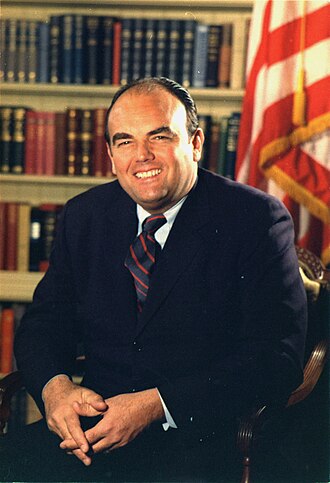
Ehrlichman, John D.
John D. Ehrlichman initially served as Counsel to the President from January 1969 to November 1969, where his duties quickly expanded from legal issues to broader policy development. This shift led to his transition in November 1969 to Assistant to the President for Domestic Affairs, a role he held until April 1973. Throughout the majority of the White House taping period (February 1971 – July 1973), he acted as Nixon's chief domestic advisor and helped direct the covert "Plumbers" unit before the escalating Watergate scandal forced his resignation in April 1973.
President Nixon convened a meeting with Vice President Agnew and a bipartisan group of Congressional leaders to discuss the national economy and his administration's "New Economic Policy." Key topics included the wage-price freeze, investment tax credits, the international monetary situation, and an import surcharge. The discussion focused on the necessity of Congressional cooperation for implementing these measures and their potential impact on inflation, trade, and specific industries like automobiles.
President Nixon met with the Council on International Economic Policy (CIEP) and key economic advisors to discuss the administration's post-August 15 New Economic Policy (NEP) and future international trade strategy. Peter G. Peterson led a presentation analyzing the shortcomings of global liberal trading systems and the challenges posed by foreign competitors like Japan, while other officials addressed the domestic economic impact, labor relations, and the status of ongoing monetary negotiations. The President emphasized the need for a firm but diplomatic approach toward Japan and directed his team to maintain the offensive on domestic economic policy while keeping options flexible regarding international monetary reform.
President Nixon met with Raymond K. Price, Jr. and John D. Ehrlichman to review and refine a draft of his upcoming September 9, 1971, economic address to Congress. The participants discussed strategies for presenting wage and price controls, proposed tax reforms, and the goal of creating new jobs while emphasizing long-term economic competitiveness. The President provided specific revisions to ensure the speech effectively balanced temporary anti-inflationary measures with a vision for national progress and international cooperation.
President Nixon met with Raymond K. Price, Jr. and John D. Ehrlichman to finalize his upcoming economic address to Congress. The participants reviewed and revised multiple drafts of the speech, focusing on the tone toward congressional Democrats and the strategic presentation of tax and spending policies. Nixon emphasized the need for bipartisan cooperation and specific wording regarding the legislative agenda, while also discussing logistical arrangements for the event and upcoming official functions with Alexander P. Butterfield.
President Nixon and John Ehrlichman coordinated on the final preparations for an upcoming address to Congress. The discussion focused on integrating new material regarding scientific research to align with a scheduled appearance by the Apollo 15 astronauts. Additionally, the President dismissed concerns raised by George Shultz regarding specific tax provisions, affirming his comfort with the current draft.
President Nixon and John Ehrlichman met to refine the text of the President's upcoming address to Congress regarding economic stabilization. The discussion focused on carefully crafting language regarding the ongoing war to ensure it balanced political sensitivity with the administration's goals for peace. Nixon directed Ehrlichman to test specific phrasing with Henry Kissinger to determine the most effective approach for addressing these high-stakes policy issues.
President Nixon and John D. Ehrlichman discussed a wide array of political and administrative challenges, including ongoing difficulties with Attorney General John Mitchell regarding the Austin busing case and antitrust policy. The two reviewed internal White House strategies for managing personnel, such as potential replacements for antitrust officials and the planned retirement of J. Edgar Hoover. Additionally, they addressed media inquiries concerning the President's personal financial dealings, specifically those involving Bebe Rebozo, and examined strategies to leverage IRS investigations against political opponents like Edmund Muskie and Edward Kennedy.
President Nixon and John Ehrlichman met in the Old Executive Office Building to discuss their scheduling priorities and potential agenda items. The conversation served as a brief administrative coordination to determine whether to proceed with specific business immediately or postpone it for a later time. No major policy decisions were reached during this introductory exchange.
President Nixon met with John Ehrlichman and H.R. Haldeman to discuss several pressing administration issues, including the political implications of offshore oil drilling in the Santa Barbara Channel and the status of his proposed presidential library site. The group also evaluated the public reception of the President's recent economic speech, deliberated on strategies for handling the ongoing Pentagon Papers controversy, and reviewed legislative challenges regarding welfare reform and school busing. The meeting functioned as a broad briefing session, resulting in instructions for staff to monitor specific political opponents and manage ongoing domestic policy initiatives.
President Nixon and John Ehrlichman discussed defensive strategies regarding inquiries into the President's personal finances and property dealings, agreeing to adopt a firm stance by reiterating that there have been no changes to his financial disclosures. The conversation shifted to internal FBI concerns, with Ehrlichman advising that Nixon meet with J. Edgar Hoover regarding a leadership transition to L. Patrick Gray. Finally, the two reviewed legislative strategy, deciding to maintain a firm position on welfare reform while pressuring Congress to act on a broader package of stalled domestic initiatives, including revenue sharing, health programs, and strike legislation.
President Nixon and John Ehrlichman discuss the handling of potential scrutiny regarding Nixon's real estate dealings, specifically the acquisition of federal property for his presidential foundation and museum. Nixon expresses a desire to proactively disclose information to shut down false rumors or investigative interest, noting that he wants to avoid the level of press intrusion experienced by the Lyndon B. Johnson administration. Additionally, the pair briefly touches upon political strategy for the current congressional session, emphasizing a push for legislative action on health and environmental programs to pressure Congress.
President Nixon, Pat Nixon, and the Cabinet met with their spouses to discuss the implementation and public perception of the administration’s New Economic Policy. Secretary of the Treasury John Connally led a comprehensive briefing on the wage-price freeze, tax reforms, and international monetary adjustments aimed at curbing inflation. The discussion emphasized the necessity of these economic measures for restoring national growth, managing federal expenditures, and building public and congressional support for the administration's program.
President Nixon, H. R. Haldeman, and John Ehrlichman discussed the public and media reaction to the Attica Prison uprising, expressing frustration that coverage from networks like NBC focused on supporting the prisoners while failing to credit Governor Nelson Rockefeller. The participants speculated that the racial dynamics of the riot and the involvement of radical figures like the Black Panthers would ultimately turn public opinion against the prisoners. Additionally, Ehrlichman confirmed that the administration had placed federal prisons on standby following threats from outside activists, though the President suggested the outcome at Attica might serve as a deterrent rather than a catalyst for further unrest.
President Nixon, H. R. Haldeman, and John D. Ehrlichman discussed the public perception and press coverage surrounding the recent uprising at Attica State Prison. The participants characterized the situation as a racially charged conflict, specifically noting the division between black inmates and white guards. The conversation focused on interpreting the political implications of the event within the broader context of American racial tensions.
President Nixon met with a large group of Republican Congressional leaders to solicit support for his administration's economic initiatives, specifically the New Economic Policy and tax reform measures. Key topics included the Job Development Tax Credit, depreciation reform, and strategies to secure bipartisan support for the Economic Stabilization Act as the program entered its second phase. The participants also discussed the necessity of public and business cooperation, as well as the international trade context of the President's economic agenda.
President Nixon and Vice President Agnew met with a bipartisan group of state and local officials, including governors and mayors, to discuss the implementation of 'Phase II' of the administration’s economic stabilization program. The discussion centered on balancing the need for continued wage-price restraints with the financial pressures facing local governments, specifically regarding public employee salaries, teacher contracts, and revenue-sharing legislation. Nixon addressed concerns regarding corporate profit limitations, emphasizing the need for productivity and investment in new equipment to ensure international competitiveness, while agreeing to establish a formal mechanism for ongoing dialogue between local officials and the administration.
President Nixon met with H.R. Haldeman and other staff members to review a wide range of administrative, political, and foreign policy matters, notably including the impending vacancy on the Supreme Court following Justice Hugo Black's resignation. The discussion addressed the political strategy for potential court nominees, the administration's stance on the Office of Economic Opportunity extension bill, and military maneuvers in Vietnam. Additionally, the President reviewed his upcoming travel schedule and press relations, and he met briefly with reporter Eugene Risher to bid him farewell before his departure for a fellowship.
President Nixon met with his inner circle, including John Mitchell, Henry Kissinger, and John Ehrlichman, to discuss a range of urgent issues including Middle East tensions, the SALT negotiations, and Supreme Court vacancies. The President directed that the Middle East situation be kept low-profile to avoid political complications, emphasized the need for a conservative nominee to fill the Supreme Court vacancy, and ordered his staff to secure comprehensive files on the Bay of Pigs and the Pentagon Papers to better manage political messaging. Additionally, the participants reviewed economic indicators, discussed the President's public relations strategy regarding J. Edgar Hoover, and brainstormed ways to capitalize on the Democratic Party's internal divisions.
Alexander P. Butterfield, Charles W. Colson, and John D. Ehrlichman convened in the Oval Office to discuss administrative operations and scheduling matters. The brief interaction focused on the staff's need for dedicated time to manage official White House work. The recording concludes abruptly before any significant decisions or follow-up actions could be finalized.
President Nixon, H.R. Haldeman, and John Ehrlichman discussed the administration's strategy for releasing an expurgated version of the Pentagon Papers despite concerns raised by Henry Kissinger. The participants aimed to use the documents to turn the political narrative against the Democrats, ultimately deciding to proceed with the release while tasking Ehrlichman to coordinate with Richard Helms to declassify further sensitive intelligence records. Additionally, the group reviewed the staffing structure for the Council on International Economic Policy and finalized plans for the President's upcoming economic speech in Detroit.
President Nixon consulted with John Ehrlichman to clarify the administration's official stance regarding a proposed amendment on prayer in schools. The two men discussed the nuances of supporting voluntary prayer initiatives as part of their legislative agenda. Ehrlichman remained non-committal about the political viability or certainty of the administration's position during the exchange.
President Nixon, Vice President Agnew, and members of his Cabinet met to coordinate a unified administration strategy ahead of critical International Monetary Fund (IMF) meetings and ongoing global trade negotiations. The discussion emphasized the necessity of maintaining the recently imposed 10% import surcharge and a firm bargaining stance to address the nation's economic balance of payments and reshape the international monetary system. Nixon and his advisors agreed that while foreign partners would likely criticize U.S. policy, maintaining domestic political support and correcting long-standing trade imbalances remained the administration's primary objective.
President Nixon met with John Ehrlichman and William Magruder to discuss the administration's 'New Technology Opportunities Program,' which aims to stimulate American industry, improve national competitiveness, and address economic needs through bold, innovative initiatives. The participants focused on the importance of aggressive systems management—drawing parallels to the Manhattan and Apollo projects—to combat the complacency and limited vision currently found within traditional federal agencies. Magruder provided an update on ongoing research into trade, tax incentives, and antitrust policies, while the President emphasized the need for a high-visibility, psychological lift to revitalize American technological and industrial dominance.
President Nixon met with Republican congressional leadership, staff, and advisors to coordinate the administration’s legislative agenda for the final months of the 1971 session. The discussion focused on securing passage of the President's tax package, welfare reform, and revenue-sharing initiatives, while navigating difficult Senate opposition and House parliamentary hurdles. Nixon emphasized the urgent need for political pressure on Democrats regarding a federal wage deferral bill and outlined strategies for upcoming Supreme Court nominations to ensure successful confirmations.
President Nixon, Henry Kissinger, George H. W. Bush, and John Ehrlichman met to discuss the administration's critical foreign policy challenges, specifically the upcoming UN vote on Taiwan's status and the strategic implications of upcoming high-level summits. Bush was instructed to maintain a firm, public stance in New York regarding the UN resolution, while Kissinger and the President coordinated the timing of U.S. outreach to the Soviet Union and China to avoid domestic and diplomatic conflicts. The meeting also addressed domestic administrative issues, including housing litigation strategy, welfare reform messaging to Congress, and tax policy coordination with Treasury Secretary John Connally.
President Nixon met with leaders from various national education organizations to hear their concerns regarding the state of public education, specifically focusing on the financial crisis facing schools. Representatives emphasized the need for federal assistance, the reliance on inequitable property taxes for school funding, and the challenges of integrating diverse student populations. Nixon reaffirmed his support for education and his administration's commitment to exploring tax reform and alternative funding methods, such as revenue sharing, to alleviate the pressure on local school districts.
President Nixon met with a group of influential Southern Democratic congressmen and key administration officials to discuss domestic and foreign policy priorities. The dialogue focused primarily on the administration's ongoing efforts regarding the Vietnam War, seeking to gauge and solidify support among conservative Democrats for the President's legislative and military agendas. The meeting served as a strategic outreach effort to maintain congressional backing for the administration's broader policy goals.
President Nixon and John Ehrlichman discuss the growing political pressure to address federal busing mandates, noting that the issue has become a significant concern in states like Michigan and Tennessee. They deliberate on potential legislative responses, including the possibility of a constitutional amendment versus other policy interventions during upcoming House debates on school aid. The conversation concludes with a directive for Ehrlichman to continue coordinating with John Mitchell to finalize a strategy by the end of the week.
President Nixon consulted with John D. Ehrlichman to discuss personnel matters and the strategic handling of a sensitive legal or administrative issue. The conversation centered on the status of individuals potentially linked to a Boston-related matter and the broader implications of court involvement. Nixon expressed uncertainty regarding the current situation and instructed Ehrlichman to delay further external communications until he could personally review the details.
President Nixon met with bipartisan Congressional leadership to outline his post-freeze economic program and announce plans for an upcoming summit in Moscow. He detailed the formation of a tripartite Pay Board, a Price Commission, and a committee on interest and dividends to maintain economic stability through a mix of voluntary cooperation and necessary sanctions. Additionally, the President briefed the leaders on the status of international monetary negotiations and his strategic approach to the May 1972 summit with Soviet leadership regarding arms control and trade.
President Nixon held a brief, one-minute meeting with John D. Ehrlichman in the Oval Office. Due to the lack of an available transcript or audio clarity, the specific subject matter and any resulting directives remain undocumented in the historical record. This session reflects the routine, often rapid nature of executive consultation between the President and his senior staff.
President Nixon met with John Mitchell and John Ehrlichman to discuss high-level personnel and policy matters, specifically focusing on potential Supreme Court nominees, school busing legislation, and tensions regarding FBI Director J. Edgar Hoover. The group evaluated candidates such as Robert C. Byrd and Howard H. Baker Jr., while also debating the merits of a constitutional amendment versus legislative action to address court-ordered busing. Additionally, the President and his advisors addressed the secure handling of sensitive files related to the Pentagon Papers investigation and contemplated how to manage Hoover’s increasingly difficult tenure.
President Nixon met with John Ehrlichman and CIA Director Richard Helms to discuss the President's access to sensitive, classified intelligence documents, specifically concerning past operations like the Bay of Pigs and the assassination of Ngo Dinh Diem. Nixon emphasized his need for full information regarding historical foreign policy and intelligence "dirty tricks" to prepare for upcoming diplomatic negotiations and to manage political exposure. Following this, Nixon met with David Kennedy, Henry Kissinger, and Peter Peterson to strategize on high-stakes textile trade negotiations with Japan, where they aimed to secure an agreement by applying pressure while maintaining the credibility of the U.S. position.
President Nixon met with John D. Ehrlichman in the Executive Office Building to review and coordinate the Domestic Advisor's upcoming professional schedule. The discussion centered on managing Ehrlichman's calendar to ensure alignment with presidential priorities and administrative demands. No further policy decisions were recorded during this brief administrative meeting.
President Nixon met with his Cabinet and key staff members to review the administration’s domestic and foreign policy priorities, primarily focusing on the economic transition to 'Phase II' and the announcement of a 1972 Soviet summit. Officials discussed the successful implementation of the wage-price freeze and the strategy for securing organized labor's cooperation on the newly formed Pay Board and Price Commission to curb inflation. Additionally, the President addressed the importance of linking economic policy to job growth through his pending tax proposals, while Secretary of State Rogers and the President emphasized that international diplomatic overtures toward the Soviet Union and China were part of a cohesive, long-term strategy for global peace.
President Nixon met with John N. Mitchell and John D. Ehrlichman to discuss the vetting and selection of nominees for the Supreme Court, specifically Herschel H. Friday and Mildred L. Lillie. The participants evaluated the candidates' judicial backgrounds, conservative credentials, and potential obstacles to confirmation, such as past clients and political affiliations. They emphasized the importance of ensuring the nominees' ideological suitability and agreed to initiate thorough background checks while considering the potential reactions of Senate Democrats and Republicans.
President Nixon met with John Ehrlichman and later Henry Kissinger to discuss a range of sensitive administrative and political matters, including Supreme Court appointments and the declassification of CIA documents related to the Ngo Dinh Diem assassination. The participants strategized on managing intelligence disclosures and potential immunity questions, while also coordinating the President's upcoming schedule, budget priorities, and Phase II wage and price controls. Finally, they deliberated on diplomatic appointments for the inauguration of South Vietnamese President Nguyen Van Thieu, ultimately favoring Elliot Richardson for the delegation.
President Nixon met with D.C. Mayor Walter Washington, Chief Jerry Wilson, and senior aides to discuss city progress, including positive economic and crime statistics, and the ongoing effort to secure a new professional baseball team for the District. Following the departure of local officials, the President transitioned to a strategic discussion with John Ehrlichman regarding the timing and public relations framing for upcoming Supreme Court nominations, specifically those of Herschel Friday and Mildred Lillie. Nixon emphasized prioritizing trial court experience as a key credential and instructed aides to manage the announcement sequence to maximize political impact.
President Nixon met with H.R. Haldeman and John Ehrlichman to coordinate administration strategy regarding agricultural policy, specifically addressing corn prices and the potential replacement of Secretary of Agriculture Clifford Hardin. The participants also discussed the difficulty of managing Republican legislators and the need for a more centralized, proactive approach to securing legislative support. Additionally, they reviewed potential Supreme Court nominees and debated the administration's response to media inquiries regarding the President's personal finances and business dealings involving Charles G. Rebozo.
President Nixon and John Ehrlichman met to discuss the President’s upcoming schedule and strategic adjustments to his administrative agenda. The conversation touched upon personnel matters, specifically the President’s interactions with Bebe Rebozo and H.R. Haldeman, alongside an evaluation of current budget options. Nixon emphasized his openness to alternative political strategies and programs, signaling a willingness to defer specific actions until the following year.
President Nixon met with John Ehrlichman and John Mitchell to discuss potential Supreme Court nominees, specifically focusing on Herschel H. Friday and Mildred L. Lillie. The participants evaluated the candidates' judicial philosophies and potential for Senate confirmation, with Nixon emphasizing his desire for conservative appointees who would align with his administration's views. The meeting concluded with plans to finalize the nomination strategy, including coordinating with key political figures and preparing for upcoming announcements.
President Nixon met with Henry Kissinger, John Mitchell, and John Ehrlichman to discuss high-level administration business, ranging from foreign policy to domestic personnel matters. The primary focus of the session was an extensive deliberation regarding potential Supreme Court nominees—specifically evaluating candidates like Herschel Friday and Mildred Lillie—amidst reports of Chief Justice Warren Burger’s dissatisfaction and rumored resignation threats. Additionally, the group reviewed internal FBI tensions, including the management of William C. Sullivan and the leadership status of J. Edgar Hoover, as well as various trade and political scheduling issues.
President Nixon, John Mitchell, and John Ehrlichman met to strategize on upcoming Supreme Court nominations, specifically evaluating candidates like Lewis Powell, William French Smith, and Herschel Friday. They discussed the complications of appointing a woman to the Court, focusing on the potential for the American Bar Association (ABA) to deem a female candidate unqualified, which the President sought to avoid to prevent political backlash. Ultimately, Nixon decided to prioritize the nomination of Lewis Powell, aiming to finalize the selection while managing the ABA's evaluation process through Mitchell's liaison, Lawrence Walsh.
President Nixon and John Ehrlichman discussed the potential forced resignation of FBI Director J. Edgar Hoover and the administrative details surrounding his potential departure. The pair also addressed damaging allegations in Newsday regarding Bebe Rebozo’s financial dealings, specifically concerning Fisher Island stock transactions. They weighed the strategic benefits of filing a lawsuit against Newsday to force a retraction and generate positive publicity to counter the reports.
President Nixon and Republican Congressional leaders met to coordinate strategy on key foreign and domestic policy initiatives, emphasizing the administration's progress in achieving global peace and economic stabilization. Secretary of State William Rogers provided an assessment of U.S. leadership, focusing on the upcoming United Nations vote regarding Taiwan, the ongoing India-Pakistan crisis, and preparations for Nixon's summits in Moscow and Beijing. The group also discussed legislative tactics for securing Republican priorities, specifically the Economic Stabilization Act and the ongoing challenge of the Mansfield Amendment to Vietnam policy. Nixon urged the leaders to maintain a firm, unified front to avoid projecting vulnerability to foreign adversaries and domestic political opponents.
President Nixon met with his senior advisors to strategize on federal budget planning for fiscal years 1972 and 1973, focusing on controlling expenditures, managing the national economy, and navigating pending legislation such as revenue sharing and welfare reform. A primary objective was to reconcile budgetary constraints with political priorities, including the potential for a veto strategy against unfavorable congressional initiatives. The participants also discussed the necessity of maintaining a strong defense posture, the implications of defense spending on the economy, and the administration's ongoing efforts to resolve the Vietnam War and secure the release of prisoners of war.
President Nixon and John D. Ehrlichman discussed the development of the 1973 federal budget, specifically focusing on potential new initiatives and tax policy. The participants reviewed the perspectives of Caspar Weinberger regarding fiscal strategy and coordinated their respective schedules with John B. Connally. This meeting served as a planning session to align administrative priorities and scheduling for upcoming budgetary negotiations.
President Nixon and John Ehrlichman discussed political strategies regarding the issue of school busing, evaluating the potential for a constitutional amendment to leverage political advantage against rivals like Edward Kennedy, Edmund Muskie, and Henry Jackson. Nixon emphasized the importance of aligning with the powerful education lobby and explored linking busing to broader education policies, including aid to parochial schools. The pair aimed to capitalize on the busing controversy as a significant electoral issue by appealing to specific interest groups.
President Nixon and John D. Ehrlichman held a brief meeting in the Oval Office to coordinate scheduling matters. The discussion centered on managing Ehrlichman's upcoming calendar and administrative availability. No substantive policy decisions were recorded during this short exchange.
President Nixon and John Ehrlichman met to coordinate domestic policy initiatives and staffing strategies, specifically focusing on the potential replacement of FBI Director J. Edgar Hoover and a proposed new tax structure. They discussed the political risks of introducing a Value Added Tax, exploring how it might support education funding and property tax relief without alienating middle-income voters. Furthermore, they reviewed internal management concerns regarding international economic policy and the need for greater cohesion among administration officials like George Shultz, Peter G. Peterson, and John Connally.
President Nixon and John Ehrlichman coordinate their late-afternoon scheduling, specifically focusing on arranging a meeting with George P. Shultz. The participants weigh various timing options to accommodate the President's availability. Ultimately, they decide to finalize a meeting time for later that evening.
President Nixon, Rose Mary Woods, and John Ehrlichman discussed the management of anti-war demonstrations, press relations, and personnel issues, including the logistical planning for the First Lady's participation in the upcoming trip to the People's Republic of China. The President expressed frustration with staff leaks to the media and emphasized the need for maintaining professional distance from reporters. Additionally, the group addressed the President's personal schedule, the costs and protocols regarding family visits to California and Camp David, and instructions for managing condolence correspondence.
President Nixon met with George Shultz and John Ehrlichman to strategize on international economic policy, specifically addressing the U.S. surcharge, currency convertibility, and the role of the Federal Reserve. A central goal of the discussion was managing the complex relationships between the Treasury Department, international allies like Japan and European nations, and domestic economic advisors. Nixon emphasized the need for a unified strategy that maintains U.S. independence, while Shultz was tasked with brokering better cooperation among staff to ensure policy decisions are implemented effectively and without bureaucratic interference.
President Nixon consulted with Alexander P. Butterfield to review and modify his upcoming schedule for October 26, 1971. The discussion centered on managing meetings with Vice President Spiro Agnew, Senator Wallace F. Bennett, Vietnam veterans, and a National Security Council budget session involving George P. Shultz and John B. Connally. Seeking to accommodate more time with Connally before his departure, the President evaluated potential adjustments to the timing of his morning and afternoon appointments.
President Nixon met with Senator Wallace Bennett and senior advisors to discuss legislative strategy for the upcoming Senate session, specifically focusing on a pending tax bill and the potential for a restrictive Senate vote to prevent extraneous amendments like H.R. 1. The participants analyzed the political landscape of the Senate Finance Committee, the influence of Chairman Russell Long, and the administration's cautious approach to welfare and social security reform. Additionally, the President briefly touched upon the United Nations vote regarding Taiwan and his frustration with international reactions toward U.S. policy.
President Nixon and his senior advisors, including H. R. Haldeman, Henry Kissinger, and John Connally, met to discuss defense budget strategies, the political fallout from Taiwan's expulsion from the United Nations, and preparations for upcoming foreign diplomacy. Nixon emphasized the need for a leaner, more effective military posture that focuses on strategic procurement rather than broad manpower, while also debating the risks of domestic political opposition and the impact of the defense budget on the economy. The group analyzed the necessity of maintaining a strong defense to bolster negotiating positions with the Soviet Union and China, while also coordinating the administration’s measured public response to the UN vote.
President Nixon met with his budget and domestic policy advisors, including John Ehrlichman and John Mitchell, to evaluate the political and economic feasibility of a proposed Value Added Tax (VAT) as a mechanism to fund public and private education. The primary objectives of the plan were to provide federal relief for local property taxes, address the California Supreme Court’s school funding ruling, and extend aid to parochial schools to appeal to blue-collar Catholic voters. The participants debated the political risks of proposing a new federal tax in an election year versus the potential benefits of offering tangible relief to homeowners and securing support from key constituencies.
President Nixon met with William Ruckelshaus, John Ehrlichman, John Whitaker, and later Clifford Hardin to discuss administrative personnel changes and pending agricultural policies. The group focused heavily on managing the timing of Secretary of Agriculture Hardin’s resignation and selecting a successor while avoiding political fallout from various farm interest groups. Additionally, Nixon directed his staff to resolve labor disputes and facilitate a grain sale to the Soviet Union, prioritizing the deal's completion despite resistance from unions.
President Nixon, John D. Ehrlichman, and John R. Price, Jr. discuss Price's political future and the complexities of running for Congress in New York. The President emphasizes that unlike in California, New York politics requires working closely with local party leaders and organizations, even if it requires compromise. Nixon advises Price to secure support from party figures like Joseph M. Margiotta while maintaining his own ideological stance, and the group reviews strategies for handling specific political rivals and redistricting issues. The meeting concludes with the President presenting gifts to Price in appreciation of his service to the administration.
President Nixon consulted John Ehrlichman regarding a potential call to Nelson Rockefeller to discuss the status of Rockefeller's welfare experiments. Ehrlichman reported that recent tensions between Rockefeller and the Department of Health, Education, and Welfare had been successfully resolved following a meeting with Elliot Richardson and John Veneman. Nixon subsequently decided to proceed with the call and scheduled a follow-up meeting with Ehrlichman for shortly thereafter.
President Nixon consulted with John Ehrlichman regarding an upcoming interaction with New York Governor Nelson Rockefeller to prepare for potential requests for financial assistance. Ehrlichman agreed to monitor the situation and screen future communications to manage Rockefeller's expectations. The discussion focused on maintaining administrative control over the President's engagement with the Governor.
President Nixon met with John Ehrlichman and George Shultz to discuss a wide range of personnel, legislative, and economic policy matters. The conversation covered judicial and administrative appointments—specifically regarding Robert Kunzig and potential Supreme Court candidates—the status of welfare reform legislation, and political strategy for the 1972 election. They also reviewed economic initiatives, including a possible value-added tax, the Pay Board's handling of labor contracts, and the status of international trade negotiations, with Nixon emphasizing the need to maintain strong control over federal spending and policy direction.
President Nixon met with his senior staff, including H. R. Haldeman, Henry Kissinger, and John Ehrlichman, to coordinate a strategy for countering Congressional opposition to the foreign aid program and to manage the administration's public relations. The participants discussed the necessity of adopting an aggressive offensive stance against partisan critics who threatened national security initiatives, while also planning for a future Cabinet meeting focused on the 1972 campaign. Furthermore, they reviewed internal personnel shifts, including potential changes within the Justice Department and the FBI, and aligned on the timing and messaging for upcoming Vietnam troop withdrawal announcements to maximize political impact.
President Nixon met with his Cabinet Committee on Executive Reorganization to coordinate strategy for the administration's departmental restructuring proposals. The discussion focused on overcoming bureaucratic resistance, navigating complex Congressional committee jurisdictions, and addressing concerns regarding constituency-based programs like the Rural Electrification Administration. To advance these reforms, Nixon directed his Cabinet members to personally engage with key Congressional leaders and exert stricter control over their respective bureaucracies to ensure support for the legislative agenda.
In this Oval Office meeting, President Nixon, John Ehrlichman, and Henry Kissinger discussed various administrative and political priorities, including government reorganization, the replacement of Cabinet Secretaries, and the management of the Agriculture Department. The participants also reviewed strategies for handling the Pentagon Papers controversy, addressed the status of the FBI under J. Edgar Hoover, and debated the implementation of a Value Added Tax (VAT). Additionally, the group strategized on domestic legislative hurdles, specifically the pending Congressional vote on school busing, and coordinated their approach to upcoming meetings regarding Vietnam troop withdrawal policies.
President Nixon, H.R. Haldeman, and John Ehrlichman coordinated with Attorney General John Mitchell to discuss scheduling for an upcoming trip to Florida. The group reviewed recent election results, specifically analyzing the political implications of mayoralty races for national coalitions. Mitchell agreed to align his schedule to join the President in Florida following his commitment to attend a dinner for Senator Robert P. Griffin.
President Nixon and John Ehrlichman discuss political outreach strategies, focusing on the potential benefits of engaging with Democratic mayors like Boston's Kevin White. The two men deliberate on how to manage these relationships to bolster the administration's image of bipartisan cooperation. Additionally, they briefly touch upon administrative scheduling and the status of ongoing court-related matters.
President Nixon met with several Republican House members to discuss critical legislative and political concerns, including the administration's judicial nominees, busing policies, and pending Office of Economic Opportunity (OEO) legislation. The participants reviewed the President's upcoming foreign policy agenda, specifically focusing on the Taiwan UN vote and his forthcoming trips to the People's Republic of China and the Soviet Union. The conversation also touched upon domestic economic issues, notably the dock strike and potential grain sales to the Soviet Union, as Nixon sought to align his legislative strategy with key congressional allies.
President Nixon and John Ehrlichman discuss the potential appointment of Earl L. Butz as Secretary of Agriculture, with Nixon expressing concerns regarding Butz's name. They deliberate on the recommendation of the "Triumvirate"—Frederic Malek, Bryce Harlow, and John Whitaker—while considering an alternative candidate, Representative John Kyl. Nixon instructs Ehrlichman to have Whitaker evaluate Kyl's suitability during an upcoming meeting, tasking them with assessing whether Kyl would be a strong political asset.
President Nixon met with John Ehrlichman, later joined by H.R. Haldeman and George Shultz, to discuss a broad range of political and economic issues. The group focused on coordinating strategy for upcoming congressional votes on busing, the potential veto of child development legislation, and the selection of a new Secretary of Agriculture. Furthermore, they reviewed economic policies, specifically addressing concerns regarding the dock strike, the potential re-imposition of wage-price freezes, and the need to manage Arthur Burns regarding monetary policy and the money supply.
President Nixon met with John Ehrlichman, John Whitaker, and Secretary of Agriculture Earl Butz to discuss political strategy regarding depressed corn prices and agricultural policy heading into the 1972 election cycle. The President emphasized the need for Butz to serve as a strong, partisan advocate for farmers to counter potential anti-administration sentiment in agricultural states. The group also addressed the logistics of a forthcoming administrative announcement regarding government reorganization, with Nixon insisting on a concise, one-sentence statement to avoid overcomplicating the issue.
President Nixon and John D. Ehrlichman discussed the strategic framing of personnel changes within the Department of Agriculture, specifically regarding the transition from Secretary Clifford M. Hardin to Earl L. Butz. They reviewed potential government reorganization plans, focusing on the placement of the Coast Guard and concerns regarding Secretary John A. Volpe’s management. Additionally, the President briefly evaluated his public relations strategy, weighing the benefits of potential interviews with various media outlets, including Reader’s Digest and Playboy.
President Nixon and John Ehrlichman discuss the internal strategy for reorganizing the Department of Agriculture, emphasizing the need to secure support from Roy Ash and the Ash Council. Nixon instructs Ehrlichman to coordinate with Charls Walker to ensure the reorganization plan is presented as a necessary concession to achieve broader community development goals. They also agree to balance the public framing of the decision by providing credit to both Earl Butz and Clifford Hardin.
President Nixon and John Ehrlichman discuss the logistics and necessity of providing private financial backing for a sensitive negotiation involving overseas interests. Nixon emphasizes that the operation cannot rely on government funding, necessitating a more hardened approach to secure the required resources. The two agree on the urgency of the task and move to finalize the strategy for executing the funding.
President Nixon met with outgoing Secretary of Agriculture Clifford Hardin and his designated successor, Earl Butz, to coordinate the transition and manage the associated media rollout. The participants discussed the timing of Hardin's resignation and the logistics for a forthcoming joint press conference to announce the change in leadership. Additionally, the group touched upon international matters, including U.S. relations with Turkey, and addressed administrative planning regarding the potential reorganization of the Department of Agriculture.
President Nixon and John Ehrlichman discuss the President’s firm intention to veto an education bill due to philosophical objections regarding the role of government in child-rearing. Nixon addresses his tactical frustrations with Secretary Elliot L. Richardson, who disagrees with the administration's stance and has been hesitant to align with the President's position. Ehrlichman agrees to coordinate with Richardson while acknowledging the political pressure on the Secretary and the President's resolve to ultimately reject the legislation.
President Nixon and John Ehrlichman briefly discussed the political challenges of public support for wartime leadership before transitioning to an upcoming energy policy meeting. Ehrlichman advised the President to adopt a listening role during the session while setting a specific agenda to address ATM-level control. The pair finalized the meeting's structure, with Ehrlichman proposing to introduce the key participants and issues sequentially.
John D. Ehrlichman and Attorney General John N. Mitchell discuss friction with Governor Ronald Reagan regarding welfare reform negotiations between his office and the Department of Health, Education and Welfare. Reagan had been complaining to Vice President Agnew about the perceived lack of progress and broken commitments, prompting concern within the administration. They agree that Mitchell should instruct Reagan to resolve the specific dispute over program slots directly with Secretary Elliot Richardson, avoiding further involvement of the President.
President Nixon met with his Cabinet and staff to discuss high-stakes domestic and foreign policy issues, including the administration's stance on school desegregation and busing, and potential vetoes regarding child development and welfare legislation. The President also briefed Secretary of Commerce Maurice Stans on his upcoming trip to the Soviet Union, emphasizing that trade should be treated as a strategic tool rather than an over-eager pursuit. Nixon instructed Stans to maintain a shrewd bargaining position and to subtly convey the administration's political strength to Soviet leadership to influence diplomatic negotiations.
President Nixon met with John Ehrlichman and H. R. Haldeman to deliberate on urgent fiscal and political strategies as the administration faced a looming deadline regarding a continuing resolution for federal funding. The group discussed the political risks of taking a hardline stance against Congress, specifically targeting the Senate's perceived irresponsibility, while weighing the potential consequences of a government shutdown. Ultimately, the President decided to adopt a confrontational approach with Congressional leaders to avoid being forced into signing unfavorable legislation, prioritizing his image as a decisive leader over compromising with legislative opponents.
President Nixon met with his Cabinet officers to discuss a variety of domestic and international issues, including transportation leadership, government funding through a continuing resolution, and the cultivation of opium poppies in Turkey. The conversation also touched upon administrative transitions, such as the departure of Secretary of Agriculture Clifford Hardin, and strategies for managing the national economy and price controls. Nixon emphasized the importance of maintaining clear leadership and coordination across departments to ensure the success of his domestic policy initiatives.
President Nixon and John Ehrlichman debriefed regarding a recent Cabinet meeting, specifically criticizing Secretary of Transportation John Volpe’s comical and repetitive presentation style. They discussed the logistics of 'Transpo '72,' with Nixon expressing concern that the event would lead to significant traffic issues. Additionally, they reviewed Secretary of Health, Education, and Welfare Elliot Richardson’s performance, concluding that he had received the President's firm message regarding budgetary constraints.
President Nixon, John Connally, Donald Rumsfeld, and a delegation of Republican Congressional leaders met to coordinate legislative strategy regarding the administration's domestic economic program and various foreign policy concerns. The discussion focused on the implementation of wage and price controls, pending tax legislation, and the management of international trade negotiations, particularly regarding Japan and the import surcharge. Participants also addressed the confirmation of Supreme Court nominees Lewis F. Powell and William Rehnquist, as well as ongoing legislative battles concerning the Vietnam War and Defense Department appropriations.
President Nixon met with Peter G. Peterson, George P. Shultz, John D. Ehrlichman, H. R. Haldeman, and Henry Kissinger to discuss personnel changes and key policy initiatives. The President offered Peterson the position of Secretary of Commerce, emphasizing the need for a combative and effective advocate to handle public relations and congressional outreach. The group also deliberated on the political risks of the President addressing the AFL-CIO, explored strategies for upcoming international monetary negotiations, and reviewed the status of Vietnam peace talks following a leak regarding troop withdrawal numbers.
President Nixon and John Ehrlichman discuss a political strategy to neutralize a proposed amendment to the Tax Bill by Senator Charles Percy, which would provide federal subsidies to states for welfare costs. Fearing the amendment’s $2.8 billion price tag and its potential to undermine administration revenue-sharing goals, the pair decides to offer a political concession to Percy—an agreement to support his initiative later if H.R. 1 moves forward—to prevent the amendment from being introduced. They agree that a veto of the tax bill is not a viable option due to other critical provisions like the investment tax credit and auto excise reductions, ultimately opting to make a deal to avoid the fiscal impact of the amendment.
President Nixon and John Ehrlichman met to discuss the administration's legislative strategy regarding HR1 and a problematic amendment threatening the broader tax bill. The discussion focused on the political necessity of avoiding a presidential veto of the tax package while managing potentially unfavorable legislative amendments. They ultimately decided to pursue negotiations with Senator Charles Percy to mitigate the amendment's impact and effectively handle the political leverage involving state governors and Governor Ronald Reagan.
President Nixon and John Ehrlichman discuss the strategic implications of Senator Charles Percy’s proposed amendment to H.R. 1, the pending tax bill. Nixon argues that yielding to Percy on the amendment creates a legislative scenario where the bill might fail or require a presidential veto, whereas avoiding the amendment ensures the passage of a bill he is obligated to sign. After confirming that George Shultz concurs with this assessment, they reach a consensus to prioritize the bill's passage over legislative confrontation.
President Nixon consults with John Ehrlichman regarding the strategic implications of incorporating specific provisions into H.R. 1, a major legislative proposal. Nixon expresses concern over the risks of being forced to sign an undesirable tax bill and emphasizes the necessity of avoiding such a scenario. Ultimately, the President decides to postpone further action on tax legislation to maintain control over the administration's fiscal agenda.
President Nixon and John Ehrlichman discuss the successful negotiation of a memorandum of understanding with Senator Charles Percy regarding welfare reform legislation. The administration agrees to support an amendment to avoid a broader legislative defeat, while maintaining that this position does not necessitate including the program in the federal budget. They also address the political motivations of Governors Ronald Reagan and Nelson Rockefeller, and finalize plans to provide financial assistance to Governor Richard Ogilvie by shifting welfare costs into the current fiscal year.
President Nixon and John Ehrlichman discuss the political challenges of advancing welfare reform, specifically addressing concerns raised by Governor Ronald Reagan regarding rising costs. The pair strategizes on how to handle Senator Charles Percy's involvement and reconcile the conflicting interests of Republican governors like Nelson Rockefeller. Nixon ultimately instructs Ehrlichman to proceed with managing these legislative hurdles despite the difficult political landscape.
President Nixon met with Interior Secretary Rogers Morton to discuss the administration's policy priorities, including the development of Western water projects, management of Indian affairs, and the status of U.S. territories like Micronesia. Additionally, Massachusetts Governor Francis Sargent joined the meeting to address welfare reform legislation, state economic challenges, and potential political strategies for the upcoming 1972 campaign. The participants explored ways to enhance the President's environmental record and streamline the Administration's messaging to better appeal to young voters and the broader public.
President Nixon met with John Connally, John Ehrlichman, and George Shultz to conduct a wide-ranging review of the Fiscal Year 1973 budget and political strategy ahead of the 1972 election. The group evaluated various initiatives, including revenue sharing, public housing, narcotics enforcement, and a proposed Value Added Tax (VAT), while weighing potential congressional opposition and the electoral impact of these policies. Key decisions included maintaining a firm stance on space program funding to support jobs in California and Texas, addressing federal pay increases, and finalizing a strategy for a high-profile narcotics task force.
President Nixon met with John Ehrlichman, John Connally, and George Shultz to discuss potential tax policy initiatives, specifically the implementation of a Value Added Tax (VAT) linked to the repeal of residential real estate taxes for education. The group evaluated the political feasibility of introducing such a plan, weighing the risks of congressional interference from Wilbur Mills against the potential for an effective 1972 campaign centerpiece. Ultimately, they reached a consensus to avoid immediate legislative action, opting instead to wait for the McElroy Commission report and delay a formal proposal until later in the spring to build public support and maintain a sense of stability.
President Nixon met with his senior advisors to coordinate on several pressing domestic and foreign policy issues. The discussion covered defense budget allocations and force levels, strategic handling of the ongoing India-Pakistan crisis, and potential legislative vetoes regarding the tax bill and campaign financing provisions. The President directed his staff to maintain a firm stance against certain spending measures, tasking Ehrlichman and Shultz with managing congressional outreach and coordinating with lobbyists to solidify opposition to unfavorable tax legislation.
President Nixon and John Ehrlichman met in the Oval Office to discuss the President's upcoming official schedule. The conversation focused on the logistical planning and arrangement of various appointments and commitments. No significant policy decisions were recorded during this brief administrative review.
President Nixon and John Ehrlichman met to strategize the messaging and policy focus for the upcoming State of the Union address, specifically prioritizing issues like property tax relief, nursing home reform, and health initiatives. They discussed utilizing public-facing events and environmental appearances by administration figures, including Julie Nixon Eisenhower, to improve the President's standing on key issues. Additionally, the pair coordinated management protocols for the President's upcoming absence, clarifying the decision-making roles for John Connally, George Shultz, and Ehrlichman.
President Nixon met with John Mitchell, John Ehrlichman, Clark MacGregor, and William Timmons to discuss legislative strategy, primarily regarding a pending tax bill and the controversial Pastore amendment. The group deliberated whether the President should publicly signal his intention to veto the bill if it retained the amendment, weighing the potential impact on 1972 campaign financing against the desire to assert executive authority. Additionally, the participants reviewed the contentious confirmation process for Earl L. Butz as Secretary of Agriculture, ultimately deciding to maintain the nomination and reject calls for his withdrawal.
President Nixon and John D. Ehrlichman met briefly to coordinate their schedules and align on an upcoming discussion regarding policy initiatives for the elderly. The brief exchange focused on logistical arrangements, with the participants deciding to delay their more substantive meeting until later that afternoon. No major policy decisions were reached during this preliminary scheduling session.
President Nixon and John Ehrlichman met to discuss the administration's strategy for an upcoming speech at the White House Conference on Aging, focusing on how to address the needs of the elderly while navigating budget constraints and potential Congressional interference. The conversation spanned a variety of political and economic topics, including legislative tactics regarding busing, potential agricultural appointments, and the public relations fallout surrounding labor leader George Meany. Additionally, the pair coordinated responses to the 1972 Democratic presidential field and discussed internal staff assignments, including a proposed project for Edward C. Nixon involving water-filtering technology.
President Nixon instructed the White House operator to summon Charles W. Colson to his Executive Office Building (EOB) location. John D. Ehrlichman was present during the call, which served as a brief administrative directive to coordinate a meeting with Colson. No further substantive policy matters were discussed during this brief communication.