Mitchell, John N.
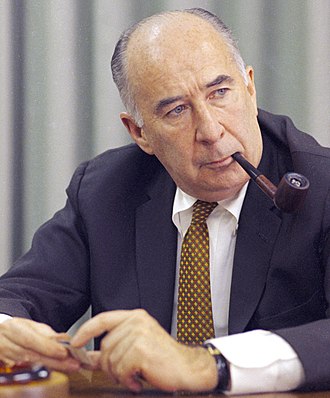
John N. Mitchell served as the 67th Attorney General of the United States from January 1969 until February 1972. He transitioned from the Justice Department to manage Nixon's reelection campaign, serving as the Director of the Committee for the Re-Election of the President (CRP) from March 1972 until his resignation in July 1972 shortly after the Watergate break-in. During the White House taping period, Mitchell was frequently recorded discussing campaign intelligence operations, the ITT antitrust settlement, and the early stages of the Watergate cover-up.
President Nixon and his Cabinet met to discuss the ongoing military operations in Indochina and the development of the administration's national health reform agenda. Regarding the war, officials reviewed the progress of South Vietnamese incursions into Laos and Cambodia, noting that the strategy was successfully disrupting enemy supply lines while shifting the burden of ground operations away from American forces. The conversation then transitioned to a detailed proposal from Secretary of Health, Education, and Welfare Elliot Richardson regarding healthcare reform, with the group debating the costs, tax implications, and administrative feasibility of implementing Health Maintenance Organizations (HMOs) and national health insurance standards.
President Nixon, H.R. Haldeman, and Ronald Ziegler met to discuss the President's upcoming schedule, including a potential press conference and public relations strategies regarding recent media coverage of his trip to Des Moines. Later, John Mitchell joined the meeting to coordinate his own upcoming press conference, specifically focusing on Revenue Sharing and the Law Enforcement Assistance Administration (LEAA). The group prioritized proposing a reorganization of U.S. Capitol Police security, using the President’s successful implementation of the Executive Protective Service as a model, which Nixon subsequently discussed with Speaker Carl Albert.
President Nixon held two distinct meetings in the Oval Office: the first with Turkish diplomat Targut Menemencioglu and his team to discuss geopolitical concerns in Pakistan, India, and Turkey, including the future of the Central Treaty Organization (CENTO); the second with Chief Justice Warren Burger, John Mitchell, and John Dean regarding judicial reform and the President's potential appearance at an American Bar Association event in London. During the first session, Nixon reaffirmed the importance of maintaining U.S. support for Pakistan and stability in the region despite domestic Congressional opposition. The subsequent meeting focused on the need to expedite the criminal justice system in the U.S. and coordinated scheduling for Law Day and judicial conferences.
President Nixon met with his National Security Council and key cabinet officials to receive a high-level briefing on developments in Soviet strategic capabilities, particularly concerning new ICBM silo construction and ballistic missile test programs. The participants evaluated the implications of these technological advancements for U.S. defense posture, including the necessity of maintaining a robust anti-ballistic missile (ABM) system. Discussions emphasized the need for a coordinated approach to strategic negotiations and the potential impact of Soviet military growth on current arms limitation efforts.
President Nixon met with his Cabinet and key staff to discuss the status of the administration's revenue sharing legislative agenda and receive briefings on various international developments. Administration officials reported on their outreach efforts to build public and Congressional support for revenue sharing while addressing opposition from labor and minority groups. Additionally, Cabinet members provided updates on their recent foreign travels, emphasizing the geopolitical successes of the Nixon Doctrine in Southeast Asia and the strengthening of international cooperation on transportation and environmental safety.
President Nixon met with John Mitchell, Robert Dole, and H. R. Haldeman to discuss political strategies, media relations, and the administration's public image regarding the Vietnam War. The participants reviewed the political fallout from recent events, including a physical altercation at the Gridiron dinner and the news of Thomas E. Dewey's sudden death. The conversation focused on framing the President’s Vietnam policy as a major administration achievement while navigating legislative challenges, such as campaign spending reform and opposition from congressional "doves."
President Nixon and the National Security Council met to evaluate U.S. policy options regarding the People's Republic of China's potential admission to the United Nations and the status of Taiwan. Attendees debated the risks of a potential diplomatic defeat, weighing the benefits of "dual representation" versus maintaining the current, increasingly untenable policy of excluding the PRC. The President emphasized the need to manage domestic American public opinion carefully while assessing tactical shifts, ultimately seeking a strategy that minimizes political fallout while addressing the evolving geopolitical reality of China's status.
In this meeting, President Nixon, John Mitchell, and Thomas Pappas discussed domestic and international affairs, focusing on the administration's political challenges and the need to maintain American global influence. Nixon expressed frustration with domestic critics, including intellectuals and the media, while reaffirming his commitment to a principled end to the Vietnam War that would protect U.S. credibility and honor. They also reviewed geopolitical situations in Greece, Italy, and Yugoslavia, with Pappas providing advisory input on foreign relations and the political climate abroad. The President signaled his resolve to pursue his policy agenda despite domestic opposition, specifically mentioning his upcoming meeting with the Congressional Black Caucus.
President Nixon and his Cabinet met to discuss the ongoing challenge of inflation and rising construction costs, focusing on the administration's strategic options for economic stabilization. Dr. Paul McCracken reviewed current inflationary trends and labor market data, outlining a spectrum of potential responses ranging from maintaining current fiscal policies and targeted interventions to implementing more aggressive measures like wage and price controls. The meeting served as a forum to evaluate the efficacy of various regulatory mechanisms, such as the National Commission on Productivity and the suspension of the Davis-Bacon Act, while weighing the political and practical risks of further government intervention in the economy.
President Nixon and Attorney General John Mitchell confer briefly regarding the administration's economic policy and public relations strategy. Nixon expresses a desire to move past political distractions and firmly commit to the administration's primary economic agenda, referencing recent interactions with business leaders. The discussion emphasizes the need for a cohesive, disciplined approach to managing economic policy and public perceptions.
President Nixon met with H.R. Haldeman, John Mitchell, and John Dean to discuss the administration's strategic response to a recent unanimous Supreme Court ruling on school busing. The group focused on distancing the White House from the controversial decision, emphasizing that enforcement should remain the responsibility of local school authorities and district courts rather than federal agencies like HEW. Nixon firmly instructed his staff to avoid taking credit for the ruling, express no personal endorsement of it, and ensure that HEW officials do not overstep their authority in implementing desegregation plans.
President Nixon consulted with Attorney General John Mitchell’s assistant, Sue Morrison, to coordinate a meeting with Mitchell. The President reviewed Mitchell's morning schedule, specifically ensuring he would not miss an HEW staff meeting, before ultimately deciding to schedule the appointment for the afternoon when his own workload with other officials would be lighter. Nixon directed Morrison to clear time in Mitchell’s calendar to accommodate the meeting.
President Nixon met with Alexander P. Butterfield, John N. Mitchell, and H. R. Haldeman to briefly review matters following a photo session. The discussion focused on logistical details regarding a planned trip by Butterfield to Puerto Rico, specifically concerning the duration and base of operations for the visit. The brief exchange concluded before any further administrative or political business could be addressed.
President Nixon met with his administration officials, including John Mitchell, Elliot Richardson, and George Shultz, to coordinate the White House's response to a recent Supreme Court ruling on school desegregation. Concerned about the ruling's political impact and the potential for a "double standard" between the North and South, Nixon directed his subordinates to remain disciplined and avoid proactive initiatives, emphasizing that the administration would comply with the law without going beyond what was strictly required by the courts. The President also instructed his team to keep a low profile on the Ribicoff amendment to avoid further legislative complications while managing upcoming political optics regarding Southern school policies.
President Nixon met with H.R. Haldeman, John Mitchell, and other administration officials to coordinate political strategy regarding ongoing anti-war demonstrations and personnel appointments. The group discussed ensuring peaceful compliance with court orders concerning protestors, while Mitchell provided an update on staffing, including plans to recruit Ken Rush and Vernon Walters for key administration roles. Nixon also instructed Mitchell to delay antitrust litigation against television networks to avoid negative political fallout following the Pentagon Papers controversy, while maintaining his overall goal of aggressively challenging the media establishment.
President Nixon met with his Cabinet and key staff to coordinate legislative strategies and manage domestic policy agendas. The discussion focused on securing passage for welfare reform and other administration priorities by engaging directly with congressional leadership and balancing competing interests within the labor market. Participants assessed the challenges of mobilizing support among both Democrats and Republicans and emphasized the necessity of persistent lobbying and effective communication with legislative committees.
President Nixon and John Mitchell discuss the security management of ongoing anti-war demonstrations in Washington, specifically focusing on the coordination between military and civilian authorities. They address the role of the Capitol Police in handling protesters on congressional grounds and express a cynical willingness to let law enforcement use force if necessary. The President emphasizes the importance of maintaining clear jurisdictional responsibility for the crowd control operations to ensure the demonstrations proceed according to the administration's plan.
President Nixon met with key advisors and congressional leadership to strategize on economic stimulation and political coalition-building. The discussion prioritized directing federal funds and public works projects—particularly in California—to combat unemployment and secure electoral support. Concurrently, Nixon and his aides explored strategies to form a coalition of Republicans and conservative Southern Democrats in Congress to advance key administration goals, including the revival of the Supersonic Transport (SST) program and countering anti-war legislative efforts.
President Nixon met with John Mitchell, John Connally, and Alexander Butterfield to discuss the political landscape ahead of the 1972 election, including campaign organization, potential fundraising strategies, and the roles of key figures like Spiro Agnew, Wilbur Mills, and Maurice Stans. The participants reviewed recent civil unrest and the positive public response to the administration's firm handling of demonstrators in Washington, D.C. Additionally, they evaluated various foreign policy challenges, specifically the Middle East peace negotiations led by William Rogers and strategies for winding down the war in Vietnam, while expressing significant frustration regarding the loyalty and effectiveness of the State Department.
President Nixon met with H.R. Haldeman and other staff members to discuss public relations strategies, specifically focusing on how to capitalize on recent public approval of the administration's firm handling of anti-war protests in Washington, D.C. They reviewed internal polling data showing strong support for the police and authorized the administration to project a tough 'law and order' stance. Furthermore, they coordinated plans to move forward with revenue sharing legislation and addressed the need for better communication strategies regarding foreign policy and upcoming agricultural events.
President Nixon and Attorney General John N. Mitchell discuss the coordination of political outreach involving Chicago Mayor Richard J. Daley and philanthropist W. Clement Stone. The conversation focuses on the Supersonic Transport (SST) program as a primary subject for these interactions. The pair coordinates these efforts to manage Daley’s upcoming visit with the President.
President Nixon consulted with Attorney General John N. Mitchell and close associate Bebe Rebozo following a dinner with White House correspondents held on May 8, 1971. The participants reviewed the evening's events, including the reception of the President's remarks among attendees such as Chief Justice Warren E. Burger and journalist Peter Lisagor. Additional brief discussions touched upon personal matters, including Robert Abplanalp's health, Mother's Day arrangements, and family updates regarding David and Julie Eisenhower.
President Nixon and his Cabinet met to receive a briefing on international affairs and domestic policy, with a focus on Secretary of State William P. Rogers' recent diplomatic travels to the Middle East and the feasibility of desalinization technology. Rogers reported on his efforts to stabilize the Middle East through ceasefire maintenance and discussed the geopolitical concerns of various regional leaders. Dr. Edward E. David Jr. and other experts presented a detailed plan to advance domestic water desalinization and nuclear power capabilities, with the President calling for a major, accelerated federal effort to ensure American technological leadership. The meeting concluded with a brief status report from Treasury Secretary David M. Kennedy regarding the current international monetary situation and the fluctuations of the dollar.
President Nixon held a series of wide-ranging meetings with senior administration officials to discuss legislative priorities, economic policy, and institutional management. Key topics included advancing revenue sharing and welfare reform through strategic cooperation with Representative Wilbur Mills, managing federal aid to higher education, and reorganizing desalinization research. Additionally, the President and his advisors examined anti-trust policy, the financial struggles of the railroad industry, and the positive implications of a revised upward tick in first-quarter Gross National Product (GNP) figures.
President Nixon initiates a conference call with George P. Shultz and John N. Mitchell to facilitate a conversation with John B. Connally. The participants coordinate the logistics of connecting with Connally to address pressing administrative matters. This brief exchange serves primarily as an operational bridge to bring the key advisors together for a broader policy discussion.
President Nixon met with his Cabinet and key advisors to announce a major breakthrough in Strategic Arms Limitation Talks (SALT) with the Soviet Union, culminating in a joint statement to be released simultaneously in both nations. The agreement establishes a framework to prioritize limiting anti-ballistic missile (ABM) systems while pursuing parallel measures for offensive weapons. Nixon emphasized that the breakthrough was achieved by maintaining a strong U.S. defense posture, and he urged his administration to avoid public speculation or detailed commentary that could complicate sensitive ongoing negotiations.
President Nixon met with J. Edgar Hoover, John Mitchell, and senior staff to coordinate a stronger federal response to rising violence against police officers, including the potential implementation of federal insurance benefits for fallen officers' families. The group discussed strategies to foster public support for law enforcement, such as establishing an annual Police Recognition Day and organizing high-profile meetings between the President and police leadership to counter anti-authority sentiment. Additionally, the President issued a directive to create a centralized, independent agency to tackle the national drug crisis, moving responsibilities away from HEW to improve accountability and treatment programs for military personnel.
President Nixon met with Henry Kissinger, John N. Mitchell, and other staff to refine a forthcoming speech at West Point and discuss a wide range of domestic and international political strategy. Key topics included the U.S. response to Soviet naval activity in Cuba, the ongoing effort to manage the Vietnam War in the public consciousness, and organizational strategies for the 1972 primaries, specifically concerning Ohio, California, and Texas. Nixon and Mitchell also reviewed potential personnel appointments and cabinet-level changes, including the roles of Leonard Firestone and Louie Nunn, while finalizing the administration's political positioning regarding Democratic challengers.
President Nixon and Attorney General John Mitchell discuss the political fallout from recent anti-war protests and the media's coverage of law and order issues. The conversation emphasizes the administration's commitment to combatting domestic drug abuse, specifically rejecting the legalization of marijuana and framing the issue as a national crisis rather than one isolated to Vietnam. The two conclude by coordinating plans for a follow-up meeting scheduled for June 3 to address these policy initiatives.
President Nixon met with a large group of law enforcement officials, including J. Edgar Hoover and Attorney General John Mitchell, to discuss the increasing dangers facing police officers and to bolster morale through strong federal support. The conversation covered the need for legislative action, such as federal death benefits for families of slain officers, as well as strategies for better inter-agency cooperation against civil unrest and drug-related crime. Nixon emphasized the importance of public respect for law and order, highlighting recent May Day demonstrations as a point of discussion regarding the administration's firm stance on maintaining public security.
President Nixon met with J. Edgar Hoover, John Mitchell, Egil Krogh, and John Ehrlichman to coordinate an upcoming meeting with law enforcement leaders. The participants discussed the administration's proposed legislation for providing financial compensation to the families of crime victims and strategies for presenting these initiatives to police officials. Nixon specifically instructed Hoover to emphasize the FBI's commitment to providing assistance to local police departments as part of the broader legislative agenda.
President Nixon met with H. R. Haldeman, Robert Dole, and John Mitchell to discuss the administration's political strategy, including the management of the 1972 Republican National Convention site selection and efforts to increase youth voter registration. The group evaluated the political risks of pending legislation, specifically gun control, health care, and public works bills, while coordinating messaging to contrast Nixon's policies with Democratic alternatives. Additionally, the President and his advisors reviewed strategies for handling press relations—including a potential public moratorium for Vice President Agnew—and addressed concerns regarding the Vietnam War, POW repatriation, and the impact of economic issues on his reelection prospects.
President Nixon met with Philadelphia District Attorney Arlen Specter and Attorney General John Mitchell to discuss strategies for the Philadelphia mayoral race, the promotion of law enforcement policies, and broader national concerns regarding drug abuse and judicial reform. Nixon emphasized the importance of securing Philadelphia for future elections and advised Specter to maintain a firm stance on law enforcement without alienating minority voters. The participants also explored the effectiveness of pre-indictment probation programs for addicts and the need to reduce court backlogs to restore public confidence in the judicial system.
President Nixon and Attorney General John Mitchell discuss the political fallout from a recent meeting with police chiefs, specifically regarding the exclusion of New York City Police Commissioner Patrick Murphy. The conversation shifts to the ongoing tensions between New York Governor Nelson Rockefeller and Mayor John Lindsay, with both men criticizing Lindsay’s administrative abilities and his reliance on liberal staff. Finally, they touch upon the political future of Lindsay, speculating on his upcoming speaking engagements in New Hampshire and the viability of his potential political ambitions.
President Nixon and Attorney General John Mitchell discuss political maneuvering and administrative challenges, specifically focusing on the performance and future prospects of political figures like Murphy and Arlen Specter. The conversation touches on the volatile nature of urban conflicts and leadership struggles. Nixon emphasizes the importance of monitoring Specter's career trajectory, characterizing him as a promising figure for the future.
President Nixon, Vice President Agnew, and a large group of Cabinet members and senior staff met to establish a strategic framework for domestic policy, budget planning for the 1973 fiscal year, and the development of the 1972 Republican legislative and election platform. Participants reviewed polling data regarding national, community, and family concerns, noting that the economy, inflation, and unemployment are primary public priorities while other issues like pollution and consumerism are often driven by media visibility. The President and attendees emphasized the need for better communication to receive credit for administration accomplishments, focusing on a limited number of 'gut issues' rather than overextending on too many programs. Ultimately, the group discussed the necessity of coordinating policy initiatives and messaging to ensure visible progress on key economic and social concerns ahead of the 1972 election.
President Nixon met with Marie Lombardi and a large group of associates in the Oval Office to discuss the Vince Lombardi Memorial fund and the broader societal value of sports. The conversation focused on the role of athletics in fostering character, discipline, and competitive drive, with Nixon sharing personal anecdotes about his own experiences as a student-athlete. The meeting concluded with the President presenting commemorative gifts, including cufflinks and golf balls, and pledging his personal financial support to the memorial fund.
President Nixon met with his cabinet, diplomatic staff, and intelligence officials to declare drug abuse 'public enemy number one' and to coordinate a comprehensive strategy for eradicating the international supply of narcotics. The participants evaluated the effectiveness of current interdiction programs in Southeast Asia, the Middle East, and Europe, ultimately concluding that despite increased law enforcement efforts, the drug problem was expanding. The President directed his team to prioritize the escalation of foreign pressure, including potential subsidies for poppy crop eradication in Turkey, and announced the centralization of domestic drug policy under a new White House office.
President Nixon consults with John Mitchell and Henry Kissinger regarding the legal response to the New York Times' publication of classified documents. The participants agree to take a low-key, formal approach by putting the newspaper on legal notice while simultaneously initiating a covert investigation to identify the leakers. Nixon secures support for this stance by leveraging Henry Kissinger's report that former President Lyndon Johnson would publicly back actions taken to defend the integrity of government against such security breaches.
President Nixon, John Mitchell, and Henry Kissinger met to discuss the administration's response to the unauthorized publication of the Pentagon Papers and its potential impact on ongoing peace negotiations. The participants emphasized the need to defend government integrity against the leak while strategizing how to prevent political rhetoric from undermining the North Vietnamese incentive to negotiate. Additionally, Kissinger briefed the President on his upcoming Asia trip, highlighting the diplomatic importance of the China initiative and the necessity of maintaining operational secrecy during his travels.
President Nixon met with John Mitchell, John Ehrlichman, and Ronald Ziegler to discuss the administration's aggressive response to the New York Times' publication of the Pentagon Papers. Nixon characterized the leak as an attack on the presidency and a national security crisis, demanding that his staff sever all contact with the Times and pursue legal action against the newspaper and individuals like Daniel Ellsberg. The participants strategized on framing the documents as the "Kennedy-Johnson Papers" to shift blame to previous administrations while emphasizing the necessity of protecting classified information.
President Nixon and Attorney General John Mitchell discuss the administration's strategic response to the publication of the Pentagon Papers. Mitchell confirms that Secretary of State William Rogers has agreed to issue a public statement, which will be vetted by the White House to ensure it employs strong, evocative language regarding national security breaches. The pair express their determination to sway public opinion against the media's actions and discuss the appointment of Judge Murray Gurfein to handle the case.
President Nixon and Attorney General John Mitchell discuss strategies to manipulate public perception regarding a security breach, specifically emphasizing the need to manufacture a narrative that links the incident to a church. The participants focus on orchestrating a leak or public disclosure to discredit their opponents rather than merely pursuing a standard legal or technical investigation. Nixon commends Mitchell’s tactical approach, signaling approval for these deceptive information operations.
President Nixon met with his National Security Council to discuss strategy for Mutual and Balanced Force Reduction (MBFR) negotiations with the Soviet Union, emphasizing the importance of verification and maintaining allied unity. The President and his advisors examined how to use these potential force reductions to counter domestic congressional pressure for unilateral troop withdrawals. Additionally, the group addressed the ongoing crisis surrounding the publication of the Pentagon Papers, with Nixon expressing a need to strengthen penalties for leaking classified information and to defend the executive branch's ability to maintain secure communications.
President Nixon met with his senior advisors to strategize on managing the political fallout from the release of the Pentagon Papers and the Senate's recent passage of the non-binding Mansfield amendment regarding troop withdrawals. The President decided to counter the growing legislative pressure by emphasizing that the amendment was inconsistent with ongoing diplomatic efforts to secure a ceasefire and prisoner of war (POW) releases, while also directing his team to frame the document leak as a breach of national security perpetrated by the previous Democratic administrations. Additionally, the participants discussed the ongoing legal battle against the New York Times and the Washington Post, weighing the public relations benefits of pursuing the case through the Supreme Court versus allowing the matter to be resolved through congressional inquiry.
President Nixon met with his Cabinet to address the persistent problem of unauthorized leaks within the federal bureaucracy and to establish clear expectations for departmental discipline. He emphasized that decision-making must remain internal and closed to prevent political sabotage, specifically citing the negative impact of leaks on economic policy and administrative unity. Nixon announced that H.R. "Bob" Haldeman would oversee efforts to tighten internal controls, while Secretary John Connally was designated to handle the official announcement of upcoming economic policy decisions.
President Nixon and Attorney General John Mitchell consulted on how to handle potential internal dissension within the FBI regarding the Daniel Ellsberg case. Nixon directed Mitchell to instruct FBI Director J. Edgar Hoover to avoid any actions that could publicly compromise the Bureau's unity, particularly ahead of the President’s scheduled address at the FBI graduation. The conversation emphasized the administration's firm resolve to prosecute Ellsberg for the Pentagon Papers leak to prevent future government personnel from committing similar acts of theft.
President Nixon and Attorney General John Mitchell discussed the necessity of preventing FBI Director J. Edgar Hoover from engaging in actions related to the Daniel Ellsberg case that could spark internal dissent or embarrass the Bureau. Nixon directed Mitchell to personally intervene with Hoover to ensure a united administrative front, emphasizing that protecting the Bureau's integrity and focusing on the prosecution of Ellsberg were paramount. Nixon authorized Mitchell to use his name to reinforce the importance of these instructions while maintaining a firm stance on the administration's commitment to the Ellsberg litigation.
President Nixon and H.R. Haldeman discussed a wide range of administrative and political concerns, focusing heavily on strategies for addressing the leaking of the Pentagon Papers and tightening government security classification systems. The President emphasized his desire to drastically reduce the number of individuals with top-secret clearances and instructed staff to implement a more restrictive, "Presidential" level of classification. Additionally, they reviewed the President's upcoming schedule, including trips and public appearances, and deliberated on personnel matters such as the appointment of an NLRB counsel and potential roles for Marty Anderson.
President Nixon, John Mitchell, and H.R. Haldeman discuss the ongoing legal strategy regarding the Pentagon Papers case, specifically expressing concern over the Supreme Court's unexpected request for data on U.S. war casualties since World War II. Mitchell confirms that legal action against Daniel Ellsberg will proceed regardless of the Court's pending ruling to prevent future unauthorized leaks. Nixon emphasizes the necessity of framing the prosecution to avoid creating a martyr and to ensure government employees are deterred from similar disclosures.
President Nixon met with Henry Kissinger and Attorney General John Mitchell to discuss the legal and political fallout following the Supreme Court's ruling on the Pentagon Papers. The President directed his team to aggressively pursue the criminal case against Daniel Ellsberg, emphasizing that they should utilize leaks to the press to discredit him and his supporters. They also strategized on reforming the executive classification system to prevent future unauthorized disclosures of presidential memoranda and sensitive national security information.
President Nixon met with his senior advisors, including H.R. Haldeman, Henry Kissinger, John Mitchell, and Melvin Laird, to determine the administration's strategy following the Supreme Court's ruling allowing the publication of the Pentagon Papers. The President rejected the idea of broad declassification as a response to the court defeat, fearing it would appear like an admission that the government's classification system was worthless. Instead, he decided to maintain a hard line on the prosecution of Daniel Ellsberg, pursue investigations into potential leaks and conspiracies within the government, and direct his staff to target the Brookings Institution to recover classified materials.
President Nixon met with John Mitchell, H. R. Haldeman, and John Ehrlichman primarily to discuss the ongoing investigation into the leak of the Pentagon Papers and the prosecution of Daniel Ellsberg. The participants strategized on how to expose the existence of a broader conspiracy, suggesting that the administration should leverage media leaks and congressional committees to sway public opinion. Nixon emphasized the need for strict control over the investigative process, instructing that no final indictments be issued without his direct approval while the team continued to build their case.
President Nixon held a series of meetings involving staff and administration officials to coordinate on several pressing domestic and economic policy matters. The participants discussed legislative strategy regarding the Lockheed Corporation, the political risks associated with school busing and desegregation litigation in Texas, and the appointment of William D. Eberle as the new Special Trade Representative. Nixon emphasized a transition toward prioritizing domestic interests in international trade negotiations and sought to align his team on messaging regarding the administration's stance on school integration compliance.
President Nixon met with H.R. Haldeman and John Mitchell to discuss a wide-ranging agenda encompassing the 1972 campaign strategy, potential Cabinet-level personnel shifts, and upcoming major economic policy decisions. The group evaluated the political ramifications of the President's recent overtures to China, the ongoing busing controversy, and the necessity of managing conservative Republican factions. A significant portion of the discussion focused on a proposed package of economic interventions, including a possible wage and price freeze, to address domestic inflation and international monetary concerns. These deliberations underscored a transition toward more direct administrative control over economic policy as the 1972 election cycle approached.
President Nixon met with Vice President Agnew and his Cabinet to discuss the administration's foreign policy objectives and the state of the national economy. Agnew briefed the attendees on his recent international tour, highlighting the global reception of the Nixon Doctrine and the challenges posed by the Arab-Israeli conflict, East Pakistan, and the increasing Soviet and Chinese presence in various regions. Nixon and his advisers subsequently addressed the economic outlook, emphasizing the need for an aggressive, unified defense of administration policies regarding inflation and unemployment, while dismissing the viability of permanent wage and price controls. Finally, the President mandated a strict reduction in government personnel and grade-level escalation to improve budget management across executive departments.
President Nixon met with the Cabinet Committee on Opportunities for the Spanish Speaking (CCOSS), led by Dr. Henry M. Ramirez, to discuss increasing Hispanic representation and employment within the federal government. Emphasizing that the administration must proactively identify and promote talent rather than waiting for external political pressure, the President linked the development of human resources to the broader necessity of maintaining American economic competitiveness against global rivals like Japan and Western Europe. Nixon formally charged cabinet members to improve departmental hiring practices and mandated regular progress reports to ensure accountability in expanding opportunities for Hispanic Americans.
President Nixon met with Senator James L. Buckley and Attorney General John N. Mitchell to discuss the administration’s foreign policy, specifically ongoing developments regarding the People’s Republic of China and the Soviet Union. Nixon emphasized his commitment to maintaining a strong national defense, detailing his efforts to secure congressional support for military hardware, including the ABM system and naval modernization, despite resistance from Democrats. The participants discussed strategies to leverage conservative support for defense spending while countering potential budget cuts proposed by political rivals in the lead-up to the 1972 election. Nixon proposed arranging a private briefing for influential conservatives to provide them with the strategic data necessary to advocate for his defense priorities.
President Nixon met with John Mitchell, H.R. Haldeman, and Henry Kissinger to address serious unauthorized leaks of sensitive government documents, specifically a Kissinger memorandum regarding talks with Chou En-lai and a proposed "gold window" economic policy. The President expressed intense frustration over the disclosures in Paul Scott’s column and directed his staff to identify the sources, suspecting potential leaks from the Treasury Department or the Council of Economic Advisers. Additionally, the group discussed political strategies for managing the Kent State grand jury announcement, handling the Teamsters' request for Jimmy Hoffa's pardon, and balancing the President's public appearances before veterans' organizations.
President Nixon and members of the National Security Council met to review the Fiscal Year 1973 defense budget and evaluate U.S. strategic capabilities relative to the USSR. The discussion centered on balancing budgetary constraints with the requirements of the Nixon Doctrine, specifically regarding troop deployments in Europe, East Asia, and the need for flexible "swing forces." The participants assessed the modernization of strategic forces, naval requirements, and the political implications of U.S. military presence abroad in the context of ongoing diplomatic negotiations with China and the Soviet Union.
President Nixon met with his staff and advisors to organize a crucial upcoming strategy session at Camp David regarding his forthcoming economic program. The discussion focused on finalizing the details of his August 16, 1971, address, specifically addressing the closing of the gold window, the implementation of import taxes, and the mechanics of a wage-price freeze. Nixon emphasized the need for decisive action and strict control over the bureaucratic process to ensure a coherent policy rollout, while also addressing ongoing concerns regarding school desegregation and busing litigation.
President Richard Nixon met with John N. Mitchell to finalize preparations for the administration's major economic policy announcement, specifically the upcoming wage and price freeze. The two discussed key components of the new program, including tax incentives, budget cuts, revenue sharing, and the decision to close the gold window. They also coordinated the President's schedule, including an upcoming cabinet meeting and the rollout of his national address regarding these fiscal measures.
President Nixon and John Mitchell discuss the successful delivery and public reception of the President's recent televised speech announcing a major wage-price freeze and international economic policy shift. The conversation highlights the strategic decision to prioritize domestic concerns like jobs and the cost of living over complex monetary explanations to ensure a compelling message. Nixon tasks Mitchell with coordinating with Treasury Secretary John Connally to ensure that interest rates and corporate dividend limits are emphasized during upcoming press briefings to maintain public support.
President Nixon convened a large meeting with Vice President Agnew and his Cabinet to discuss the national economy and the "New Economic Policy" he had announced the previous day. Key topics included the wage-price freeze, import surcharges, tax relief, budget cuts, and the convertibility of the dollar. The administration sought Cabinet support for these initiatives and discussed their potential impact on international trade and domestic employment.
President Nixon met with George Shultz and John Mitchell to address pressing domestic challenges, including economic policy during the Phase I wage-price freeze, ongoing labor disputes like the West Coast dock strike, and the legislative strategy for the 1972 federal budget. The group discussed the political and legal complexities of the Justice Department's Will Wilson situation and the potential for granting executive clemency to Teamsters leader Jimmy Hoffa to secure labor support for the 1972 election. Nixon instructed his advisors to maintain a firm public stance on these issues while continuing to navigate the potential political risks associated with his administration's economic and personnel decisions.
President Nixon, Pat Nixon, and the Cabinet met with their spouses to discuss the implementation and public perception of the administration’s New Economic Policy. Secretary of the Treasury John Connally led a comprehensive briefing on the wage-price freeze, tax reforms, and international monetary adjustments aimed at curbing inflation. The discussion emphasized the necessity of these economic measures for restoring national growth, managing federal expenditures, and building public and congressional support for the administration's program.
President Nixon met with his inner circle, including John Mitchell, Henry Kissinger, and John Ehrlichman, to discuss a range of urgent issues including Middle East tensions, the SALT negotiations, and Supreme Court vacancies. The President directed that the Middle East situation be kept low-profile to avoid political complications, emphasized the need for a conservative nominee to fill the Supreme Court vacancy, and ordered his staff to secure comprehensive files on the Bay of Pigs and the Pentagon Papers to better manage political messaging. Additionally, the participants reviewed economic indicators, discussed the President's public relations strategy regarding J. Edgar Hoover, and brainstormed ways to capitalize on the Democratic Party's internal divisions.
President Nixon consulted with H. R. Haldeman, John Mitchell, and Ron Ziegler regarding the timing of the announcement of Justice John M. Harlan's resignation from the Supreme Court. The group discussed creating a 'double play' strategy by announcing two judicial appointments simultaneously to maximize political leverage. Additionally, Nixon reviewed his upcoming schedule—including potential trips to Florida and Disney World—and discussed public comments regarding the possible departure of the Washington Senators baseball team from the nation's capital.
President Nixon and Attorney General John Mitchell discuss the strategy for announcing the resignation of Supreme Court Justice John M. Harlan. Nixon aims to coordinate the announcement with the Chief Justice to prevent negative press speculation and secure a favorable news cycle. Mitchell agrees to contact the Chief Justice immediately to determine the status of the resignation and assess the feasibility of an afternoon press briefing.
Attorney General John Mitchell updates President Nixon on the health status of Supreme Court Justice John Marshall Harlan, who is currently undergoing medical tests. Mitchell reports that Chief Justice Warren Burger is coordinating the situation and intends to handle the matter with discretion to prevent premature leaks regarding Harlan’s potential departure. Nixon instructs Mitchell to ensure Burger manages the timing carefully, prioritizing both political sensitivity and speed.
President Nixon met with John Mitchell and Arthur Burns to discuss a range of sensitive political and economic issues, including potential Supreme Court appointments following Justice John Harlan's resignation and the administration's international economic strategy. The participants evaluated the challenges of currency realignment, the gold standard, and U.S. negotiating positions ahead of upcoming international meetings with central bankers and finance ministers. Additionally, they addressed the implementation of the administration's post-freeze 'Phase II' economic policies and the importance of securing labor cooperation to maintain public support for these initiatives.
President Nixon met with the National Security Council and senior advisors to conduct an extensive assessment of the deteriorating political and military situation in South Vietnam, focusing on the stability of the Nguyen Van Thieu administration and the threat posed by opposition factions and communist forces. The discussion covered strategic military planning for the upcoming dry season in Cambodia and Laos, the progress of Vietnamization, and the implications of U.S. troop withdrawal timelines on both the battlefield and domestic public opinion. Participants also evaluated the potential impact of diplomatic initiatives, including the President's announcement regarding Henry Kissinger’s trip to Peking, on North Vietnam's strategic calculations and internal morale.
President Nixon and John Mitchell discuss the strategy for upcoming Supreme Court nominations, specifically evaluating potential candidates such as Richard H. Poff and Lawrence E. Walsh. The conversation centers on navigating the approval process within the House and Senate, ensuring the candidates meet conservative criteria, and considering the political advantages of appointing a Catholic jurist. Nixon tasks Mitchell with vetting candidates for these qualifications and coordinating with House leadership, specifically Jerry Ford, to secure support for the nominations.
President Nixon, Vice President Agnew, and members of his Cabinet met to coordinate a unified administration strategy ahead of critical International Monetary Fund (IMF) meetings and ongoing global trade negotiations. The discussion emphasized the necessity of maintaining the recently imposed 10% import surcharge and a firm bargaining stance to address the nation's economic balance of payments and reshape the international monetary system. Nixon and his advisors agreed that while foreign partners would likely criticize U.S. policy, maintaining domestic political support and correcting long-standing trade imbalances remained the administration's primary objective.
President Nixon and H.R. Haldeman review the positive public and political reception of the President's recent appearance at the Detroit Economic Club, noting the favorable impact on his economic policies. The conversation shifts to logistical planning for upcoming presidential travel to Montana and Alaska, as well as discussions regarding the strategic utility of disparaging remarks made by a media commentator. Haldeman and the President weigh the benefits of exposing the commentator's bias to CBS affiliates to diminish his influence.
President Nixon and Attorney General John Mitchell coordinate an afternoon golf outing at Burning Tree Country Club. Nixon directs Mitchell to reschedule an antitrust meeting with John Ehrlichman to accommodate their plans. The two men agree to meet at the course to tee off at 2:30 p.m.
President Nixon and John Mitchell discussed strategies for securing the confirmation of Richard H. Poff to the Supreme Court, acknowledging the political challenge of his Southern background and limited legal practice. The President expressed a strong preference for nominating a conservative jurist and, despite his personal reservations, considered the political necessity of appointing a woman, specifically Judge Mildred L. Lillie, to appeal to changing national sentiments. Additionally, Nixon directed Robert Finch to undertake a diplomatic mission to Latin America to bolster U.S. relations, positioning the trip as a strategic initiative for his 1972 campaign.
President Nixon and Attorney General John Mitchell discuss the ongoing search for Supreme Court nominees, specifically evaluating potential candidates such as David Dyer, Mildred L. Lillie, and Hershel H. Friday. They review the political viability of these candidates, including the necessity of securing support from key Senate figures like James O. Eastland and John L. McClellan. The conversation concludes with Nixon urging Mitchell to finalize the list of nominees, with Mitchell pledging to deliver a formal package of candidates before the end of the week.
President Nixon consulted with aides John Mitchell, Charles Colson, H. R. Haldeman, Henry Kissinger, and John Connally regarding strategic messaging for the upcoming Phase II economic policy and the political fallout of his planned trip to the People's Republic of China. The participants coordinated a media roll-out for the economic plan, specifically scheduling Connally to hold a follow-up press conference to anchor the administration's position after the President’s speech. Additionally, the group discussed the positive impact of the China announcement on foreign policy optics, successfully shifting media focus away from the recent South Vietnamese election.
In a wide-ranging series of discussions, President Nixon consults with H. R. Haldeman, Daniel P. Moynihan, John N. Mitchell, and Arthur F. Burns on domestic political strategy and the management of sensitive public narratives. Key topics include the limits of social policy, the political implications of intelligence testing, and defensive tactics against hostile press coverage involving Charles Rebozo and Ramona Banuelos. The President explicitly directs Mitchell to use Immigration and Naturalization Service (INS) enforcement powers against political adversaries, specifically targeting the Los Angeles Times and various Democratic-aligned interests to neutralize criticism.
President Nixon instructed Attorney General John Mitchell to launch an aggressive investigation into the Los Angeles Times for potential immigration violations, specifically regarding the hiring of undocumented workers. Targeting publisher Otis Chandler, Nixon demanded a review of Chandler's personal staff to see if his gardener was an undocumented immigrant. The President emphasized that he wanted this directive carried out immediately and expected a formal report on the findings.
President Nixon directs Attorney General John Mitchell to purge specific personnel within the Immigration and Naturalization Service, specifically demanding the immediate removal of Rosenberg for unauthorized media appearances and challenging the loyalty of Raymond F. Farrell. Nixon expresses frustration over leaks regarding his San Clemente property and demands stricter bureaucratic discipline to counter political opposition. Furthermore, the President informs Mitchell that he has instructed Treasury Secretary John Connally to initiate income tax investigations against the Chandler family and those targeting Billy Graham.
President Nixon met with John Mitchell and John Ehrlichman to discuss high-level personnel and policy matters, specifically focusing on potential Supreme Court nominees, school busing legislation, and tensions regarding FBI Director J. Edgar Hoover. The group evaluated candidates such as Robert C. Byrd and Howard H. Baker Jr., while also debating the merits of a constitutional amendment versus legislative action to address court-ordered busing. Additionally, the President and his advisors addressed the secure handling of sensitive files related to the Pentagon Papers investigation and contemplated how to manage Hoover’s increasingly difficult tenure.
President Nixon and Attorney General John Mitchell discuss strategy for upcoming Supreme Court nominations, specifically focusing on the potential candidacy of Senator Robert C. Byrd and the reactions of various political figures. They coordinate the timeline for submitting names to the American Bar Association and the Senate while considering the use of a "smokescreen" to manage political optics. The two decide to inform Chief Justice Warren E. Burger in advance about the nomination of Mildred L. Lillie to maintain professional relations and ensure a smooth confirmation process.
President Nixon and Attorney General John Mitchell discuss the political landscape surrounding upcoming judicial nominations and the influence of Senate lobbying. They evaluate the ideological positioning of potential candidates, noting the importance of choosing individuals who align with the administration's conservative agenda. The two agree to maintain strategic ambiguity regarding the timing of the nominations to keep Senate pressure in their favor.
President Nixon met with Italian Foreign Minister Aldo Moro and his delegation to discuss European foreign policy, the international role of the United States, and the upcoming United Nations vote concerning the representation of Taiwan and the People's Republic of China. Nixon emphasized the necessity of close cooperation among the world's major powers to ensure global stability, while acknowledging Italy's difficult domestic and international balancing act. The conversation also touched on Nixon's ongoing efforts regarding the Middle East and the importance of maintaining a unified, responsible front among Western allies.
President Nixon and Attorney General John Mitchell discuss political considerations regarding potential Supreme Court nominations and judicial appointments. Nixon expresses frustration over Secretary of Transportation John Volpe's persistent pressure to appoint an Italian-American to the Supreme Court, while also tasking Mitchell with managing these lobbying efforts to shield the President's time. Additionally, the pair discusses the progress of Mildred L. Lillie's vetting process for a Supreme Court seat, with Nixon emphasizing the political optics of potentially appointing the first woman to the Court.
President Nixon and Attorney General John Mitchell discuss the pending Supreme Court nomination of Mildred L. Lillie, focusing on the optics of her marital status and religious background. The two men deliberate on the political advantages of emphasizing her marriage to an Italian-American, A.V. Falcone, and explore the potential electoral benefits of identifying her as Catholic. Nixon directs Mitchell to verify her religious and ethnic details to ensure the nomination is presented in the most favorable light.
President Nixon and Attorney General John Mitchell discuss the vetting process for the potential Supreme Court nomination of Mildred L. Lillie. They evaluate the political advantages of her Catholic faith and her marriage to an Italian husband, while also reviewing her judicial record and her husband’s professional background. Mitchell confirms that a nomination package is being prepared for the President's final approval to ensure the appointment remains on schedule.
President Nixon and Attorney General John Mitchell engage in a brief, informal discussion concerning the personal background and familial connections of an unidentified woman. The exchange focuses on navigating social or professional arrangements, with Nixon inquiring about the woman's awareness of upcoming plans. Their dialogue highlights a degree of personal rapport as they confirm details regarding her Catholic faith and her husband's profession.
President Nixon met with his Cabinet and key staff members to review the administration’s domestic and foreign policy priorities, primarily focusing on the economic transition to 'Phase II' and the announcement of a 1972 Soviet summit. Officials discussed the successful implementation of the wage-price freeze and the strategy for securing organized labor's cooperation on the newly formed Pay Board and Price Commission to curb inflation. Additionally, the President addressed the importance of linking economic policy to job growth through his pending tax proposals, while Secretary of State Rogers and the President emphasized that international diplomatic overtures toward the Soviet Union and China were part of a cohesive, long-term strategy for global peace.
President Nixon met with John N. Mitchell and John D. Ehrlichman to discuss the vetting and selection of nominees for the Supreme Court, specifically Herschel H. Friday and Mildred L. Lillie. The participants evaluated the candidates' judicial backgrounds, conservative credentials, and potential obstacles to confirmation, such as past clients and political affiliations. They emphasized the importance of ensuring the nominees' ideological suitability and agreed to initiate thorough background checks while considering the potential reactions of Senate Democrats and Republicans.
President Nixon and Attorney General John Mitchell discuss their strategy for upcoming Supreme Court nominations following an unauthorized leak of potential candidates to the American Bar Association (ABA). To mitigate negative press and manage public perception, the President instructs Mitchell to provide additional, diverse names to the ABA to create confusion and dilute criticism. They finalize a plan to delay the formal announcements to avoid media focus on specific appointees—particularly a potential female candidate—by introducing them in a staggered manner on television to maintain control of the narrative.
President Nixon and John Mitchell discuss political strategy for the 1972 election, focusing on undermining Democratic opponents and capitalizing on the President's public approval ratings. They analyze the impact of Nixon’s recent foreign policy initiatives—specifically planned visits to China and the Soviet Union—and their effect on demoralizing the Democratic field. The conversation also touches on media management, emphasizing the need to keep the administration's narrative focused on domestic prosperity and presidential leadership while minimizing the political damage caused by negative press coverage.
President Nixon met with John Ehrlichman and John Mitchell to discuss potential Supreme Court nominees, specifically focusing on Herschel H. Friday and Mildred L. Lillie. The participants evaluated the candidates' judicial philosophies and potential for Senate confirmation, with Nixon emphasizing his desire for conservative appointees who would align with his administration's views. The meeting concluded with plans to finalize the nomination strategy, including coordinating with key political figures and preparing for upcoming announcements.
President Nixon met with Henry Kissinger, John Mitchell, and John Ehrlichman to discuss high-level administration business, ranging from foreign policy to domestic personnel matters. The primary focus of the session was an extensive deliberation regarding potential Supreme Court nominees—specifically evaluating candidates like Herschel Friday and Mildred Lillie—amidst reports of Chief Justice Warren Burger’s dissatisfaction and rumored resignation threats. Additionally, the group reviewed internal FBI tensions, including the management of William C. Sullivan and the leadership status of J. Edgar Hoover, as well as various trade and political scheduling issues.
Attorney General John N. Mitchell received a briefing from the White House operator regarding the travel schedule of Lewis F. Powell, Jr. The discussion confirmed that Powell would be reachable at the Waldorf-Astoria in New York later that evening. Mitchell decided to postpone his scheduled outreach to Powell until he returned to his office on Wednesday.
President Nixon, John Mitchell, and John Ehrlichman met to strategize on upcoming Supreme Court nominations, specifically evaluating candidates like Lewis Powell, William French Smith, and Herschel Friday. They discussed the complications of appointing a woman to the Court, focusing on the potential for the American Bar Association (ABA) to deem a female candidate unqualified, which the President sought to avoid to prevent political backlash. Ultimately, Nixon decided to prioritize the nomination of Lewis Powell, aiming to finalize the selection while managing the ABA's evaluation process through Mitchell's liaison, Lawrence Walsh.
President Nixon, John Mitchell, and H.R. Haldeman met in the Oval Office to strategize on impending Supreme Court nominations and the administration's relationship with the American Bar Association (ABA). The discussion centered on vetting candidates—specifically Lewis F. Powell, Jr., Howard H. Baker, Jr., and various women—while navigating potential political fallout and media criticism regarding judicial qualifications. The President decided to prioritize Powell and expressed a willingness to move forward with nominees like Baker even if they did not receive full ABA approval, aiming to limit the influence of the organized bar and avoid public controversies similar to past nomination failures.
President Nixon and Attorney General John Mitchell discuss the political viability of potential Supreme Court nominees amidst opposition from the Los Angeles Bar Association. They specifically weigh the negative feedback regarding Mildred L. Lillie against the ongoing search for other candidates. The conversation concludes with a status update on the exploratory discussions being held with Lewis F. Powell, Jr.