Ford, Gerald R.
During the Nixon administration, Gerald R. Ford served as the House Minority Leader, representing Michigan as a Republican and acting as a crucial legislative ally for the White House throughout the taping period. Following the resignation of Spiro Agnew, Ford transitioned to the executive branch when he was sworn in as Vice President of the United States in December 1973. He held this position until August 1974, when he ascended to the presidency upon Richard Nixon's resignation.
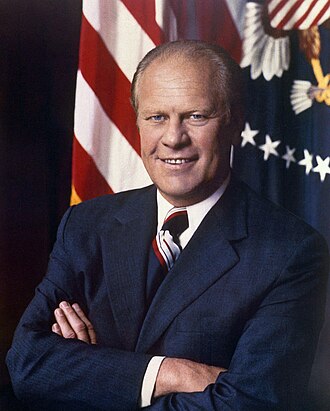
President Nixon met with Republican congressional leaders and cabinet members to discuss rural development initiatives and solicit support for the administration's policy agenda. Secretary of Agriculture Clifford Hardin and staff provided an extensive briefing on the status of rural America, highlighting demographic shifts and explaining the mechanics of proposed federal revenue-sharing programs designed to foster economic growth. Participants also reviewed legislative priorities, including the upcoming vote on the supersonic transport (SST) appropriation and other pending congressional business.
President Nixon, H. R. Haldeman, and Representative Gerald Ford discussed the potential appointment of journalist John Scali to a senior White House role intended to improve the administration's public relations and media strategy. Nixon emphasized the need for a seasoned professional to help streamline communication and counter negative media coverage, specifically regarding Vietnam and the Supersonic Transport (SST) funding vote. They also coordinated logistics for the upcoming funeral of Thomas E. Dewey, including seating arrangements and travel, while reflecting on the political challenges of the administration's legislative agenda.
President Nixon met with Vice President Agnew and Republican Congressional leaders to secure support for two of his primary initiatives: the Supersonic Transport (SST) program and a major government reorganization plan. Secretary of Transportation John Volpe advocated for the SST by addressing environmental, economic, and technological concerns, arguing that the project was essential for U.S. aviation preeminence and long-term economic growth. Subsequently, John Connally detailed the work of the Ash Council, urging the legislators to embrace a fundamental restructuring of the executive branch to improve government efficiency, accountability, and public trust. Nixon emphasized that these measures were critical for ensuring that his administration could effectively manage federal programs and maintain the nation's competitive edge.
President Nixon met with Congressional leaders Hugh Scott and Gerald Ford, along with staff members, to strategize on critical legislative and foreign policy challenges. The participants focused on securing support for the Supersonic Transport (SST) program to prevent Soviet market dominance and discussed messaging strategies regarding the ongoing military operations in Laos and Vietnamization. Nixon emphasized the importance of executive leadership and bipartisan cooperation while addressing concerns over Congressional polling pressures and upcoming milk price support decisions.
President Nixon met with Gerald R. Ford and Alexander P. Butterfield in the Oval Office for a brief, informal encounter. The discussion was limited to pleasantries and casual observations regarding the weather. No substantive policy matters or official administrative decisions were recorded during this four-minute interaction.
President Nixon and Congressman Gerald Ford discuss their mounting concerns regarding House Majority Leader Hale Boggs, whom they characterize as mentally unstable and prone to substance abuse. Due to fears that Boggs cannot be trusted with sensitive information, the President decides to exclude him from an upcoming briefing with congressional leaders. Nixon instructs Ford to consult with Speaker Carl Albert to restructure the meeting to include only Ford and Albert from the House, ensuring that classified matters regarding Vietnam negotiations can be shared securely.
President Nixon and Representative Gerald Ford discuss strategy for managing sensitive legislative meetings, specifically seeking to limit attendance to key congressional leaders like Carl Albert to maintain confidentiality. Nixon expresses frustration with political criticism of the FBI and explores ways to bypass public disclosure concerns by restricting the group size for upcoming discussions. The conversation concludes with a plan for Ford to coordinate the meeting logistics while Nixon emphasizes his desire to share confidential insights without the risks associated with larger, record-heavy briefings.
President Nixon met with key Congressional leadership, including Hugh Scott, Robert Byrd, Robert Griffin, Gerald Ford, and Carl Albert, to brief them on his upcoming televised address regarding Vietnam policy. The discussion focused on the administration's plan for troop withdrawals, the handling of the Prisoner of War (POW) issue, and the strategic rationale behind ongoing U.S. air operations in Southeast Asia. Nixon emphasized the need for flexibility in negotiations and stressed that Congressional support was essential to maintaining a credible bargaining position against North Vietnam.
President Nixon met with Vice President Agnew and Republican Congressional leaders to discuss the administration's legislative and economic agenda. The participants analyzed current economic indicators, including inflation and productivity, and evaluated the implementation of the Task Force for International Development's recommendations regarding foreign and military aid. Additionally, the group addressed the future of the military draft, focusing on pay increases and the transition toward an all-volunteer force while assessing potential legislative hurdles in Congress.
President Nixon met with Gerald Ford, John Byrnes, Elliot Richardson, and other key administration officials to develop a strategy for the administration's health insurance bill. The discussion focused on the political and economic risks of placing the financial burden of the plan on small business owners and marginal employers. To address these concerns and counter potential Democratic opposition led by Edward Kennedy and Wilbur Mills, the group decided to introduce a bill that signals the administration's awareness of the economic impact on small businesses while keeping options open for committee modifications.
President Nixon met with Vice President Agnew, Treasury Secretary John Connally, and Republican Congressional leaders to address critical economic and legislative challenges. The primary focus was the potential bankruptcy of the Lockheed Corporation and the necessary legislative strategy to secure government loan guarantees to prevent a ripple effect of industrial failures and job losses. Additionally, the group reviewed the administration's legislative priorities, including welfare reform, general and special revenue sharing, and the status of various appropriations bills.
President Nixon met with Republican congressional leadership, including Hugh Scott and Gerald Ford, to coordinate the administration’s messaging on key domestic and economic issues. The discussion focused on framing the recent mass arrests of anti-war protesters as a necessary measure to maintain public order against vandalism. Additionally, the President urged the leaders to publicly support the Lockheed loan guarantee as a critical initiative for protecting peacetime jobs, aiming to preempt political opposition from Democratic rivals.
President Nixon met with key advisors and congressional leadership to strategize on economic stimulation and political coalition-building. The discussion prioritized directing federal funds and public works projects—particularly in California—to combat unemployment and secure electoral support. Concurrently, Nixon and his aides explored strategies to form a coalition of Republicans and conservative Southern Democrats in Congress to advance key administration goals, including the revival of the Supersonic Transport (SST) program and countering anti-war legislative efforts.
President Nixon and H.R. Haldeman reviewed the President's upcoming schedule, focusing on the "Salute to Agriculture" event and strategies for congressional outreach regarding the Supersonic Transport (SST) and war-related resolutions. The two discussed domestic political tactics, including the potential for polling public sentiment on war protests and managing the optics of POW/MIA casualty reports. Nixon also directed staff to take a more aggressive, "workmanlike" approach to administrative initiatives, such as the cancer program and breeder reactor funding, to ensure the White House receives proper political credit.
President Nixon and Congressman Gerald Ford discussed legislative strategy regarding the funding of the Supersonic Transport (SST) and upcoming appropriations bills. They explored linking the SST vote to other legislative priorities, such as Lockheed funding, to pressure key members of Congress. Additionally, the President urged Ford to utilize new polling data to sway lawmakers against the pending end-the-war resolution by emphasizing public opposition to a hasty withdrawal.
President Richard Nixon and Representative Gerald R. Ford discussed legislative strategy regarding the upcoming Congressional vote on the Supersonic Transport (SST) program. The two leaders reviewed lobbying efforts and potential political influence, including Ford’s outreach to figures like John N. Mitchell, Richard J. Daley, and W. Clement Stone. Additionally, they coordinated plans for a breakfast meeting involving key Congressional leadership to advance the administration's revenue sharing proposals.
President Nixon and House Minority Leader Gerald Ford discussed the precarious vote count regarding the Supersonic Transport (SST) funding bill in the House of Representatives. Following a narrow victory in a preliminary teller vote, the two reviewed legislative strategy and the potential need for presidential intervention to secure additional support. Nixon urged Ford to maintain his coalition and prepare to deploy extra votes if necessary, requesting an immediate update once the final results were tallied.
President Nixon and Representative Gerald R. Ford discussed the successful 201-197 House vote to revive the Supersonic Transport (SST) program. The two leaders strategized on how to maintain momentum for the upcoming Senate vote, specifically identifying key Democratic swing votes and potential lobbyists like George Meany. Nixon committed to personally contacting Senator John Sherman Cooper while planning to recognize the House members who supported the administration's position.
President Nixon met with his Cabinet and Republican Congressional leaders to coordinate the administration's legislative agenda, specifically addressing the ongoing national railroad strike and the upcoming Congressional vote on the military draft. The discussion also focused on foreign policy, with Secretary of Defense Melvin Laird and Henry Kissinger providing briefings on the status of NATO, the credibility of U.S. military commitments in Europe, and the implications of recent Soviet statements regarding mutual force reductions. The President urged the Congressional leaders to maintain a firm stance against unilateral U.S. force withdrawals while emphasizing the need to handle these matters through stable, negotiated frameworks rather than disruptive legislative amendments.
President Nixon met with Vice President Agnew and a bipartisan group of Congressional leaders to announce a significant diplomatic breakthrough in the Strategic Arms Limitation Talks (SALT). Nixon informed the attendees of a forthcoming joint statement with the Soviet Union pledging to focus on limiting anti-ballistic missile (ABM) systems and certain offensive strategic weapons. While some lawmakers advocated for immediate unilateral U.S. defense cuts to demonstrate good faith, the President and his advisors successfully urged the leaders to maintain existing defense programs during the negotiations to avoid losing vital bargaining leverage.
President Nixon and his advisors met to finalize the announcement of the Strategic Arms Limitation Talks (SALT) agreement and coordinate the administration's strategy for managing congressional and public reactions. The discussion focused on emphasizing the historic nature of the deal—despite its initial status as a framework—and included logistical planning for a televised address and related press briefings. Additionally, the President addressed minor White House operational concerns, such as plumbing issues in his residence, while maintaining focus on the political leverage gained through recent ABM (Antiballistic Missile) defense initiatives.
President Nixon and Representative Gerald Ford discussed the political fallout of the administration’s recent Strategic Arms Limitation Talks (SALT) announcement, noting that it successfully neutralized criticism from J. William Fulbright and congressional “doves.” Nixon emphasized that this diplomatic breakthrough was only possible because of the administration's firm stance on the antiballistic missile (ABM) program. Ford reaffirmed his support and committed to ensuring the passage of the necessary ABM authorization and appropriation measures in the House.
President Nixon met with Republican congressional leaders, including Gerald Ford and Leslie Arends, to discuss strategies for defeating proposed legislative amendments that would mandate a withdrawal date for U.S. troops in Vietnam. The President emphasized that setting a legislative deadline would undermine sensitive, ongoing, and potentially critical negotiations, while also damaging the U.S. position regarding the return of prisoners of war. Nixon and the leadership agreed to maintain a firm stance against these anti-war resolutions to protect executive authority and preserve bargaining power, while assuring the lawmakers that the administration remained committed to ending the war and ensuring political success for the party.
President Nixon met with Republican Congressional leaders to discuss the administration’s new, multi-pronged national strategy for combating drug abuse, emphasizing a shift toward treatment, rehabilitation, and the creation of a centralized Special Action Office. During the discussion, Nixon and his team outlined plans for increased interdiction, expanded military detoxification programs, and a firm, non-permissive stance against the legalization of marijuana. Furthermore, the participants addressed the political climate surrounding the Vietnam War, with Nixon urging support against anti-war amendments and arguing that congressional deadlines for withdrawal would undermine sensitive ongoing negotiations.
President Nixon met with a bipartisan group of Congressional leaders and administration officials to propose a centralized federal office for coordinating drug abuse prevention and treatment strategies. The discussion highlighted the urgency of addressing drug addiction, particularly among servicemen in Vietnam and youth in the United States, by shifting from a fragmented, multi-agency approach to a unified, performance-based model. Participants debated the integration of law enforcement, research, and treatment programs, with an emphasis on establishing flexible, community-based solutions and securing Congressional support for new enabling legislation.
President Nixon and Representative Gerald R. Ford discuss recent legislative successes, noting the importance of these victories in demonstrating national strength to North Vietnam. The two also address the administration's aggressive stance against drug trafficking and the political controversy surrounding the New York Times' publication of the Pentagon Papers. Nixon instructs Ford to personally thank Congressman F. Edward Hébert for his role in the legislative wins while advising a cautious, hands-off approach regarding the media's handling of the classified documents.
President Nixon met with bipartisan Congressional leaders and senior administration officials to discuss the sensitive diplomatic initiative concerning the normalization of relations between the United States and the People’s Republic of China. The President and Henry Kissinger briefed the group on the nature of these confidential negotiations, emphasizing the necessity of absolute discretion to ensure the process remained successful. Nixon and his team requested that participants avoid speculation and maintain a unified, non-partisan front when speaking publicly about the delicate geopolitical implications of this shift in U.S. foreign policy.
President Nixon and his administration met with Republican Congressional leaders to discuss the 1971-1972 economic outlook, focusing on key indicators such as GNP, unemployment rates, and inflation. The discussion centered on evaluating recent economic growth, managing ongoing labor disputes in the steel and transportation sectors, and addressing political concerns regarding the administration's fiscal and wage-price policies. The President and his economic advisors emphasized their commitment to achieving peacetime economic stability and requested support from leadership to convey a positive but measured economic narrative to the public.
President Nixon met with Republican congressional leadership, including Gerald R. Ford, Hugh Scott, and Robert P. Griffin, to coordinate legislative strategy on pressing domestic economic issues and sensitive foreign policy matters. The discussion focused on securing congressional cooperation for trade and tax policies, addressing unemployment and inflation, and managing public perception regarding the Vietnam War. Additionally, Nixon emphasized the necessity of maintaining strict confidentiality in diplomatic negotiations, particularly regarding his administration’s opening to the People's Republic of China and future discussions with the Soviet Union.
President Nixon and Representative Gerald Ford discussed the political and economic implications of the administration's newly announced wage-price freeze and broader economic policy shifts. Nixon explained his strategy for protecting the dollar, including the suspension of gold convertibility and the imposition of import duties, to address international trade imbalances. Ford expressed strong support for the domestic tax and spending components of the plan, while Nixon emphasized the necessity of these unilateral actions to force international monetary reform.
President Nixon convened a meeting with Vice President Agnew and a bipartisan group of Congressional leaders to discuss the national economy and his administration's "New Economic Policy." Key topics included the wage-price freeze, investment tax credits, the international monetary situation, and an import surcharge. The discussion focused on the necessity of Congressional cooperation for implementing these measures and their potential impact on inflation, trade, and specific industries like automobiles.
President Nixon hosted a social gathering in the Oval Office for Dr. James R. Schlesinger, his family, and the Doub and Radcliffe families. The meeting primarily served as a ceremonial visit featuring a photographic session and the presentation of presidential gifts, including cufflinks and Apollo viewers, to the guests. Following the departure of the families, the President briefly discussed his schedule, specifically regarding the Oakland A's and Henry Kissinger, with Alexander P. Butterfield, Gerald R. Ford, and Robert P. Griffin.
President Nixon met with Gerald Ford and Robert Griffin to briefly discuss the administration's national economic program and legislative scheduling. Following this brief policy exchange, the focus shifted to a ceremonial visit by members of the Oakland Athletics baseball team. Nixon presented gifts, including golf balls, to the athletes to commemorate their recent on-field achievements.
President Nixon met with key advisors and members of Congress to discuss the administration's new economic program and strategy for securing legislative support. The participants emphasized the need to maintain political momentum, project unity, and avoid excessive amendments from Democrats that could derail the administration's tax and economic goals. The conversation also covered the effective use of rhetoric to blame political opponents for partisanship, as well as the personnel requirements for managing the newly established wage and price controls under the Cost of Living Council.
President Nixon met with a large group of Republican Congressional leaders to solicit support for his administration's economic initiatives, specifically the New Economic Policy and tax reform measures. Key topics included the Job Development Tax Credit, depreciation reform, and strategies to secure bipartisan support for the Economic Stabilization Act as the program entered its second phase. The participants also discussed the necessity of public and business cooperation, as well as the international trade context of the President's economic agenda.
President Nixon and H. R. Haldeman met with Gerald Ford and staff to review the President's upcoming schedule and discuss the political fallout of the recent Attica State Prison riot. Nixon and Haldeman defended New York Governor Nelson Rockefeller's handling of the situation, specifically praising the use of force and rejecting the necessity of amnesty for the inmates. Additionally, the group briefly critiqued a local Washington, D.C. environmental initiative involving bike lanes on Rock Creek Parkway, dismissing the project as a costly inconvenience to commuters.
President Nixon met with a bipartisan group of Congressional leaders to discuss the progress of the 90-day wage-price freeze and to seek input on the development of Phase II economic policies. Treasury Secretary George Shultz provided an overview of the administration's administrative efforts, including the roles of the Cost of Living Council and the IRS in enforcing the freeze. The discussion centered on the need for continued cooperation across sectors—including labor, business, and agriculture—and the development of a framework for economic stabilization once the initial freeze expired.
President Nixon met with Republican congressional leadership, staff, and advisors to coordinate the administration’s legislative agenda for the final months of the 1971 session. The discussion focused on securing passage of the President's tax package, welfare reform, and revenue-sharing initiatives, while navigating difficult Senate opposition and House parliamentary hurdles. Nixon emphasized the urgent need for political pressure on Democrats regarding a federal wage deferral bill and outlined strategies for upcoming Supreme Court nominations to ensure successful confirmations.
President Nixon and Congressman Gerald Ford discuss a recent legislative victory and the political fallout surrounding the withdrawal of Richard H. Poff from consideration. Ford praises the effectiveness of the White House staff, specifically Charles Colson, in pressuring the Chamber of Commerce regarding federal pay raise legislation. The conversation concludes with Nixon agreeing to call Senator Hugh Scott to ensure firm support for the administration's position in the Senate.
President Nixon and Representative Gerald Ford discussed the political pressures surrounding the judicial nomination of Richard H. Poff, expressing sympathy for the personal toll the process took on him and his family. The President acknowledged Charles Colson’s aggressive lobbying efforts, specifically the use of Chamber of Commerce letters to garner support. Nixon concluded the call by committing to personally contact Poff to bolster his morale during the difficult confirmation process.
President Nixon met with bipartisan Congressional leadership to outline his post-freeze economic program and announce plans for an upcoming summit in Moscow. He detailed the formation of a tripartite Pay Board, a Price Commission, and a committee on interest and dividends to maintain economic stability through a mix of voluntary cooperation and necessary sanctions. Additionally, the President briefed the leaders on the status of international monetary negotiations and his strategic approach to the May 1972 summit with Soviet leadership regarding arms control and trade.
President Nixon met with a bipartisan group of Congressional leaders and key administration officials to discuss his upcoming summit in Moscow and broader U.S. strategy regarding the Soviet Union and China. The President emphasized that his administration sought to maintain a delicate balance between the two powers without appearing to collude with one against the other. The discussion underscored the importance of bipartisan support for national defense funding and the need for diplomatic engagement to prevent escalation in volatile regions like the Middle East.
President Nixon and Republican Congressional leaders met to coordinate strategy on key foreign and domestic policy initiatives, emphasizing the administration's progress in achieving global peace and economic stabilization. Secretary of State William Rogers provided an assessment of U.S. leadership, focusing on the upcoming United Nations vote regarding Taiwan, the ongoing India-Pakistan crisis, and preparations for Nixon's summits in Moscow and Beijing. The group also discussed legislative tactics for securing Republican priorities, specifically the Economic Stabilization Act and the ongoing challenge of the Mansfield Amendment to Vietnam policy. Nixon urged the leaders to maintain a firm, unified front to avoid projecting vulnerability to foreign adversaries and domestic political opponents.
President Nixon met with his legislative leaders and foreign policy advisor Henry Kissinger to discuss the precarious political situation in the House of Representatives regarding Vietnam troop withdrawal legislation and foreign aid. Facing pressure from the Mansfield Amendment and potential legislative deadlines, the President emphasized the need to maintain negotiating leverage—specifically to ensure the return of POWs—and urged his team to prevent the House from forcing an early withdrawal deadline. Nixon directed his allies to reward Democrats who supported his Vietnam policy while instructing them to leverage Justice Department intervention in the Grand Rapids school busing case to gain political favor.
President Nixon met with key Congressional leaders and administration officials to address an impending budget crisis caused by the lack of a continuing resolution for several federal agencies, including the OEO, foreign aid, defense, and the District of Columbia. The participants debated the legality of continuing government operations without explicit authorization, with Nixon expressing a firm reluctance to engage in practices he deemed legally questionable. To resolve the standoff before the December 1st pay deadline, the group discussed legislative strategies to expedite authorization bills and tentatively set a target adjournment date of December 4th to allow Congress time to complete essential business.
President Nixon, John Connally, Donald Rumsfeld, and a delegation of Republican Congressional leaders met to coordinate legislative strategy regarding the administration's domestic economic program and various foreign policy concerns. The discussion focused on the implementation of wage and price controls, pending tax legislation, and the management of international trade negotiations, particularly regarding Japan and the import surcharge. Participants also addressed the confirmation of Supreme Court nominees Lewis F. Powell and William Rehnquist, as well as ongoing legislative battles concerning the Vietnam War and Defense Department appropriations.
President Nixon met with a bipartisan group of Congressional leaders to brief them on his recent diplomatic discussions with French President Georges Pompidou and the status of U.S. international economic policy. The conversation focused on efforts to address the global monetary crisis, the necessity of realigning exchange rates to restore the competitive position of American goods, and the importance of burden-sharing among trade partners. Nixon highlighted the recent breakthrough in negotiations with France as a critical step toward stabilizing the international monetary system and advancing domestic economic goals like job creation and inflation control.
President Nixon initiated a holiday phone call to Congressman Gerald R. Ford to exchange Christmas greetings and discuss college and professional football. During the conversation, Nixon informed Ford of the death of Representative George W. Andrews, noting that he would send a military aide to honor the late congressman. The two concluded by briefly discussing political strategy and preparing for upcoming legislative challenges in the new year.
President Nixon met with John Ehrlichman and George Shultz to discuss strategies for addressing the persistent West Coast dock strike and the administration's public posture toward labor unions. They evaluated the political necessity of firm rhetoric and potential legislative action, including an arbitration bill, while managing the logistical challenges of upcoming budget messaging and the appointment of Peter Peterson to the Commerce Department. The discussion also addressed the administration's broader concerns regarding the State Department's performance, foreign policy negotiations, and the need to mount a more aggressive political defense against Democratic challengers like Edward Kennedy.
President Nixon held a brief, informal call with House leaders Hale Boggs, Gerald Ford, and Tip O'Neill to coordinate the logistics of his upcoming State of the Union address. The participants discussed the President's plan to deliver a live address on Thursday combined with a supplementary written message to keep the presentation concise. The conversation also included lighthearted banter regarding the recent Super Bowl and a joking remark about the lack of presidential candidates within the House compared to the Senate.
President Nixon met with Vice President Agnew and Republican congressional leaders to discuss strategy regarding his recent speech on Vietnam and the administration's upcoming FY 1973 budget. The President and Henry Kissinger briefed the attendees on the Vietnam peace negotiations, emphasizing that the U.S. had made comprehensive offers while denouncing North Vietnamese intransigence and political maneuvering. Economic advisors, including George Shultz and Herbert Stein, presented the administration's fiscal plans, highlighting the importance of balancing the budget while supporting a transition to a peacetime economy through controlled spending and wage-price stabilization. Participants agreed on the necessity of maintaining a firm stance on defense and economic policy to solidify public support and improve the administration's negotiating leverage.
President Nixon met with a bipartisan group of Congressional leaders to discuss his upcoming historic trip to the People's Republic of China. The President sought to build support for the mission, briefing the group on communication protocols with Peking and his strategy for managing the international and domestic implications of the visit. The discussion emphasized the goal of establishing a new dialogue with the PRC to foster long-term global stability and balance regional power dynamics.
President Nixon met with a bipartisan group of Congressional leaders to provide a firsthand report on his recent diplomatic mission to the People's Republic of China (PRC). During the briefing, the President discussed his interactions with Chinese leadership, the strategic importance of establishing communication channels, and the complex geopolitical dynamics concerning Taiwan and the broader Pacific region. The meeting emphasized the necessity of maintaining trust and diplomatic dialogue to navigate future international relations and manage long-term foreign policy objectives.
President Nixon met with Vice President Agnew and Republican Congressional leaders to coordinate legislative strategy on key domestic priorities, specifically revenue sharing, welfare reform, and Social Security legislation. The discussion focused on overcoming legislative stalemates in the Ways and Means Committee and the Senate, particularly regarding the influence of Chairman Wilbur Mills and the need for a unified Republican stance. The President urged the leadership to maintain pressure for compromise bills that align with administration goals while avoiding fiscally irresponsible mandates during an election year.
President Nixon met with bipartisan Congressional leaders, administration officials, and cabinet members to advocate for a legislative moratorium on court-ordered busing to achieve racial balance in schools. Nixon argued that current judicial mandates were causing societal turmoil and urged Congress to act immediately to stop new busing orders while advancing his broader 'Equal Educational Opportunities Act.' The administration proposed a two-pronged strategy involving an immediate legislative moratorium followed by a long-term commitment to compensatory education funding to improve school quality, specifically for low-income and minority students.
President Nixon met with Republican congressional leaders and cabinet officials to strategize on the administration's legislative agenda, specifically focusing on revenue sharing, welfare reform, and the Equal Educational Opportunities Act. The discussion addressed the political and procedural challenges of implementing a busing moratorium and the importance of countering Democratic criticism regarding the economy. Nixon emphasized the need for a unified party strategy to leverage economic accomplishments and maintain pressure on Democratic opponents leading into the 1972 election cycle.
President Nixon met with Republican congressional leadership to coordinate administration talking points on sensitive domestic and foreign policy issues. The discussion focused primarily on the ongoing military situation in Vietnam, emphasizing the success of Vietnamization, the importance of maintaining public support, and the necessity of keeping political opposition from undermining the war effort. Additionally, the President and his advisors briefed members on key legislative priorities, specifically the administration's stance against forced busing and efforts to address rising food prices and drug-related crime. The participants discussed strategies for distributing these fact sheets and maintaining a unified front to influence public perception and legislative outcomes.
President Nixon met with Congressional leaders Hugh Scott, Gerald Ford, Clark MacGregor, and William Timmons to coordinate messaging regarding the ongoing Vietnam War and upcoming travel to the People's Republic of China. Nixon emphasized the necessity of projecting strength, instructing the group to underscore the administration's willingness to negotiate while firmly rejecting any appearance of negotiating a surrender under duress. The participants also discussed the importance of highlighting South Vietnamese resilience and Soviet support for the North Vietnamese offensive to ensure a unified public stance.
President Nixon met with Republican congressional leadership to coordinate strategy on key domestic and foreign policy issues during an election year. The discussion focused on distributing fact sheets regarding economic improvements, crime reduction, and unemployment to bolster support, while also strategizing to defeat restrictive anti-war amendments in Congress. Additionally, the President announced his decision to appoint an acting FBI director to ensure institutional stability following the death of J. Edgar Hoover, aiming to shield the bureau from partisan political controversy.
President Nixon met with bipartisan Congressional leaders to discuss the upcoming Soviet summit and the administration's strategic approach to international relations. The discussion focused on complex issues including trade, Most Favored Nation (MFN) status for the Soviet Union, and the potential for bilateral cooperation despite ideological differences. Nixon emphasized the importance of maintaining a unified stance to ensure the success of the negotiations while managing domestic political expectations.
President Nixon met with Vice President Agnew and key Republican Congressional leaders to coordinate legislative strategy on critical administration priorities, specifically revenue sharing, the defense procurement bill, and Vietnam-related war powers resolutions. The discussion focused on overcoming Democratic resistance to the President’s revenue-sharing program and maintaining a firm legislative stance on maintaining military strength. Nixon emphasized that American foreign policy, including negotiations with the Soviet Union, remains contingent upon the credibility of U.S. defenses and a unified national commitment.
President Nixon met with Vice President Agnew and Republican Congressional leaders to analyze the current political landscape and formulate electoral strategies heading into the 1972 campaign. A significant portion of the discussion focused on the perceived bias of the media in their treatment of Democratic candidate George McGovern compared to historical GOP figures like Barry Goldwater. Nixon encouraged leadership to coordinate closely on legislative and campaign messaging, noting that the Republican party must remain disciplined to capitalize on the internal divisions within the Democratic party.
President Nixon met with Republican congressional leaders and key aides to strategize on gaining legislative support for the Strategic Arms Limitation Treaty (SALT) and to discuss the timing of its implementation alongside Soviet relations. The participants also reviewed foreign policy priorities, specifically addressing the political dangers of a rapid withdrawal from Vietnam and the importance of maintaining U.S. defense commitments, including security assistance to Israel. Furthermore, the group coordinated on domestic legislative priorities, including Revenue Sharing and House Resolution 1.
President Nixon met with a large group of Republican Congressional leaders to coordinate legislative strategy and discuss the administration's economic record ahead of the upcoming election. The conversation focused on countering Senator George McGovern's economic proposals, with the President and his advisors emphasizing that the administration's policies had fostered recovery, reduced inflation, and increased civilian employment. Key action items included distributing briefing materials to counter Democratic attacks, pushing for a government spending ceiling to avoid future tax increases, and planning strategy for upcoming votes on controversial appropriation bills and foreign aid legislation.
President Nixon met with Hugh Scott, Gerald Ford, and other key staff to coordinate a political strategy for challenging Democratic nominee George McGovern's economic platform. The group focused on framing McGovern's proposed welfare and budget policies as fiscally irresponsible, arguing that they would necessitate massive tax increases and significantly expand welfare rolls. Nixon instructed his team to emphasize the importance of a $250 billion spending ceiling and expressed his commitment to using the presidential veto to combat excess government spending.
President Nixon met with Vice President Agnew and Republican Congressional leaders to coordinate legislative strategy ahead of the upcoming election, specifically focusing on the status of pending bills and the management of the Congressional schedule. Key priorities included securing a federal spending ceiling, advancing revenue sharing, and emphasizing anti-busing legislation as a must-pass measure to counter Democratic-led policies. The President urged the leadership to maintain a unified front on fiscal restraint, framing opposition to Republican economic proposals as reckless and warning that Democrats should bear the political cost for failing to curb government spending.
President Nixon, Tip O'Neill, and Gerald Ford discuss the imminent adjournment of Congress and the formal notification process required. The President invites O'Neill, Ford, and Speaker Carl Albert to the White House for an informal meeting and coffee later that afternoon. Nixon tasks his aide, William Timmons, with coordinating the logistics of this meeting based on the progress of the Senate's final activities.
President Nixon and Representative Gerald Ford discussed the upcoming reorganization of the Republican National Committee and the administration’s cabinet. Nixon confirmed that George H.W. Bush would be appointed as RNC Chair to replace Robert Dole, while Ford provided updates on managing internal party friction regarding other leadership roles, specifically balancing regional representation. The two also addressed personnel shifts, including the transition of John Volpe to Ambassador to Italy and the difficulty of vetting candidates for high-level government positions due to background check concerns.
President Nixon and Gerald Ford met to coordinate staffing and leadership changes within the Republican Party and the administration. The conversation centered on the planned appointment of George H.W. Bush as Republican National Committee chairman and the strategic necessity of balancing party leadership across various geographic and ideological lines. They also discussed administrative personnel changes, specifically the appointment of John Volpe as Ambassador to Italy and the vetting challenges associated with potential high-level appointments.
President Nixon held a brief, informal call with newly elected Democratic majority leader Tip O'Neill and Representative Gerald Ford to congratulate O'Neill on his new role. The conversation served to coordinate the congressional schedule, specifically confirming upcoming bipartisan breakfast meetings and attendance at both Hale Boggs' funeral and Harry S. Truman's memorial service. Additionally, the President clarified his intent to deliver the State of the Union as a written message rather than a formal address to Congress, citing the proximity to his second inaugural address.
President Nixon met with House Majority Leader Tip O'Neill and House Minority Leader Gerald Ford to foster rapport and discuss upcoming legislative agenda items. The President informed the congressional leaders of his decision to prioritize his inaugural address over a traditional State of the Union address to avoid redundant messaging. Nixon extended an invitation to both men for a follow-up breakfast meeting to further coordinate on the administration's legislative priorities.
President Nixon met with bipartisan Congressional leadership, Vice President Agnew, and Henry Kissinger to discuss the imminent Vietnam peace settlement and the subsequent withdrawal of U.S. forces. The participants reviewed key provisions of the agreement, including cease-fire terms, the release of prisoners of war, and the complexities surrounding continuing conflicts in Laos and Cambodia. Nixon coordinated with the congressional delegation regarding the distribution of briefings to broader legislative members and finalized plans for his public address announcing the agreement.
President Nixon met with a bipartisan group of Congressional leaders to provide a detailed briefing on the recently finalized Vietnam Peace Agreement and its implementing protocols. Henry Kissinger explained the strategic nuances of the agreement, including the status of North and South Vietnam, the mechanisms for the International Control Commission, and the timeline for the withdrawal of U.S. forces and the release of prisoners of war. The President emphasized the necessity of bipartisan Congressional support to ensure the agreement's stability and signaled that the administration would work with Congress to frame a positive resolution regarding the end of the war.
President Nixon met with Republican congressional leadership to outline his fiscal strategy for the 1974 budget, emphasizing the necessity of expenditure control to avoid tax increases and curb inflation. Nixon and his advisors discussed the use of budget impoundments to maintain a spending ceiling of $269 billion, framing this approach as a critical move for economic prosperity despite the anticipated pushback from special interest groups. The meeting concluded with a call for Republican leaders to unify behind the administration's fiscal restraint and to clearly communicate that budget cuts are essential for maintaining national economic stability.
President Nixon met with Vice President Agnew and a broad bipartisan group of Congressional leaders to outline the administration's 1974 federal budget and economic strategy. Economic advisors Herbert Stein and George Shultz presented data highlighting a strong 1972 economy and stressed the necessity of fiscal discipline to curb inflation and maintain growth. The President urged Congress to support his proposed spending ceilings, emphasizing the need to avoid the inflationary deficits experienced during the late 1960s, while briefly acknowledging progress toward a Vietnam peace settlement.
President Nixon met with bipartisan Congressional leaders, cabinet members, and staff to outline the administration’s strategy for the 1973 and 1974 federal budgets, emphasizing a commitment to avoiding tax increases. The President defended his use of impoundment to control spending and curb inflation, arguing that Congress must share the responsibility of fiscal discipline or face the political consequences of tax hikes. The discussion also addressed the economic impact of the Vietnam cease-fire, defense budget priorities, and the need for greater cooperation between the executive and legislative branches to manage spending levels.
President Nixon met with Republican congressional leaders to discuss his administration's legislative priorities, focusing primarily on securing support for a fiscally responsible budget. He emphasized the necessity of cutting spending and utilizing presidential vetoes to combat inflation and avoid tax increases, framing these actions as essential for the nation's economic stability. Additionally, the President and the leaders engaged in an extensive review of recent foreign policy, specifically highlighting the significance of the Vietnam cease-fire and the strategic importance of U.S. global leadership.
President Nixon and his advisors, including H. R. Haldeman and Henry Kissinger, held a wide-ranging meeting to discuss executive appointments, staff management, and domestic economic strategy. They specifically vetted candidates for the IRS, reviewed the organizational structure and personnel assignments for figures like Anne Armstrong, and strategized on maintaining public confidence in the face of inflation and price controls. Furthermore, Kissinger provided updates on diplomatic initiatives with the People's Republic of China, and the group analyzed the political impact of ongoing military developments in Laos and Cambodia.
President Nixon and Representative Gerald Ford discussed managing bipartisan congressional travel to the People's Republic of China, emphasizing the need for selective, balanced participation. The two also reviewed the positive reception of a recent White House event intended to reward political loyalty, specifically addressing concerns from members excluded due to their opposition to administration policies. Furthermore, they strategized on encouraging Democratic defections to the Republican Party and identified the importance of fostering congressional pride in the administration's Vietnam settlement.
President Nixon met with his congressional leadership, including Hugh Scott and Gerald Ford, to discuss the administration's legislative strategy, specifically focusing on the management of upcoming vetoes and the difficulty of securing Senate support compared to the House. The group reviewed efforts to promote public awareness of administration programs, the political implications of specific budget cuts, and strategies to recruit Democratic candidates to the Republican Party for the 1974 election cycle. Additionally, Nixon emphasized the need to handle the trade bill with the Soviet Union delicately to accommodate both the administration's foreign policy goals and the concerns of the Jewish community regarding Soviet emigration.
President Nixon and Republican congressional leaders met to discuss the administration's legislative agenda, specifically focusing on the "New Federalism" approach to governance. The President emphasized shifting decision-making power from the federal bureaucracy to local and state authorities through programs like the Better Communities Act and the Responsive Government Act. Additionally, the conversation addressed a robust crime-fighting package, including proposed federal death penalty statutes and mandatory sentences for major drug traffickers, while positioning these initiatives as essential to restoring national law and order.
President Nixon met with Republican Congressional leaders and economic advisors to discuss strategies for addressing rising food prices, inflation, and the ongoing transition of the wage-price stabilization program. Key topics included the administration's efforts to increase food supplies and imports, the management of labor-management relations, and the necessity of maintaining party unity to sustain presidential vetoes on spending legislation. The meeting underscored the administration's focus on economic control and the importance of Congressional support in implementing fiscal policy.
President Nixon met with Vice President Agnew and a bipartisan group of Congressional leaders to outline the administration's proposed foreign trade legislation. The discussion focused on securing presidential authority to negotiate trade agreements, implementing safeguards for domestic industries, and establishing pension and unemployment insurance reforms. Nixon emphasized the necessity of shifting away from a 'one-way street' trade policy to protect American workers and leverage better terms with international partners, while urging caution against attaching human rights conditions to Most Favored Nation (MFN) status for the Soviet Union to avoid jeopardizing broader diplomatic and arms control initiatives.
President Nixon initiated this brief telephone call to Congressman Gerald R. Ford for reasons that remain undocumented due to the lack of an available transcript. The conversation reflects the ongoing political consultation between the President and the House Minority Leader during a period of escalating tensions related to the Watergate scandal. No specific policy developments or concrete action items are verifiable from the existing record of this exchange.
President Nixon met with John Ehrlichman to strategize on the administration's response to the escalating Watergate investigation and the upcoming Senate Ervin Committee hearings. They discussed the legal and public relations risks of potential testimony from White House staff, specifically H.R. Haldeman and John Dean, and debated whether to adopt a posture of unified defense or to distance the President from the actions of his subordinates. Additionally, they addressed the need to manage relations with Congressional Republicans and the press to maintain political viability amidst the scandal.
President Richard Nixon and Representative Gerald R. Ford discuss the administration's recent success in sustaining a veto, noting the strong support received from both Republican and Democratic members of the House. Ford suggests that the administration should pursue strategic legislative compromises, specifically regarding the Older Americans Act, rather than maintaining a rigid stance on every issue. Nixon tasks Ford with discussing these potential compromises with John Ehrlichman at an upcoming White House reception to ensure the administration continues to achieve its policy goals without unnecessarily exhausting their legislative allies.
President Nixon met with Vice President Agnew and a bipartisan group of Congressional leaders to address the nation's growing energy needs and proposed legislative solutions. The discussion focused on mitigating potential future shortages by balancing environmental protections with domestic production efforts, including natural gas deregulation, expanded offshore oil leasing, and the completion of the Alaska pipeline. The President and his cabinet members emphasized the importance of developing a cohesive national energy strategy to maintain independence and discussed the foreign policy implications of relying on foreign oil exports. The administration sought Congressional cooperation for pending energy legislation and signaled an intent to increase research and development funding for alternative fuel sources like coal and nuclear power.
President Nixon met with Vice President Agnew, Secretary of State Rogers, USAID Administrator John A. Hannah, and a bipartisan group of Congressional leaders to secure support for the administration's foreign aid and security assistance requests. The discussion covered the implementation of the Nixon Doctrine, the strategic importance of military and development aid to maintain stability in Southeast Asia, the Middle East, and Latin America, and the necessity of burden-sharing with allies. Nixon emphasized that maintaining U.S. strength and diplomatic engagement was vital for ongoing negotiations regarding arms reduction and global peace, warning against unilateral reductions that could weaken the U.S. negotiating position.
President Nixon initiated this call to thank Representative Gerald Ford for a supportive note following the difficult resignations of top aides H.R. Haldeman and John Ehrlichman. Nixon urged Ford to rally congressional Republicans to counterattack against political critics, specifically disparaging Senator Charles Percy’s call for a special prosecutor. Ford assured the President that he was actively encouraging his colleagues to speak out in defense of the administration, noting that several members had already pledged their public support.
President Nixon met with House Minority Leader Gerald Ford to solicit political support during the escalating Watergate scandal. Nixon expressed deep personal anguish over the forced resignations of H.R. Haldeman and John Ehrlichman, while urging Ford to rally Republican members of Congress to defend his administration. He specifically requested that allies push back against critics like Senator Charles Percy and publicly support his leadership during the crisis.
President Nixon met with Republican congressional leaders and key aides to discuss strategies for managing the fallout from the Watergate scandal and controlling the political narrative. The group focused on coordinating a response to the upcoming Senate Ervin Committee hearings, specifically addressing the risks posed by potential testimony from grand jury witnesses, and explored launching a bipartisan "blue ribbon" commission on campaign finance reform to seize the legislative initiative. Additionally, the President reviewed pending administrative appointments, including the nomination of Elliot Richardson as Attorney General and the selection of William Colby to lead the CIA, while emphasizing the importance of maintaining consistent, public support from Republican allies.
President Nixon met with a broad group of Republican Congressional leaders to propose the creation of a bipartisan, independent commission on federal election reform. The President outlined the commission's broad mandate to study and recommend improvements to campaign financing, ethics, disclosure rules, and potentially the length of election campaigns. Nixon emphasized that the commission, which would include both public members and Congressional representatives, should serve as a catalyst for practical reform and generate public support for legislative action without preempting the authority of existing Congressional committees. The meeting focused on establishing a non-partisan framework to address the inefficiencies and technical challenges identified in previous election laws.
President Nixon met with key Republican congressional leaders and White House staff to discuss strategies for containing the political fallout from the Watergate scandal. The participants debated the timing and content of a forthcoming White House "White Paper" and discussed the potential benefits of a presidential press conference to restore public confidence. They also reviewed legislative management, specifically the importance of maintaining congressional support for administration initiatives amidst ongoing committee investigations and allegations of intelligence-gathering activities.
President Nixon met with Republican congressional leadership to discuss administration strategy regarding pending agricultural legislation and the proposed Alaska pipeline. The President and his team emphasized the shift toward an export-driven agricultural policy and sought consensus on managing the Senate's version of the farm bill, noting the political risks of introducing a standalone administration proposal. Regarding the Alaska pipeline, the President and Secretary Morton argued for immediate legislative approval to address urgent domestic energy shortages, asserting that current supply crises were exacerbated by previous delays and that alternative Canadian routes were not currently viable. Finally, the President urged the leaders to maintain support for his foreign policy initiatives, highlighting recent successes in Vietnam, China, and the USSR while stressing the need for continued operational security to protect sensitive ongoing negotiations.
President Nixon met with bipartisan Congressional leaders, Vice President Agnew, and key cabinet members to discuss U.S. foreign policy developments in Latin America, Southeast Asia, and Europe. Secretary of State William Rogers briefed the group on his recent tour of eight Latin American nations, emphasizing improved diplomatic relations despite complex issues regarding oil, inflation, and expropriation. Henry Kissinger provided an update on ongoing negotiations in Paris aimed at reinforcing the Vietnam ceasefire, while he and the President outlined a new strategy for strengthening Atlantic alliances, stressing the need to link economic, political, and defense policies to ensure future international stability.
President Nixon met with Vice President Agnew and Republican congressional leadership to solidify legislative strategy and enhance communication between the White House and Capitol Hill. Key discussions included Henry Kissinger’s briefing on recent negotiations in Iceland regarding the 'Year of Europe' and the progress of the Vietnam Peace Accord. The group also addressed the need for improved coordination on pending legislation, political appointments, and the management of vetoes to maintain party unity in the face of domestic challenges.
President Nixon and Congressman Gerald Ford discussed strategies to neutralize potential political disruption from Representative Pete McCloskey regarding Watergate-related initiatives by choosing to ignore his actions. The pair also reviewed ongoing personnel shifts, specifically the hiring of Melvin Laird and the sensitive, confidential return of Bryce Harlow to the White House staff. Additionally, Nixon agreed to contact William Timmons to clarify that recent leadership discussions were not intended as a criticism of his congressional relations efforts.
President Nixon and Gerald Ford discuss administration staffing and internal management strategies while emphasizing the need to focus on national governance despite the distractions of the Watergate scandal. Nixon outlines plans for personnel changes, specifically mentioning the upcoming return of an individual named Rice and addressing potential conflict of interest concerns. The President expresses his desire to maintain a strong, unified team to handle legislative and administrative legwork.
President Nixon consulted with Gerald Ford and Hugh Scott regarding legislative strategy, specifically potential vetoes for the Minimum Wage Bill and the necessity of including a youth differential. The group coordinated scheduling changes for upcoming Cabinet and bipartisan Congressional meetings to better align with the President's upcoming Vietnam and Brezhnev summit briefings. Additionally, Nixon discussed economic policy concerns, expressing skepticism toward a prolonged wage and price freeze, and dismissed concerns regarding a speech by Representative Pete McCloskey about impeachment.
President Nixon held discussions with Gerald Ford and Hugh Scott to reschedule a meeting from Thursday to Tuesday. The President aimed to consolidate the schedule to address Vietnam policy and a freshman summit in a single session. Additionally, the participants touched upon bipartisan legislative strategy, labor-management relations, and concerns regarding the economic impact of labor policy.