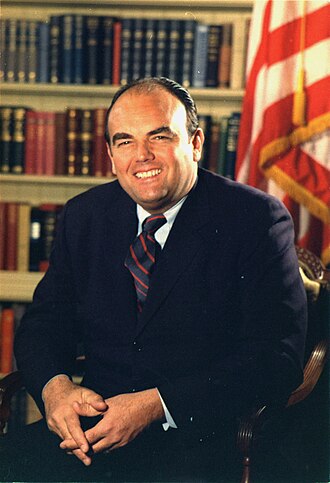
Ehrlichman, John D.
John D. Ehrlichman initially served as Counsel to the President from January 1969 to November 1969, where his duties quickly expanded from legal issues to broader policy development. This shift led to his transition in November 1969 to Assistant to the President for Domestic Affairs, a role he held until April 1973. Throughout the majority of the White House taping period (February 1971 – July 1973), he acted as Nixon's chief domestic advisor and helped direct the covert "Plumbers" unit before the escalating Watergate scandal forced his resignation in April 1973.
What Ehrlichman talks about on the tapes
Economic policy 119Congressional relations 101Public relations 91Watergate 77Vietnam War 58Political strategy 58Legislative strategy 57Welfare Reform 55Revenue sharing 53Busing 52Foreign Policy 47Executive privilege 47
Conversations (807)
— Page 6 of 9President Nixon held an Oval Office meeting with key staff members and guests, including First Lady Pat Nixon, H.R. Haldeman, John Ehrlichman, and John Dean. While the majority of the discussion is classified as a withdrawn item, the session focused on administrative scheduling matters involving John Ehrlichman. The meeting concluded after approximately 23 minutes with the departure of Alexander P. Butterfield and his associates.
President Nixon met with Henry Kissinger, William Rogers, Alexander Haig, and other advisors to coordinate the administration’s response to the terrorist murder of Israeli athletes at the Munich Olympics. The discussion focused on balancing a display of international concern and U.S. empathy with the need to avoid politicizing the games or creating a precedent for national mourning that could be exploited. Nixon decided against a formal national day of mourning but agreed to monitor the situation closely, coordinate with Israeli officials, and seek potential international action against states that harbor terrorist organizations through the UN Security Council.
President Nixon met with Henry Kissinger, H.R. Haldeman, and other staff to coordinate the administration's response to the murders of Israeli athletes at the Munich Olympics, prioritizing public diplomacy and private US support for Israel. The participants also strategized on the 1972 presidential campaign, focusing on delegating attacks against George McGovern to surrogates while emphasizing positive administration accomplishments. Finally, the group discussed ongoing foreign policy objectives, including Kissinger’s upcoming trip to Moscow and potential Vietnam peace negotiation tactics to ensure favorable optics for the election.
Alexander P. Butterfield and John D. Ehrlichman held a brief meeting in the Oval Office to coordinate the President's upcoming daily schedule. The exchange was strictly logistical, focusing on the arrangement of official appointments and time management for the President's agenda. No further policy discussions or significant political developments were recorded during this session.
President Nixon and John Ehrlichman met to coordinate political strategy, focusing primarily on debunking the budget proposals of Democratic challenger George McGovern. They discussed refining arguments regarding McGovern's welfare plans and revenue gaps while also strategizing on how to dismiss a civil suit brought by John Gardner and Common Cause. Additionally, the pair reviewed the administration's response to the Munich Olympic tragedy and aligned their messaging on economic policy to deflect criticism regarding property taxes.
President Nixon met with Vice President Agnew and Republican Congressional leaders to coordinate legislative strategy ahead of the upcoming election, specifically focusing on the status of pending bills and the management of the Congressional schedule. Key priorities included securing a federal spending ceiling, advancing revenue sharing, and emphasizing anti-busing legislation as a must-pass measure to counter Democratic-led policies. The President urged the leadership to maintain a unified front on fiscal restraint, framing opposition to Republican economic proposals as reckless and warning that Democrats should bear the political cost for failing to curb government spending.
President Nixon met with H.R. Haldeman and John Ehrlichman to discuss several political and administrative matters, including the handling of a recent terrorist attack at the Munich Olympics and public reaction to potential presidential appearances at related interfaith services. The group addressed strategies for undermining the organization Common Cause through tax investigations and political pressure. Additionally, Nixon directed the administration to provide Secret Service protection for Senator Edward Kennedy, while simultaneously tasking his aides with ensuring the detail gathered intelligence on Kennedy’s personal conduct and travel habits.
President Nixon met with George Shultz, John Ehrlichman, and others to discuss international economic policy ahead of an upcoming International Monetary Fund (IMF) meeting. Shultz presented a systematic plan for currency convertibility and reserve management, which Nixon approved for use in his upcoming IMF address. The conversation also covered the potential for wage and price control adjustments following the 1972 election and finalized the decision to provide Secret Service protection for Senator Edward M. Kennedy based on specific threats.
President Nixon met with his economic advisors Arthur Burns and George Shultz, later joined by John Ehrlichman, to deliberate on fiscal policy and political messaging during the 1972 election season. The discussion centered on establishing a federal spending ceiling, managing the national debt, and formulating a strategy to counter Democratic candidate George McGovern's tax proposals. Nixon and his team specifically sought to differentiate their economic stance from their opponent by framing their own initiatives as "tax reform" while avoiding any perception of a general tax increase.
President Nixon, Stephen B. Bull, and John D. Ehrlichman met to coordinate the President's upcoming interactions with Republican candidates. The discussion focused on managing political messaging, specifically regarding the sensitive issue of public housing funding. Nixon decided to adopt a non-committal public stance on the topic to avoid potential controversy during his meetings with GOP congressional and gubernatorial candidates.
President Nixon hosted a group of Republican candidates and officials for a photograph session, followed by a policy discussion with key economic advisors including George P. Shultz, Arthur F. Burns, and John D. Ehrlichman. The latter portion of the meeting focused on 1972 presidential campaign strategy, specifically addressing George McGovern’s recent public statements and potential outreach to George Meany. Participants also reviewed proposals regarding tax reform and broader economic policy in the context of the upcoming election.
President Nixon met with George Shultz, Arthur Burns, and John Ehrlichman to discuss economic strategy, focusing on tax reform and property tax relief. The group evaluated the political risks of pursuing tax changes before the election, debating how to frame their proposals without being perceived as increasing taxes. Additionally, the President and H. R. Haldeman discussed administrative logistics, including the potential for a cruise on the Sequoia to discuss strategy and the implementation of Secret Service protection for Senator Edward Kennedy.
President Nixon and John Ehrlichman met to coordinate political strategy ahead of the 1972 election, focusing on tax policy reform, the potential veto of a water pollution bill, and the administration's response to the Watergate scandal. Nixon emphasized a proactive, offensive campaign strategy—advocated by aides like Charles Colson and Melvin Laird—that prioritizes attacking political opponents over defensive postures. Additionally, the President and Ehrlichman discussed gathering damaging financial information on Lawrence O'Brien and McGovern campaign associates to neutralize political pressure.
President Nixon and John Ehrlichman briefly coordinate upcoming scheduling logistics following a meeting regarding drug abuse law enforcement. The discussion focuses on arranging a follow-up appointment with Egil Krogh Jr. to further examine specific proposals developed during the earlier session. Nixon explicitly instructs Ehrlichman to keep the subsequent meeting with Charles Colson efficient and brief.
President Nixon met with John Ehrlichman and Egil Krogh to strategize on a public relations campaign aimed at addressing national concerns over crime, drug abuse, and judicial leniency. Nixon proposed a radio address to explicitly criticize "soft-headed" judges, prosecutors, and probation officers who he felt were undermining law enforcement efforts despite legislative and financial support from the administration. The participants discussed drafting this statement to mobilize public opinion, and also engaged in a brief, wide-ranging conversation about the 1972 Munich Olympic Games and athletic performance.
President Nixon met with Walter Hickel, Clark MacGregor, and John Ehrlichman to discuss campaign strategy and the political climate leading up to the 1972 election. Hickel shared insights from his domestic travels, emphasizing the need for a strong electoral mandate to overcome Congressional gridlock and implement domestic reforms, particularly regarding urban development and transportation. The participants also explored foreign policy issues, including potential future diplomatic visits to China and the Soviet Union, and strategic concerns regarding resource competition in Asia.
President Nixon met with John Ehrlichman and Nelson Rockefeller to coordinate legislative strategy, particularly regarding revenue sharing, federal government reorganization, and NASA space shuttle contracts. The discussion explored ways to build a legislative mandate for a second term, including potential energy and regulatory reforms and strategies to leverage support from key congressional leaders. Later, Pat Nixon and Secretary of the Interior Rogers C. B. Morton joined the session to discuss the administration's national parks agenda, specifically focusing on promoting the centennial of Yellowstone National Park and Mrs. Nixon's upcoming public appearances.
President Nixon met with John D. Ehrlichman to discuss the public disclosure of his personal financial statement. The conversation centered on the management and presentation of the President's assets as they prepared for upcoming release requirements. No major policy shifts were recorded, as the brief exchange served primarily to coordinate administrative logistics regarding the financial filing.
President Nixon met with Philadelphia Mayor Frank L. Rizzo, White House aides, and various local stakeholders to coordinate campaign strategy for the 1972 election in Pennsylvania. The discussion focused on leveraging the benefits of incumbency, securing federal aid for Philadelphia to bolster political support, and actively undermining the campaign of George McGovern through negative publicity regarding his policy positions and past voting records. The participants also discussed efforts to engage other mayors and business leaders to align with the President's platform against McGovern's perceived socialist agenda.
President Nixon met with his economic advisors and staff to plan the logistics of an upcoming revenue-sharing bill signing ceremony and to discuss future tax policy and budget strategies. The President emphasized the need for political carefulness regarding tax reform, expressing a strong desire to avoid any perception of a tax increase while seeking ways to provide property tax relief for senior citizens. The participants debated the merits of various tax proposals, including minimum tax adjustments and simplification measures, ultimately focusing on balancing fiscal responsibility with the administration's political objectives leading up to the 1972 election.
President Nixon and John Ehrlichman discussed political strategy regarding welfare reform legislation, specifically focusing on the administration's messaging and the potential fallout of failing to pass a bill before Congress adjourns. Nixon expressed skepticism toward the current congressional prospects and directed Ehrlichman to coordinate a public relations strategy and handle communications with legislative leadership. They also touched upon scheduling concerns related to upcoming meetings with Elliot Richardson and potential political risks associated with ongoing hearings, such as the General John D. Lavelle case.
President Nixon met with his administration officials, including Elliot Richardson and John Ehrlichman, to discuss the political feasibility of passing welfare reform (H.R. 1) before the 1972 election. Given the lack of time and the potential for a hostile or obstructionist legislative environment, the participants concluded that passing a comprehensive welfare bill was unlikely and that aggressive pressure on Congress would be counterproductive. Nixon decided that the administration should maintain its formal support for H.R. 1 while simultaneously pivoting to a strategy of aiming for a decisive election mandate, intending to reintroduce the reform package in the next Congress under more favorable conditions.
President Nixon met with John Ehrlichman to review an extensive legislative agenda in preparation for a meeting with Congressional leaders. The discussion focused on controversial bills, specifically the Office of Economic Opportunity (OEO) and water pollution legislation, where Nixon weighed the political risks of a veto against the executive necessity of maintaining control over mandatory spending. Nixon expressed a firm reluctance to approve language that locked in funding for programs he intended to cut, leading to deliberations on potential legal strategies for withholding funds or utilizing vetoes to preserve executive discretion.
President Nixon met with Charles Colson, John Ehrlichman, and Henry Kissinger to refine the 1972 reelection campaign strategy. The participants prioritized keeping the focus on national security and foreign policy while framing George McGovern's shifting positions as evidence of poor character and lack of trustworthiness. They also discussed attacking the financial disclosures of the Kennedy family and McGovern’s campaign to create a political liability for their opponents, while Nixon instructed his staff to focus on positive foreign policy outreach with international leaders.
President Nixon and John Ehrlichman consulted on the viability of sustaining a presidential veto regarding Office of Economic Opportunity (OEO) legislation. They assessed the reluctance of congressional leaders like Gerald Ford and Hugh Scott to support the veto, noting Ford's specific preoccupation with a Civil Air Patrol program in his district. Nixon directed Ehrlichman to consult with William Timmons for a more definitive assessment of the legislative prospects before moving forward.
President Nixon and John Ehrlichman discussed the precarious vote count required to sustain a potential presidential veto of the Office of Economic Opportunity (OEO) legislation currently before Congress. Ehrlichman relayed input from William Timmons, who expressed uncertainty regarding the vote count for the conference report compared to previous versions of the bill. The two decided to investigate whether the administration could delay the veto decision until the following day to better assess their legislative standing.
President Nixon consulted with Alexander P. Butterfield and Stephen B. Bull regarding a brief appearance to greet staff from the Finance Committee for the Re-election of the President. He also conferred with John D. Ehrlichman to discuss the structure of the Cabinet Committee to Combat Terrorism. The President ultimately decided that the FBI should be included in the committee, citing the bureau's superior intelligence capabilities.
President Nixon met with John Ehrlichman, Robert Merriam, and Lewis Engman to review the progress of an Advisory Commission on Intergovernmental Relations (ACIR) study concerning national fiscal policy, school financing, and property tax reform. The discussion focused on the urgent need to address the heavy property tax burden on the elderly—which the President characterized as a national scandal—and evaluated the potential for implementing a federal "circuit breaker" relief program. Nixon instructed the team to keep their findings confidential until after the 1972 election and requested that the Treasury Department conduct a parallel study on their recommendations to maintain strategic flexibility.
President Nixon met with his senior aides and advisors to discuss a broad range of political and foreign policy issues, including congressional strategy regarding a spending ceiling and potential budget vetoes. The group examined the political impact of the recent U.S.-Soviet grain deal and reviewed recent polling data ahead of the 1972 election. Additionally, Henry Kissinger and Alexander Haig provided an update on ongoing Vietnam peace negotiations and finalized plans for Haig's upcoming mission to Saigon to consult with President Nguyen Van Thieu.
President Nixon and John Ehrlichman discuss administrative matters regarding Raymond Price's schedule and the development of an upcoming radio address. The core of their conversation centers on a proposal to move a revenue sharing event from the White House to a historical venue in Philadelphia, such as Independence Hall, to symbolically align the administration's "New American Revolution" agenda with the nation's founding sites. Ehrlichman is tasked with investigating the logistics of this proposal, including the feasibility of hosting hundreds of guests at a National Park Service site.
President Nixon and John Ehrlichman discuss the logistics and symbolism of choosing a location for a significant upcoming event. Nixon expresses a desire to host the proceedings at a venue with greater historical gravitas than the White House, specifically suggesting Constitution Hall in Philadelphia to underscore themes of revolutionary change. Ehrlichman is tasked with exploring the feasibility of this site as an alternative, weighing the public relations impact against traditional venue expectations.
President Nixon met with Republican Congressional leaders to discuss the critical need for a $250 billion federal spending ceiling to combat inflation and prevent the necessity of tax increases. The participants strategized on how to manage the upcoming House vote on HR 16810, expressing concern that Democratic leadership was pushing irresponsible, expansive spending bills—including massive social welfare and Social Security packages—that threatened the administration's fiscal goals. The President emphasized that passing the spending cap was a vital political and economic tool to hold Congress accountable and establish a framework for the 1974 budget, while also providing leverage for future presidential vetoes.
President Nixon met with H. R. Haldeman and later John Ehrlichman to coordinate administrative scheduling and legislative strategy. The discussions covered logistics for diplomatic credential presentations, Pat Nixon’s appearances at upcoming events, and the status of John Connally. Additionally, the group debated legislative strategy regarding a debt limit and expenditure ceiling bill, specifically evaluating the effectiveness of White House congressional liaisons and the necessity of direct presidential engagement with legislative leaders.
President Nixon and John Ehrlichman discussed legislative strategies, specifically the administration's stance on H.R. 1, the pending water quality bill, and potential Social Security legislation. They emphasized the need to maintain a firm position on spending limits to bolster Nixon's reelection campaign, including the potential use of a veto to contrast the administration's fiscal discipline with Congressional spending. Furthermore, they reviewed media relations and planned public events, such as a revenue-sharing ceremony, to highlight administration accomplishments while minimizing negative coverage.
President Nixon met with Charles Colson, Henry Kissinger, and John Ehrlichman to coordinate the administration's political strategy against George McGovern's campaign. The discussion centered on countering McGovern’s accusations of moral corruption by projecting strength and avoiding defensive maneuvers, while also managing media relations and planning responses to legislative challenges. Key decisions included maintaining a firm stance on welfare reform legislation to avoid appearing inconsistent and preparing a strategic public response to potential developments in Vietnam peace negotiations.
President Nixon met with Elliot Richardson and several senior staff members to discuss political strategy regarding the welfare reform bill, H.R. 1, and the potential impact of a new amendment offered by Senator Adlai E. Stevenson III. The group analyzed the risks of appearing inconsistent if the administration supported the Stevenson proposal, which closely mirrored the President's original welfare plans, while balancing the need to preserve the administration's credibility as the bill faced likely defeat. Ultimately, they discussed using a parliamentary tactic—having Senator Hugh Scott support the amendment—to expose the lack of substantive differences between the two parties and ensure the administration would not be blamed if the legislation failed.
President Nixon and John Ehrlichman met to discuss the administration's legislative strategy regarding railroad retirement vetoes and ongoing welfare reform negotiations. The conversation focused on the political implications of potential veto overrides and the complexities surrounding the Family Assistance Plan, including proposed amendments by Senators Ribicoff and Stevenson. Ehrlichman updated the President on current legislative developments and testing metrics to determine the administration's tactical approach to securing support.
President Nixon met with a large group of reporters and staff in the Oval Office to conduct a press conference, followed by a private debriefing with his senior aides, including H.R. Haldeman, John Ehrlichman, and Charles Colson. During the public session, Nixon addressed current events such as the 1972 campaign, the status of the Vietnam peace negotiations, allegations regarding the U.S.-Soviet grain deal, and his stance against a 1973 tax increase. Following the departure of the press, the President and his advisors discussed the effectiveness of his performance, particularly the benefit of using his responses as recorded campaign material, and strategized on future scheduling and media messaging.
President Nixon met with his senior staff and campaign advisors to assess his 1972 reelection strategy, focusing on framing the debate against George McGovern around key issues like Vietnam, welfare, busing, and national defense. The group discussed the necessity of moving from a defensive posture to an aggressive offense by highlighting the radical nature of McGovern's positions to the general public. Additionally, the President met with James Hodgson and other officials to review progress on veterans' benefits and education programs, confirming plans to maintain support among Vietnam-era veterans as part of the broader campaign effort.
President Nixon and John Ehrlichman met to strategize on legislative tactics regarding the federal debt limit and spending legislation as the congressional session drew to a close. They discussed the administration's firm stance against spending amendments, as well as the political complications surrounding a potential busing filibuster led by Senator Hugh Scott and James B. Allen. Ultimately, Nixon directed the administration to resist compromise on these issues, favoring a strategy that would allow Congress to conclude its session without enacting unfavorable legislation.
President Nixon met with his economic advisors and Republican Senate leadership to coordinate a strategy for securing congressional support for a federal spending ceiling. The discussion focused on the necessity of controlling runaway federal expenditures and the potential use of the presidential veto to enforce a $250 billion spending limit. Nixon and his team evaluated the legislative outlook for the debt limit bill, including strategies for handling amendments and managing potential political fallout regarding domestic programs.
President Nixon, John Ehrlichman, and Ronald Ziegler met to discuss legislative strategy regarding a controversial water bill and H.R. 1, weighing the political risks of a pocket veto against the necessity of limiting federal spending. The group examined concerns about congressional session timelines and the potential for a spending ceiling, ultimately agreeing to delay a final decision while maintaining a low-key public posture. Beyond legislative mechanics, the President and Ehrlichman analyzed the 1972 campaign landscape, noting that their focus on fiscal conservatism, social values, and national defense was resonating with voters disillusioned by the perceived permissiveness of the opposition.
President Nixon met with his senior advisors to discuss 1972 campaign strategies, including countering Democratic attacks on corruption and addressing negative press coverage. The participants evaluated legislative priorities, specifically the potential vetoes of the welfare reform bill (H.R. 1) and the water pollution control bill, while navigating the timing of Congressional adjournment. Finally, Nixon discussed the recent Washington, D.C. jail takeover, requesting an assessment of potential prison reforms and the feasibility of incorporating D.C. facilities into the federal prison system.
President Nixon met with H.R. Haldeman and John Ehrlichman to coordinate the end-of-session legislative strategy, including maneuvering around the debt ceiling and potential vetoes of the water bill. The group discussed the 1972 campaign, specifically criticizing Senator Charles Percy for his public antagonism toward the White House and strategizing on how to support primary opponents like Roman Pucinski. Additionally, they reviewed sensitive foreign policy developments regarding Vietnam negotiations and leaks, while also managing the President’s logistical schedule, including upcoming radio addresses and security protocols for telephone access.
President Nixon met with John Ehrlichman and William Timmons to strategize on congressional adjournment and potential vetoes of key legislation, specifically a costly water bill and H.R. 1. The President expressed frustration with the spending implications of these bills and debated whether to sign them, veto them immediately, or force a stalemate to pressure Congress. Ultimately, Nixon decided to gamble by withholding action and stalling, intending to blame Congress for the resulting legislative gridlock and budget issues if they were forced to return from recess for an override attempt.
President Nixon met with H.R. Haldeman, John Ehrlichman, Raymond Price, and other staff members to coordinate his campaign messaging and media strategy for the final weeks of the 1972 election. The discussion centered on drafting a series of radio speeches covering foreign policy, economic issues, and social concerns, specifically addressing paternalism and property tax reform for the elderly. Nixon emphasized maintaining a non-partisan, uplifting tone in his speeches and decided against directly attacking George McGovern, opting instead to focus on his own "New American Majority" and the broader philosophy of his administration.
In this meeting, President Nixon met with Charles Colson, Manolo Sanchez, and John Ehrlichman to discuss political strategy and campaign messaging for the 1972 election. The discussion centered on managing legislative issues, such as potential vetoes of social spending bills, and neutralizing corruption allegations related to the Watergate scandal. Participants also reviewed the effectiveness of campaign rhetoric against George McGovern, focusing on his foreign policy positions and the authenticity of anti-war statements, while strategizing on how to appeal to specific labor and ethnic constituencies.
President Nixon and John Ehrlichman discuss political strategy, focusing on the tactical advantages of a 20% federal spending limitation and planning for an upcoming revenue-sharing ceremony in Philadelphia with Mayor Frank Rizzo. The conversation also addresses the status of congressional adjournment regarding the debt ceiling and welfare legislation, as well as concerns regarding potential Watergate-related hearings by Senator James O. Eastland. They discuss the necessity of protecting the White House via executive privilege while acknowledging that individuals like John Mitchell might be compelled to testify.
President Nixon and John Ehrlichman discuss the strategic benefits of a 20% federal spending limitation, noting its utility in enforcing bureaucratic discipline and shifting blame to Congress. They also coordinate a planned appearance in Philadelphia, framing the event as a non-gimmicky, bipartisan return to constitutional principles. Finally, they briefly address the ongoing political fallout and potential witness appearances related to the Watergate-linked hearings involving John Mitchell and others.
President Nixon and John D. Ehrlichman coordinate messaging strategy regarding pending legislation and press relations ahead of a planned media briefing. They discuss the potential veto of Social Security and water quality bills, framing them around spending limitations and congressional failure to adopt administration reforms. Furthermore, they strategize on countering negative press coverage related to Watergate and the US-Soviet grain deal by attacking journalistic bias, invoking comparisons to McCarthyism, and highlighting the failure of outlets to report on campaign violence against the President.
President Nixon and John Ehrlichman discuss political strategy for the upcoming election, specifically addressing the administration's stance on social security, welfare reform, and budget spending. The President instructs Ehrlichman to aggressively attack the media's coverage of the campaign, suggesting they label the opposition's tactics as 'McCarthyism' and highlight the 'double standard' of the Washington Post and New York Times. Nixon also briefly addresses concerns regarding his personal financial disclosures and property investments, dismissing reports that suggested any impropriety.
President Nixon met with H.R. Haldeman and John Ehrlichman to coordinate administration strategy regarding the upcoming election and legislative agenda. The discussion focused on managing the political fallout of the Watergate scandal—specifically involving Donald Segretti—and planning aggressive media and press relations to ostracize outlets considered hostile to the White House. Additionally, the participants addressed the potential for significant budget cuts across federal departments and the President's firm stance against amnesty for draft evaders.
President Nixon met with Manolo Sanchez and John D. Ehrlichman to coordinate the President's upcoming schedule. The primary focus of the meeting involved preparations for a forthcoming audio message and the arrangement of a subsequent private meeting with Ehrlichman. The discussion concluded as the participants departed the Oval Office shortly thereafter.
President Nixon met with John Ehrlichman to coordinate the administration's legislative strategy, focusing on upcoming vetoes of the water and spending bills and potential responses to Congress. The President also discussed tax reform communication strategies and initiatives to secure support from Catholic leadership regarding parochial school aid. Later, Nixon hosted football star Gale Sayers and aides to discuss minority business programs, the role of minority athletes as positive role models, and the potential for retired athletes to transition into community service and business leadership roles.
President Nixon met with H.R. Haldeman, John Connally, and other advisors to discuss campaign messaging, the effectiveness of recent political television broadcasts, and the President's upcoming schedule. The group evaluated the impact of Nixon’s defense and foreign policy messaging, deciding to forgo the release of a new tax plan to avoid unnecessary controversy. Nixon and his team also strategized on the handling of upcoming legislative vetoes, particularly a water bill, while weighing the benefits of presidential travel versus remaining in Washington to maintain a 'presidential' public image.
President Nixon met with William E. Timmons and John D. Ehrlichman to discuss legislative strategy regarding the federal debt limit, impending congressional adjournment, and the political fallout from his recent veto of a water bill. The President emphasized his desire to use these vetoes to frame a narrative of fiscal responsibility, specifically positioning the water bill as a choice between higher taxes and fiscal restraint. Nixon also directed his staff to continue pursuing substantial cuts to federal personnel and spending while carefully timing additional vetoes to maximize political advantage before the 1972 election.
President Nixon and John Ehrlichman met to strategize on the administration’s domestic policy messaging, focusing on crafting a unified narrative of responsible governance versus Congressional fiscal irresponsibility ahead of the 1972 election. They discussed the tactical use of veto messages, upcoming radio talks, and regional outreach efforts to contrast the President's legislative priorities with Congress's performance on issues like welfare reform, environmental policy, and taxation. To reinforce this image of a diligent executive, they planned to stage a photographic opportunity at the White House showcasing the President's extensive workload of legislative review and veto preparation.
President Nixon met with H. R. Haldeman and other staff members to finalize his pre-election campaign schedule, including plans for radio addresses, a Veterans Day event, and a trip to Appalachia. The discussion focused on projecting a presidential image while avoiding political pitfalls like unscripted press conferences, where the President feared questions would be dominated by the Watergate controversy. The participants also evaluated potential Senate leadership changes and debated media strategy, with the President directing his staff to shun hostile press members and prioritize more favorable outlets.
John Ehrlichman and William Timmons discussed the chaotic status of congressional adjournment, specifically the legislative hurdles involving highway, debt, and securities bills in both the House and Senate. Due to a lack of quorums and ongoing disputes over riders, the administration struggled to secure definitive legislative action. President Nixon ultimately authorized Ehrlichman and Timmons to cancel a planned meeting with congressional leaders and terminate the unproductive session if no progress was made.
President Nixon and John Ehrlichman met to finalize logistical and messaging plans for an upcoming revenue sharing signing ceremony in Philadelphia. They discussed the staging protocols for Vice President Spiro Agnew, specifically ensuring Agnew presided over the event while defining the President’s position on stage. Nixon instructed Ehrlichman to prepare a concise signing statement that provided a comprehensive narrative of the administration’s legislative journey for early distribution to the press.
President Nixon and John Ehrlichman coordinated messaging for an upcoming press conference and developed a strategy for publicizing the administration’s legislative agenda. They discussed the tactical use of meetings with congressional candidates to bolster support for Republican programs, particularly regarding revenue sharing. Additionally, the President reviewed his schedule for travel to Camp David and the timing of various administrative briefings.
President Nixon, H. R. Haldeman, Charles Colson, and John Ehrlichman coordinated logistics for upcoming administrative meetings. The participants finalized the scheduling of a briefing at the White House followed by a retreat at Camp David. The discussion concluded with the President authorizing Haldeman to proceed with the arrangements for these high-level sessions.
President Nixon and John Ehrlichman met to coordinate scheduling details for upcoming events, including a meeting on economic issues at Camp David and First Lady Pat Nixon’s travel to Florida. They briefly discussed recent press briefings conducted by Ehrlichman and George Shultz. The conversation concluded with administrative arrangements regarding timing and the logistics for upcoming discussions.
President Nixon met with his senior advisors and campaign staff to coordinate strategy for the final weeks of the 1972 presidential election, focusing heavily on the political ramifications of ongoing Vietnam peace negotiations. The President expressed a firm commitment to securing a durable peace that ensured the survival of South Vietnam, while advisors discussed how to counter George McGovern’s criticisms regarding the war and economic issues. The conversation also covered campaign media tactics, including radio and television appearances, and touched upon concerns regarding press coverage of Watergate-related controversies like the Segretti activities.
President Nixon and John Ehrlichman met to coordinate the administration's public messaging for the final weeks of the 1972 campaign, focusing on forthcoming speeches regarding farm, urban, and economic issues. They specifically strategized on how to frame George McGovern's economic policies as detrimental, instructing administration spokesmen to emphasize the negative impacts of his platform on taxes, prices, and unemployment. Furthermore, they discussed legislative strategy regarding pending bill signings and mandated that agency officials move beyond superficial budget trimming to pursue substantive cuts in major federal programs following the election.
President Nixon and John Ehrlichman met to discuss the political strategy surrounding the potential veto of HR 1, a massive welfare and social security bill, while balancing concerns over fiscal responsibility and the upcoming 1972 election. They evaluated the political risks of appearing insensitive to the elderly and the blind versus the long-term economic consequences of payroll taxes, ultimately deciding to hold off on a final public decision. Additionally, the two discussed strategies for countering negative press coverage, specifically regarding the Watergate scandal, and weighed plans to marginalize the Washington Post through reduced access and accreditation pressure.
President Nixon and John Ehrlichman met to discuss the administration's messaging strategy regarding the economic implications of HR 1, specifically addressing payroll tax increases tied to Social Security and the administration's budget outlay targets. They focused on how to defend the President’s fiscal philosophy, including differentiating between the administration's proposed reforms and the more expensive increases recently passed by Congress. Additionally, they strategized on how to frame the President’s involvement in legislative matters during the ongoing Vietnam peace negotiations to portray his demanding schedule and commitment to both domestic and international priorities.
President Nixon met with various staff and visitors, including H.R. Haldeman and John Ehrlichman, to coordinate end-of-campaign activities and legislative priorities. Key decisions included the veto of the Older Americans bill and the strategic timing of further bill signings to maintain positive press coverage. The group also discussed campaign surrogates, including Senator Robert Dole, and planned polling efforts to gauge public sentiment on the Vietnam War and presidential approval ratings.
H. R. Haldeman briefs President Nixon on a proposed settlement strategy regarding the Common Cause campaign finance litigation, which would involve disclosing five million dollars in pre-March 1972 contributions to mitigate the negative publicity of Hugh Sloan's imminent testimony. Ehrlichman, along with Maurice Stans and John Dean, argues that settling now and postponing further litigation until after the election is the best way to cut losses. Nixon expresses concern over the public relations impact but ultimately authorizes the team to proceed if they believe it is the most viable option. Additionally, Haldeman and Nixon briefly discuss the distribution of a White House white paper to the press, with the President requesting to limit the release to Vice President Agnew's statements.
President Nixon met with H.R. Haldeman at Camp David to discuss the tactical cancellation of a scheduled Chicago trip following a deadly train accident, prioritizing optics and security over campaign appearances. The two reviewed status updates on Vietnam peace negotiations, strategizing how to manage public perception should talks with North Vietnam falter, including plans for a potential presidential television address. Additionally, the President and his staff coordinated on various administrative and legal matters, including the handling of a Common Cause lawsuit regarding campaign donor disclosures.
President Nixon and John Ehrlichman met to coordinate the content and strategy for an upcoming radio address titled “The Birthright of an American Child.” The discussion focused on refining a ten-point policy agenda to be presented during the speech. Nixon instructed Ehrlichman to take the necessary time to carefully review and finalize these specific goals to ensure the message was effectively crafted.
President Nixon and John Ehrlichman met to strategize for the final days of the 1972 presidential campaign, focusing on the use of radio addresses to communicate directly with the public while avoiding the hostility of traditional campaign rallies. They discussed the administration's platform, including domestic policy issues and racial topics, and coordinated the development of a series of speeches. A significant portion of the conversation centered on managing the ongoing Watergate scandal, with Nixon and Ehrlichman exploring the potential for a White House-led internal investigation to control the narrative and minimize political damage following the election.
President Nixon and John Ehrlichman met to discuss the potential reorganization of the executive branch and the status of leadership within the Justice Department. The conversation focused on the tenure of FBI Director L. Patrick Gray and Attorney General Richard G. Kleindienst, specifically addressing their performance and the political ramifications of their potential retention or resignation. Ehrlichman provided updates on congressional and press reactions, while the two weighed the impact of a departmental overhaul on these personnel decisions.
President Nixon and H.R. Haldeman met to coordinate final logistics for the 1972 presidential campaign, focusing on radio addresses, polling strategies, and scheduling for upcoming candidate support calls. The discussion covered concerns regarding campaign disruptions, such as heckling at events, and the ongoing fallout from the Watergate investigation, including the roles of John Mitchell and Donald Segretti. Additionally, the President and his staff discussed the rollout of national health insurance policy and their desire to maintain a distance from certain political candidates while managing public perceptions through television and media engagement.
President Nixon consulted with John Ehrlichman to express strong opposition to language regarding health maintenance organizations (HMOs) in an upcoming health care speech. Nixon directed that references to HMOs be removed and mandated that the term "national health insurance" be replaced with "comprehensive health insurance" to distance his proposal from socialist-leaning government programs. The conversation concluded with Nixon emphasizing his skepticism toward the existing legislative program and calling for a rigorous internal review of the administration's health care policy.
President Nixon and his senior staff, H. R. Haldeman and John Ehrlichman, coordinated campaign messaging in the final days before the 1972 election. Much of the discussion focused on refuting George McGovern’s criticisms regarding Vietnam, specifically emphasizing the administration's stance that they had achieved a breakthrough toward "peace with honor" while clarifying that remaining "central points" were merely details requiring resolution. To reinforce these themes, Nixon made a series of telephone calls to various Republican candidates across the country to offer his endorsement, boost morale, and provide talking points for their final campaign appearances.
President Nixon held a series of phone conversations with political allies including Robert Dole, William Mills, Gordon Allott, and James McKevitt on November 4, 1972. The calls served to build momentum and express appreciation for campaign support from key constituencies and regional leaders as the general election approached. Nixon discussed localized campaign strategies, the importance of maintaining unity within the party, and securing support from diverse groups, including the black community. The discussions also touched on logistical concerns regarding campaign messaging and the management of sensitive political relationships.
John D. Ehrlichman coordinates with the Camp David operator to facilitate a telephonic connection with Ronald L. Ziegler while President Nixon and H. R. Haldeman are present. The discussion focuses on managing Henry A. Kissinger’s travel schedule, specifically regarding the timing of public announcements concerning his upcoming trip to Paris. The participants deliberate on how to synchronize these communications with Ziegler and potential plans for Kissinger to visit Camp David.
John D. Ehrlichman directs Press Secretary Ronald L. Ziegler to adopt a strict policy of providing "no comment" regarding all future statements made by George McGovern, Sargent Shriver, and other Democratic leaders following the 1972 election. Ehrlichman emphasizes that the White House should treat these political figures as if they do not exist to avoid engaging in post-election recriminations. The conversation establishes this blanket refusal to comment as the official strategy for dealing with inquiries about the defeated opposition.
President Nixon met with H.R. Haldeman and John Ehrlichman at Camp David to strategize the comprehensive reorganization of his second-term administration. The participants focused on restructuring cabinet-level departments, delegating authority to a new tier of 'super secretaries,' and planning high-profile personnel changes across federal agencies, including the State and Defense Departments. Additionally, they evaluated potential cabinet replacements and discussed the public relations strategy for announcing these shifts to ensure executive efficiency and maintain political momentum.
President Nixon, H.R. Haldeman, and John Ehrlichman met at Camp David to strategize the personnel changes and structural reorganization for the President’s second term. The participants discussed replacing Secretary of State William P. Rogers with Kenneth Rush and deliberated over various Cabinet-level and departmental appointments, emphasizing the need for 'tough' management and political responsiveness. They also addressed the transition of White House staff, the handling of the energy crisis, and the importance of ensuring ethnic and regional representation, specifically seeking Catholic and Southern appointees for key roles.
President Nixon and John Ehrlichman discuss the potential retention of Peter G. Peterson during the administration's second-term reorganization. Nixon expresses a softened stance on Peterson's value, suggesting he may be useful in the Commerce Department despite previous reservations. Ehrlichman is tasked with consulting George Shultz during a scheduled meeting to determine if offering Peterson the Commerce position is a viable bargaining strategy.
President Nixon and John Ehrlichman discussed the prospects of Peter G. Peterson accepting a new appointment related to foreign policy. Based on feedback from Henry Kissinger, Ehrlichman advised that Peterson was likely to accept the role. Consequently, the President decided to delay pursuing alternative candidates to focus on finalizing the offer with Peterson.
President Nixon and John Ehrlichman briefly discussed the status of second-term administration reorganization and Cabinet appointments. Nixon informed Ehrlichman that he had already addressed these issues with H.R. Haldeman, rendering a more detailed discussion unnecessary. The brief call concluded with the President encouraging Ehrlichman to enjoy the weather at Camp David.
President Nixon and John Ehrlichman held a brief, informal meeting at Camp David to exchange pleasantries and address the delivery of a television set. The discussion was entirely social in nature, focusing on personal items rather than official government business or policy. No administrative decisions or substantive developments resulted from this brief encounter.
In this meeting at Camp David, President Nixon and H. R. Haldeman discuss the personnel and strategic reorganization of the administration's second term, including the management of press relations and the handling of key cabinet members and staffers. Nixon emphasizes the need for loyal, dedicated personnel and discusses his desire to establish a more personal, warmer public image by utilizing surrogates and better controlling media access. They also address the tactical handling of critical news outlets, specifically Life and Time magazines, and deliberate on the best approach for announcing upcoming cabinet changes and the President’s post-landslide agenda.
President Nixon coordinates a meeting at Camp David with John D. Ehrlichman and George H.W. Bush. The President determines the logistics for the gathering, instructing Ehrlichman to bring Bush to the Aspen Lodge to facilitate their discussion. The brief call serves primarily as a scheduling coordination between the participants.
President Nixon consulted with H. R. Haldeman and John Ehrlichman to finalize logistical arrangements for an upcoming family trip to New York and to coordinate the scheduling of political meetings at Camp David. The participants discussed hotel accommodations, the timing of a secretive meeting with Henry Kissinger to avoid premature press attention, and the importance of balancing Republican leadership presence at Camp David by inviting Barry Goldwater to meet alongside Nelson Rockefeller. Additionally, they reviewed progress on RNC personnel matters, including directives for John Mitchell to mobilize key committee staff.
President Nixon and John Ehrlichman met to discuss staffing and organizational plans for the upcoming second term, focusing on personnel management and political maneuvering. The two men criticized the recent conduct of Donald Rumsfeld, labeling him an opportunist, and evaluated the power struggle between Henry Kissinger and William Rogers. They also coordinated strategy for an upcoming meeting with Nelson Rockefeller, with Nixon emphasizing the need to limit the scope of discussions regarding the State and Defense Departments.
President Nixon, H.R. Haldeman, and John Ehrlichman met to strategize the second-term administration reorganization, focusing on personnel changes and reining in the influence of key advisors. They discussed the forced departure of Herbert G. Klein, the management of Henry Kissinger’s growing public celebrity and professional friction with Secretary of State William Rogers, and the need to exert tighter presidential control over ambassadorship selections. The group further coordinated tactical appointments within the State Department, specifically intending to use Kenneth Rush and William J. Casey to assert greater administrative oversight.
President Nixon and John Ehrlichman discussed the logistics of second-term administration staffing, specifically confirming George H. W. Bush’s acceptance of the Republican National Committee chairmanship. The two men also strategized on managing Robert Dole’s transition and finalized plans to replace Secretary of Transportation John A. Volpe. They determined that a firm, consistent policy of limiting domestic cabinet appointments to four years would be the primary justification for personnel changes.
President Nixon and John Ehrlichman discuss the management of an individual referred to as "Bill" to mitigate political fallout in Milwaukee. The two consider whether to adopt a "hardline" approach regarding his potential exit or transition. They conclude that the situation requires firm handling to ensure the individual understands his position and complies with the administration's goals.
President Nixon and John Ehrlichman met to discuss the staffing and strategic reorganization of the administration's second term, including the planned departure of Cabinet members like George Romney and John Volpe. They evaluated the optics of announcing these changes, weighing the advantages of a symbolic press event at Camp David to project an image of decisive action. Additionally, they reviewed the status of Vietnam peace negotiations, acknowledging the high public expectations created by Henry Kissinger, and strategized on potential personnel appointments, including the U.N. ambassadorship for John Scali and various departmental roles.
President Nixon met with Secretary of Housing and Urban Development (HUD) George Romney and John Ehrlichman to discuss Romney’s impending departure from the administration and his post-government career plans. They reviewed potential leadership roles for Romney in the private sector, focusing on his interest in merging the Urban Coalition and the National Center for Volunteer Action to create a new, non-partisan "think tank" for community development. The participants also discussed the structural reorganization of HUD for Nixon’s second term, emphasizing decentralization and the necessity of finding a suitable successor to maintain momentum on domestic policy goals.
President Nixon, John Ehrlichman, and John Volpe met to discuss the administration's second-term reorganization and Volpe's potential transition from Secretary of Transportation to Ambassador to Italy. Nixon emphasized the strategic importance of strengthening relations with Italian-Americans and the Catholic Church, viewing Volpe as a vital political asset for these goals. Volpe, who expressed concerns about his recent health and the logistical challenges of the ambassadorship, agreed to consider the offer while keeping open the possibility of a delayed start to allow for a smooth leadership transition at the Department of Transportation.
H. R. Haldeman and John D. Ehrlichman coordinated the President’s administrative schedule at Camp David following a meeting with Robert Dole. The participants discussed the transition to a meeting with Gerald Ford, where Ehrlichman was requested to be present, and arranged for a subsequent meeting between the President and Richard Kleindienst. They also touched upon the potential appointment of Joseph T. Sneed, ultimately deciding to bypass him due to the speculative nature of his candidacy.
H. R. Haldeman and John D. Ehrlichman confer regarding the management of an individual’s schedule and the handling of sensitive findings. The discussion centers on the unpredictable behavior of the subject, who has reportedly engaged in erratic actions that complicate administrative control. Ultimately, they decide to withhold information until the subject completes his current tasks to ensure better oversight of the final report.
President Nixon met with a large group of African American administration officials and staffers to discuss their roles in the administration, career advancement, and broader racial issues within the government and society. Nixon expressed his appreciation for their support and work, specifically highlighting the efforts of Robert J. Brown, while addressing the need to create more opportunities for minorities in both government and private industry. The discussion touched upon the importance of merit-based professional growth, the recruitment of young people into public service, and the President's commitment to improving representation and progress over his next term.
President Nixon met with George Shultz and John Ehrlichman to discuss the administration's economic strategy and preparations for the second-term transition. The conversation focused heavily on the management of wage and price controls, inflation mitigation, and labor relations, including potential appointments to the Productivity Commission and the Commission on Industrial Peace. Additionally, the group addressed the reorganization of the Treasury Department, international trade policy, and the potential role of Peter G. Peterson as a special representative for economic affairs.
John D. Ehrlichman met with George D. Webster at Camp David to discuss Webster's potential appointment and the administration's second-term reorganization of the Internal Revenue Service (IRS). Ehrlichman emphasized the need to build a loyal team within the IRS to better serve the President's interests and counter bureaucratic resistance. They also discussed a strategy to leverage the Common Cause organization's tax-exempt status against their political activities and addressed the necessity of retaining key personnel like Edwin S. Cohen.