Ehrlichman, John D.
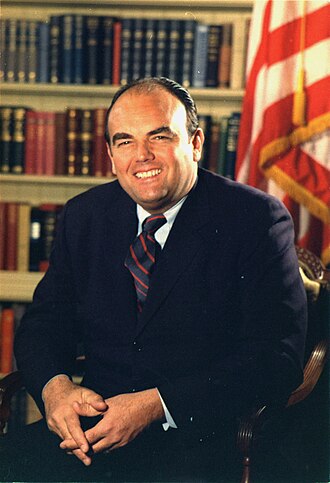
John D. Ehrlichman initially served as Counsel to the President from January 1969 to November 1969, where his duties quickly expanded from legal issues to broader policy development. This shift led to his transition in November 1969 to Assistant to the President for Domestic Affairs, a role he held until April 1973. Throughout the majority of the White House taping period (February 1971 – July 1973), he acted as Nixon's chief domestic advisor and helped direct the covert "Plumbers" unit before the escalating Watergate scandal forced his resignation in April 1973.
What Ehrlichman talks about on the tapes
Economic policy 119Congressional relations 101Public relations 91Watergate 77Vietnam War 58Political strategy 58Legislative strategy 57Welfare Reform 55Revenue sharing 53Busing 52Foreign Policy 47Executive privilege 47
Conversations (807)
— Page 5 of 9President Nixon met with H. R. Haldeman, John Ehrlichman, and others to manage the political fallout and transition following the death of FBI Director J. Edgar Hoover. The group discussed the necessity of appointing an interim director to avoid a controversial Senate confirmation process during an election year. Additionally, they coordinated a strategy for the President's upcoming trip to Annapolis, emphasizing planned interactions with young people and potential public appearances to bolster his public image.
President Nixon, through John D. Ehrlichman, directs Press Secretary Ronald L. Ziegler to brief the press regarding the upcoming appointment of an acting FBI director. The primary goal is to manage media speculation by confirming the pending announcement while avoiding premature commitments regarding a permanent nominee. Ultimately, the administration decides against pre-emptively closing off the option of a full-time appointment, opting instead to limit public messaging to the announcement of an acting director.
President Nixon and John Ehrlichman discuss the messaging strategy for Press Secretary Ronald Ziegler regarding upcoming political appointments and the selection of an Acting FBI Director following J. Edgar Hoover’s recent death. They emphasize the need to distinguish between permanent Supreme Court appointments and temporary political assignments to deflect public criticism. The pair concludes by coordinating the logistics for an afternoon meeting with a prospective candidate.
President Nixon and John Ehrlichman discuss public messaging strategies regarding the school enrollment choices of White House correspondents. They deliberate on how to frame survey data to minimize controversy, while also addressing scheduling conflicts related to a funeral. Ultimately, the President decides to abandon a specific plan of action to avoid potential political friction.
President Nixon met with Ronald Ziegler and John Ehrlichman to coordinate the public announcement of L. Patrick Gray III’s appointment as FBI Director. The discussion focused on managing the political optics and potential criticisms regarding the vacancy of the position and Gray’s interim status. Additionally, the President reviewed media coverage and the reception of his recent public remarks, including his commentary on the legacy of the late J. Edgar Hoover.
President Nixon and John Ehrlichman coordinate the logistics and messaging strategy for an upcoming announcement regarding the appointment of an acting Attorney General. They determine that the announcement should be handled personally rather than through Press Secretary Ronald Ziegler due to political sensitivities regarding Richard Kleindienst. The President confirms that the designated spokesperson has been fully briefed on the necessary talking points to manage the public narrative.
President Nixon met with his senior advisors and officials to manage the leadership transition at the FBI following J. Edgar Hoover’s death and to strategize regarding the upcoming Soviet summit amid the North Vietnamese invasion. The group discussed the political implications of L. Patrick Gray’s nomination as acting FBI director and debated whether to proceed with the summit given potential domestic backlash and the ongoing conflict. Ultimately, Nixon signaled his intent to project strength and maintain leadership, emphasizing that he would only cancel the summit if it demonstrably improved the prospects for ending the war in Vietnam.
John D. Ehrlichman coordinates with Press Secretary Ronald L. Ziegler regarding the upcoming press conference to announce the appointment of L. Patrick Gray III as acting FBI Director. Ehrlichman outlines the procedural flow of the announcement, instructs Ziegler on how to field press inquiries, and clarifies the technical employment status of Gray for salary purposes. The two agree to meet in person to finalize the specific language Ziegler should use when announcing that a permanent nomination for the position will be deferred until after the election.
President Nixon and John Ehrlichman discuss an unauthorized letter sent to Cardinal Cooke supporting anti-abortion efforts, which has upset New York Governor Nelson Rockefeller. Concerned that the letter was perceived as a deliberate administration intervention in New York's sensitive state-level abortion legislation, Nixon directs Ehrlichman to investigate how the letter was released and to contact Rockefeller to apologize. The conversation concludes with a plan to rectify the political damage and a brief mention of potential delays regarding the administration's push for aid to parochial schools.
President Nixon and John Ehrlichman discuss the political fallout and potential friction surrounding a letter concerning abortion policy in New York. The President expresses concern that the administration's involvement in the issue could complicate relationships between the Conservative Party and Nelson Rockefeller Jr. during a legislative battle. Ehrlichman is tasked with investigating the origins of the correspondence to ensure the White House avoids appearing to intervene in state-level political disputes.
President Nixon met with Vice President Agnew, Cabinet members, and senior staff to discuss the administration's recent escalation in Vietnam, specifically the blockade of North Vietnamese ports. The President articulated his rationale for the decision and sought unified support from his team to manage potential congressional and public opposition. He emphasized the necessity of leadership during difficult times and urged his Cabinet to present a cohesive front in defending the policy to the public.
President Nixon met with Ambassador Walter H. Annenberg, John N. Mitchell, and John D. Ehrlichman to discuss diplomatic relations, the 1972 Republican National Convention, and political strategy for the upcoming election. The participants focused on local campaign support in Pennsylvania—specifically regarding Frank Rizzo—and potential political endorsements from influential figures like Norton Simon. Nixon and Annenberg reaffirmed their strong personal and political alliance, with Nixon explicitly requesting Annenberg's continued service as Ambassador to the Court of St. James's following the 1972 election.
President Nixon, H. R. Haldeman, Charles Colson, and other staff members met to discuss the immediate aftermath and implications of the assassination attempt on Governor George Wallace. The President expressed intense frustration with the lack of information and the perceived incompetence of the Secret Service, repeatedly ordering his staff to bypass them and mobilize the FBI to take control of the investigation. Nixon specifically emphasized the need to determine the assailant's identity and political motivations—particularly any potential ties to anti-Vietnam War sentiments—to prevent media speculation or a repeat of the perceived failures following the John F. Kennedy assassination.
President Nixon, H.R. Haldeman, and John Ehrlichman discussed the immediate aftermath of the assassination attempt on Governor George Wallace. The conversation centered on the status of the investigation into the assailant, Arthur H. Bremer, and the coordination of federal law enforcement efforts led by L. Patrick Gray and W. Mark Felt. Ehrlichman received instructions to maintain tight control over the information flow to the President, specifically drawing comparisons to the handling of the John F. Kennedy assassination to ensure effective management and reporting.
President Nixon and John Ehrlichman discuss the aftermath of the assassination attempt on Governor George C. Wallace by Arthur Bremer. Nixon expresses intense concern regarding the FBI's handling of the investigation, drawing explicit parallels to the perceived failures of the John F. Kennedy assassination inquiry. The two coordinate efforts to maintain White House oversight of the federal investigation and the subsequent psychiatric and legal proceedings involving Bremer.
President Nixon and John Ehrlichman briefly discuss concerns regarding the absence of a formal list and the political activities of Hubert Humphrey and a figure identified as McGarrett. The exchange highlights the President's unease regarding these developments and his subsequent decision to refrain from contacting an unspecified individual. The brief meeting serves to monitor ongoing political monitoring efforts and potential outreach strategies.
President Nixon met with key advisors, including H. R. Haldeman, John Ehrlichman, and Charles Colson, to discuss the political and psychological fallout following the attempted assassination of George Wallace and the administration's military strategy in Vietnam. The group deliberated on how to leverage the shooting to push for tougher gun control legislation while managing the negative public perception of White House-led investigations. Additionally, the President issued firm instructions to General Alexander Haig regarding military promotions and leadership, emphasizing a policy of rewarding personnel who take risks over those who strictly adhere to bureaucratic caution.
President Nixon met with his Cabinet and key staff to discuss the upcoming departure of Secretary of the Treasury John B. Connally and to address broader administration matters. The discussion covered the timing of administrative changes, the transition of economic policy responsibilities to George Shultz, and the status of ongoing federal investigations following the recent shooting of George C. Wallace. Connally reflected on his tenure as Treasury Secretary and his future plans, while the President reaffirmed his commitment to his current economic program and leadership agenda.
John D. Ehrlichman and Ronald L. Ziegler met to coordinate messaging strategy regarding the President's upcoming travel and public perception. They discussed managing speculation surrounding the President's motivations, particularly concerning political optics in Texas and the administration's strategic objectives. The discussion concluded with a focus on controlling the timing and effectiveness of public disclosures to maintain narrative consistency.
President Nixon and John Ehrlichman discussed the administration's policy on pending gun control legislation, with the President directing Ehrlichman to prepare formal recommendations. The discussion also touched upon the President's public image and the positive response to his recent foreign policy actions, specifically the mining of Haiphong. Additionally, the participants coordinated scheduling details regarding international visitors and potential meetings with public figures like Arthur Linkletter.
President Nixon directed John Ehrlichman to prepare for a pivot toward a constitutional amendment regarding busing legislation, expressing frustration over the lack of progress in Congress. Nixon argued that the administration's current, more moderate proposal was ineffective and that an amendment would provide a clear ideological battleground against the eventual Democratic presidential nominee. Ehrlichman was instructed to task staff with drafting the amendment for a potential rollout by September or shortly before the Republican National Convention.
President Nixon met with his senior staff, including H.R. Haldeman, Henry Kissinger, and John Ehrlichman, to coordinate messaging and strategy ahead of his upcoming Soviet Summit. The group discussed controlling the flow of information to the press—specifically managing William Rogers's public statements to ensure they did not conflict with the President's own summit briefings—and addressed Vietnam military policy, including the President's frustration with air strike performance. Additionally, the President and his staff reviewed domestic legislative priorities, such as the black lung bill veto, busing policy, and welfare reform, while also discussing the investigation into Arthur Bremer following the assassination attempt on George Wallace.
President Nixon met with Senator Robert C. Byrd, John Ehrlichman, and Clark MacGregor to discuss the pending black lung benefits bill. Acknowledging the fiscal concerns and potential budget implications, Nixon informed Byrd of his decision to sign the legislation, concluding that a veto would likely be overridden by Congress. They coordinated a public relations strategy for the announcement, agreeing that Byrd would signal his satisfaction with the meeting to the press while emphasizing the President's careful deliberation of the budgetary and humanitarian factors.
President Nixon met with key staff members and Henry Kissinger to coordinate domestic political strategy and foreign policy initiatives. The participants discussed managing the Congressional reaction to the recently negotiated SALT agreement, securing support for defense spending, and balancing the Administration's position on welfare reform legislation. Additionally, the President and Kissinger reviewed the recent Moscow summit, focusing on the sophisticated nature of Communist leadership and strategies for countering international criticism of U.S. actions in Vietnam.
H. R. Haldeman and John Ehrlichman coordinated administrative strategy regarding Elliot Richardson's push for the Higher Education Conference Report, specifically concerning the administration's stance on controversial busing amendments. The pair agreed that Richardson must be instructed to abandon his position in favor of the White House’s priorities, with Haldeman tasked to direct Kenneth R. Cole, Jr. to deliver this instruction. Additionally, they reached a consensus to delay testimony on supplemental appropriations by Melvin R. Laird until at least November, following consultation with John C. Whitaker.
President Nixon met with H. R. Haldeman, John Ehrlichman, and Henry Kissinger to strategize his public relations posture ahead of the upcoming Democratic National Convention. The participants reached a consensus that the President should maintain a low-visibility, high-stature profile, focusing primarily on foreign policy successes—such as the recent trips to the Soviet Union and China—rather than engaging in domestic political spectacles. Additionally, they reviewed administrative appointments, including the confirmation of George Shultz and Richard Kleindienst, and discussed the President's upcoming travel and speaking schedule.
President Nixon met with his senior staff, including John Ehrlichman and H.R. Haldeman, to discuss a wide-ranging agenda involving domestic policy, foreign affairs, and personnel management. Key domestic discussions focused on contentious issues such as federal busing orders in Detroit, education policy, and welfare reform, alongside strategies for revenue sharing. The participants also evaluated the quality and selection procedures for U.S. translators and ambassadorial appointments, while reflecting on historical foreign policy precedents and upcoming international diplomatic requirements.
President Nixon met with his senior advisors and Cabinet members, including Elliot Richardson and Caspar Weinberger, to evaluate the legislative strategy for H.R. 1, the administration's welfare reform bill. The participants debated whether to maintain a firm stance on the original proposal or pursue a compromise with Senator Ribicoff to improve the chances of Senate passage before the Democratic National Convention. Nixon expressed concern that moving toward a compromise might blur the administration's policy distinctions from Democratic nominee George McGovern, while his advisors argued that failing to act could lead to the collapse of the legislation. Ultimately, the President deferred a final decision, requesting further analysis on the political and budgetary implications of the potential concessions.
President Nixon and his advisors discussed the management of White House social events, specifically reviewing complaints about guest logistics and the President's personal exhaustion regarding formal dinners. The conversation also shifted to political strategy, including the President's public stance on school busing, the necessity of maintaining a clear administrative position, and upcoming strategies regarding the Democratic National Convention. Nixon and his staff further evaluated the potential of Elliot Richardson for high-level appointments while expressing concerns about the ideological unpredictability of the opposition.
President Nixon and John Ehrlichman met to strategize on the administration’s legislative agenda, specifically focusing on a potential veto of an education bill to emphasize their opposition to school busing. They discussed the political risks and benefits of the veto, the ongoing Detroit desegregation case, and strategies for managing welfare reform and revenue sharing. Additionally, the President and Ehrlichman analyzed public relations tactics, expressing their shared desire to discredit the press and shift from traditional press conferences toward more controlled one-on-one media formats.
President Nixon and John Ehrlichman discussed the administration’s strategy regarding a pending Detroit busing court decision and the controversial use of the pesticide DDT. The President sought to navigate political sensitivities by limiting his public commentary on active legal proceedings while weighing his stance on Environmental Protection Agency policies. Ultimately, the two reached an understanding on how the President should address these sensitive issues to maintain administrative alignment without committing to premature public positions.
President Nixon met with New York political and business leaders, including Nelson Rockefeller and John Volpe, to discuss federal mass transit grants and funding for new subway cars in New York City. The conversation expanded into a wide-ranging policy discussion covering international relations, the defense budget, and the procurement of military hardware like the F-14 fighter jet. In the final portion of the meeting, Nixon and John Ehrlichman reviewed legislative priorities, specifically focusing on welfare reform, the higher education bill, and political strategy regarding the 1972 presidential campaign against George McGovern.
President Nixon and John Ehrlichman met to discuss the administration's legislative priorities, specifically focusing on support for a pesticide bill and the status of international hijacking and sabotage conventions. The discussion also touched upon the legislative mechanics and constitutional considerations of a proposed busing moratorium. Additionally, the President inquired about historical wiretapping practices during the Kennedy administration as part of his broader interest in congressional and legal affairs.
President Nixon met with a large group of broadcast industry executives and administration officials to discuss regulatory and legislative challenges facing the industry. Key topics included the burden of proof in license renewal processes, the impact of Federal Communications Commission (FCC) and Federal Trade Commission (FTC) regulations on operations, and concerns regarding network news bias. The discussion focused on seeking potential legislative solutions to protect broadcasters from costly legal challenges and to stabilize the regulatory environment for private enterprise.
President Nixon met with his economic advisors, including George Shultz, Caspar Weinberger, and Herbert Stein, to address public and political concerns regarding rising food and beef prices. The group analyzed potential government interventions, such as suspending import quotas, utilizing government food stockpiles, and the political implications of implementing price controls. Following this, the President consulted with Kermit Gordon regarding the administration's economic policies and engaged in a broader discussion concerning the political orientation of intellectuals and the Brookings Institution.
President Nixon held a wide-ranging series of meetings with advisors and staff to discuss economic policy, pending legislation, and emergency disaster responses. Key discussions included plans to reduce government stockpiles, the political implications of food prices and busing legislation, and the federal government's mobilization efforts following Hurricane Agnes and the Rapid City flooding. The session also incorporated administrative coordination for upcoming film projects involving the President and members of the Wolper Organization.
President Nixon met with John D. Ehrlichman to discuss scheduling arrangements and administrative matters. Following a six-minute private discussion that remains withdrawn from the record, the President utilized the White House operator to facilitate a return telephone call. No substantive policy developments were documented during this brief administrative session.
President Nixon met with his economic and policy advisors, including George P. Shultz, Herbert Stein, and John D. Ehrlichman, to deliberate on fiscal strategy, federal spending constraints, and the administration's legislative priorities. The discussion focused on managing the federal budget for fiscal years 1973 through 1975, specifically addressing inflation, revenue sharing, welfare reform, and potential veto strategies to control congressional expenditures. The participants also explored the political ramifications of proposed spending cuts and tax policy adjustments ahead of the upcoming election cycle.
President Nixon met with his senior staff, including Ronald Ziegler, H. R. Haldeman, and John Ehrlichman, to coordinate press strategy and finalize his upcoming schedule. The discussion covered various administrative topics such as television audio issues, revenue sharing, and the management of high-profile political figures like Martha Mitchell. Furthermore, the group evaluated the political landscape, including campaign personnel shifts and pending legislative priorities like the debt ceiling and welfare reform.
President Nixon met with Republican members of the Senate Finance Committee to discuss the legislative impasse surrounding welfare reform (H.R. 1) and upcoming fiscal challenges. The participants evaluated the political feasibility of passing administration-backed legislation, expressing concerns over the influence of liberal amendments, rising costs, and the lack of support from Chairman Russell Long. Ultimately, the group discussed strategies for managing the impending debt ceiling extension and the threat of an unpopular Social Security increase, with the President firming his stance on vetoing non-budgetary spending items.
President Nixon met with John Ehrlichman to prepare for an upcoming press conference by refining administration positions on various domestic and foreign policy issues. The discussion covered strategies for addressing rising meat prices without imposing immediate controls, clarifying the administration's stance on busing legislation, and managing public expectations regarding gun control and welfare reform. They also reviewed political maneuvers concerning Social Security funding, the Legal Services Corporation, and the legal implications of the Ellsberg-Russo/Pentagon Papers case.
President Nixon and John Ehrlichman discussed communication strategies for an upcoming press conference, specifically focusing on how to frame complex policy issues for the public. They reviewed messaging on welfare reform and Social Security, with Nixon advising that absolute numbers are more effective than percentages for explaining the impact of welfare changes. Additionally, the pair coordinated positions on current political issues, including gun control, the Supreme Court's ruling on the death penalty, federal flood relief funding, and legislative maneuvers regarding anti-busing amendments.
President Nixon and John Ehrlichman discuss communication strategies regarding welfare reform and the political messaging of Social Security increases. They also deliberate on administrative stances toward gun control, specifically the regulation of Saturday night specials, and debate the management of supplemental legislative funding. The conversation concludes with Nixon reaffirming his position on maintaining a moratorium on certain spending issues.
President Nixon met with John Mitchell, H.R. Haldeman, George Shultz, and John Ehrlichman to discuss political strategy and personal staffing matters. A significant focus of the meeting was the potential resignation of John Mitchell and the mounting pressures on his wife, Martha Mitchell, regarding their public life and the 1972 campaign. The participants also discussed administrative policy, specifically welfare reform, and the ideological leanings of recent Supreme Court appointees.
H. R. Haldeman and John D. Ehrlichman consulted via telephone to discuss the political fallout from the President’s recent press conference. The pair also assessed the current status of an ongoing vote in the House of Representatives. This dialogue served as a strategic check-in regarding legislative developments and the administration's public messaging following recent media exposure.
President Nixon and John D. Ehrlichman met to coordinate their upcoming legislative schedule and domestic policy agenda. They specifically discussed the arrangements for a Friday meeting between the administration and congressional leaders. The conversation functioned as a logistical briefing to ensure alignment on pending executive-legislative priorities.
President Nixon met with John Ehrlichman to discuss a broad range of domestic political strategy, upcoming legislative vetoes, and the ongoing investigation into the Watergate break-in. The President emphasized a campaign strategy focused on law and order, specifically highlighting the threat of domestic radicals and the need to capitalize on the administration's judicial appointments. Regarding Watergate, Ehrlichman briefed the President on the potential criminal liabilities of Jeb Stuart Magruder and the legal maneuvers intended to manage the unfolding scandal, including efforts to distance the White House from the burglars and avoid implicating John Mitchell.
President Nixon and John D. Ehrlichman engaged in a brief telephone consultation to coordinate administrative activities. Given the lack of a transcript and the cross-reference to a subsequent conversation, the primary focus appears to be the scheduling or redirection of a pending discussion. No substantive policy decisions or developments are documented in this brief exchange.
John D. Ehrlichman approached President Nixon to discuss scheduling a meeting regarding an unspecified matter in New York. Due to the President’s lack of availability at that moment, the conversation concluded immediately without addressing the substantive details. No further decisions or actions were taken during this brief exchange.
President Nixon and John Ehrlichman met to coordinate political and legislative strategy for the upcoming 1972 reelection campaign. They discussed tactics to paint the Democratic opposition as extreme, specifically adopting the term "McGovernites" to emphasize the potential dangers of George McGovern's policies, such as increased government spending and tax hikes. The President emphasized a strategy of holding Congress accountable for fiscal irresponsibility while framing his own platform as a defender against radical change, intending to solidify a massive electoral mandate.
President Nixon met with his Cabinet and senior staff to discuss strategies for achieving a balanced federal budget by 1975, emphasizing the necessity of immediate spending cuts and potential vetoes of congressional legislation to curb inflation. Budget Director George Shultz outlined the administration’s plan to issue "ceiling letters" to agency heads to enforce strict fiscal guidelines and reduce government deficits. The participants also reviewed recent positive economic indicators, including growth in the Gross National Product and declining unemployment, while noting that the public generally views government spending as a primary driver of inflation.
President Nixon initiated a brief call to John Ehrlichman to coordinate their schedules for the remainder of the day. Due to a sudden conflict involving a 2:00 p.m. meeting with Vice President Spiro Agnew, Nixon postponed his discussion with Ehrlichman. The two agreed to reconnect later that afternoon once the President's schedule cleared.
President Nixon met with John Ehrlichman to dictate instructions regarding a recent conversation he had with Lyndon B. Johnson concerning the upcoming overseas travel of the Johnson family. The discussion focused on coordinating protocol and security arrangements for Luci Baines Johnson and Lady Bird Johnson's visits to London, Paris, Bonn, and Israel. Specifically, the President addressed potential security risks, including the threat of hijackings, during their week-long stay in Israel.
President Nixon dictates a memorandum to John D. Ehrlichman regarding the coordination of travel logistics and security arrangements for Luci B. Johnson, Pat Nugent, and Lady Bird Johnson. The discussion focuses on enhancing security protocols for their upcoming itinerary, specifically concerning airline anti-hijacking measures and diplomatic courtesies extended through embassies. Additionally, Nixon addresses the involvement of Henry Kissinger and General Richard Schulz in these security efforts, including the potential for a follow-up call to the Johnson family.
President Nixon and John Ehrlichman met to coordinate the President's upcoming schedule, focusing on meetings with local government officials and legislative strategy. They discussed political intelligence regarding George McGovern's campaign, specifically examining the potential to influence Joseph Alioto and analyzing the Democratic Convention dynamics. Additionally, they strategized on how the President should advocate for revenue sharing while publicly resisting legislative attempts by Senator Russell Long to impose restrictive conditions on the funding.
President Nixon met with a large delegation of mayors and local government officials to strategize on securing the passage of federal revenue sharing legislation in the Senate. Nixon emphasized the necessity of a bipartisan, non-restrictive bill and cautioned the attendees against allowing extraneous amendments—such as welfare reform—to jeopardize the legislation's chances before the upcoming Republican convention. The participants expressed their gratitude for the administration's leadership and pledged to lobby key senators to ensure the bill remained clean and reached the President's desk without delay.
President Nixon met with various administration officials to review the progress of the Property Review Board, focusing on the management and transfer of federal lands for public use. The President expressed frustration with bureaucratic inertia, citing a specific case at Camp Pendleton where beach access was hindered by poor facility planning and lack of oversight. Additionally, the President urged his staff to better publicize positive economic trends, such as inflation reduction and job growth, to provide congressional candidates with a more effective campaign narrative.
President Nixon and John D. Ehrlichman met in the Oval Office to address miscellaneous administrative matters and scheduling concerns. The discussion served as a routine touch-base on outstanding presidential business and logistical items. No major policy shifts or strategic decisions were finalized during this exchange.
President Nixon met with John Ehrlichman to discuss legislative strategy, including the management of federal budget concerns and the potential vetoing of various bills, such as the rural development and water legislation. They reviewed plans to blame George McGovern for rising food prices by connecting them to his food stamp legislation, while also coordinating the administration's political messaging for the 1972 campaign. Furthermore, the participants addressed personnel management within the executive branch, including the role of Vice President Agnew and potential Cabinet-level changes, alongside legal considerations regarding the disclosure of wiretaps in the Leslie Bacon perjury case.
President Nixon and John Ehrlichman met briefly in the Old Executive Office Building to discuss administrative and political matters. The majority of the meeting's duration consists of a withdrawn segment classified as a personal, returnable item. Consequently, no substantive policy decisions or actionable directives are documented in the remaining available record.
President Richard Nixon and John D. Ehrlichman engaged in a brief telephone conversation to coordinate administrative matters. The discussion, which remains largely undocumented due to the lack of an available transcript, reflects ongoing communication between the President and his chief domestic advisor regarding White House operations. As noted in the finding aid, this interaction is linked to further administrative discussions documented in subsequent recordings.
John D. Ehrlichman briefed President Nixon on an agenda for an upcoming press conference and shared perspectives from Ron Ziegler. The discussion touched upon the 1972 presidential campaign, specifically focusing on the political credibility of George McGovern's running mate, Thomas F. Eagleton, and his potential status on the Democratic ticket. The brief meeting centered on strategizing how these campaign developments might impact the President's public messaging.
President Nixon and John Ehrlichman discuss legislative strategies regarding the Office of Economic Opportunity (OEO) and the restructuring of its board of directors. The pair considers a proposal to reform the board's composition by selecting representatives from both former poverty lawyers and client groups. Additionally, they touch upon broader legislative priorities, including H.R. 1, school busing policies, and handgun control measures pending before the Senate Judiciary Committee.
President Nixon and John Ehrlichman discuss the administration's stance on gun control legislation, specifically focusing on policies regarding 'Saturday night specials.' The conversation addresses potential public statements concerning the FBI and Director L. Patrick Gray's previous remarks on the issue. They deliberate on the extent of the administration's involvement in current legislative proposals and the strategic messaging required to handle the matter.
President Nixon and John Ehrlichman met to discuss campaign strategy, personnel management, and the handling of various administrative issues. The President expressed significant frustration with the political performance of staff member Peter Flanigan, ultimately directing Ehrlichman to strip Flanigan of his remaining domestic policy responsibilities. Additionally, they strategized on managing negative press regarding Grumman Corporation layoffs by potentially facilitating F-14 sales to the Shah of Iran to create a positive media narrative.
President Nixon met with Jack D. Maltester, John J. Gunther, and John D. Ehrlichman to discuss the legislative status of federal revenue sharing and the political landscape of the 1972 presidential campaign. Participants analyzed strategies for securing support for revenue sharing in the Senate Finance Committee, particularly in light of Senator Allen J. Ellender’s recent death. The group also examined potential endorsements from Democratic mayors and the importance of securing the California vote in the upcoming election.
President Nixon met with his economic advisors and key staff, including George Shultz, Caspar Weinberger, Herbert Stein, H.R. Haldeman, and John Ehrlichman, to refine the administration's public relations strategy regarding the economy ahead of the 1972 election. The group evaluated the political impact of inflation, unemployment, and food prices, concluding that the public primarily associated rising food costs with processors and middlemen rather than the administration. Nixon directed his team to avoid getting bogged down in minor press interviews and instead focus their efforts on high-impact television appearances and providing economic talking points for political surrogates to utilize in their campaigns.
President Nixon and John Ehrlichman discuss the potential political fallout surrounding the legal case of Jake Jacobsen and his partner, specifically focusing on protecting John Connally. Ehrlichman reports that Attorney General Richard Kleindienst is willing to delay an indictment, though he fears the risk of public disclosure. Nixon instructs Ehrlichman to coordinate closely with Connally and prioritize his guidance on how to manage the situation to avoid negative implications for him.
President Nixon and John Ehrlichman discussed the "Jacobson thing," a matter involving a client whose situation had reverted to its original state. Ehrlichman confirmed he had spoken with his contact regarding the issue, and they considered taking guidance from this individual. The conversation focused on the reactions of others involved, particularly "Kama," and the administration's willingness to provide aid if necessary.
President Nixon met with Alexander M. Haig, Jr. and John D. Ehrlichman to discuss military strategy in Vietnam and the administration's political agenda during the 1972 election year. Nixon expressed frustration with the lack of progress in peace negotiations and advocated for intensified bombing campaigns, including the potential targeting of North Vietnamese dikes to force a resolution. Additionally, the participants addressed the need to counter criticism from the United Nations and discussed strategies for promoting the administration's economic record to voters.
President Nixon and John D. Ehrlichman engaged in a brief telephone consultation regarding internal administration matters. The recording consists primarily of unintelligible segments, yielding no verifiable policy decisions or specific substantive developments. Consequently, the nature of their discussion remains undocumented due to the poor audio quality of the transcript.
President Nixon met with H.R. Haldeman and John Ehrlichman to discuss political strategy, the administration's use of federal investigative agencies, and upcoming personnel decisions. The President expressed frustration that the administration was not effectively using its power to investigate political opponents, specifically focusing on Lawrence O'Brien and the Democratic National Committee. They also discussed managing cabinet expectations regarding potential reappointments and coordination with figures like Herbert G. Klein and John Mitchell for forthcoming events.
President Nixon held brief discussions with First Lady Pat Nixon and aide John D. Ehrlichman while working from the Old Executive Office Building. The dialogue primarily concerned scheduling logistics for the remainder of the day, specifically coordinating the timing of the President's upcoming commitments. Nixon subsequently dictated a memorandum for the file to document his activities.
President Nixon and John Ehrlichman spoke briefly to coordinate their upcoming schedule. The primary focus of the discussion was establishing the timing for a future meeting at the Executive Office Building. No substantive policy decisions were made during this brief administrative check-in.
President Nixon met with his senior advisors, including H. R. Haldeman and John Ehrlichman, to discuss administrative strategy, personnel changes, and political damage control ahead of the 1972 election. A significant portion of the discussion focused on managing rising food prices and the potential political fallout, with the President exploring aggressive options like a temporary price freeze on meat. Additionally, they reviewed plans to leverage the IRS to investigate political opponents, such as Lawrence O'Brien, and finalized shifts in cabinet and sub-cabinet personnel to ensure greater control in a potential second term.
President Nixon, along with advisors Kissinger, Haldeman, Ehrlichman, and Colson, discussed several key issues. They addressed concerns about the Strategic Arms Limitation Treaty (SALT) and potential congressional amendments, particularly from Senator Jackson, and debated strategies for managing these reservations with the Soviets. The conversation also delved into economic matters, focusing on rising food prices, the potential for a price freeze on hides and other goods, and the political implications of these economic trends. Additionally, the group touched upon the Arthur Bremer assassination attempt and its potential political fallout, as well as the upcoming presidential schedule involving youth and women leaders.
President Nixon and John Ehrlichman discussed a legislative development regarding the export of animal hides, expressing frustration over a House vote that took place without proper administration coordination. Nixon expressed concern that the restrictive nature of the bill was driven by the Department of Commerce rather than George Shultz's office. Ehrlichman was tasked with investigating the source of the legislative error and providing a follow-up briefing to the President.
President Nixon and H. R. Haldeman met to discuss political strategy and administration initiatives, including the transition to a post-Vietnam economy and foreign policy successes. Much of the conversation focused on managing the political fallout from the Watergate scandal, specifically addressing the legal and public relations implications of the Dwayne Andreas campaign contribution and potential testimony from Jeb Stuart Magruder. Nixon and Haldeman also reviewed the President's upcoming schedule, including the Republican National Convention and strategies for handling media questions regarding Vietnam and campaign finances.
President Nixon met with members of the Council on Environmental Quality (CEQ) to discuss the agency's third annual report and the broader direction of national environmental policy. The conversation emphasized shifting the focus of environmentalism from a perceived niche interest for intellectuals to a practical, inclusive movement that benefits urban residents and the working class through accessible public parks and improved living conditions. Nixon encouraged the CEQ to prioritize increasing public park usage, noting that environmental advocacy should address urgent urban issues such as lead paint and sanitation alongside traditional conservation efforts.
President Nixon and John Ehrlichman met to coordinate political strategy ahead of the 1972 election, focusing on the management of various sensitive administration issues. They discussed the tactical delay of the Daniel Ellsberg trial, potential IRS audits of Lawrence O’Brien, and the pursuit of political intelligence through Bobby Baker regarding Democratic rivals. Additionally, the pair evaluated the risks of a proposed railroad bailout bill and considered the political implications of vetoing a water quality bill and a federal blue-collar pay raise.
President Nixon met with John Ehrlichman to discuss political strategy for the upcoming campaign and address pressing domestic policy challenges. They focused on framing the administration’s opposition to the pending water quality bill by linking it to excessive tax burdens and negative impacts on jobs, contrasting this with a critical portrayal of George McGovern’s spending policies. Additionally, they reviewed economic issues, including rising food prices and potential strategies for stabilization, alongside administrative scheduling and campaign staffing adjustments involving the roles of H.R. Haldeman and David Parker.
President Nixon and John Ehrlichman engage in a brief, disjointed exchange regarding the scheduling of individuals in the Oval Office. The participants attempt to clarify whether colleagues named Alex or Liz are currently present or expected for a meeting. No substantive policy decisions or political developments are recorded during this brief administrative interaction.
President Nixon met with John Ehrlichman and Henry Kissinger to refine the guest list and agenda for an upcoming Cabinet dinner, emphasizing the need to limit attendance to substantive advisors while managing political optics. Following these domestic discussions, the President and Kissinger reviewed ongoing foreign policy challenges, specifically exploring options for Vietnam peace negotiations and strategies to handle potential trade agreements with Japan. Nixon expressed a desire for a firm, principled approach to the Vietnam conflict, explicitly rejecting weak concessions and directing staff to maintain strict confidentiality regarding the sensitive status of these negotiations.
President Nixon met with a large group of Republican Congressional leaders to coordinate legislative strategy and discuss the administration's economic record ahead of the upcoming election. The conversation focused on countering Senator George McGovern's economic proposals, with the President and his advisors emphasizing that the administration's policies had fostered recovery, reduced inflation, and increased civilian employment. Key action items included distributing briefing materials to counter Democratic attacks, pushing for a government spending ceiling to avoid future tax increases, and planning strategy for upcoming votes on controversial appropriation bills and foreign aid legislation.
President Nixon met with Alexander P. Butterfield and John D. Ehrlichman to restructure the White House scheduling process, specifically aiming to reduce H.R. Haldeman’s involvement in minor administrative tasks and daily logistics. The group discussed preparations for an upcoming meeting at Camp David, which would include a briefing by George W. Romney, and addressed potential veto strategies for pending legislation such as the Office of Economic Opportunity bill and the water quality bill. Additionally, the President emphasized the need for more aggressive political messaging and the development of catchy, effective slogans to counter Democratic tax reform proposals.
President Nixon dictates a series of directives to John Ehrlichman regarding post-election media strategy, administrative initiatives, and campaign platform messaging. Key action items include investigating television broadcast licenses held by Katharine Graham's Washington Post, establishing a commission on women's issues to be announced post-convention, and balancing labor platform language concerning U.S.-owned plants in Mexico. Nixon also instructs Ehrlichman to coordinate with Melvin Laird on a speech regarding the F-14 aircraft to address its performance issues.
President Nixon directed John Ehrlichman to develop a strategy for addressing rising food prices and automobile industry labor practices. Concerned that food inflation could erode Republican support in the Midwest and Texas, Nixon proposed meeting with industry leaders to threaten a price freeze unless consumer costs were lowered. Additionally, the President discussed pressuring auto manufacturers to increase hiring in light of their strong sales and profits, tasking Ehrlichman and other advisors with formulating a formal recommendation on these economic interventions.
President Nixon dictates a memorandum to John D. Ehrlichman regarding the strategic management of the upcoming Republican National Convention. Nixon expresses concern over potential disruption by liberal Senate figures like Edward Brooke and Charles Percy and instructs Ehrlichman to coordinate with convention planners to ensure conservative interests are balanced. Specifically, the President calls for high-profile television segments featuring Barry Goldwater to solidify conservative support and counterbalance liberal factions on the convention floor.
President Nixon and John Ehrlichman discuss the political risks and economic necessity of supporting pending railroad legislation, weighing concerns about corporate bailouts against the need to preserve jobs. Nixon grants Ehrlichman permission to authorize Secretary John Volpe to negotiate the bill’s passage despite opposition from other advisors. Additionally, the pair discusses rectifying a misleading Washington Post report regarding Elliot Richardson's stance on state aid, confirming that Richardson will hold a press conference to clarify the administration's support for imposing a legislative spending lid.
President Nixon and John Ehrlichman discuss the political implications of a railroad industry issue, weighing the risks of appearing to favor big business versus the necessity of protecting jobs. The conversation shifts to a leaked report regarding Secretary Elliot Richardson's alleged opposition to a land giveaway, prompting the President to express frustration over the inaccuracy of the leak. Nixon ultimately grants Ehrlichman the latitude to manage these legislative and public relations concerns while seeking to understand the source of the misinformation.
President Nixon met with Rose Mary Woods, John D. Ehrlichman, and several visitors, including NFL legend Jim Brown, to discuss campaign political strategies, administrative personnel, and minority business initiatives. The discussion covered concerns regarding campaign financing, the potential for political leaks, and the status of government staff. Following the departure of Woods and the visitors, Nixon and Ehrlichman reviewed upcoming meetings with George Romney and the Cost of Living Council to address public relations challenges regarding food prices and government staffing.
President Nixon met with key staff members, including H. R. Haldeman, John Ehrlichman, and Henry Kissinger, to coordinate administration messaging and political strategy ahead of the Republican National Convention. The discussion focused on managing media relations, attacking political opponent George McGovern—specifically regarding his potential appointment of Ramsey Clark as FBI director—and handling the resignation of Sargent Shriver. The President also reviewed progress on revenue sharing legislation, the administration's stance on busing, and ongoing diplomatic efforts concerning Vietnam and U.S.-Soviet relations.
President Nixon and John Ehrlichman discussed the impending resignation of HUD Secretary George Romney and his recent efforts to secure a private meeting with the President. They reviewed Romney’s tactical attempts to leverage potential resignation rumors to gain approval for additional staffing from the Office of Management and Budget. Nixon ultimately authorized the requested personnel increase through Caspar Weinberger while planning to address Hurricane Agnes relief efforts during the broader meeting with Romney and General George A. Lincoln.
President Nixon met with HUD Secretary George Romney and other officials to discuss the federal disaster relief efforts in Wilkes-Barre, Pennsylvania, following devastating flooding. They evaluated the effectiveness of current recovery operations, addressed coordination problems among federal agencies, and debated the potential appointment of a dedicated federal disaster director, with William Scranton and Frank Carlucci suggested as candidates. Amidst these discussions, Romney expressed his frustration over declining influence within the administration and his desire to resign, prompting the President to counsel him on a graceful departure that would avoid damaging the 1972 re-election campaign.
President Nixon met with Veterans Affairs Administrator Donald E. Johnson and other aides to discuss the administration's legislative strategy regarding veterans' benefits and a messaging campaign for the 1972 election. Nixon emphasized the need to contrast his support for Vietnam veterans with the Democratic opposition's stance on amnesty and national security, specifically targeting comments made by Sargent Shriver and Ramsey Clark. The session also included administrative updates, such as the upcoming resignation of George Romney and a social visit with Donald McI. Kendall and his family, during which they exchanged gifts and discussed presidential items.
President Nixon and John Ehrlichman discussed the sensitive management of HUD Secretary George Romney's resignation and the potential appointment of Richard Van Dusen as his successor. They also strategized to exploit a Virgin Islands financial scandal involving George McGovern's supporters by leaking information to journalist Clark Mollenhoff. Finally, Nixon directed Ehrlichman to assemble a team, potentially involving Murray Chotiner, to conduct opposition research and identify compromising information on McGovern's major financial donors and associates.
President Nixon and John Ehrlichman discuss political strategy regarding HUD Secretary George Romney and the administration's campaign efforts. The President directs Ehrlichman to initiate opposition research on the financial contributors and supporters of Democratic opponent George McGovern. Nixon emphasizes that this vetting process must be conducted discreetly by a small team of government personnel to uncover potential scandals or compromising associations before the October campaign deadline.
President Nixon and John D. Ehrlichman engaged in a brief telephone consultation while at Camp David. The conversation was designated as a personal returnable item and no transcript remains available for public review. Consequently, the specific topics discussed and any resulting action items remain restricted and undocumented in the current historical record.
President Nixon met briefly with John D. Ehrlichman at Camp David to conduct internal administrative business. The discussion remains largely inaccessible as the transcript is undefined and reflects a withdrawn item. No substantive policy developments or decisions can be discerned from this one-minute exchange.
President Richard M. Nixon and John D. Ehrlichman met in the Oval Office for a brief three-minute discussion. The session consisted entirely of a withdrawn segment classified as personal and returnable material. Consequently, no substantive policy decisions or administrative actions are preserved in the historical record of this interaction.