Moorer, Thomas H. (Adm.)
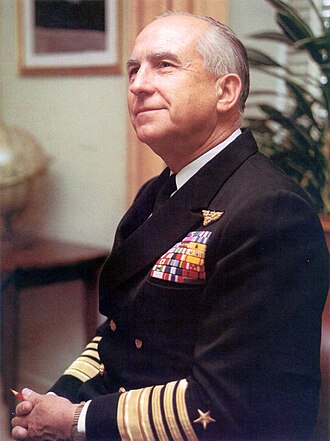
Admiral Thomas H. Moorer began the Nixon administration as Chief of Naval Operations, a post he held from August 1967 until July 1970. In July 1970, President Nixon elevated him to Chairman of the Joint Chiefs of Staff, making him the nation's top military officer throughout the White House taping period until his retirement in July 1974. In this capacity, Moorer frequently advised Nixon on Vietnam War strategy, including the 1972 mining of Haiphong Harbor, and was notably implicated in the Moorer-Radford affair involving the unauthorized transfer of classified National Security Council documents to the Pentagon.
President Nixon met with Secretary of Defense Melvin Laird, Admiral Thomas Moorer, Henry Kissinger, and Chairman of the NATO Military Committee Admiral Sir Nigel Henderson to discuss the strategic importance of NATO and global defense priorities. The participants analyzed the role of conventional versus nuclear deterrents and evaluated international security concerns in regions including Vietnam, the Middle East, and South Africa. Nixon emphasized the necessity of maintaining alliance cohesion and credible defense capabilities while monitoring Soviet geopolitical ambitions and SALT negotiations.
President Nixon met with his senior national security and military advisors, including Henry Kissinger, Melvin Laird, and Admiral Thomas Moorer, to receive an update on the ongoing Lam Son 719 operation in Laos. The discussion focused on the military situation on the ground, the effectiveness of South Vietnamese forces, and strategies to manage press coverage regarding the conflict. Nixon emphasized the importance of maintaining a unified administration message and advised his team to treat the press as an adversarial force rather than providing direct, vulnerable answers to speculative inquiries.
President Nixon met with his national security team, including Vice President Agnew, Henry Kissinger, and William Rogers, to review the status of ongoing military operations in Southeast Asia and the complex diplomatic situation in the Middle East. Military leadership provided a detailed briefing on Operation Lam Son 719 and related efforts to interdict the Ho Chi Minh Trail, emphasizing that while the fighting is intense, the operations are effectively disrupting enemy logistics and protecting American withdrawal interests. The discussion subsequently shifted to the Middle East, where the President expressed frustration over Israel's reluctance to offer a concrete negotiating position despite Egypt's concessions. Nixon concluded by stressing the importance of maintaining a firm stance, noting that while the U.S. remains a reliable ally, it will not offer unconditional support without a reciprocal commitment to a serious peace process.
President Nixon met with Henry Kissinger, Alexander Haig, William Rogers, Melvin Laird, Admiral Thomas Moorer, and Richard Helms to coordinate strategy following the President's March 4, 1971, press conference. The discussion focused on maintaining public and political momentum for the ongoing Vietnamization effort and the military operations in Laos (Lam Son), specifically addressing potential responses to North Vietnamese missile fire and troop movements. Nixon emphasized the necessity of success in Southeast Asia to maintain American global credibility, while the participants reviewed intelligence on enemy capabilities and planned upcoming Congressional testimony and media appearances to manage the narrative surrounding the war.
President Nixon met with his National Security Council and key cabinet officials to receive a high-level briefing on developments in Soviet strategic capabilities, particularly concerning new ICBM silo construction and ballistic missile test programs. The participants evaluated the implications of these technological advancements for U.S. defense posture, including the necessity of maintaining a robust anti-ballistic missile (ABM) system. Discussions emphasized the need for a coordinated approach to strategic negotiations and the potential impact of Soviet military growth on current arms limitation efforts.
President Nixon met with Republican congressional leaders and cabinet members to discuss rural development initiatives and solicit support for the administration's policy agenda. Secretary of Agriculture Clifford Hardin and staff provided an extensive briefing on the status of rural America, highlighting demographic shifts and explaining the mechanics of proposed federal revenue-sharing programs designed to foster economic growth. Participants also reviewed legislative priorities, including the upcoming vote on the supersonic transport (SST) appropriation and other pending congressional business.
President Nixon and Admiral Thomas H. Moorer discussed the status of Operation Lam Son 719, focusing on the tactical challenges posed by poor weather conditions affecting U.S. air support for the Army of the Republic of Vietnam (ARVN). Moorer provided updates on North Vietnamese truck traffic in the mountain passes and characterized the ARVN's morale as strong despite recent enemy activity near Khe Sanh. The President emphasized the strategic importance of monitoring the weather to clear the way for continued airstrikes against enemy supply routes.
President Nixon met with Admiral Thomas H. Moorer to address inaccuracies in press reporting concerning the military situation in Laos, specifically Operation Lam Son. They discussed erroneous Associated Press and Time magazine accounts regarding ARVN troop movements and enemy logistics along the Ho Chi Minh Trail. Nixon emphasized a preference for factual reporting over optimistic spin, directing Moorer to ensure public messaging remained grounded in actual military results.
President Nixon and Admiral Thomas H. Moorer discussed the ongoing withdrawal of the Army of the Republic of Vietnam (ARVN) forces from the Lam Son 719 operation in Laos. The President expressed frustration with media narratives framing the operation as a failure and emphasized the need to pivot public focus toward significant North Vietnamese casualties. To counter negative press accounts, the administration sought to better highlight the operation's strategic objectives and utilize eyewitness accounts from pilots to convey the military success of the mission.
President Nixon met with members of the National League of Families of American Prisoners and Missing in Southeast Asia, along with various military officials and members of Congress, to observe the signing of a proclamation for the National Week of Concern for POW/MIA. The gathering served as a public demonstration of support for families affected by the ongoing war in Vietnam. The ceremony focused on acknowledging the plight of those missing in action and reinforcing the administration's commitment to their families.
President Nixon and the National Security Council met to evaluate U.S. policy options regarding the People's Republic of China's potential admission to the United Nations and the status of Taiwan. Attendees debated the risks of a potential diplomatic defeat, weighing the benefits of "dual representation" versus maintaining the current, increasingly untenable policy of excluding the PRC. The President emphasized the need to manage domestic American public opinion carefully while assessing tactical shifts, ultimately seeking a strategy that minimizes political fallout while addressing the evolving geopolitical reality of China's status.
President Nixon met with his national security team and Secretary of the Treasury John Connally to discuss the ongoing Vietnamization strategy, the military situation in Laos, and the administration's efforts to manage Congressional and media opposition. Nixon emphasized the importance of maintaining his planned withdrawal schedule to ensure the stability of South Vietnam and warned that setting an arbitrary Congressional deadline would lead to a strategic failure. The group also addressed the inaccuracies in press coverage regarding South Vietnamese troop casualties and coordinated their messaging for upcoming legislative briefings.
President Nixon met with Henry Kissinger, H. R. Haldeman, and other staff members to review the positive public and political reception of his April 7, 1971, address regarding Vietnam. The President expressed frustration with staff members he perceived as lacking resolve, while praising Kissinger and Haldeman for their staunch support. They discussed strategies for promoting administration policies, including the use of improved visual charts to illustrate troop withdrawals and casualty reductions, and addressed the political implications of the Lieutenant William Calley case.
President Nixon met with Admiral Thomas H. Moorer, David Packard, and Alexander M. Haig, Jr. to discuss the proposed reorganization of U.S. military command structures, specifically the potential dissolution of the U.S. Southern Command (SOUTHCOM) in Panama. Nixon argued that moving responsibilities to Washington would better align with his goal of reducing the U.S. military footprint in South America, while Moorer and the Joint Chiefs expressed concerns that such a shift could signal weakened regional ties and harm diplomatic rapport. The conversation also touched upon the need for the administration to publicly defend the military against media criticism regarding the conduct of officers in Vietnam and investigations like My Lai.
President Nixon met with a large group of senior military and diplomatic officials to discuss the current state of NATO and the importance of maintaining U.S. commitment to the alliance. The participants focused on the economic and political strength of Europe, the potential for future unity, and the necessity of preventing unilateral troop reductions that could jeopardize geopolitical stability. The discussion highlighted the administration's efforts to influence congressional opinion, specifically regarding legislative proposals like the Mansfield Amendment, while emphasizing the administration's resolve to sustain a strong, collective defense posture.
President Nixon met with his Cabinet and key advisors to announce a major breakthrough in Strategic Arms Limitation Talks (SALT) with the Soviet Union, culminating in a joint statement to be released simultaneously in both nations. The agreement establishes a framework to prioritize limiting anti-ballistic missile (ABM) systems while pursuing parallel measures for offensive weapons. Nixon emphasized that the breakthrough was achieved by maintaining a strong U.S. defense posture, and he urged his administration to avoid public speculation or detailed commentary that could complicate sensitive ongoing negotiations.
President Nixon met with Vice President Agnew and a bipartisan group of Congressional leaders to announce a significant diplomatic breakthrough in the Strategic Arms Limitation Talks (SALT). Nixon informed the attendees of a forthcoming joint statement with the Soviet Union pledging to focus on limiting anti-ballistic missile (ABM) systems and certain offensive strategic weapons. While some lawmakers advocated for immediate unilateral U.S. defense cuts to demonstrate good faith, the President and his advisors successfully urged the leaders to maintain existing defense programs during the negotiations to avoid losing vital bargaining leverage.
President Nixon met with his National Security Council to discuss strategy for Mutual and Balanced Force Reduction (MBFR) negotiations with the Soviet Union, emphasizing the importance of verification and maintaining allied unity. The President and his advisors examined how to use these potential force reductions to counter domestic congressional pressure for unilateral troop withdrawals. Additionally, the group addressed the ongoing crisis surrounding the publication of the Pentagon Papers, with Nixon expressing a need to strengthen penalties for leaking classified information and to defend the executive branch's ability to maintain secure communications.
President Nixon met with the Joint Chiefs of Staff, Vice President Agnew, and key defense officials to review the military’s fiscal year 1973 budget and strategic posture. The Joint Chiefs presented briefings on the shifting global military balance, particularly the expansion of Soviet strategic and conventional forces, and argued that current fiscal constraints threatened the effectiveness of the Nixon Doctrine. The President emphasized the need to build a compelling public and congressional case for defense requirements to counter an anti-military climate, while acknowledging the severe domestic fiscal pressures he faced.
President Nixon met with Henry Kissinger, Adm. Thomas Moorer, and other administration officials to strategize on the escalating India-Pakistan crisis, specifically aiming to prevent an outbreak of war. The discussion emphasized a policy of U.S. neutrality and the importance of avoiding public pressure on Pakistan while encouraging quiet, behind-the-scenes diplomatic efforts to reach a political accommodation. Nixon decided to send representatives to explore humanitarian relief options as a pragmatic vehicle to facilitate these sensitive political conversations with Pakistani leader Yahya Khan.
President Nixon and members of the National Security Council met to review the Fiscal Year 1973 defense budget and evaluate U.S. strategic capabilities relative to the USSR. The discussion centered on balancing budgetary constraints with the requirements of the Nixon Doctrine, specifically regarding troop deployments in Europe, East Asia, and the need for flexible "swing forces." The participants assessed the modernization of strategic forces, naval requirements, and the political implications of U.S. military presence abroad in the context of ongoing diplomatic negotiations with China and the Soviet Union.
President Nixon met with the National Security Council and senior advisors to conduct an extensive assessment of the deteriorating political and military situation in South Vietnam, focusing on the stability of the Nguyen Van Thieu administration and the threat posed by opposition factions and communist forces. The discussion covered strategic military planning for the upcoming dry season in Cambodia and Laos, the progress of Vietnamization, and the implications of U.S. troop withdrawal timelines on both the battlefield and domestic public opinion. Participants also evaluated the potential impact of diplomatic initiatives, including the President's announcement regarding Henry Kissinger’s trip to Peking, on North Vietnam's strategic calculations and internal morale.
President Nixon and the National Security Council met to coordinate U.S. strategy regarding European security, specifically focusing on the upcoming ministerial meetings in Brussels and the push for Mutual and Balanced Force Reduction (MBFR) talks. Participants discussed the complexities of navigating negotiations with Soviet counterparts, managing the varying interests of NATO allies, and addressing the political pressures surrounding troop levels and defense burden-sharing. The conversation concluded with a consensus on the need to maintain a unified diplomatic front while carefully managing the timing and scope of potential force reductions.
President Nixon met with senior administration officials, including Henry Kissinger, Richard Helms, and Admiral Thomas Moorer, to discuss urgent foreign policy concerns regarding the escalating India-Pakistan conflict and the geopolitical maneuvering of the Soviet Union. The participants evaluated the risks posed by Soviet involvement in the region and the potential for broader international instability. The meeting served to align the administration's strategic stance on these pressing global security challenges.
President Nixon hosted a ceremony in the Oval Office to honor General Leonard F. Chapman, Jr., upon the conclusion of his tenure as Commandant of the Marine Corps. The President formally presented General Chapman with the Distinguished Service Medal in recognition of his leadership during the Vietnam War and his service on the Joint Chiefs of Staff. The meeting included remarks from both the President and the General reflecting on the dedication of Marine Corps personnel, the importance of military families, and Chapman's 36-year career.
President Nixon and Admiral Thomas H. Moorer reviewed the progress of ongoing U.S. bombing operations in Vietnam, which had been hampered by poor weather conditions. Moorer provided updates on strikes against transshipment points and petroleum storage, while noting that South Vietnamese forces were preparing to use captured enemy weapons to harass North Vietnamese units. Nixon emphasized the urgency of these strikes to maximize damage before diplomatic constraints related to his upcoming visit to the People's Republic of China narrowed military options.
President Nixon and Admiral Thomas H. Moorer engaged in a brief, informal exchange following the Christmas holiday. The conversation focused primarily on their mutual appreciation for a recent professional football game. No official policy decisions or strategic military matters were discussed during this interaction.
President Nixon convened this meeting of the National Security Council to assess the potential for a major North Vietnamese military offensive and to coordinate U.S. support for South Vietnam. The participants, including Henry Kissinger, Melvin Laird, and Admiral Thomas Moorer, discussed enemy troop movements, the effectiveness of Vietnamization, and the need for enhanced military authorities for field commanders. Nixon directed the council to provide robust support while ensuring that South Vietnamese forces receive the primary public credit, emphasizing that the U.S. must remain committed to a successful outcome despite domestic political pressures.
President Nixon, Admiral Thomas Moorer, and Henry Kissinger met to discuss the necessity of maintaining direct communication channels between the President and the Joint Chiefs of Staff, notwithstanding bureaucratic concerns from the Department of Defense. Nixon emphasized his constitutional duty as Commander-in-Chief and expressed frustration with constraints following the Charles Radford security leak incident involving columnist Jack Anderson. The President instructed Kissinger and General Alexander Haig to manage potential friction with the Secretary of Defense to ensure the military leadership could continue to report directly to him.
President Nixon and members of the National Security Council met to evaluate strategic options for the ongoing Strategic Arms Limitation Talks (SALT), focusing on ABM site deployments and the potential inclusion of submarine-launched ballistic missiles (SLBMs). Nixon emphasized the political necessity of securing an agreement that prevents Soviet strategic superiority, while participants debated the relative merits of "hard-site" defense versus current safeguard proposals and the impact of these negotiations on Congressional support. The discussion underscored a shared concern regarding the erosion of U.S. bargaining leverage and established a firm directive to pursue an agreement based on the principle of strategic equivalency.
President Nixon met with Admiral Thomas H. Moorer, Kenneth Rush, and Henry Kissinger to express severe frustration regarding the U.S. military's handling of the North Vietnamese offensive and the poor flow of information from the Department of Defense. Nixon criticized General Creighton W. Abrams for a lack of imagination and aggressive leadership, demanding immediate, intensified use of air power and B-52s regardless of weather conditions. The President asserted his authority as Commander-in-Chief, ordering that all future military reports be provided to him directly and in an unsanitized format to bypass administrative delays.
President Nixon met with H. R. Haldeman, Henry Kissinger, and Admiral Thomas Moorer to coordinate the U.S. military and public relations response to the massive North Vietnamese invasion. Nixon expressed intense frustration with military reporting and the lack of aggressive action, ordering naval forces to prepare for a selective blockade and authorizing expanded air strikes and naval gunfire against the invasion force. The participants discussed strategies for managing the optics of the conflict, the potential for an orderly South Vietnamese retreat to better defensive positions, and the necessity of winning the engagement to maintain U.S. global credibility.
President Nixon and Admiral Thomas Moorer discuss ongoing air operations and naval bombardment efforts in Vietnam, specifically focusing on strikes within the B-3 area and the DMZ. The President expresses his desire for maximum military effort, demanding that all available Seventh Fleet cruisers and destroyers be deployed to the region immediately. Moorer is instructed to disregard psychological operations and provide a detailed report on the naval deployment to Henry Kissinger by 10:00 a.m. to facilitate upcoming strategic plans.
President Nixon and Henry Kissinger discussed the ongoing North Vietnamese offensive and their frustration with the lack of aggressive military responses from U.S. air commanders. The participants evaluated the effectiveness of current air strikes and naval gunfire while debating the potential need for a leadership shake-up, including the possible replacement of commanding officers to ensure more imaginative and vigorous tactics. Additionally, Nixon emphasized the psychological importance of massive B-52 strikes and analyzed the geopolitical risks for the Soviet Union regarding the conflict ahead of their upcoming summit.
President Nixon, Henry Kissinger, and Admiral Thomas Moorer discussed the urgent need to increase the intensity of U.S. air operations in Vietnam, specifically focusing on expanding B-52 sorties to achieve psychological impact. Nixon expressed dissatisfaction with current leadership and mandated the immediate appointment of an experienced, aggressive air commander to oversee the campaign. Moorer committed to providing a recommendation for this new commander by noon and working with the Air Force Chief of Staff to expedite the deployment of additional aircraft.
President Nixon met with Henry Kissinger, H. R. Haldeman, Melvin Laird, and Admiral Thomas Moorer to coordinate the administration's public and military response to the North Vietnamese Easter Offensive. The group discussed the importance of maintaining a firm stance to protect U.S. credibility and ensure the success of the President's upcoming Moscow trip, while emphasizing that the ongoing conflict was a Soviet-backed "massive communist invasion." Significant decisions included Laird’s plan to publicly highlight the effectiveness of South Vietnamese forces and U.S. air support, while maintaining strategic ambiguity regarding potential naval blockades or mining operations.
President Nixon consulted Admiral Thomas H. Moorer regarding the escalation of bombing campaigns in North Vietnam, specifically authorizing strikes up to Haiphong. The President expressed significant concern regarding the vulnerability of U.S. destroyers to Soviet-supplied gunboats and shore-based rocket attacks. Additionally, Moorer updated Nixon on the deployment schedule of the USS Newport News and the strategic use of destroyers to provide fire support for South Vietnamese ground troops in Military Region Two.
President Nixon and Admiral Thomas H. Moorer held a brief check-in to discuss military readiness following a reported accident. The President sought assurance that personnel were properly prepared to handle the situation, though specific details regarding the nature of the incident remain vague in the transcript. Moorer confirmed the status of ongoing preparations before the call concluded.
President Nixon met with his national security team, including Henry Kissinger, Admiral Thomas Moorer, and Secretary of Defense Melvin Laird, to receive a comprehensive military briefing on the ongoing North Vietnamese Easter Offensive. Admiral Moorer provided a detailed regional analysis of the conflict, noting that while South Vietnamese forces were facing intense pressure and heavy casualties, they were holding key positions with the crucial assistance of U.S. air power and naval support. The President emphasized that the conflict would remain difficult but reaffirmed his commitment to maintaining air support and striking military targets in North Vietnam until the offensive subsided.
President Nixon met with Republican congressional leadership to coordinate strategy on key domestic and foreign policy issues during an election year. The discussion focused on distributing fact sheets regarding economic improvements, crime reduction, and unemployment to bolster support, while also strategizing to defeat restrictive anti-war amendments in Congress. Additionally, the President announced his decision to appoint an acting FBI director to ensure institutional stability following the death of J. Edgar Hoover, aiming to shield the bureau from partisan political controversy.
In this meeting, President Nixon confers with Henry Kissinger, H. R. Haldeman, John Connally, and Admiral Thomas Moorer to finalize plans for a military escalation in Vietnam. Frustrated by previous constraints, Nixon decides to implement a naval blockade of North Vietnam and launch intensive air strikes against key strategic targets, including rail yards, power plants, and oil supplies. Nixon emphasizes the necessity of this decisive action to prevent a U.S. defeat, secure the release of prisoners of war, and force a ceasefire, while explicitly directing Moorer to maintain the chain of command directly to him and bypass Secretary of Defense Melvin Laird. The group also discusses the potential cancellation of the upcoming Soviet summit as a consequence of these actions and addresses the possible replacement of General Creighton Abrams in theater.
Henry Kissinger contacts Admiral Thomas H. Moorer to coordinate a high-priority, clandestine meeting with President Nixon. Kissinger instructs Moorer to expedite the departure of a visiting Taiwanese admiral to ensure immediate availability for the President. The conversation emphasizes strict operational security, specifically warning Moorer not to disclose his movements to anyone.
President Nixon met with his senior advisors and military officials to coordinate an aggressive military response to the North Vietnamese offensive. The discussion centered on implementing a naval blockade of North Vietnam and intensifying air strikes, with Nixon emphasizing the necessity of a decisive victory to protect American prestige and prevent a communist takeover in Southeast Asia. The President also consulted with his staff on the strategic messaging for a forthcoming public announcement, weighing the psychological impact of a blockade against traditional bombing campaigns.
President Nixon convened his National Security Council to weigh critical military options regarding the ongoing North Vietnamese offensive and the potential collapse of South Vietnamese forces. Key participants, including Henry Kissinger, Melvin Laird, and John Connally, debated the strategic risks of maintaining the status quo versus implementing a naval blockade and intensified air strikes on North Vietnam. While acknowledging the potential for a diplomatic crisis and the likely cancellation of the upcoming Moscow summit, the President and his advisors emphasized the necessity of demonstrating resolve to protect U.S. credibility and avoid a catastrophic military defeat. Ultimately, the discussion centered on whether a more aggressive military posture could provide the leverage required to salvage the situation in South Vietnam and secure the release of American prisoners of war.
President Nixon met with Vice President Agnew, Cabinet members, and senior staff to discuss the administration's recent escalation in Vietnam, specifically the blockade of North Vietnamese ports. The President articulated his rationale for the decision and sought unified support from his team to manage potential congressional and public opposition. He emphasized the necessity of leadership during difficult times and urged his Cabinet to present a cohesive front in defending the policy to the public.
President Nixon met with Henry Kissinger, Alexander Haig, and Admiral Thomas Moorer to evaluate the domestic and international reactions to his recent decision to blockade North Vietnam. The participants discussed the progress of North Vietnamese offensives, the effectiveness of ongoing U.S. air strikes against logistics targets, and the necessity of maintaining firm public and political resolve. Nixon emphasized his determination to continue the operation until the North Vietnamese offensive failed, while the group considered the potential impact on the upcoming Soviet summit and the importance of coordinating public messaging through administration officials like Melvin Laird.
President Nixon and Admiral Thomas Moorer discussed the implementation of the naval blockade and intensified bombing campaign against North Vietnam. Nixon emphasized the necessity of focusing on primary military targets like rail lines and power plants rather than secondary objectives. Moorer reported on a successful and supportive two-hour meeting with Senator John C. Stennis and the Senate Armed Services Committee regarding the operation.
President Nixon met with H. R. Haldeman, Vice President Spiro Agnew, Henry Kissinger, and Admiral Thomas Moorer to coordinate administration responses to the Vietnam War and manage the public narrative surrounding the conflict. The discussion focused on the effectiveness of recent bombing campaigns and the blockade of North Vietnam, as well as the need to address internal military resistance regarding bombing targets. Nixon also received a briefing from Agnew on his recent diplomatic trip to Japan, Thailand, and South Vietnam, and coordinated plans for the Vice President to visit the recently wounded George Wallace.
President Nixon and Admiral Thomas Moorer discuss the logistical timeline for a forthcoming international trip, specifically focusing on travel duration and comfort. They conclude that the transit will require approximately three weeks to complete. The brief exchange confirms that Moorer's scheduling conflicts, specifically his commitments involving George Shultz, will be resolved in time to accommodate this mission.
President Nixon met with his senior military and national security leadership, including Henry Kissinger, Melvin Laird, and the Joint Chiefs of Staff, to align the administration on the status and defense of pending Vietnam peace negotiations. The discussion focused on the current terms of the settlement agreement, the importance of maintaining public and congressional support, and the necessity of contingency planning should North Vietnam violate the terms. Nixon emphasized that the agreement was the best obtainable outcome and instructed his team to present a unified, positive front while preparing for potential retaliatory actions if the cease-fire collapsed.
President Nixon consulted with Admiral Thomas H. Moorer to discuss his desire to send a formal message of appreciation to military commanders following recent bombing operations over North Vietnam. Moorer confirmed that North Vietnamese forces were significantly depleted of missiles and supplies, attributing the success of the campaign directly to the President's decisive leadership. Nixon requested that the commendation avoid a tone of triumphalism while emphasizing the professionalism and courage of the Air Force personnel involved.
President Nixon instructed Admiral Thomas H. Moorer to draft a message to military commanders commending the courage and sacrifice of forces involved in the recent bombing operations in Vietnam. Nixon emphasized the necessity of maintaining resolve and morale despite domestic political criticism of the air campaign, asserting that the pressure on the North Vietnamese had been effective. This directive served to ensure that service members understood their efforts were recognized by the administration as a critical factor in achieving peace.
President Nixon met with Henry Kissinger, William Rogers, Melvin Laird, Admiral Thomas Moorer, and Colonel Richard Kennedy to coordinate the administration's public relations and congressional strategy regarding Vietnam. The participants discussed the military effectiveness of recent bombing campaigns, the necessity of countering negative media reports by highlighting North Vietnamese civilian destruction, and the importance of maintaining a unified front. Nixon directed his team to avoid a defensive posture and to provide briefings for key congressional allies using photographic evidence of military targets, while stressing that the administration must remain cautious about disclosures until upcoming negotiations conclude.
President Nixon hosted a ceremony in the Oval Office to honor General Alexander M. Haig, Jr. with the Defense Distinguished Service Medal. The event, attended by Haig’s family and high-ranking administration officials, served as a formal recognition of Haig’s significant contributions to national security and his diplomatic efforts, including his work supporting Henry Kissinger. The gathering concluded with photo opportunities and brief discussions regarding Haig's transition out of his White House role.
President Nixon met with Admiral Thomas H. Moorer to discuss the triumphant return of American Prisoners of War (POWs) from Vietnam and the strategic success of the recent air campaigns. The two focused on leveraging the high morale and patriotism of the returning POWs to solidify public support for the administration's military policies and to justify the necessity of the Vietnam bombing raids. Additionally, they reviewed strategies for future military planning, the importance of maintaining a strong defense budget, and the administration’s firm opposition to amnesty for draft evaders.
General Brent G. Scowcroft contacted Admiral Thomas H. Moorer on behalf of President Nixon to coordinate the guest list for an upcoming luncheon. The primary purpose was to confirm whether Admiral Moorer approved of General Andrew J. Goodpaster’s attendance. Moorer granted his approval, and Scowcroft proceeded to finalize the arrangements.
President Nixon met with Generals Brent Scowcroft and Andrew Goodpaster to discuss the strategic implications of the Vietnam settlement, the return of American POWs, and future NATO relations. Nixon emphasized that the recent peace agreement and the successful December 1972 bombing campaign significantly bolstered American credibility with allies and boosted domestic morale. The group also analyzed the importance of maintaining a firm stance with NATO partners during ongoing security negotiations and the potential for long-term military force restructuring in Europe.
President Nixon consulted with Admiral Thomas Moorer regarding a request from Reader's Digest publisher Hobart Lewis to produce a feature article on the return of American Prisoners of War. Nixon proposed that military analyst Hanson Baldwin be granted access to collect information for the story, provided all details remain confidential until the repatriation process concluded on March 28. Moorer agreed to cooperate with Baldwin and assured the President that the security of the information would be maintained.
President Nixon met with members of the National Security Council and other senior officials to discuss the strategic balance of power between the U.S. and the USSR, specifically in anticipation of the SALT II negotiations. The discussion focused on the impact of qualitative and quantitative disparities in throw-weight, bombers, and MIRV technology on U.S. and Soviet first- and second-strike capabilities. Nixon emphasized the importance of maintaining an appearance of strategic equivalence to preserve the confidence of U.S. allies and domestic support, directing his team to refine their negotiating strategy without rushing into a premature moratorium on weapons testing.
President Nixon and Admiral Thomas Moorer discuss the management of a high-profile, emotionally compelling news story involving the return of prisoners of war and the contributions of a specific nurse. Nixon requests that Moorer cooperate with anticipated media inquiries, emphasizing the need to shape a positive narrative regarding these events. The conversation serves as an alert to ensure military personnel are prepared to provide coordinated testimony once the timing is appropriate.
Admiral Thomas H. Moorer called to commend President Nixon on a nationally televised speech regarding the homecoming of American prisoners of war and the state of national defense. Nixon urged Moorer to lobby Congress vigorously against defense budget cuts, arguing that a strong military posture was essential for successful negotiations with the Soviet Union on arms limitations. Additionally, the President requested that Moorer track the career advancement of a captain on the USS Albany who had served as the commanding officer for his son-in-law, David Eisenhower.
President Nixon and members of the National Security Council met to discuss the strategic importance of Mutual Balanced Force Reductions (MBFR) amidst growing congressional pressure for unilateral U.S. troop cuts. The discussion focused on maintaining a credible conventional defense posture in Europe to avoid a reliance on "tripwire" nuclear escalation, which Nixon and his advisors agreed would be untenable given the current parity in nuclear capabilities between the U.S. and the Soviet Union. Participants ultimately reached a consensus to pursue negotiations that link force improvements with potential reductions while resisting domestic isolationist trends and preserving NATO's operational cohesion.
Admiral Thomas H. Moorer called President Nixon to express support following the President's televised address regarding the Watergate scandal. The two discussed the appointment of Elliot Richardson as the new Attorney General and the subsequent vacancy within the Department of Defense. Nixon signaled his intention to recruit a successor from California to fill the leadership gap created by Richardson's move.