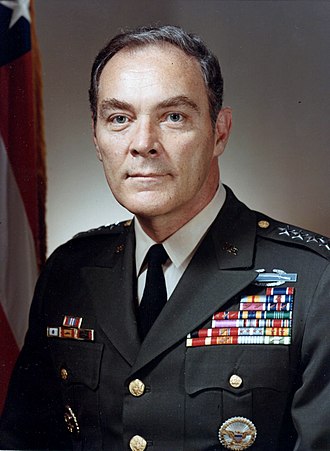
Haig, Alexander M., Jr.
Alexander M. Haig, Jr. began his service in the Nixon administration as a military assistant to National Security Advisor Henry Kissinger from January 1969 to June 1970, before being promoted to Deputy Assistant to the President for National Security Affairs. He held this deputy role for the majority of the White House taping period, from June 1970 until January 1973, when he transitioned to the Pentagon to become Vice Chief of Staff of the U.S. Army. As the Watergate scandal forced the resignation of H.R. Haldeman, Nixon recalled Haig to serve as White House Chief of Staff from May 1973 until the president's resignation in August 1974.
President Nixon met with VFW leadership, Donald E. Johnson, Charles W. Colson, and Alexander M. Haig, Jr. to discuss the administration's Vietnam War policies, including the status of U.S. Prisoners of War and the progress of Vietnamization. A significant portion of the discussion focused on domestic challenges facing returning veterans, particularly the high unemployment rates among Vietnam veterans and the need for improved federal job training and placement programs. Nixon directed his team to prioritize veteran employment initiatives and emphasized the importance of ensuring these programs served all veterans equitably, including minorities.
President Nixon met with H.R. Haldeman and various staff members, including Peter Flanigan, Henry Kissinger, and John Ehrlichman, to deliberate on high-level personnel appointments, government reorganization, and legislative strategy. A primary focus was identifying a strong, business-oriented candidate for an ambassadorial role to navigate international economic negotiations and counter State Department bureaucracy. The group also discussed managing the President’s public image regarding economic policy, the Alaska pipeline, and Vietnam, while addressing the need to discipline administration officials who publicly diverged from official policy. The President emphasized a preference for direct, high-level policy control and instructed his staff to bolster communication efforts and strengthen the administration’s political messaging.
President Nixon met with David H. Popper, Alexander M. Haig, Jr., and others to discuss the geopolitical situation in Cyprus, specifically focusing on the leadership of Archbishop Makarios and the fragile stability between Greek and Turkish factions. The participants assessed the potential for regional conflict and the importance of maintaining diplomatic stability in the eastern Mediterranean. The brief meeting concluded with the President presenting gifts to the attendees.
President Nixon met with Charles Whitehouse, Alexander Haig, and Raymond Price to discuss the progress and challenges of the war in Vietnam, particularly focusing on pacification efforts and the difficulties of establishing democratic institutions in a nation lacking such historical tradition. The conversation explored the comparative success of various governmental structures in different regions of the world, acknowledging the political complexities of maintaining democracy in developing countries. Following this strategic review, Nixon and his advisors briefly discussed Whitehouse's potential future assignments, including potential ambassadorships, before concluding the meeting with a presentation of gifts.
President Nixon met with David M. Kennedy and General Alexander Haig to discuss the strategic objectives and logistical planning for Kennedy’s upcoming diplomatic tour of Vietnam, Indonesia, Micronesia, Hong Kong, and Thailand. The President emphasized the critical need for an expert evaluation of South Vietnam’s post-withdrawal economic viability and urged Kennedy to consult directly with local leaders and business figures to bypass the perceived limitations of State Department bureaucracy. Additionally, Nixon provided specific instructions for managing regional alliances, including reassuring Thai leadership of U.S. commitment and addressing the political complexities of Micronesian governance.
President Nixon, Henry Kissinger, and Alexander Haig met to discuss the volatile diplomatic landscape of the Middle East, focusing specifically on Israeli concerns regarding potential border adjustments and U.S. policy. The participants examined the implications of a return to 1967 borders, the role of the Soviet Union in the region, and the necessity of maintaining military support for Israel. The discussion concluded with a consensus on the need to consult Joseph Sisco to better align future U.S. policy options ahead of a scheduled meeting with Secretary of State William Rogers.
President Nixon met with his senior national security and military advisors, including Henry Kissinger, Melvin Laird, and Admiral Thomas Moorer, to receive an update on the ongoing Lam Son 719 operation in Laos. The discussion focused on the military situation on the ground, the effectiveness of South Vietnamese forces, and strategies to manage press coverage regarding the conflict. Nixon emphasized the importance of maintaining a unified administration message and advised his team to treat the press as an adversarial force rather than providing direct, vulnerable answers to speculative inquiries.
President Nixon met with his national security team, including Vice President Agnew, Henry Kissinger, and William Rogers, to review the status of ongoing military operations in Southeast Asia and the complex diplomatic situation in the Middle East. Military leadership provided a detailed briefing on Operation Lam Son 719 and related efforts to interdict the Ho Chi Minh Trail, emphasizing that while the fighting is intense, the operations are effectively disrupting enemy logistics and protecting American withdrawal interests. The discussion subsequently shifted to the Middle East, where the President expressed frustration over Israel's reluctance to offer a concrete negotiating position despite Egypt's concessions. Nixon concluded by stressing the importance of maintaining a firm stance, noting that while the U.S. remains a reliable ally, it will not offer unconditional support without a reciprocal commitment to a serious peace process.
President Nixon met with his task force leaders and advisors to discuss the legislative strategy for the Task Force on International Development proposals and the challenges of securing Congressional support. Key participants included Rudolph Peterson, Peter Peterson, Clark MacGregor, and Henry Kissinger, who debated the jurisdictional split of foreign assistance programs between the State and Defense Departments. The group emphasized the need to integrate foreign aid with broader U.S. economic and trade policies, and Nixon tasked MacGregor with coordinating closely with Congressional leadership to ensure the proposals moved forward without significant delays.
President Nixon held two distinct meetings in the Oval Office: the first with Turkish diplomat Targut Menemencioglu and his team to discuss geopolitical concerns in Pakistan, India, and Turkey, including the future of the Central Treaty Organization (CENTO); the second with Chief Justice Warren Burger, John Mitchell, and John Dean regarding judicial reform and the President's potential appearance at an American Bar Association event in London. During the first session, Nixon reaffirmed the importance of maintaining U.S. support for Pakistan and stability in the region despite domestic Congressional opposition. The subsequent meeting focused on the need to expedite the criminal justice system in the U.S. and coordinated scheduling for Law Day and judicial conferences.
President Nixon met with Henry Kissinger, Alexander Haig, William Rogers, Melvin Laird, Admiral Thomas Moorer, and Richard Helms to coordinate strategy following the President's March 4, 1971, press conference. The discussion focused on maintaining public and political momentum for the ongoing Vietnamization effort and the military operations in Laos (Lam Son), specifically addressing potential responses to North Vietnamese missile fire and troop movements. Nixon emphasized the necessity of success in Southeast Asia to maintain American global credibility, while the participants reviewed intelligence on enemy capabilities and planned upcoming Congressional testimony and media appearances to manage the narrative surrounding the war.
President Nixon met with Gerard C. Smith and General Alexander M. Haig, Jr. to facilitate a photo opportunity during the signing of a private letter containing instructions for the U.S. ambassador. The discussion touched upon the administration's public diplomatic position and the prospects for the Strategic Arms Limitation Talks (SALT). Nixon expressed skepticism regarding immediate progress, suggesting that negotiations would likely remain stalled until the conclusion of the Soviet Party Congress.
President Nixon met with his national security team and Secretary of the Treasury John Connally to discuss the ongoing Vietnamization strategy, the military situation in Laos, and the administration's efforts to manage Congressional and media opposition. Nixon emphasized the importance of maintaining his planned withdrawal schedule to ensure the stability of South Vietnam and warned that setting an arbitrary Congressional deadline would lead to a strategic failure. The group also addressed the inaccuracies in press coverage regarding South Vietnamese troop casualties and coordinated their messaging for upcoming legislative briefings.
General Alexander M. Haig, Jr. met with diplomat Douglas MacArthur, II to review MacArthur’s extensive career in foreign service and military affairs. The discussion covered his assignments across Europe, Japan, and the Middle East, including observations on geopolitical tensions in regions such as Jordan, Pakistan, and Iran. The conversation served primarily as a retrospective on MacArthur's professional background and experiences with various international regimes and conflicts.
President Nixon met with Douglas MacArthur, II, and General Alexander Haig to discuss the strategic importance of Iran and the planning of a potential future presidential visit. The conversation centered on the upcoming British military withdrawal from the Persian Gulf and the necessity of bolstering Iran—under the Shah's leadership—as a regional stabilizer and key U.S. ally to counterbalance Soviet influence. Nixon instructed MacArthur and Haig to proceed with planning for a visit while emphasizing the need to coordinate through private channels rather than the State Department to avoid bureaucratic delays, and also addressed broader global concerns regarding U.S. credibility, military presence in Thailand, and varying stages of democratic development in international regimes.
President Nixon contacted Alexander M. Haig, Jr. to request an immediate, in-person meeting at the White House. The call served primarily as a brief logistical coordination to facilitate a secure discussion between the two men. Haig acknowledged the request and prepared to depart his office to join the President.
President Nixon met with George Shultz and Alexander Haig to discuss the administration's economic and defense strategies. Nixon expressed strong support for retaining Paul McCracken as a steady hand on the economy, despite internal rumors of his potential departure. The President also outlined a highly confidential, multi-pronged approach to international relations, emphasizing the need for absolute secrecy regarding potential ABM agreements with the Soviet Union and the use of hard-line tactics to pressure North Vietnam into negotiations before the upcoming political window closed.
President Nixon met with David M. Kennedy and Alexander M. Haig, Jr. to discuss Kennedy’s recent diplomatic trip to Asia, focusing on economic and political conditions in Vietnam, Indonesia, and Thailand. They evaluated the effectiveness of U.S. aid programs and the conduct of embassy staff, with Nixon expressing a strong desire to replace existing economic advisors with private-sector CEOs to better promote stability and self-reliance. Additionally, Nixon directed Haig to aggressively reduce the number of Peace Corps personnel in the Pacific territories, citing concerns over their behavior and political leanings.
President Nixon and Alexander Haig discussed the Israeli proposal for a Suez Canal withdrawal, a diplomatic development encouraged by Henry Kissinger to secure a temporary period of stability in the Middle East. Haig expressed concern that the State Department might react negatively to the proposal's initial toughness, potentially leading to a premature rejection by the Egyptians. They concluded that the administration should allow the diplomatic process to play out for now, with the President reserving potential intervention with Israeli leadership for a later stage.
President Nixon met with Australian Prime Minister John G. Gorton and General Alexander M. Haig, Jr. to discuss geopolitical relations, the Vietnam War, and the management of international racial and religious conflicts. The conversation covered Australia's role in Southeast Asia, the treatment of POWs, and the broader historical responsibilities of Western powers in maintaining global stability. Nixon also reaffirmed his support for trade, specifically regarding Australian beef imports, and presented Gorton with a commemorative gift before the meeting's conclusion.
President Nixon met with General Alexander Haig and an unidentified staffer to review a wide range of foreign policy and administrative matters, including the status of POW statements and military operations in Vietnam. The discussion addressed the diplomatic complexities of potential aid to Indian refugees from Pakistan, the desire to maintain a flexible policy regarding Middle East peace prospects in the Suez region, and concerns over media speculation regarding U.S.-China relations. Nixon requested updated, verifiable casualty figures for North and South Vietnam to better inform his upcoming public messaging.
President Nixon and Alexander Haig coordinate the review and handling of a newly arrived memorandum from Henry Kissinger. Nixon directs Haig to ensure the document is processed efficiently without duplicating efforts. The President emphasizes his intention to personally manage the handling of the memo to ensure a favorable outcome.
President Nixon consulted with General Alexander M. Haig, Jr. to request comparative data on Vietnam War casualties, specifically seeking figures from the current week contrasted with those from one and two years prior. Additionally, the President requested information regarding the size and composition of the 1st Marine Division. This inquiry reflected Nixon’s effort to contextualize current military losses and force structure as part of his ongoing assessment of the Vietnam conflict.
President Nixon met with General Alexander M. Haig, Jr. to address sensitive national security matters involving Japan. Due to the classified nature of the discussion, the specific details remain redacted under national security exemption guidelines. The consultation reflects ongoing executive-level oversight of U.S.-Japan diplomatic and strategic relations during this period.
President Nixon met briefly with Alexander M. Haig, Jr. in the Oval Office to coordinate his official daily schedule. The conversation focused on logistical arrangements regarding upcoming presidential meetings. No further policy developments or complex issues were addressed during this short interaction.
President Nixon met with Alexander Haig and H.R. Haldeman to coordinate strategy for an upcoming press conference, focusing heavily on countering North Vietnamese propaganda regarding Prisoners of War (POWs) and ceasefire proposals. They discussed correcting public misinterpretations of Secretary of State William Rogers' recent statements on China, emphasizing the need to keep diplomatic rhetoric low-key to avoid unnecessary friction. Additionally, the President and his staff reviewed concerns over television production techniques and public image management, balancing the importance of authentic substance over staged performance.
President Nixon and General Alexander Haig met to clarify the strategic implications and specific conditions of a recent unilateral offer regarding the repatriation of enemy prisoners of war. They assessed how this proposal differed from previous U.S. positions and discussed the numerical disparity between the 576 enemy prisoners offered for release and the approximately 430 Americans held in North Vietnam. The discussion focused on establishing a firm, consistent administrative stance to ensure the President could clearly articulate U.S. policy in future public or diplomatic inquiries.
President Nixon and Alexander Haig reviewed the administration's strategic messaging regarding North Vietnamese Prisoners of War (POWs) to ensure that the term "reciprocity" was avoided in official negotiations. Haig clarified that while the proposed prisoner releases were conditional upon agreement regarding neutral host countries, the U.S. remained flexible regarding specific numbers and inspection arrangements. The discussion focused on differentiating new proposals, such as expanded inspection rights for neutral organizations, from prior public statements to maintain tactical clarity with North Vietnamese counterparts.
President Nixon and Alexander Haig briefly discuss the semantics of differentiating between "modern" and "grand" in an unspecified administrative context, with Nixon expressing frustration over the distinction. Haig confirms that he and Henry Kissinger are working to restore certain traditions. The conversation concludes with a brief check on other outstanding issues, which Haig indicates are well-covered.
President Nixon and Alexander Haig review the specific terms of a new proposal regarding American prisoners of war in Vietnam. They clarify that the United States remains willing to pursue unilateral repatriation of prisoners regardless of the enemy's response. Additionally, they discuss the introduction of a new bilateral proposal involving the internment of POWs in a neutral country.
President Nixon and Alexander Haig confer regarding the sensitive diplomatic channels utilized for the release of prisoners of war (POWs). The discussion focuses on clarifying the administration's stance on the involvement of third-party nations and outside organizations in facilitating these negotiations. Nixon emphasizes the importance of maintaining direct control over these interactions to ensure that no unauthorized assurances are conveyed to external parties.
President Nixon met with Admiral Thomas H. Moorer, David Packard, and Alexander M. Haig, Jr. to discuss the proposed reorganization of U.S. military command structures, specifically the potential dissolution of the U.S. Southern Command (SOUTHCOM) in Panama. Nixon argued that moving responsibilities to Washington would better align with his goal of reducing the U.S. military footprint in South America, while Moorer and the Joint Chiefs expressed concerns that such a shift could signal weakened regional ties and harm diplomatic rapport. The conversation also touched upon the need for the administration to publicly defend the military against media criticism regarding the conduct of officers in Vietnam and investigations like My Lai.
President Nixon met with H.R. Haldeman and Alexander Haig to discuss the critical need for a major policy announcement to strengthen his position against mounting congressional pressure regarding the Vietnam War. They evaluated the political impact of potential developments, including a Strategic Arms Limitation Talks (SALT) agreement and diplomatic initiatives involving China and the USSR. Ultimately, Nixon emphasized that he required a decisive, high-profile move to bolster his support in the Senate, deciding to prioritize a meeting with South Vietnamese President Nguyen Van Thieu as a key strategic action. The conversation concluded with a brief meeting involving Charles Rhyne and Richard Moore regarding the potential for a presidential initiative to promote international law.
President Nixon met with Ambassador Ernest V. Siracusa and Alexander Haig to discuss the political and economic instability in Bolivia under President Juan José Torres. The participants analyzed Bolivia's internal challenges, including a lack of institutional support, social unrest, and the flight of skilled professionals, while comparing these conditions to the relative economic growth seen in Brazil. Nixon emphasized that the U.S. should maintain a patient, positive, and supportive diplomatic stance toward the region, despite the persistent political volatility and the perceived anti-American rhetoric from local intellectuals and media figures.
President Nixon met with Senator William B. Saxbe and Alexander M. Haig, Jr. to discuss the political challenges of extending the military draft and maintaining U.S. foreign policy commitments in Vietnam and Asia. Saxbe expressed concerns regarding growing anti-military sentiment among the youth and in Congress, warning that a filibuster could derail draft legislation and force a precarious renewal in a presidential election year. The President emphasized the necessity of a stable military to support international standing and urged Saxbe to help solidify support among Republican legislators, while also briefly discussing the strategic importance of various domestic infrastructure projects in Ohio.
President Nixon met with his staff to discuss public relations strategies, specifically focusing on improving outreach to congressional wives and managing the public perception of the administration's accomplishments. The group reviewed the President's schedule and evaluated the effectiveness of recent social events, while also debating the political implications of shifting federal facilities and promoting key initiatives like cancer research and desalinization programs. Additionally, they touched upon legislative concerns, including the potential for a volunteer army and the reaction to Senator Mike Mansfield's resolution regarding the reduction of U.S. troops in Europe.
President Nixon and Alexander Haig discussed a strategic plan to secure public support for a forthcoming presidential statement by utilizing endorsements from former Cabinet members. The discussion focused on coordinating these endorsements, specifically involving Dean Acheson and William P. Rogers, to bolster the administration's position. Haig outlined the procedure for staging these endorsements to ensure maximum political impact for the President's signature.
President Nixon met with a large group of senior military and diplomatic officials to discuss the current state of NATO and the importance of maintaining U.S. commitment to the alliance. The participants focused on the economic and political strength of Europe, the potential for future unity, and the necessity of preventing unilateral troop reductions that could jeopardize geopolitical stability. The discussion highlighted the administration's efforts to influence congressional opinion, specifically regarding legislative proposals like the Mansfield Amendment, while emphasizing the administration's resolve to sustain a strong, collective defense posture.
President Nixon directs Alexander Haig to meet with him immediately prior to a scheduled session with Secretary of State William P. Rogers. The conversation serves to coordinate staff access and scheduling for the President's upcoming diplomatic deliberations. Nixon specifically notes that Henry Kissinger is currently occupied in a meeting with Gerard C. Smith, necessitating Haig's prompt arrival for a briefing.
President Nixon directs Alexander M. Haig, Jr. to meet with him immediately to discuss recent developments regarding Henry Kissinger's negotiations with Gerard Smith. The President intends to consult with Haig regarding the status of these talks before proceeding to a scheduled meeting with Secretary of State William P. Rogers. This brief exchange serves to coordinate administration strategy and brief the President on critical diplomatic updates.
President Nixon met with Robert D. Murphy and Alexander M. Haig, Jr. to discuss the geopolitical implications of the United States' shifting China policy, particularly regarding Taiwan's status in the United Nations. The participants analyzed the political stability and leadership of Chiang Kai-shek and explored the feasibility of a 'two-China' policy versus the risks of abandoning a long-standing ally. Nixon expressed concern that tactical maneuvering within the UN would fail to win respect from Peking and might instead signal a loss of American resolve to the international community.
President Nixon hosted a series of brief meetings in the Oval Office to recognize the service of several individuals, including Admiral R. C. Robinson, Jack T. Cole, and long-serving government employee Carson Howell, often presenting them with commemorative gifts. During these sessions, the President discussed his opposition to the legalization of marijuana and orchestrated various photo opportunities for his guests. Additionally, Nixon met with Catherine May Bedell and Peter G. Peterson to discuss her nomination to the U.S. Tariff Commission, emphasizing the need for her to work closely with his administration and maintain direct communication with his key advisors.
President Nixon and Alexander Haig discuss the administration's skepticism regarding ongoing international negotiations and the potential for foreign powers to exploit U.S. diplomatic overtures. Nixon emphasizes that ongoing talks with the Soviet Union and China should not inhibit necessary American military actions in Vietnam. The two conclude that the U.S. must maintain a firm posture, ensuring that diplomatic channels do not prevent a robust response to military provocations.
President Nixon met with various aides and associates, including Charles G. Rebozo and General Alexander M. Haig, Jr., to address administrative matters and ongoing policy concerns. The discussions involved managing the President's schedule, press coverage, and broad economic considerations regarding business leadership and market influences. The participants reviewed draft materials and organizational strategies for future meetings while ensuring the alignment of public messaging with internal policy objectives.
President Richard Nixon and General Alexander Haig discussed the publication of the Pentagon Papers by the New York Times, characterizing the leak as a massive security breach. Haig suggested the documents were likely stolen during the transition from the Johnson administration, aiming to influence the Hatfield-Mansfield Amendment vote. Nixon expressed frustration over the security failure and speculated that the internal Democratic discord caused by the documents might ultimately damage the reputations of Kennedy and Johnson.
President Nixon met with his cabinet, diplomatic staff, and intelligence officials to declare drug abuse 'public enemy number one' and to coordinate a comprehensive strategy for eradicating the international supply of narcotics. The participants evaluated the effectiveness of current interdiction programs in Southeast Asia, the Middle East, and Europe, ultimately concluding that despite increased law enforcement efforts, the drug problem was expanding. The President directed his team to prioritize the escalation of foreign pressure, including potential subsidies for poppy crop eradication in Turkey, and announced the centralization of domestic drug policy under a new White House office.
President Nixon met with William P. Rogers, Alexander M. Haig, Jr., and Ronald L. Ziegler to coordinate an administration response to the publication of the Pentagon Papers. The participants discussed strategies to minimize the perceived impact of the leaks by emphasizing that the papers represented an internal Department of Defense study rather than a consensus view of the administration, while concurrently highlighting the President's commitment to a new, independent Vietnam policy. They also addressed broader diplomatic issues, including NATO relations, arms limitation negotiations with the Soviet Union, and personnel transitions involving key foreign service positions.
President Nixon and General Alexander Haig met to discuss diplomatic strategies and the handling of the war in Vietnam, specifically focusing on the roles of Secretary of State William Rogers and National Security Advisor Henry Kissinger. The conversation touched upon the administration's relationship with South Vietnamese President Nguyen Van Thieu and the necessity of coordinated messaging from U.S. officials like Ellsworth Bunker and Vice President Spiro Agnew. They further evaluated the impact of Soviet military interests on American policy objectives and the internal management of administration communication regarding the conflict.
President Nixon met with Republican congressional leaders, including Gerald Ford and Leslie Arends, to discuss strategies for defeating proposed legislative amendments that would mandate a withdrawal date for U.S. troops in Vietnam. The President emphasized that setting a legislative deadline would undermine sensitive, ongoing, and potentially critical negotiations, while also damaging the U.S. position regarding the return of prisoners of war. Nixon and the leadership agreed to maintain a firm stance against these anti-war resolutions to protect executive authority and preserve bargaining power, while assuring the lawmakers that the administration remained committed to ending the war and ensuring political success for the party.
President Nixon met with Alexander Haig to discuss ongoing foreign policy challenges, specifically concerns regarding a proposed State Department cable to Cairo and the broader diplomatic strategy in the Middle East. The pair also addressed the political impact of the Pentagon Papers, with Nixon emphasizing the need for firm management of the situation to prevent further division among critics. Additionally, they reviewed military developments in Vietnam and Laos, focusing on the handling of press relations and the status of diplomatic negotiations.
President Nixon met with C. Fred Bergsten, Alexander Haig, and Stephen Bull to discuss Bergsten’s transition out of the White House. The President expressed appreciation for Bergsten's service and encouraged him to maintain professional ties with the administration, specifically mentioning Peter G. Peterson and the Brookings Institution as he prepares to write a book. The brief meeting concluded with the President commending Bergsten’s contributions and past work.
President Nixon and H.R. Haldeman discussed a wide range of administrative and political concerns, focusing heavily on strategies for addressing the leaking of the Pentagon Papers and tightening government security classification systems. The President emphasized his desire to drastically reduce the number of individuals with top-secret clearances and instructed staff to implement a more restrictive, "Presidential" level of classification. Additionally, they reviewed the President's upcoming schedule, including trips and public appearances, and deliberated on personnel matters such as the appointment of an NLRB counsel and potential roles for Marty Anderson.
President Nixon directs Alexander M. Haig, Jr. to revoke security clearances for personnel at private entities like the Brookings Institution and Rand Corporation, citing a need to tighten the classification system. Nixon expresses alarm upon learning that over a million individuals currently hold top-secret access, demanding a drastic reduction to 10,000 clearances. He requests a legal memorandum on modifying classification executive orders to establish a more exclusive, restrictive hierarchy for sensitive government documents.
President Nixon, Henry Kissinger, Alexander Haig, and Representative F. Edward Hébert met to discuss congressional strategy regarding the draft and the influence of legislative language on ongoing Vietnam peace negotiations. The President tasked Hébert with reviewing specific amendment language to ensure it aligned with White House objectives while avoiding problematic deadline constraints. The discussion also addressed the administration's high-stakes diplomatic maneuvering, specifically balancing potential summits with the Soviet Union and China.
President Nixon met with H.R. Haldeman, Henry Kissinger, and Representative F. Edward Hébert to discuss legislative strategy, public relations, and foreign affairs. The primary focus was navigating a Congressional resolution on the Vietnam War, with Nixon instructing Hébert to resist firm withdrawal deadlines while attempting to tie any potential concessions to a ceasefire and prisoner exchange. Additionally, the participants reviewed press leaks involving the Supreme Court, planned the President’s upcoming July 3rd appearance, and coordinated a personal response to the tragic deaths of three Soviet cosmonauts.
Henry Kissinger and Alexander Haig coordinate the President's final revisions to a Congressional resolution concerning Vietnam. Kissinger emphasizes that the administration must ensure the resolution is not distributed until finalized and clarifies that the White House is merely acquiescing to, rather than supporting, the measure. Haig is tasked with disseminating these instructions to relevant staff to ensure the administration's stance remains properly framed.
President Nixon met with Ambassador Walter P. McConaughy and Alexander Haig to discuss the delicate task of balancing the United States' commitment to Taiwan with the administration's ongoing efforts to normalize relations with the People's Republic of China. The participants addressed the diplomatic challenge of maintaining Taiwan's seat in the United Nations amidst declining international support and shifting geopolitical priorities. Nixon emphasized that while the administration remained steadfast in its support for Taiwan, he viewed the normalization of ties with the PRC as a strategic necessity for broader U.S. interests, including the Cold War relationship with the Soviet Union.
President Nixon met with H.R. Haldeman, Alexander Haig, and Henry Kissinger to strategize against the ongoing unauthorized leaking of classified government documents, specifically focusing on the Pentagon Papers and the role of Rand Corporation analyst Daniel Ellsberg. Expressing deep frustration with administration personnel like Charles Cooke, whom he suspected of compromising national security by sharing cables with Ellsberg, Nixon demanded a tougher, more aggressive approach to identifying and punishing leakers. The President directed his staff to implement a strict, "gloves off" policy toward the press while orchestrating a campaign to use leaked information to discredit his political opponents and shift public focus away from Vietnam.
President Nixon met with Henry Kissinger and Alexander Haig to finalize strategy and messaging for Kissinger’s upcoming secret mission to Pakistan and his eventual trip to the People's Republic of China. The participants discussed controlling the size and composition of the presidential delegation and press corps to exclude perceived hostile outlets like The New York Times and The Washington Post. Nixon directed that his foreign policy briefings emphasize American strength and resolve, particularly regarding Vietnam, Japan, and the Soviet Union, while cautioning against appearing weak or overly conciliatory on the issue of Taiwan.
President Nixon met with NSC staffer Robert G. Houdek, his wife, Alexander Haig, and Ronald Ziegler to facilitate a brief farewell and photo opportunity. During the meeting, the President discussed Houdek’s transition to Princeton University for his undergraduate studies. The encounter concluded with the President presenting a gift featuring the presidential seal to Houdek's wife.
President Nixon met with General Alexander Haig to discuss the status of diplomatic initiatives, including the upcoming Middle East policy and potential summit meetings with Soviet and Chinese leaders. They addressed the necessity of coordinating foreign policy messages to manage congressional and public perceptions while avoiding premature escalations in the Middle East. Following Haig's departure, Nixon worked with John K. Andrews, Jr. to revise an upcoming speech for the National Archives, focusing on refining themes of American national identity, the value of patriotism, and the importance of emphasizing the country's virtues.
President Nixon and his advisors, including H. R. Haldeman and Alexander Haig, met to refine the President's upcoming speech for the Bicentennial celebrations. They focused on trimming the text to fit a 12-minute delivery, adjusting the tone to emphasize American idealism, and finalizing strategies for the presentation, including the decision to withhold the written text from the press. Additionally, the group discussed potential public relations benefits from the speech, such as the future renaming of Air Force One to the "Spirit of '76."
President Nixon consulted Alexander M. Haig, Jr. to confirm the status of specific instructions regarding the Strategic Arms Limitation Talks (SALT). Haig verified that the directives had been dispatched and confirmed he personally discussed the matter with lead negotiator Gerard C. Smith. The President expressed satisfaction upon receiving confirmation that the communication had been successfully relayed.
President Nixon and Alexander Haig discuss the recent deadly rocket attack on the Da Nang Air Base and review Henry Kissinger’s ongoing diplomatic trip to Southeast Asia. They focus on Kissinger's efforts to bolster South Vietnamese morale regarding troop withdrawal timelines, while affirming continued commitments to air power and economic aid. Additionally, they coordinate potential final communications with Soviet Ambassador Anatoliy Dobrynin regarding upcoming administration travel plans.
President Nixon and Alexander Haig met briefly to discuss immediate administrative scheduling and the necessity of initiating preparations for an upcoming project. The discussion focused on evaluating the success of previous efforts while emphasizing the need for urgent follow-up actions. Although the recording is brief and contains largely procedural dialogue, the participants signaled a priority to begin execution on their pending agenda.
President Nixon and Alexander Haig discussed strategies for managing U.S. foreign policy, specifically focusing on balancing negotiations with the Soviet Union while preparing for a diplomatic opening with the People's Republic of China. Nixon emphasized the need to adopt a tougher, more assertive stance toward the Soviets regarding Berlin and the Strategic Arms Limitation Talks (SALT) to counter their perceived delaying tactics. The President decided to bypass traditional channels like David K. E. Bruce, opting to communicate directly to ensure the U.S. maintains the psychological initiative in these high-stakes geopolitical maneuvers.
President Nixon met with H.R. Haldeman and Alexander Haig to discuss the administration's aggressive response to the Pentagon Papers leaks and the ongoing investigation into alleged leakers and conspirators. The group coordinated efforts to plant friendly personnel in congressional committees to serve as investigative conduits and reviewed progress on polygraph testing and evidence gathering against individuals like Charles Cooke and Daniel Ellsberg. Additionally, the President and Haig discussed foreign policy strategy, specifically addressing the diplomatic maneuvering with the Soviet Union regarding the SALT talks and the administration's cautious, calculated approach toward the upcoming opening with the People's Republic of China.
President Richard Nixon and Alexander Haig coordinate the scheduling and logistical arrangements for Henry Kissinger’s upcoming return and debriefing. The discussion touches upon potential meeting venues, including the Pentagon, and addresses concerns regarding the political alignment and reliability of certain individuals associated with the Rand Corporation and the broader foreign policy establishment. Nixon also voices personal frustration regarding the perceived vindictiveness of Secretary of State William P. Rogers as they finalize the necessary reporting protocols.
President Nixon met with Ambassador Henry J. Tasca and Alexander Haig to discuss the delicate political situation in Greece and the pressure from the U.S. Congress to restore democratic governance. Tasca provided an update on his recent testimony before congressional committees, emphasizing the importance of Greece's role in NATO and the need for the Greek government to demonstrate progress toward liberalization. Nixon urged the Greek leadership, specifically George Papadopoulos, to schedule elections and end martial law to appease congressional critics and bolster their international standing ahead of Vice President Spiro Agnew’s upcoming visit.
President Nixon met with his senior advisors, including John Connally and H. R. Haldeman, to formulate a strategy for addressing the U.S. economic crisis, specifically focusing on potential wage and price controls, import taxes, and fiscal policy. The group discussed the importance of timing their economic announcements to maximize psychological impact and manage congressional and international reactions. Later in the meeting, Nixon met with George H. W. Bush and Rudolph A. Peterson to discuss Peterson’s appointment to the UN Development Program and the need for better coordination of U.S. international economic and foreign aid policies.
Alexander M. Haig, Jr. and staff members met in the Cabinet Room to finalize logistics and seating arrangements for an upcoming briefing involving the President, Vice President, and senior military officials. The participants debated the placement of briefing materials and chairs to ensure that both the President and Vice President could effectively view documents and presentations. Haig finalized the seating chart for the Joint Chiefs of Staff and other officials to facilitate a smooth, orderly exchange of information during the planned session.
President Nixon met with the Joint Chiefs of Staff, Vice President Agnew, and key defense officials to review the military’s fiscal year 1973 budget and strategic posture. The Joint Chiefs presented briefings on the shifting global military balance, particularly the expansion of Soviet strategic and conventional forces, and argued that current fiscal constraints threatened the effectiveness of the Nixon Doctrine. The President emphasized the need to build a compelling public and congressional case for defense requirements to counter an anti-military climate, while acknowledging the severe domestic fiscal pressures he faced.
President Nixon and Alexander Haig discuss the initial positive reception to Nixon’s televised address announcing a wage-price freeze. Haig reports favorable feedback from a broad range of political and economic figures, noting that the speech successfully projected a crisp and confident tone. The conversation concludes with a brief update on Henry Kissinger’s ongoing, private negotiations regarding Vietnam, which the President hopes will be effectively camouflaged by the economic policy announcement.
President Nixon and H. R. Haldeman met to assess the public and political reception of the President's August 15 economic address, discussing strategies to maintain the momentum of his new policy. They evaluated the positive reactions from business leaders and discussed upcoming PR tactics, including the use of photographs from Camp David and orchestrating television appearances to frame the President as a bold, decisive leader. The conversation also touched upon coordinating with figures like Nelson Rockefeller and John Mitchell to ensure ongoing support and manage political fallout from economic decisions such as the wage-price freeze and budget cuts.
President Nixon convened a large meeting with Vice President Agnew and his Cabinet to discuss the national economy and the "New Economic Policy" he had announced the previous day. Key topics included the wage-price freeze, import surcharges, tax relief, budget cuts, and the convertibility of the dollar. The administration sought Cabinet support for these initiatives and discussed their potential impact on international trade and domestic employment.
President Nixon and Alexander Haig met to discuss ongoing Vietnam War negotiations, specifically focusing on the status of the Demilitarized Zone. Nixon expressed concern regarding the duration of potential talks, cautioning against being drawn into an unproductive dialogue that might leave the administration vulnerable to military provocation. The discussion centered on the necessity of Henry Kissinger’s involvement and the strategic timing required to maintain leverage during the negotiation cycles.
President Nixon and Alexander Haig met to discuss the status of ongoing Vietnam War negotiations, specifically focusing on the challenges of achieving a stable withdrawal before the 1972 election. They analyzed North Vietnamese strategies, the political situation in Saigon, and the necessity of managing U.S. public opinion regarding troop levels and POW releases. Nixon expressed skepticism toward Henry Kissinger's optimism regarding diplomatic breakthroughs, urging Haig to maintain a firm, cautious stance. The conversation also briefly addressed an unauthorized media leak concerning a potential 'accidental war' agreement with the Soviet Union.
President Nixon met with Robert Dole, Alexander Haig, and H. R. Haldeman to discuss political strategy, the administration's wage and price freeze, and foreign affairs. A significant portion of the conversation centered on the Attica state prison riots, where Nixon expressed support for Governor Nelson Rockefeller's refusal to grant amnesty to the rioters. Additionally, the participants reviewed Dole's recent trip to the Far East and evaluated potential Democratic opponents and general campaign messaging for the 1972 election.
President Nixon met with U.S. Ambassador to Indonesia Francis J. Galbraith and Alexander M. Haig, Jr. to discuss the political and economic climate in Indonesia under President Suharto. The discussion focused on balancing economic and military aid to ensure Indonesia’s regional stability while navigating concerns regarding the U.S. approach to the People's Republic of China. Nixon emphasized the necessity of maintaining military support for Indonesia despite conflicting views within the Foreign Service, and Galbraith provided an update on Indonesian perspectives regarding the Vietnam War and American withdrawal.
President Nixon met with Prince and Princess Hitachi of Japan to facilitate diplomatic relations, discuss the Prince's upcoming tour of the United States, and exchange views on international affairs. The conversation covered the importance of U.S.-Japan relations for global peace, the impact of royal visits on foreign diplomacy, and the Prince's interest in cancer research. The meeting also featured personal exchanges regarding their respective families and the President's past visits to Japan.
President Nixon and Alexander Haig discuss a statistical analysis regarding the correlation between U.S. foreign aid recipients and the democratic legitimacy of those nations' leaders. Nixon tasks Haig with refining a previous report to identify which aid-receiving countries lack leaders elected through contested democratic processes. This request reflects the President's desire to evaluate foreign policy commitments against strict democratic standards within a tight thirty-minute deadline.
President Nixon directed Alexander Haig to conduct a detailed review of U.S. foreign aid programs provided to various African nations. The President specifically requested that Haig identify countries based on the status of their leadership and electoral legitimacy, emphasizing a preference for supporting regimes with contested, elected leadership. Haig acknowledged these instructions, setting the stage for a strategic reevaluation of how economic, military, and food assistance is distributed across the continent.
President Nixon directed Alexander Haig to demand an immediate report from the State Department regarding the legitimacy of current foreign leaders in countries receiving U.S. aid. Nixon expressed frustration with the State Department's interpretation of his request, clarifying that he wanted to specifically identify which leaders had participated in contested elections that met American standards. He ordered Haig to ensure the department delivered this prioritized list within 15 minutes.
President Nixon and Alexander Haig discuss the need for a briefing regarding the democratic legitimacy and election histories of various foreign nations receiving U.S. aid. Nixon expresses frustration with the pace of the administrative staff, directing Haig to ensure the State Department produces a concise fifteen-minute report. The President intends to use this data to evaluate the political background of current foreign leaders in relation to American democratic standards.
President Nixon directed Alexander M. Haig, Jr. to coordinate with the State Department to produce a report quantifying the impact of conditioning U.S. foreign aid on the requirement that recipient nations hold contested, democratic elections. Nixon requested a simplified categorical analysis showing how many countries would be disqualified from receiving various forms of assistance, including loans, grants, and PL 480 shipments, under such a policy. The President emphasized that this data should be easily obtainable and expressed frustration that the administration had not already prepared such an assessment.
President Nixon directed Alexander Haig to formulate a strategy for reducing foreign aid to specific nations, explicitly targeting countries that lack contested democratic elections. Nixon dismissed concerns regarding the political optics or difficulty of such a policy, insisting that the process of cutting aid to these governments would be straightforward. This brief discussion prioritized the strategic realignment of American foreign assistance by conditioning it on domestic political governance.
President Nixon instructed Alexander M. Haig, Jr. to expand a foreign aid report to include all recipient nations, ensuring the analysis reflects the actual nature of their political processes. Nixon expressed frustration that previous drafts failed to critically assess whether countries—including Vietnam, Mexico, and Colombia—maintained legitimately contested elections rather than one-party or authoritarian systems. He directed Haig to ensure the report provides an honest accounting of these political structures to inform administration policy.
President Nixon instructed Alexander Haig to broaden the criteria for evaluating foreign democratic processes beyond a limited focus on only two nations. Nixon emphasized that assessments of legitimate governance should center on whether a country holds truly contested elections rather than one-party systems or non-competitive processes. He specifically cited countries like Mexico, Colombia, and Ethiopia as examples of nations that fail to meet this standard of a contested, democratic election.
President Nixon consulted with Alexander M. Haig, Jr. regarding a report on foreign aid. Nixon approved the provided memo detailing the ninety-one countries currently receiving assistance and instructed Haig to halt any further work on additional components of the project. The discussion served to confirm that the information provided met the President's specific requirements.
President Nixon and Alexander M. Haig, Jr. held a brief, one-minute meeting in the Old Executive Office Building to coordinate administrative or security matters. The discussion occurred in conjunction with a longer, more substantive consultation between the two men held earlier that day. No specific policy decisions were finalized during this particular interaction.
President Nixon directed Alexander M. Haig, Jr. to prepare statistical comparisons of recent Vietnam War casualties against historical lows from the past five years. The President sought to identify the most compelling timeframe—ranging from four weeks to three months—to frame casualty figures for potential public use. Haig was tasked with providing this data efficiently without overextending administrative resources.
President Nixon met with Alexander Haig and Henry Kissinger to strategize on public relations, the upcoming U.S. troop withdrawal schedule, and foreign policy maneuvers regarding the People's Republic of China and Vietnam. The discussion focused on timing troop announcements to maintain political leverage, counter domestic critics, and navigate delicate diplomatic relations with the USSR and North Vietnam. The participants agreed that sustaining a phased withdrawal—coupled with strategic public disclosures—was essential to maintain executive authority and protect the administration’s negotiating position ahead of the President's planned summit travel.
President Nixon consulted with Alexander Haig to discuss the reception of his recent press conference, specifically regarding his sharp rhetoric against Senate efforts to cut foreign aid. Nixon defended his stance as necessary, arguing that the legislative threats were irresponsible and suggesting a broader policy of cutting aid to numerous African nations if the Senate persisted. The two evaluated the political fallout of the remarks and briefly touched upon contingency plans for compromise should their legislative position weaken.
President Nixon met with attorney Charles Rhyne and Alexander Haig to discuss the international reaction to Nixon’s recent foreign policy initiatives, specifically his opening of relations with the People's Republic of China. Rhyne provided a briefing on his recent trip to Yugoslavia, where he engaged with President Josip Broz Tito and various international legal figures regarding the role of world law in global diplomacy. Following this, the participants explored the potential for a presidential address or public statement emphasizing the rule of law as a cornerstone of U.S. moral leadership and a framework for managing international conflicts.
President Nixon met with Representative Jack Kemp and Alexander Haig to discuss Kemp’s recent fact-finding trip to Vietnam and Laos, where he countered domestic criticism regarding the effectiveness of Vietnamization. The participants discussed strategies for countering political opponents—specifically referencing Paul N. McCloskey, Jr.—and addressed domestic legislative concerns, including aid to parochial schools and defense funding. Nixon encouraged Kemp to take a firm public stance on supporting Israel and maintaining national defense, while the conversation also touched on Kemp’s legislative priorities and a scheduled visit to Buffalo.
President Nixon met with the National Security Council and senior advisors to conduct an extensive assessment of the deteriorating political and military situation in South Vietnam, focusing on the stability of the Nguyen Van Thieu administration and the threat posed by opposition factions and communist forces. The discussion covered strategic military planning for the upcoming dry season in Cambodia and Laos, the progress of Vietnamization, and the implications of U.S. troop withdrawal timelines on both the battlefield and domestic public opinion. Participants also evaluated the potential impact of diplomatic initiatives, including the President's announcement regarding Henry Kissinger’s trip to Peking, on North Vietnam's strategic calculations and internal morale.
President Nixon met with Prime Minister Souvanna Phouma of Laos, along with Prince Khammao, Alex Toumayan, and Alexander Haig, to discuss the geopolitical implications of the President's upcoming trip to the People's Republic of China. Phouma expressed strong support for the opening of relations with Beijing, while noting Hanoi's apprehension regarding potential shifts in Chinese policy toward North Vietnam's regional ambitions. Nixon emphasized his intention to maintain U.S. foreign aid for countries threatened by communist aggression even after the conclusion of hostilities in Southeast Asia, despite facing increasing domestic pressure from Congress regarding such assistance.
President Nixon, Alexander Haig, and Stephen Bull met in the Oval Office to coordinate logistics for the President's upcoming schedule and administrative tasks. The discussion focused on finalizing arrangements for a trip to Florida, handling courier reports, and organizing a meeting with British Foreign Secretary Sir Alec Douglas-Home. Key action items included coordinating with Henry Kissinger and arranging for White House photographer Ollie Atkins to manage press access for photo opportunities during the diplomatic visit.
President Nixon met with Malaysian Prime Minister Tun Abdul Razak to discuss American policy in Southeast Asia and the upcoming diplomatic opening with the People's Republic of China (PRC). Nixon emphasized the necessity of a continued U.S. presence in the region to maintain stability and countered concerns about the PRC's influence by framing his upcoming diplomatic outreach as a necessary, pragmatic dialogue. The leaders also reviewed regional security issues, including the conflict in Vietnam, the situation in Cambodia, and the importance of self-reliance for Southeast Asian nations.
President Nixon and Alexander M. Haig, Jr. briefly discussed the activities and awareness of the White House press corps. Haig confirmed to the President that the press was actively tracking his ongoing actions. The brief exchange served to acknowledge current media scrutiny and maintain situational awareness regarding public perception.