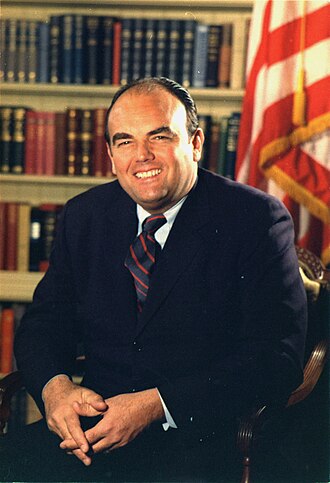
Ehrlichman, John D.
John D. Ehrlichman initially served as Counsel to the President from January 1969 to November 1969, where his duties quickly expanded from legal issues to broader policy development. This shift led to his transition in November 1969 to Assistant to the President for Domestic Affairs, a role he held until April 1973. Throughout the majority of the White House taping period (February 1971 – July 1973), he acted as Nixon's chief domestic advisor and helped direct the covert "Plumbers" unit before the escalating Watergate scandal forced his resignation in April 1973.
President Nixon and his Cabinet met to discuss the ongoing military operations in Indochina and the development of the administration's national health reform agenda. Regarding the war, officials reviewed the progress of South Vietnamese incursions into Laos and Cambodia, noting that the strategy was successfully disrupting enemy supply lines while shifting the burden of ground operations away from American forces. The conversation then transitioned to a detailed proposal from Secretary of Health, Education, and Welfare Elliot Richardson regarding healthcare reform, with the group debating the costs, tax implications, and administrative feasibility of implementing Health Maintenance Organizations (HMOs) and national health insurance standards.
President Nixon met with John Ehrlichman and George Shultz to discuss the restructuring of international monetary policy and the role of Peter G. Peterson within the administration. They debated strategies for economic coordination, specifically regarding the 'Quadriad' and the integration of international economic business into White House deliberations. The group also touched on upcoming budget preparations for the 1972 State of the Union, the potential for increased defense spending, and the need for improved public relations regarding administration public works projects.
President Nixon met with John Ehrlichman and Washington Governor Daniel J. Evans to discuss regional economic concerns, specifically the impact of Hanford nuclear reactor funding cuts on Washington state employment. The conversation also covered a broad range of domestic policy and administrative matters, including the legislative strategy for revenue sharing, potential health maintenance organization (HMO) initiatives, and various high-level appointments. Additionally, Nixon and his staff coordinated efforts to strengthen support among agricultural voters through outreach programs involving Senator Robert Dole.
President Nixon met with John Ehrlichman and Alexander Butterfield to address internal disagreements regarding economic forecasts provided by the Commerce Department. The discussion centered on aligning departmental output with administration messaging and ensuring cooperation from the American business community. Nixon emphasized the need to combat unfavorable media narratives and maintain strict control over the administration’s economic platform.
President Nixon, John Ehrlichman, George Shultz, and H.R. Haldeman met to discuss administration strategies for managing public perception of economic performance and shaping domestic policy. The participants focused on countering negative economic narratives, particularly regarding the Consumer Price Index, by highlighting positive trends like lowered food prices and mortgage interest rates. Additionally, the group addressed labor issues within the construction industry, including the potential manipulation of government contract spending, and explored methods to build support for the President's revenue-sharing initiatives among local government officials.
President Nixon met with John Ehrlichman, George Shultz, and John Whitaker to coordinate a strategic public relations campaign surrounding the administration's agricultural policies and rural development initiatives. The discussion focused on scheduling upcoming presidential travel to Iowa and other locations to bolster support among farmers and improve the administration’s image regarding farm policy. Additionally, the group addressed broader economic concerns, including manpower training for Vietnam veterans, welfare reform, and the economic justification for the Supersonic Transport (SST) program.
President Nixon consulted with various staff members regarding administrative matters and staffing inquiries. The primary focus of the discussion involved evaluating the professional background and political reliability of Joseph E. Parker, a Washington insider with extensive experience in Congress and agricultural policy. Nixon sought to assess Parker's suitability for a potential role, specifically noting his Democratic affiliation and his reputation for being savvy on Capitol Hill.
President Nixon met with H. R. Haldeman, John Ehrlichman, and Stephen Bull to discuss the administration's frustration with media coverage of inflation statistics and to coordinate the upcoming Quadriad meeting. Nixon expressed concern over inconsistent reporting between outlets regarding economic data and emphasized the importance of ensuring John Connally's dominant role in his economic team. The discussion also briefly touched upon a recent attack involving a Soviet diplomat's vehicle.
President Nixon met with H.R. Haldeman and various staff members, including Peter Flanigan, Henry Kissinger, and John Ehrlichman, to deliberate on high-level personnel appointments, government reorganization, and legislative strategy. A primary focus was identifying a strong, business-oriented candidate for an ambassadorial role to navigate international economic negotiations and counter State Department bureaucracy. The group also discussed managing the President’s public image regarding economic policy, the Alaska pipeline, and Vietnam, while addressing the need to discipline administration officials who publicly diverged from official policy. The President emphasized a preference for direct, high-level policy control and instructed his staff to bolster communication efforts and strengthen the administration’s political messaging.
President Nixon met with Interior Secretary Rogers C. B. Morton and advisor John D. Ehrlichman to address organizational restructuring and leadership appointments within the Department of the Interior. The discussion centered on identifying a strong Undersecretary with budget expertise, with Jim Schlesinger emerging as a primary candidate despite potential friction with other cabinet members. Additionally, the group reviewed the status of the Alaska pipeline project, acknowledging the complexities of native land claims, environmental concerns, and the national need for a cohesive energy policy.
President Nixon met with his advisors, including Secretary of Labor James Hodgson and George Shultz, to debate strategies for curbing inflation and rising construction costs, specifically focusing on the potential suspension of the Davis-Bacon Act. The participants weighed the political risks of appearing anti-union against the need to exert pressure on construction labor leaders to accept voluntary wage stabilization. Nixon ultimately favored a targeted approach to the construction industry over broad wage-price controls to avoid broader economic disruptions and political backlash. The group decided to finalize an announcement strategy for the suspension, potentially leveraging the upcoming Governors' Conference to bolster the administration's position.
President Nixon met with George Shultz and John Ehrlichman to coordinate administration strategy on welfare reform, economic policy, and federal housing mandates. The participants discussed the political challenges of the Welfare Reform Bill, the potential suspension of the Davis-Bacon Act to curb inflation in the construction industry, and the necessity of maintaining a firm, unified administration stance on low-income housing policies. Nixon decided against proactively seeking wage and price controls while instructing his team to monitor the situation closely, emphasizing a preference for pragmatic, tested solutions over ideological commitments.
President Nixon met with Dr. Edward E. David, Jr., Peter M. Flanigan, H. R. Haldeman, and John D. Ehrlichman to coordinate the upcoming Science Advisory Committee meeting and address the political challenge of unemployed scientists and engineers. Nixon emphasized the need to show administration concern for these displaced professionals without necessarily relying on federal bailouts for universities or costly retraining programs. The group further discussed shifting to international cooperation in space and science—including potential collaboration with the Soviet Union—and evaluated strategic applications for technology in areas like energy and agriculture.
President Nixon and H. R. Haldeman convened with senior advisors and staff to coordinate administrative messaging on foreign trade and economic policy, with a focus on enforcing stricter discipline among cabinet officers. The President also consulted Henry Kissinger on national security matters, specifically seeking to navigate the ongoing friction between Kissinger and Secretary of State William P. Rogers while managing the sensitive public relations aspects of the Vietnam War and the Laotian operation. Additionally, the President issued directives regarding internal staff management and requested an investigation into a recent security leak concerning the Strategic Arms Limitation Talks (SALT).
President Nixon met with Arizona Governor Jack Williams to discuss the state's economic conditions and urgent concerns regarding water resource management and infrastructure funding. Following Williams' departure, Nixon consulted with John Ehrlichman and Ronald Ziegler regarding strategy for an upcoming meeting with state governors, specifically aiming to avoid hostile media coverage by favoring private discussions over open forums. The President ultimately decided to conduct his pitch to the governors in a closed setting to ensure candid communication without the interference of grandstanding attendees.
President Nixon hosted John B. Waters, Jr. and his family for a brief social visit and photo opportunity in the Oval Office, during which he presented them with gifts and discussed the office's surroundings. The meeting served primarily as a gesture of goodwill toward the Waters family, including informal conversation regarding Tennessee politics and previous speaking engagements. Outside of the family visit, the recording includes brief, fragmented discussion regarding strategy for a separate event, emphasizing the President's desire to control media access and minimize public exposure during specific political sessions.
President Nixon met with his senior aides and advisors to strategize the temporary suspension of the Davis-Bacon Act, framing the move as an emergency measure to combat inflation in the construction industry rather than an attack on labor unions. The group, including H.R. Haldeman, John Ehrlichman, Charles Colson, and George Shultz, worked to refine a public statement that would justify the suspension by drawing parallels to the administration's previous interventions in the steel and oil sectors. Nixon emphasized the need to maintain credibility with his political allies while ensuring the message clearly articulated that the suspension was a necessary response to rising costs rather than a permanent repeal of labor protections.
President Nixon met with Republican congressional leaders and cabinet members to discuss rural development initiatives and solicit support for the administration's policy agenda. Secretary of Agriculture Clifford Hardin and staff provided an extensive briefing on the status of rural America, highlighting demographic shifts and explaining the mechanics of proposed federal revenue-sharing programs designed to foster economic growth. Participants also reviewed legislative priorities, including the upcoming vote on the supersonic transport (SST) appropriation and other pending congressional business.
President Nixon met with George Shultz, John Ehrlichman, H.R. Haldeman, and other advisors to navigate complex legislative and diplomatic challenges, including dairy price supports, Social Security reform, and welfare legislation. The discussion focused on managing relations with House Ways and Means Chairman Wilbur Mills and coordinating the administration's position on sensitive issues like Japanese textile trade negotiations. Additionally, the President assessed the professional friction between National Security Advisor Henry Kissinger and Secretary of State William P. Rogers, considering the implications for foreign policy decision-making.
President Nixon met with various staff members and advisors to refine the administration's political and legislative strategy, specifically regarding the textile quota issue and relations with key Congressional leaders like Wilbur Mills and John Byrnes. The President finalized plans to issue a statement on textile legislation while balancing pressure from the industry against the strategic risks of legislative entanglement. Additionally, the President discussed methods for managing Republican Congressional relations through targeted meetings and evaluated strategies to counter negative media coverage through the use of news tapes.
President Nixon met with John Byrnes and senior White House staff to coordinate a unified Administration strategy against House Ways and Means Chairman Wilbur Mills regarding ongoing Japanese textile negotiations. Concerned that Mills was bypassing the White House to conduct his own foreign policy, Nixon directed Byrnes to publicly support the President’s official position and reject the implication that congressional leaders held a veto over executive authority. The group finalized a plan for the President to issue a formal statement that afternoon, followed immediately by Byrnes endorsing the policy to the press to solidify Republican unity.
President Nixon met with his Cabinet and key staff to discuss the status of the administration's revenue sharing legislative agenda and receive briefings on various international developments. Administration officials reported on their outreach efforts to build public and Congressional support for revenue sharing while addressing opposition from labor and minority groups. Additionally, Cabinet members provided updates on their recent foreign travels, emphasizing the geopolitical successes of the Nixon Doctrine in Southeast Asia and the strengthening of international cooperation on transportation and environmental safety.
President Nixon met with John Ehrlichman and George Shultz to manage his public image regarding municipal relations and to coordinate domestic policy strategies. The participants discussed strategies for addressing criticisms from mayors concerning funding, plans to promote special revenue sharing, and the political challenges associated with Social Security legislation and the federal budget. They also evaluated potential administrative action items, including a planned visit to a California health facility to highlight health maintenance initiatives and preparations for an upcoming press conference.
President Nixon and H.R. Haldeman reviewed the President's recent public relations efforts, focusing specifically on the impact of his recent eulogy for Whitney M. Young, Jr. and the need to strategically manage the President's press interviews. They discussed concerns regarding the influence and tactics of speechwriter William Safire, as well as the importance of maintaining an image of accessibility through controlled media engagements rather than traditional press conferences. Additionally, the President provided specific instructions to his staff regarding future press outreach and the upcoming funeral arrangements for Thomas E. Dewey.
President Nixon met with Alexander P. Butterfield to review his upcoming official schedule, including logistics for the National Alliance of Businessmen reception, a stag dinner for Maurice Stans, and an event for Reverend Akaka of Hawaii. They discussed whether to utilize receiving lines based on the President's familiarity with the guests and finalized dress codes for upcoming diplomatic dinners. Additionally, the President consulted briefly with John Ehrlichman regarding potential political strategies for the Supersonic Transport (SST) and considered potential short-term travel plans for First Lady Pat Nixon ahead of their daughter Tricia's wedding.
President Nixon met with his senior advisors, including H.R. Haldeman and John Ehrlichman, to discuss domestic economic policy and management of cabinet officials. The discussion focused on addressing maneuvering by cabinet members, such as Arthur Burns and Maurice Stans, who were attempting to bypass the established Domestic Council system regarding economic issues. Nixon decided that these matters should be handled exclusively through the formal Domestic Council process rather than through uncoordinated committee meetings, effectively asserting control over his economic advisors and cabinet structure.
President Nixon met with H.R. Haldeman and John Ehrlichman to discuss personnel and administrative strategy, specifically regarding the contentious appointment of an Under Secretary of the Interior. They evaluated the political risks of defying Senator Gordon Allott's preferences while navigating the administration’s broader economic objectives and cabinet management. To reduce social friction and administrative inefficiency, the President decided to reduce the frequency of cabinet meetings to a structured hour every two weeks and to shift toward engaging sub-cabinet members in social functions.
President Nixon met with H. R. Haldeman and Charles Colson to discuss foreign policy messaging, the administration's defensive stance regarding the Vietnam War, and potential media strategies. A primary focus was the potential recruitment of journalist John A. Scali to assist in communications and press relations, despite concerns about how he would interact with Henry Kissinger and the National Security Council. The group also reviewed current Gallup poll trends and the impact of public-facing appearances, including the President's daughter’s engagement and media interviews, on the administration's approval ratings.
President Nixon met with Secretary of Agriculture Clifford Hardin and a large delegation of dairy industry representatives to discuss federal agricultural policy and industry concerns. The meeting served as a forum for stakeholders to engage directly with the administration regarding price supports and the economic interests of the dairy sector. This engagement took place amidst broader administration efforts to manage agricultural production and solidify support among industry leaders.
President Nixon met with John Ehrlichman, George Shultz, and Henry Kissinger to coordinate administration strategy on key legislative and economic priorities. The discussion covered a wide range of policy initiatives, including election and welfare reform, government reorganization efforts, and the political sensitivity surrounding abortion policies in military hospitals. Most notably, the group strategized on economic stabilization measures, debating the viability of a construction industry wage-price board and the administration's stance on the Supersonic Transport (SST) project to protect domestic employment.
President Nixon met with his economic and agricultural advisors to discuss political strategies regarding the dairy industry and legislative support. The group, including George Shultz, John Connally, and Clifford Hardin, addressed the necessity of securing political backing from powerful dairy organizations while balancing the economic implications of milk price supports. Nixon emphasized the importance of securing credit for any concessions made to these groups and coordinating closely with Congressional leaders, such as Speaker Carl Albert and Wilbur Mills, to manage these interests effectively.
President Nixon met with George Shultz, John Ehrlichman, and James Hodgson to finalize a plan for stabilizing rampant wage inflation in the construction industry through an Executive Order. The proposed strategy involves creating industry-specific wage stabilization boards overseen by a tripartite 'super board' to moderate strikes and wage hikes, backed by the threat of suspending the Davis-Bacon Act for non-compliant areas. Nixon directed his team to present this plan to the Cabinet and key stakeholders as a collaborative effort to ensure broader buy-in while maintaining the administration’s leverage over labor unions.
President Nixon and John Ehrlichman met to finalize the agenda for an upcoming Cabinet meeting focused on stabilizing wages and prices. They reviewed the roles of Paul McCracken and James Hodgson in presenting the administration's plan, which included a strategy to secure support from union leader George Meany. Additionally, the two discussed managing political tensions regarding California Governor Ronald Reagan's opposition to the California Rural Legal Assistance (CRLA) program.
President Nixon and his Cabinet met to discuss the ongoing challenge of inflation and rising construction costs, focusing on the administration's strategic options for economic stabilization. Dr. Paul McCracken reviewed current inflationary trends and labor market data, outlining a spectrum of potential responses ranging from maintaining current fiscal policies and targeted interventions to implementing more aggressive measures like wage and price controls. The meeting served as a forum to evaluate the efficacy of various regulatory mechanisms, such as the National Commission on Productivity and the suspension of the Davis-Bacon Act, while weighing the political and practical risks of further government intervention in the economy.
President Nixon, assisted by John D. Ehrlichman and Alexander P. Butterfield, initiated a telephone call to Secretary of Agriculture Clifford M. Hardin. The primary purpose of the contact was to facilitate direct communication with the Secretary. No further substantive policy discussions were captured in this brief exchange.
President Nixon met with a large group of staff members to express his gratitude for their dedicated efforts in preparing the administration's revenue sharing proposals. He emphasized the necessity of these legislative reforms, encouraged the team to remain confident despite inevitable political challenges, and distributed commemorative gifts to those involved. Additionally, Nixon consulted with John Ehrlichman to finalize a decision regarding the Agricultural Extension Service, ultimately deciding to support Secretary of Agriculture Clifford Hardin's position to ensure the program's stability.
President Nixon met with key White House staff and advisors to coordinate the administration's public posture regarding the Calley court-martial, the strategy for an upcoming televised Vietnam speech, and pending domestic legislation. Nixon emphasized that his review of the Calley case was consistent with the judicial process and sought to distance the White House from the prosecution's specific tactics while maintaining a firm stance on military policy. The participants also discussed the President's legislative priorities, specifically managing the potential veto of an education bill, and reviewed economic indicators to bolster confidence in the administration's domestic program.
President Nixon met with John Ehrlichman and George Shultz to discuss a wide-ranging agenda of domestic and foreign policy issues, including handling public letters regarding the William L. Calley case and upcoming anti-war demonstrations. The participants reviewed economic strategies, focusing on the need to revitalize industrial research, antitrust policy, and international trade goals. They also evaluated the President’s recent Southeast Asia speech, progress on revenue sharing legislation, and the ongoing reorganization of the intelligence community.
President Nixon and a wide-ranging group of Cabinet members, advisors, and Congressional representatives met to discuss the growing national energy crisis and the necessity of transitioning to nuclear power. AEC Chairman Glenn Seaborg and other experts detailed the technological, environmental, and economic advantages of the liquid metal fast breeder reactor, emphasizing its ability to maximize fuel efficiency and provide long-term, pollution-free energy. The participants concluded that a strong national commitment, including significant federal funding and industry collaboration, is essential to accelerate the development of demonstration reactors and ensure future energy independence.
President Nixon held a broad-ranging meeting with H. R. Haldeman, John Ehrlichman, George Shultz, Henry Kissinger, and John Connally to discuss domestic and foreign policy priorities, including economic strategy, upcoming personnel changes, and bureaucratic management. The participants reviewed positive retail sales and GNP growth, evaluated the political viability of energy and environmental proposals, and strategized on handling potential civil service and diplomatic appointments. A significant portion of the discussion focused on managing the administration's political image, navigating legislative obstacles in Congress, and addressing the status of long-serving officials like J. Edgar Hoover.
George P. Shultz, acting on behalf of President Nixon and John D. Ehrlichman, contacts Julius Shiskin to secure urgent statistical data regarding North American Rockwell’s operations in California. The discussion centers on the immediate retrieval of specific economic or industrial figures required for a briefing for the President. Shiskin agrees to expedite the request and provide the information to the White House within the hour.
President Nixon, John Ehrlichman, and Arthur Burns held this discussion to coordinate economic strategy and review the administration's political management of upcoming challenges. They focused on strengthening the partnership between Burns and John Connally, particularly regarding balance-of-payments policies, interest rates, and the political handling of potential steel industry inflation. Nixon also sought Burns’ perspective on international concerns, including the Berlin negotiations and German political stability, before Burns departed for a diplomatic trip to Europe.
President Nixon and John Ehrlichman discuss the need to adopt a 'hard-line' public stance on welfare reform to address rising public frustration and secure support for H.R. 1. The President emphasizes shifting the narrative away from expanding welfare rolls toward promoting work requirements and personal responsibility, utilizing striking anecdotes similar to those used by Governor Ronald Reagan. To implement this communication strategy, Nixon instructs Ehrlichman to coordinate with speechwriter William Safire to develop tough, persuasive rhetoric that highlights the systemic problems with the current welfare apparatus.
President Nixon and his senior staff, including H.R. Haldeman and John Ehrlichman, review strategies for managing press relations and controlling the public narrative regarding federal budget figures. The discussion emphasizes the importance of carefully timing news cycles—specifically balancing press conferences with television appearances—to ensure maximum impact. The group also deliberates on how to frame economic data to counter potential negative interpretations by the media and political opponents.
President Nixon and John Ehrlichman met to review talking points prepared by Patrick Buchanan for the President's upcoming address to the American Society of Newspaper Editors. The discussion focused on justifying the necessity of government surveillance for security purposes—citing threats to public officials and recent media coverage of White House cameras—and refining economic messaging to better highlight positive indicators like retail sales. Nixon directed Ehrlichman to coordinate with George Shultz and Paul McCracken to ensure the presentation of economic data utilized specific, impactful examples rather than generalized statistics.
President Nixon met with John Ehrlichman and George Shultz to discuss aggressive strategies for managing the federal bureaucracy and suppressing unwanted antitrust litigation. Nixon issued a direct order to halt the Justice Department's antitrust proceedings against ITT, expressing frustration with Richard McLaren's pursuit of conglomerates and demanding personnel changes for those failing to follow administration directives. Additionally, the group reviewed legislative tactics for rural revenue sharing and considered methods for securing political cooperation on economic policy from key members of Congress.
President Nixon met with his administration officials, including John Mitchell, Elliot Richardson, and George Shultz, to coordinate the White House's response to a recent Supreme Court ruling on school desegregation. Concerned about the ruling's political impact and the potential for a "double standard" between the North and South, Nixon directed his subordinates to remain disciplined and avoid proactive initiatives, emphasizing that the administration would comply with the law without going beyond what was strictly required by the courts. The President also instructed his team to keep a low profile on the Ribicoff amendment to avoid further legislative complications while managing upcoming political optics regarding Southern school policies.
President Nixon met with a group of Republican congressmen and administration staff to discuss the dire financial situation of the Lockheed Corporation and the political implications of a government-backed rescue. The discussion focused on the potential economic impact of a Lockheed collapse, particularly regarding job losses among subcontractors, and the challenge of securing congressional approval for necessary financial support. The participants weighed the broader risks to the economy and the administration's leadership against the optics of bailing out a defense contractor amid competing domestic budget priorities.
President Nixon met with Secretary of Transportation John A. Volpe and others to discuss administrative strategies, including suburban housing integration, the status of the 'Operation Breakthrough' housing program, and federal reorganization efforts. Volpe expressed a desire for greater inclusion of Cabinet members in the decision-making process and offered suggestions for improving morale among federal civil servants through more frequent direct engagement with the President. The participants also touched on foreign policy concerns regarding Latin American politics and the potential for a visit by Volpe to Italy to gauge regional conditions.
In this Oval Office meeting, President Nixon consulted with his advisors regarding the administration's ongoing strategies for Vietnam, domestic antitrust enforcement, and economic policy. The President discussed the status of peace negotiations with Henry Kissinger, emphasizing the need for public relations maneuvers concerning prisoners of war (POWs) and a time-certain troop withdrawal, while concurrently utilizing military pressure. Additionally, Nixon directed his staff to maintain political secrecy regarding antitrust cases involving ITT and the television networks, and he reviewed welfare reform and revenue sharing progress with George Shultz.
President Nixon met with Senator Russell Long, administration officials, and congressional representatives to strategize on the advancement of the President’s welfare and health care legislation. The discussion focused on overcoming opposition to the administration's health bill, particularly the competing proposal from Senator Edward Kennedy, while emphasizing the need for congressional education and potential compromises to secure passage. Additionally, the President and Senator Long discussed refining welfare reform, specifically focusing on work incentives, child support enforcement, and addressing public concerns regarding welfare dependency.
President Nixon and John Ehrlichman discuss the administration's response to organized anti-war protests scheduled to block traffic in Washington, D.C. They conclude that the situation should be managed by local police rather than federal troops or injunctions, agreeing that the President should adopt a firm public stance during his upcoming press conference. Additionally, Ehrlichman confirms that Treasury Secretary John Connally is handling opposition from business executive Fred Borch regarding administration policy, and they finalize plans for the upcoming Cabinet meeting.
President Nixon directs John Ehrlichman to initiate a comprehensive review of federal housing project allocations to ensure administration supporters receive appropriate consideration. Nixon expresses frustration that project funding has been disproportionately awarded to Democrats and dissident Republicans instead of loyal allies like Congressman Elford Cederberg. This directive mandates a systematic vetting process for future project drafts to strengthen political patronage before the upcoming campaign season.
President Nixon met with his Cabinet and key staff to coordinate legislative strategies and manage domestic policy agendas. The discussion focused on securing passage for welfare reform and other administration priorities by engaging directly with congressional leadership and balancing competing interests within the labor market. Participants assessed the challenges of mobilizing support among both Democrats and Republicans and emphasized the necessity of persistent lobbying and effective communication with legislative committees.
President Nixon met with Henry Kissinger and subsequently with Henry Ford II and Lee Iacocca to discuss major policy and political concerns. The conversation with Kissinger focused on Vietnam strategy, including the management of public perception, the administration's frustration with the 'establishment' and anti-war activists, and the President's diplomatic initiatives regarding the People's Republic of China. Later, Ford and Iacocca briefed the President on the economic and logistical burdens placed on the auto industry by Department of Transportation and environmental regulations, specifically regarding safety, emissions, and bumper standards. Nixon acknowledged the industry's concerns, emphasizing the need to balance safety and environmental goals with the economic realities of maintaining a competitive U.S. automotive sector.
President Nixon met with senior staff and Cabinet members to address various domestic policy challenges, including automobile safety regulations, school desegregation strategies, and environmental initiatives. A significant portion of the discussion focused on managing the administration's economic message and the internal friction regarding withholding federal funds from Congress. The President also emphasized the need for a unified voice on economic policy and directed staff to improve the administration's political coordination on projects like the Alaska pipeline and public parks.
President Nixon met with H.R. Haldeman and John Ehrlichman to discuss a range of administrative and political appointments, including potential roles for Donald Rumsfeld and a successor for George A. Lincoln at the Office of Emergency Preparedness. The group evaluated current government reorganization proposals, economic policy messaging coordinated by John Connally, and the political implications of upcoming automobile safety regulations concerning air bags. They also touched on cabinet-level personnel strategies, specifically addressing the need to improve public relations and increase representation of specific demographic groups.
President Nixon met with various staff and associates, most notably Elmer H. Bobst, to discuss administrative matters, the President's upcoming travel schedule, and, primarily, the strategic management of federal cancer research. Bobst, a long-time advocate in the field, offered sharp criticisms of the National Institutes of Health (NIH), arguing that the organization suffers from excessive bureaucracy and a lack of accountability in allocating research grants. Nixon and John D. Ehrlichman consulted with Bobst regarding potential leadership for a new cancer program, specifically discussing the qualifications of candidates like Dr. Henry S. Kaplan to lead the initiative more effectively than existing bureaucratic structures.
President Nixon and John D. Ehrlichman discussed the professional credentials of Dr. Henry S. Kaplan, a researcher from Stanford University. Ehrlichman briefed the President on Kaplan’s recent interview with Elliot Richardson and Dr. Edward E. David, Jr., noting that both officials were impressed by the doctor. The brief conversation served to confirm the President's approval of the assessment provided by his subordinates regarding Kaplan.
President Nixon and John Ehrlichman discussed political coordination, the handling of the 'Blackjack' housing case, and the administration's stance on a proposed Domestic Intelligence Review Board. Regarding the Blackjack case, the two agreed to stall federal intervention by citing recent court decisions as a basis to re-evaluate potential discrimination, while also planning to terminate the HUD official responsible for initiating the action. They further clarified the administration's neutral position on the Intelligence Review Board to avoid direct political entanglements with FBI oversight debates.
President Nixon and John Ehrlichman discussed how the administration should publicly address the complexities of Supreme Court rulings on school busing and racial balance. They strategized on how to frame the executive branch’s role in complying with court decisions—emphasizing evenhandedness in both the North and South—while downplaying direct federal intervention. The conversation also clarified the administration’s tactical opposition to the Ribicoff and Stennis amendments, attributing their stance to legislative timing rather than a rejection of the principles of equal application of the law.
President Nixon and John Ehrlichman discuss political strategy regarding the Republican Coordinating Committee and the administration's stance on the Blackjack housing discrimination case. Nixon rejects the idea of participating in the committee to avoid political entanglements with figures like Reagan and Rockefeller. Regarding the Blackjack case, they decide to frame the administration's position based on recent court precedents, emphasizing that referendum actions are constitutional unless there is clear evidence of intent to discriminate.
President Nixon and John Ehrlichman consult on the legal interpretation of Supreme Court rulings regarding racial balance, specifically distinguishing between government-mandated discrimination and individual choices. Nixon seeks clarity on how to frame these legal precedents in public rhetoric, focusing on the limitation of government action versus personal decision-making. The discussion serves to refine the administration's stance on school desegregation and housing policies to ensure a politically advantageous position for the Republican party.
President Nixon met with Vice President Agnew, Treasury Secretary John Connally, and Republican Congressional leaders to address critical economic and legislative challenges. The primary focus was the potential bankruptcy of the Lockheed Corporation and the necessary legislative strategy to secure government loan guarantees to prevent a ripple effect of industrial failures and job losses. Additionally, the group reviewed the administration's legislative priorities, including welfare reform, general and special revenue sharing, and the status of various appropriations bills.
President Nixon met with members of the President's Commission on School Finance and the President's Panel on Nonpublic Education to discuss the urgent financial crises facing both public and private school systems across the country. The participants examined challenges such as the reliance on property taxes for funding, the decline of parochial school enrollment, and the necessity of maintaining educational quality and equality in inner-city and rural schools. Nixon emphasized the importance of a viable private education sector and tasked the Commission with providing actionable recommendations that focus on systemic reform, local responsibility, and restoring public confidence in the educational system.
President Nixon convened an extensive afternoon meeting in the Oval Office with his key economic advisors, including George Shultz, John Connally, Arthur Burns, and Paul Volcker, to deliberate on pressing fiscal and monetary policy issues. The discussion focused on addressing the nation's ongoing economic instability, involving high-level strategy sessions with administration officials and cabinet members. These deliberations were critical in shaping the Nixon administration's approach to inflation and international monetary concerns, ultimately informing the direction of domestic economic policy.
President Nixon met with H.R. Haldeman, John Ehrlichman, and Ronald Ziegler to coordinate the administration's response to the anti-war "May Day" protests in Washington, D.C., and to strategize on key legislative priorities. The participants discussed public relations efforts regarding the recent mass arrests, specifically aiming to project a unified, firm stance of support for local law enforcement. Additionally, Nixon directed efforts to secure sufficient support in Congress for the Supersonic Transport (SST) funding bill, linking its success to future technological defense initiatives like the B-1 bomber program.
President Nixon and John Ehrlichman coordinate a strategy to thank supporters who participated in recent demonstrations, a proposal Nixon had previously discussed with H.R. Haldeman. The pair plans to finalize the logistics of these meetings, determining whether to slot the supporters and a separate session with George Shultz around 2:30 or 3:00 p.m. Nixon delegates the final scheduling decisions to Ehrlichman and Haldeman, instructing them to act promptly.
President Nixon and John Ehrlichman discussed the competitive status of the Japanese transistor radio industry within the United States market. The brief exchange focused on evaluating Japanese market share relative to domestic production capabilities. No specific policy actions were finalized, but the discussion highlighted presidential concern regarding foreign dominance in the American electronics sector.
President Nixon met with H.R. Haldeman and other staff members to discuss public relations strategies, specifically focusing on how to capitalize on recent public approval of the administration's firm handling of anti-war protests in Washington, D.C. They reviewed internal polling data showing strong support for the police and authorized the administration to project a tough 'law and order' stance. Furthermore, they coordinated plans to move forward with revenue sharing legislation and addressed the need for better communication strategies regarding foreign policy and upcoming agricultural events.
President Nixon and John Ehrlichman coordinated legislative strategy regarding key political figures, specifically Gerald Ford and Wilbur Mills, concerning upcoming policy or administrative appointments. They discussed the necessity of securing Ford’s public support and maneuvering Mills into a position where he would be compelled to endorse or accept their proposal. The conversation focused on tactical timing and leveraging political pressure to ensure the desired outcome before formalizing the plan.
President Nixon met with various administration officials and Secretary of State William P. Rogers to discuss legislative strategy, current foreign policy, and the political outlook of the Middle East. The President coordinated efforts with George Shultz and Clark MacGregor to build congressional support for revenue sharing and the Super Sonic Transport (SST) funding. Following these domestic agenda items, Secretary Rogers provided an extensive debriefing on his recent diplomatic tour of nine countries, focusing on the stability of Thailand, Turkey, Saudi Arabia, and Jordan, as well as his efforts to engage Anwar Sadat in Middle East peace negotiations.
President Nixon met with H. R. Haldeman and John Ehrlichman to discuss domestic economic policy, the status of the Supersonic Transport (SST) program, and sensitive foreign policy issues. The President expressed frustration with Secretary of State William Rogers' handling of Middle East policy and explicitly directed that Henry Kissinger be sidelined from Israeli-related negotiations to prevent partisan complications. Nixon also finalized a decision to adopt a more confrontational approach toward the press, ending his participation in traditional social dinners with journalists.
President Nixon and John Ehrlichman discussed administrative logistics, focusing on the status of the Supersonic Transport (SST) project and discussions with Boeing leadership. They also reviewed the scheduling and attendance for an upcoming Cabinet meeting, specifically coordinating the roles of Vice President Agnew and Secretary Rogers C.B. Morton. The conversation served to align internal priorities regarding infrastructure projects and executive branch meeting agendas.
President Nixon and his Cabinet met to receive a briefing on international affairs and domestic policy, with a focus on Secretary of State William P. Rogers' recent diplomatic travels to the Middle East and the feasibility of desalinization technology. Rogers reported on his efforts to stabilize the Middle East through ceasefire maintenance and discussed the geopolitical concerns of various regional leaders. Dr. Edward E. David Jr. and other experts presented a detailed plan to advance domestic water desalinization and nuclear power capabilities, with the President calling for a major, accelerated federal effort to ensure American technological leadership. The meeting concluded with a brief status report from Treasury Secretary David M. Kennedy regarding the current international monetary situation and the fluctuations of the dollar.
President Nixon met with H.R. Haldeman and John Ehrlichman to discuss establishing a high-priority, federally funded national program for water desalinization. Expressing frustration with the existing bureaucracy within the Department of the Interior, Nixon directed his aides to reorganize the effort under the leadership of NASA to leverage its project management capabilities and improve public relations. The President proposed immediate action to construct large-scale prototype plants in California and Texas, aiming to address critical water shortages and align the initiative with his national growth policy.
President Nixon held a series of wide-ranging meetings with senior administration officials to discuss legislative priorities, economic policy, and institutional management. Key topics included advancing revenue sharing and welfare reform through strategic cooperation with Representative Wilbur Mills, managing federal aid to higher education, and reorganizing desalinization research. Additionally, the President and his advisors examined anti-trust policy, the financial struggles of the railroad industry, and the positive implications of a revised upward tick in first-quarter Gross National Product (GNP) figures.
President Nixon consulted with various staff and political allies, including H.R. Haldeman, Leslie Arends, and Frank Bow, to coordinate strategy regarding House legislative votes and foreign policy objectives. A primary focus was managing opposition to the Mansfield Amendment, which proposed significant reductions to NATO troop levels, and leveraging John Scali to organize effective public and legislative pushback. Additionally, Nixon reflected on his upcoming foreign policy address, contrasting his broader vision for the nation with the mechanical nature of domestic initiatives like revenue sharing.
President Nixon met with Secretary of Health, Education, and Welfare Elliot Richardson, incoming official Dr. Merlin K. "Morty" DuVal, and senior staff to discuss the administration's health care reform strategy and the challenges of managing federal health bureaucracies. The President emphasized the need for DuVal to establish firm control over autonomous agencies like the NIH and NIMH while cautioning him against being co-opted by the entrenched bureaucracy. The group also strategized on how to secure political support from the medical profession for the administration's health plan, framing it as a pragmatic, centrist alternative to the more radical proposals championed by Senator Edward Kennedy.
President Nixon met with key staff and Mayor Richard J. Daley to coordinate administrative policy, discuss political strategies for the 1972 election, and address urban issues. The conversation covered the management of welfare reform, the privatization of legal services, and the handling of social issues like narcotics and homosexuality. Nixon specifically emphasized establishing a direct, cooperative relationship with Mayor Daley to navigate urban housing challenges, reinforce law enforcement support, and promote federal initiatives at the local level.
In this meeting, President Nixon and Henry Kissinger discussed the delicate status of SALT negotiations, specifically weighing whether to press for further wording changes with the Soviets or accept the current draft to avoid diplomatic irritation and potential leaks. Following Kissinger's departure, Nixon met with John Ehrlichman, Peter Peterson, and James Roche to address the challenges facing the American automobile industry. The group focused on mitigating overly rigid safety and environmental regulations that threatened the industry's competitiveness against foreign imports, while exploring broader strategies to maintain America's technological and economic dominance in an increasingly globalized market.
President Nixon met with H.R. Haldeman, John Ehrlichman, John Connally, and others to discuss strategies for securing Senate support for the supersonic transport (SST) project and to coordinate political appointments. The group analyzed the legislative landscape, focusing on shifting the framing of the SST from a purely environmental issue to a matter of jobs and economic impact. Furthermore, Nixon emphasized the need for a loyal, aggressive leader within the IRS to ensure the administration could effectively utilize the agency to monitor political enemies and friends alike.
President Nixon met with his Cabinet and Republican Congressional leaders to coordinate the administration's legislative agenda, specifically addressing the ongoing national railroad strike and the upcoming Congressional vote on the military draft. The discussion also focused on foreign policy, with Secretary of Defense Melvin Laird and Henry Kissinger providing briefings on the status of NATO, the credibility of U.S. military commitments in Europe, and the implications of recent Soviet statements regarding mutual force reductions. The President urged the Congressional leaders to maintain a firm stance against unilateral U.S. force withdrawals while emphasizing the need to handle these matters through stable, negotiated frameworks rather than disruptive legislative amendments.
President Nixon met with H.R. Haldeman to finalize his upcoming public schedule, focusing on managing media engagements and minimizing redundant appearances with business leaders. The conversation addressed the logistical handling of upcoming events, including a trip to the Lyndon B. Johnson Library opening and the scheduling of Saudi King Faisal, while also coordinating the administration's stance on the Supersonic Transport (SST) funding and a ongoing railroad strike. Additionally, they reviewed internal personnel issues, specifically regarding the promotion of a member of the First Family's extended relatives and the necessity of maintaining presidential control over executive scheduling.
President Nixon met with John Ehrlichman and George Shultz to discuss the political collapse of the Supersonic Transport (SST) program and strategy regarding a pending railroad strike. The participants reviewed the administration's economic agenda, including the need for a long-term fiscal strategy and a potential tax revision to address property taxes and broaden the political constituency. Additionally, they coordinated preparations for an off-the-record briefing with business magazine editors and discussed international economic concerns and civil unrest.
President Nixon met with entertainer Art Linkletter, DeVan L. Shumway, and John D. Ehrlichman to discuss Linkletter’s ongoing anti-drug campaign and his educational outreach in schools. The conversation focused on the classification of drug users, the societal dangers of marijuana compared to alcohol, and the negative impact of narcotics on youth motivation and discipline. The President expressed strong disapproval of a recent statement by a National Institute of Mental Health official regarding marijuana penalties and reaffirmed his commitment to firm law enforcement against drug use and radical demonstrators.
President Nixon and John Ehrlichman discuss the need to reprimand Dr. Bertram S. Brown of the National Institute of Mental Health for publicly contradicting statements made by the President during a recent press conference. Nixon expresses frustration that an administration official would undermine his position and instructs Ehrlichman to investigate Brown's credentials. Ultimately, the President directs press secretary Ron Ziegler to publicly refute Brown's comments to ensure administrative discipline.
President Nixon met with his staff and advisors to coordinate the strategic announcement of the Strategic Arms Limitation Talks (SALT) agreement with the Soviet Union. The group focused heavily on controlling the release of information to the press and Congressional leaders to prevent premature leaks and to ensure that the administration controlled the narrative regarding the agreement's historical significance. They devised a plan to conduct high-level briefings for wire services and network correspondents to shape media coverage, while also briefly discussing the termination of the Supersonic Transport (SST) project.
President Nixon met with his Cabinet and key advisors to announce a major breakthrough in Strategic Arms Limitation Talks (SALT) with the Soviet Union, culminating in a joint statement to be released simultaneously in both nations. The agreement establishes a framework to prioritize limiting anti-ballistic missile (ABM) systems while pursuing parallel measures for offensive weapons. Nixon emphasized that the breakthrough was achieved by maintaining a strong U.S. defense posture, and he urged his administration to avoid public speculation or detailed commentary that could complicate sensitive ongoing negotiations.
President Nixon met with key advisors including John Ehrlichman, George Shultz, and Henry Kissinger to navigate a broad agenda covering economic policy, domestic legislative priorities, and the recent Strategic Arms Limitation Talks (SALT) agreement. The participants discussed strategies for managing inflation and fiscal policy, coordinating economic messaging through the Quadriad, and securing congressional support for revenue-sharing initiatives. Furthermore, the President focused on maintaining political discipline regarding his SALT negotiations, successfully leveraging support from key figures like McGeorge Bundy to bolster the agreement's reception among Senate leadership.
President Nixon met with H. R. Haldeman, George Shultz, John Ehrlichman, and Henry Kissinger to discuss several pressing domestic and foreign policy issues. The team reviewed Peter Peterson's potential new roles in intelligence and government reorganization, addressed political concerns regarding environmental regulations, and formulated plans to require an "economic impact statement" for future agency decisions. Additionally, the President and Kissinger finalized plans for a diplomatic meeting with South Vietnamese President Nguyen Van Thieu, deciding to prioritize the regional impact over potential negative reactions from American liberals.
President Nixon and John D. Ehrlichman discuss shifting federal management of water resource projects from the Department of the Interior to NASA, aiming to leverage NASA's technical and management expertise for broader social applications. The President expresses frustration with the current bureaucracy and advocates for utilizing modern scientific approaches over traditional departmental methods. Additionally, the participants coordinate a legislative strategy involving Congressman F. Edward Hébert regarding land use at Camp Pendleton and address ongoing concerns related to New York police issues and J. Edgar Hoover.
President Nixon met with J. Edgar Hoover, John Mitchell, and senior staff to coordinate a stronger federal response to rising violence against police officers, including the potential implementation of federal insurance benefits for fallen officers' families. The group discussed strategies to foster public support for law enforcement, such as establishing an annual Police Recognition Day and organizing high-profile meetings between the President and police leadership to counter anti-authority sentiment. Additionally, the President issued a directive to create a centralized, independent agency to tackle the national drug crisis, moving responsibilities away from HEW to improve accountability and treatment programs for military personnel.
President Nixon met with his senior staff and cabinet members to finalize a new, centralized strategy for combating the heroin epidemic among Vietnam veterans and the general public, including the establishment of a Special Action Office. The President directed that this new office would oversee federal drug rehabilitation, prevention, and enforcement efforts across all departments, emphasizing the urgent need for a cohesive, high-level response to prevent former servicemen from turning to crime. During the discussions, Nixon also pressed for stricter loyalty within the administration, authorized an investigation into intelligence leaks, and evaluated personnel appointments within the CIA and military leadership.
President Nixon met with H.R. Haldeman, Henry Kissinger, and other staff members to strategize on administration messaging, foreign policy initiatives, and political tactics. The conversation centered on managing the upcoming press conference, refining the administration's stance on drug policy by shifting focus toward youth rather than just veterans, and monitoring polling data regarding China and the United Nations. Nixon and his advisors also reviewed plans for an upcoming speech at West Point and discussed sensitive diplomatic maneuvering regarding potential summits and China-related negotiations.
President Nixon and John Ehrlichman discuss the administrative restructuring of water policy and a strategic pivot in the administration's drug abuse program. Nixon instructs Ehrlichman to frame the new drug initiative around youth addiction rather than specifically focusing on veterans to avoid negative political associations with the war. They also plan to use an 'inspired leak' to journalist Stewart Alsop to preemptively control the narrative and discuss moving oversight of the program away from the National Institute of Mental Health to a team led by Egil Krogh.
President Nixon met with John Ehrlichman, George Shultz, and Peter Peterson to strategize on national economic goals, focusing on research and development (R&D) and long-term industrial planning. The discussion centered on creating a cohesive framework to address U.S. competitiveness, particularly regarding trade and labor, and the potential for a new commission to oversee domestic technological breakthroughs like breeder reactors and desalinization. The participants also explored strategies to communicate these initiatives to the public and political leaders, aiming to frame them as vital for future job growth and national strength.
President Nixon and John Ehrlichman met to discuss the administrative handling of a forthcoming presidential speech and the vetting of potential political appointees. They reviewed the distribution of speech drafts to key staff members, including Henry Kissinger and Alexander Haig, while incorporating revisions based on Kissinger's recommendations. Additionally, Nixon expressed strong reservations about appointing individuals like Charles Schultze or John Gardner due to their perceived ties to Democratic candidates, ultimately deciding against their inclusion.
President Nixon and John Ehrlichman discuss a request from New York Governor Nelson Rockefeller for emergency federal financial assistance to support New York City police, citing recent unrest and violence. Nixon explores the political implications of providing direct aid to the state to counteract budget maneuvering by Mayor John Lindsay. The two agree that Ehrlichman will evaluate potential funding sources and contact Rockefeller to determine if a strategic federal grant can be announced.
President Nixon and John D. Ehrlichman met to discuss the President’s upcoming schedule and follow up on matters previously addressed in a discussion with H. R. Haldeman. The participants focused on coordinating executive priorities and managing the President's time. This interaction served to ensure administrative continuity and alignment among top-level advisors regarding the administration's immediate agenda.