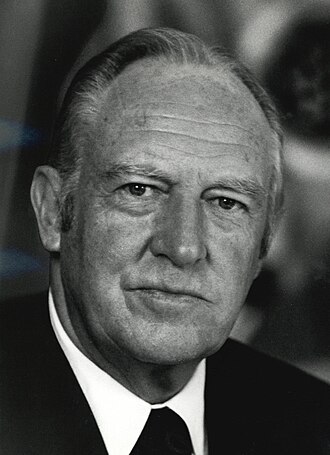
Rogers, William P.
William P. Rogers served as the United States Secretary of State from January 1969 to September 1973, encompassing the entirety of the Nixon White House taping period. Despite his senior cabinet rank, Rogers was frequently sidelined by President Nixon and National Security Advisor Henry Kissinger, who routinely bypassed the State Department to conduct secret back-channel negotiations regarding China, Vietnam, and the Soviet Union. Nevertheless, Rogers remained a key diplomatic figure during this era, focusing on Middle East peace initiatives and officially signing the Paris Peace Accords in January 1973.
President Nixon and his Cabinet met to discuss the ongoing military operations in Indochina and the development of the administration's national health reform agenda. Regarding the war, officials reviewed the progress of South Vietnamese incursions into Laos and Cambodia, noting that the strategy was successfully disrupting enemy supply lines while shifting the burden of ground operations away from American forces. The conversation then transitioned to a detailed proposal from Secretary of Health, Education, and Welfare Elliot Richardson regarding healthcare reform, with the group debating the costs, tax implications, and administrative feasibility of implementing Health Maintenance Organizations (HMOs) and national health insurance standards.
President Nixon met with West German Vice Chancellor Walter Scheel, Secretary of State William P. Rogers, and National Security Advisor Henry Kissinger to discuss the delicate status of Berlin and broader US-German relations. The participants evaluated the complex negotiations regarding Berlin's political ties to the Federal Republic and the necessity of maintaining Western access despite Soviet pressures. Following Scheel’s departure, Nixon and Kissinger reviewed the President's recent press conference, touching upon the strategic use of television to manage public perception on Vietnam, the Cuban missile situation, and ongoing prisoner of war issues.
President Nixon met with H.R. Haldeman and various staff members, including Peter Flanigan, Henry Kissinger, and John Ehrlichman, to deliberate on high-level personnel appointments, government reorganization, and legislative strategy. A primary focus was identifying a strong, business-oriented candidate for an ambassadorial role to navigate international economic negotiations and counter State Department bureaucracy. The group also discussed managing the President’s public image regarding economic policy, the Alaska pipeline, and Vietnam, while addressing the need to discipline administration officials who publicly diverged from official policy. The President emphasized a preference for direct, high-level policy control and instructed his staff to bolster communication efforts and strengthen the administration’s political messaging.
President Nixon and Secretary of State William P. Rogers met to discuss delicate foreign policy issues, including the situation in Laos involving UN Secretary-General U Thant and broader strategic considerations regarding China and the Soviet Union. The two also discussed the administration's public relations strategy, with Nixon emphasizing the need to control the release of information to the press to avoid appearing reactive. Additionally, the President expressed strong opposition to placing public housing projects in suburban neighborhoods, framing the issue as an economic concern rather than a racial one.
President Nixon and H.R. Haldeman reviewed the President's upcoming schedule, discussed potential ambassadorial appointments for J. Willard Marriott, Jr. and Charles D. Thornton, and evaluated strategies for public and media relations. Nixon expressed strong reservations about White House staff members, particularly Henry Kissinger, appearing on television to discuss substantive policy matters. They also analyzed recent Gallup poll data regarding the Vietnam War and the invasion of Laos, deciding to implement more frequent polling to better track public opinion trends.
President Nixon met with his senior national security and military advisors, including Henry Kissinger, Melvin Laird, and Admiral Thomas Moorer, to receive an update on the ongoing Lam Son 719 operation in Laos. The discussion focused on the military situation on the ground, the effectiveness of South Vietnamese forces, and strategies to manage press coverage regarding the conflict. Nixon emphasized the importance of maintaining a unified administration message and advised his team to treat the press as an adversarial force rather than providing direct, vulnerable answers to speculative inquiries.
President Nixon met with his national security team, including Vice President Agnew, Henry Kissinger, and William Rogers, to review the status of ongoing military operations in Southeast Asia and the complex diplomatic situation in the Middle East. Military leadership provided a detailed briefing on Operation Lam Son 719 and related efforts to interdict the Ho Chi Minh Trail, emphasizing that while the fighting is intense, the operations are effectively disrupting enemy logistics and protecting American withdrawal interests. The discussion subsequently shifted to the Middle East, where the President expressed frustration over Israel's reluctance to offer a concrete negotiating position despite Egypt's concessions. Nixon concluded by stressing the importance of maintaining a firm stance, noting that while the U.S. remains a reliable ally, it will not offer unconditional support without a reciprocal commitment to a serious peace process.
President Nixon met with Henry Kissinger, Alexander Haig, William Rogers, Melvin Laird, Admiral Thomas Moorer, and Richard Helms to coordinate strategy following the President's March 4, 1971, press conference. The discussion focused on maintaining public and political momentum for the ongoing Vietnamization effort and the military operations in Laos (Lam Son), specifically addressing potential responses to North Vietnamese missile fire and troop movements. Nixon emphasized the necessity of success in Southeast Asia to maintain American global credibility, while the participants reviewed intelligence on enemy capabilities and planned upcoming Congressional testimony and media appearances to manage the narrative surrounding the war.
President Nixon met with his National Security Council and key cabinet officials to receive a high-level briefing on developments in Soviet strategic capabilities, particularly concerning new ICBM silo construction and ballistic missile test programs. The participants evaluated the implications of these technological advancements for U.S. defense posture, including the necessity of maintaining a robust anti-ballistic missile (ABM) system. Discussions emphasized the need for a coordinated approach to strategic negotiations and the potential impact of Soviet military growth on current arms limitation efforts.
President Nixon and H.R. Haldeman reviewed the President's recent public relations efforts, focusing specifically on the impact of his recent eulogy for Whitney M. Young, Jr. and the need to strategically manage the President's press interviews. They discussed concerns regarding the influence and tactics of speechwriter William Safire, as well as the importance of maintaining an image of accessibility through controlled media engagements rather than traditional press conferences. Additionally, the President provided specific instructions to his staff regarding future press outreach and the upcoming funeral arrangements for Thomas E. Dewey.
President Nixon and the National Security Council met to evaluate U.S. policy options regarding the People's Republic of China's potential admission to the United Nations and the status of Taiwan. Attendees debated the risks of a potential diplomatic defeat, weighing the benefits of "dual representation" versus maintaining the current, increasingly untenable policy of excluding the PRC. The President emphasized the need to manage domestic American public opinion carefully while assessing tactical shifts, ultimately seeking a strategy that minimizes political fallout while addressing the evolving geopolitical reality of China's status.
President Nixon and his Cabinet met to discuss the ongoing challenge of inflation and rising construction costs, focusing on the administration's strategic options for economic stabilization. Dr. Paul McCracken reviewed current inflationary trends and labor market data, outlining a spectrum of potential responses ranging from maintaining current fiscal policies and targeted interventions to implementing more aggressive measures like wage and price controls. The meeting served as a forum to evaluate the efficacy of various regulatory mechanisms, such as the National Commission on Productivity and the suspension of the Davis-Bacon Act, while weighing the political and practical risks of further government intervention in the economy.
President Nixon met with his senior advisors, including Kissinger, Rogers, and Laird, to finalize the strategy and messaging for a televised address regarding the Vietnam War. They analyzed recent public opinion polling, which showed a significant, though potentially temporary, boost in the President's approval ratings following his intervention in the William Calley case. Nixon emphasized the need for simplified, slogan-based communication to gain public support for his administration's policies, specifically criticizing his own staff's tendency to over-complicate policy presentations. The President decided against allowing film coverage for an upcoming social event, expressing frustration with the constant focus on minor PR details.
President Nixon and Secretary of State William P. Rogers discuss the positive reception of the President's recent televised speech regarding the war in Southeast Asia. Rogers reports that guests at the Luxembourg Embassy, including foreign dignitaries, were moved by the address, particularly the emotional anecdote about a young boy named Kevin. They also address the ongoing political challenges regarding the POW issue, with Nixon expressing defiance toward Congressional opposition and maintaining that his policy stance is essential to avoid granting a victory to the communists.
President Nixon and the Council on International Economic Policy (CIEP) met to review global economic trends, specifically focusing on the United States' competitive position regarding trade, technological exports, and shifting GNP shares among developed and developing nations. The participants discussed the challenges posed by Japanese industrial policies, the role of multinational corporations, and potential antitrust law reforms to better align with international business realities. The meeting served to define the CIEP’s procedural structure and establish priorities for future foreign economic initiatives, including trade legislation and adjustment assistance programs.
Secretary of State William P. Rogers and Peter G. Peterson met to discuss various diplomatic and domestic policy issues, including U.S. relations with Australia and New Zealand, military interests in Singapore, and the status of Vietnam policy. The discussion touched on the political challenges posed by the Vietnam War, including public reaction to the President's speeches, student demonstrations, and the broader generational gap affecting support for the administration. The participants also reviewed scheduling matters and the administrative reorganization of the Cabinet and National Security Council.
President Nixon met with Franco Mario Malfatti, President of the European Commission, and various U.S. officials to address rising protectionist tensions between the United States and the European Economic Community (EEC). The discussion focused on the necessity of reciprocal trade concessions, specifically identifying how minor, mutually beneficial adjustments—such as those regarding citrus and textiles—could alleviate domestic political pressures and prevent broader trade conflicts. Nixon emphasized the importance of finding practical solutions to avoid protectionism, while Malfatti discussed the EEC’s ongoing efforts toward economic integration and the logistical challenges posed by the community's potential expansion. To facilitate progress, the parties agreed to coordinate follow-up efforts, including an upcoming diplomatic mission by Ambassador David Kennedy to Europe and Asia.
President Nixon met with Secretary of State William Rogers and several staff members to discuss two primary agendas: the public relations strategy for Tricia Nixon’s upcoming wedding and the administration's foreign policy maneuvering regarding China and Vietnam. Nixon emphasized the need for a choreographed, graceful presentation of the wedding to the press while explicitly rejecting over-exposure on talk shows. Regarding international affairs, the participants discussed the necessity of capitalizing on the ongoing withdrawal from Vietnam to secure domestic credit for broader diplomatic achievements, including the recent opening to China and progress on arms control, while maintaining a firm stance on security and defense appropriations.
President Nixon and Secretary of State William P. Rogers discuss a proposed diplomatic tour of the Middle East, which would follow Rogers' scheduled attendance at SEATO and CENTO meetings in London and Ankara. Nixon encourages the trip, noting its potential to shift media focus away from Vietnam and capitalize on invitations from Israel, Egypt, and Jordan. Additionally, the two touch upon labor relations, specifically regarding Nixon’s recent outreach to George Meany and building trades leaders, as well as the positive impact of the President's recent China initiative on public discourse.
President Nixon met with H. R. Haldeman, Ronald Ziegler, and other staff members to discuss political messaging, upcoming public appearances, and strategies for managing the administration's image. Key topics included the President's stance on welfare and a guaranteed annual income, the handling of Vietnam War protestors, and the ongoing antitrust case involving ITT. The President also emphasized his desire to aggressively challenge the media and the political opposition, while planning for an upcoming meeting with Secretary of State William P. Rogers.
President Nixon met with Secretary of State William Rogers and H. R. Haldeman to finalize the agenda and strategy for Rogers's upcoming diplomatic trip to the Middle East, which included stops in London, Paris, Ankara, Saudi Arabia, Egypt, and Israel. The participants discussed the need for the U.S. to maintain a balance of power while managing difficult negotiations between Israel and Egypt, particularly regarding the Suez Canal. Additionally, the President pressed Rogers to address the Turkish heroin trade during his visit and reviewed the political fallout concerning Vice President Agnew's recent remarks on China policy and the ongoing anti-war protests in Washington.
President Nixon met with various staff and associates, most notably Elmer H. Bobst, to discuss administrative matters, the President's upcoming travel schedule, and, primarily, the strategic management of federal cancer research. Bobst, a long-time advocate in the field, offered sharp criticisms of the National Institutes of Health (NIH), arguing that the organization suffers from excessive bureaucracy and a lack of accountability in allocating research grants. Nixon and John D. Ehrlichman consulted with Bobst regarding potential leadership for a new cancer program, specifically discussing the qualifications of candidates like Dr. Henry S. Kaplan to lead the initiative more effectively than existing bureaucratic structures.
President Nixon met with various administration officials and Secretary of State William P. Rogers to discuss legislative strategy, current foreign policy, and the political outlook of the Middle East. The President coordinated efforts with George Shultz and Clark MacGregor to build congressional support for revenue sharing and the Super Sonic Transport (SST) funding. Following these domestic agenda items, Secretary Rogers provided an extensive debriefing on his recent diplomatic tour of nine countries, focusing on the stability of Thailand, Turkey, Saudi Arabia, and Jordan, as well as his efforts to engage Anwar Sadat in Middle East peace negotiations.
President Nixon and his Cabinet met to receive a briefing on international affairs and domestic policy, with a focus on Secretary of State William P. Rogers' recent diplomatic travels to the Middle East and the feasibility of desalinization technology. Rogers reported on his efforts to stabilize the Middle East through ceasefire maintenance and discussed the geopolitical concerns of various regional leaders. Dr. Edward E. David Jr. and other experts presented a detailed plan to advance domestic water desalinization and nuclear power capabilities, with the President calling for a major, accelerated federal effort to ensure American technological leadership. The meeting concluded with a brief status report from Treasury Secretary David M. Kennedy regarding the current international monetary situation and the fluctuations of the dollar.
President Nixon and Secretary of State William P. Rogers discussed strategies to delay or defeat the Mansfield Amendment, which proposed a significant reduction in U.S. troops stationed in Europe. Concerned that the amendment would undermine NATO and erode international confidence in the United States, Nixon urged Rogers to lobby key senators, specifically Scott, Cooper, and Aiken, to stall the legislative process. They agreed to coordinate these lobbying efforts and explore hosting a high-level briefing to persuade lawmakers that such a troop withdrawal would be detrimental to U.S. foreign policy interests.
President Nixon met with Henry Kissinger and H.R. Haldeman to coordinate strategy regarding the Mansfield Amendment, which sought to withdraw U.S. troops from Europe. The President emphasized his firm opposition to the amendment, arguing that such decisions must be handled through executive negotiation rather than legislative mandate. The discussion also covered the delicate geopolitical maneuvering regarding a 'two-China' policy at the United Nations, domestic welfare reform messaging, and the management of economic news to combat negative public sentiment.
President Nixon and Secretary of State William Rogers discussed strategies to defeat the Mansfield Amendment, which proposed significant troop reductions in Europe. Nixon instructed Rogers to convey to Senator Mike Mansfield that the administration would aggressively oppose the measure because it would destabilize U.S. foreign policy and undermine ongoing negotiations with the Soviet Union and NATO allies. They also planned to coordinate with senior former officials and pressure skeptical Republican senators to ensure the administration's position prevailed.
President Nixon met with a large group of senior military and diplomatic officials to discuss the current state of NATO and the importance of maintaining U.S. commitment to the alliance. The participants focused on the economic and political strength of Europe, the potential for future unity, and the necessity of preventing unilateral troop reductions that could jeopardize geopolitical stability. The discussion highlighted the administration's efforts to influence congressional opinion, specifically regarding legislative proposals like the Mansfield Amendment, while emphasizing the administration's resolve to sustain a strong, collective defense posture.
President Nixon and Henry Kissinger met with Senator Edward Brooke to discuss the administration's strategic foreign policy, specifically focusing on the delicate negotiations regarding the People's Republic of China, Vietnam, and arms control. The President emphasized the need for discretion regarding ongoing initiatives to avoid undermining diplomatic efforts or domestic support, while urging Brooke to maintain a unified front against congressional efforts to impose troop withdrawal deadlines. The conversation served to align their messaging and ensure that legislative pressure, such as the Mansfield Amendment, would not jeopardize the administration's broader geopolitical objectives.
President Nixon and Secretary of State William P. Rogers discuss the administration's strategy for countering the Mansfield Amendment ahead of an upcoming Senate vote. Rogers advises the President to avoid personal attacks on Senator Mike Mansfield, noting that Dean Acheson’s disparaging public comments about the Senator have generated sympathy for him among other lawmakers. Rogers also provides an update on his recent testimony before the Senate Foreign Relations Committee regarding war powers and foreign policy, emphasizing the ongoing legislative tension over the Senate's role in executive decision-making.
President Nixon and Secretary of State William P. Rogers discuss the administration's opposition to the Mathias Amendment and its potential impact on U.S. foreign policy and NATO negotiations. They express concern that the amendment’s requirements for reporting to Congress and forcing mutual force reductions would undermine diplomatic leverage with the Soviet Union. The two agree to maintain a firm stance against the proposal while planning to coordinate later to manage the legislative strategy.
President Nixon and Secretary of State William P. Rogers discussed their firm opposition to a proposed congressional amendment requiring biannual reporting on sensitive diplomatic negotiations, arguing that such transparency would undermine the administration's ability to conduct effective foreign policy. Nixon expressed his intent to maintain a hard line against the amendment, asserting that there was no acceptable compromise to offer lawmakers. The two agreed to postpone a scheduled meeting to accommodate the President's upcoming engagement with state legislators regarding revenue sharing.
President Nixon and Secretary of State William Rogers discussed strategies for advancing peace negotiations in the Middle East and the status of Strategic Arms Limitation Talks (SALT) with the Soviet Union. Rogers provided an update on his recent diplomatic tour, noting promising overtures from Egyptian President Anwar el-Sadat regarding a potential interim settlement and the future removal of Soviet personnel. The President emphasized a firm stance toward Israel, arguing that the U.S. must leverage its military and economic support to pressure Israel into serious negotiations, while also planning to coordinate closely with Congressional leaders on the upcoming SALT announcement regarding anti-ballistic missile (ABM) systems.
President Nixon, H. R. Haldeman, and Henry Kissinger met to coordinate the announcement of a breakthrough in the Strategic Arms Limitation Talks (SALT), emphasizing that the agreement was a presidential initiative. They strategized on how to manage key Cabinet members, particularly William Rogers and Melvin Laird, to ensure they felt included and supportive without revealing the sensitive details of the negotiation process. Additionally, the President discussed his plans to brief legislative leaders and handle potential leaks, while Kissinger briefed the group on secret diplomatic efforts involving China and North Vietnam.
President Nixon and Secretary of State William P. Rogers discuss the strategic management of upcoming Congressional votes, specifically the Mansfield Amendment, and a significant breakthrough in the Strategic Arms Limitation Talks (SALT). To maintain leverage and avoid the appearance of political maneuvering, Nixon instructs Rogers to confidentially brief Senator Mike Mansfield about the progress on SALT only after the Senate vote concludes. They also address diplomatic logistics, including Vice President Agnew’s planned attendance at South Korean President Park Chung-hee’s inauguration and the potential for Rogers to represent the U.S. at an Atoms for Peace anniversary event in Geneva.
President Nixon and H. R. Haldeman discuss legislative strategy regarding upcoming Senate votes on the Mathias and Mansfield amendments. The conversation centers on timing the floor votes to minimize opposition success, specifically noting that the Mansfield amendment is expected to be defeated. Nixon consults with Secretary of State William P. Rogers to coordinate communication with Senator Mike Mansfield, aiming to manage the debate schedule and ensure favorable outcomes for the administration.
President Nixon and Secretary of State William P. Rogers coordinate legislative strategy to defeat the Mathias resolution, an amendment regarding troop reductions that the administration views as undermining foreign policy. Rogers updates the President on his discussions with Senator Mike Mansfield regarding a sensitive upcoming announcement and outlines his plan to lobby Senators Charles Percy and John Sherman Cooper to block the resolution. The President emphasizes the importance of preventing leaks while stressing that the resolution's call for unilateral NATO reductions would cripple ongoing negotiations with the Soviet Union.
President Nixon met with his Cabinet and key advisors to announce a major breakthrough in Strategic Arms Limitation Talks (SALT) with the Soviet Union, culminating in a joint statement to be released simultaneously in both nations. The agreement establishes a framework to prioritize limiting anti-ballistic missile (ABM) systems while pursuing parallel measures for offensive weapons. Nixon emphasized that the breakthrough was achieved by maintaining a strong U.S. defense posture, and he urged his administration to avoid public speculation or detailed commentary that could complicate sensitive ongoing negotiations.
In this meeting, President Nixon consulted with Secretary of State William P. Rogers regarding Middle East diplomacy, emphasizing his desire to push for a peace settlement before the upcoming election season and expressing frustration with the influence of Israeli interests. Following this, the President met with Henry Kissinger and Ronald Ziegler to coordinate the upcoming public announcement of a SALT agreement with the Soviet Union. Nixon and Kissinger strategically aligned on how to brief Congressional leaders while minimizing specific disclosures about negotiating history, MIRVs, and treaty structures to maintain control over the process.
President Nixon met with Vice President Agnew and a bipartisan group of Congressional leaders to announce a significant diplomatic breakthrough in the Strategic Arms Limitation Talks (SALT). Nixon informed the attendees of a forthcoming joint statement with the Soviet Union pledging to focus on limiting anti-ballistic missile (ABM) systems and certain offensive strategic weapons. While some lawmakers advocated for immediate unilateral U.S. defense cuts to demonstrate good faith, the President and his advisors successfully urged the leaders to maintain existing defense programs during the negotiations to avoid losing vital bargaining leverage.
President Nixon, William P. Rogers, and Charles W. Colson met to discuss the political implications and public relations strategy surrounding the announcement of the Strategic Arms Limitation Talks (SALT) agreement. The participants analyzed how the agreement could undermine the positions of Democratic critics and presidential hopefuls like Edmund Muskie and Hubert Humphrey, who had previously advocated for positions the administration had now effectively bypassed. Nixon and Colson agreed to maintain a sense of mystery and confidence regarding foreign policy, concluding that keeping public commentary brief would reinforce the President's stature as a far-sighted leader in command of momentous international developments.
President Nixon met with his SALT delegation, including Henry Kissinger and Gerard C. Smith, to strategize for upcoming negotiations in Helsinki and manage public and bureaucratic expectations. The discussion focused on maintaining a firm stance on the 'Safeguard' ABM program while emphasizing the need to keep details confidential to prevent premature leaks and political opposition. Nixon stressed that the delegation should project strength and avoid defensiveness, ultimately aiming to finalize a comprehensive treaty that would serve American security interests.
President Nixon met with Secretary of State William P. Rogers to discuss complex foreign policy strategies involving the Soviet Union, the People's Republic of China, and the Middle East. Nixon emphasized the importance of leveraging the Soviet Union's underlying anxiety regarding China while maintaining a careful, high-level approach to diplomatic overtures with the PRC. Regarding the Middle East, the President instructed Rogers to take a firm stance in negotiations, expressing personal willingness to apply pressure on Israel to reach a settlement while critiquing the current Israeli leadership.
President Nixon met briefly with Secretary of State William P. Rogers and aide Stephen B. Bull to coordinate scheduling and logistics for upcoming appointments. The participants finalized the arrangements for an impending meeting and confirmed the availability of staff support. The discussion concluded with the parties departing to continue their daily schedules.
President Nixon, H.R. Haldeman, and Henry Kissinger discussed the recent killings of police officers in New York and Washington D.C., with Nixon expressing strong support for law enforcement and frustration over perceived inaction. They also covered upcoming presidential travel, including potential trips for Vice President Agnew and Kissinger's own international engagements, as well as the ongoing Vietnam War and the complex diplomatic situation regarding the People's Republic of China. A decision was made to schedule a press conference for Tuesday, May 25th, and Nixon emphasized the need for a strong statement on marijuana policy.
President Nixon and Secretary of State William P. Rogers discussed internal security concerns regarding police violence and coordinated a private strategy meeting regarding sensitive diplomatic outreach to the People's Republic of China. Nixon directed Rogers and Henry Kissinger to prepare comprehensive political and diplomatic arguments for this China policy shift while maintaining a firm presidential posture. The participants agreed to meet privately following a scheduled luncheon with King Faisal to finalize their approach before Rogers’ upcoming trip to Europe.
President Nixon and Henry Kissinger met to strategize on two critical foreign policy initiatives: the pursuit of Mutual and Balanced Force Reductions (MBFR) in Europe and the shifting U.S. approach toward the People's Republic of China (PRC) and the United Nations. They discussed the tactical necessity of appearing proactive while maintaining control over the pace of negotiations, specifically regarding a potential 10% troop reduction in Europe and the delicate diplomatic maneuverings required to manage Taiwan's status at the UN. Secretary of State William P. Rogers joined the discussion to refine these strategies, and the President emphasized the importance of consulting with allies before making any final policy declarations to ensure domestic and international stability.
President Nixon and Secretary of State William P. Rogers discuss shifting diplomatic strategies regarding the Middle East and the fallout from a sensitive media leak concerning the People's Republic of China. The conversation addresses the influence of Soviet leadership on Egyptian President Anwar el-Sadat and examines statements made by King Faisal regarding Israel. Nixon and Rogers coordinate their response to the Washington Post report, evaluating the roles of Henry Kissinger and administration press secretaries in managing the potential security breach.
President Nixon and Secretary of State William P. Rogers met to coordinate their public messaging strategy ahead of an upcoming presidential press conference. They discussed the political implications of recent comments regarding Middle East policy and the administration's stance toward Israel. Nixon instructed Rogers to maintain a low-key approach regarding these diplomatic sensitivities to ensure consistent communication.
President Nixon and Secretary of State William P. Rogers discuss the administration's evolving strategy regarding the People's Republic of China's admission to the United Nations, specifically debating the merits of a two-resolution approach to separate admission from the expulsion of Taiwan. Nixon emphasizes the importance of reassuring Taiwan privately while managing domestic and international perception through Rogers' forthcoming Senate testimony. Additionally, the two touch upon the sensitive status of U.S. combat roles in Vietnam ahead of meetings with South Vietnamese leadership and review the recent visit by King Faisal of Saudi Arabia.
President Nixon and Secretary of State William P. Rogers coordinated their public messaging in preparation for an upcoming presidential press conference. They discussed maintaining a noncommittal stance on Middle East arms sales to Israel and ongoing Mutual and Balanced Force Reduction (MBFR) talks, while expressing sympathy for the domestic political pressures faced by Egyptian leader Anwar el-Sadat. Furthermore, the two men agreed on the necessity of bolstering American morale through more patriotic, upbeat public events and symbolic displays, such as those involving martial music.
President Nixon and Secretary of State William P. Rogers discuss maintaining a firm bargaining position regarding international trade and economic policy. They reflect on recent public appearances, specifically addressing national morale and the President's attendance at a Memorial Day event at West Point. The conversation concludes with an emphasis on balancing domestic political pressures with a responsible approach to economic management.
President Nixon and Secretary of State William P. Rogers discuss the successful media coverage of Tricia Nixon's wedding and the positive trend of declining U.S. casualties in Vietnam. The conversation shifts to the recent Pentagon Papers leak in the New York Times, which Nixon characterizes as a massive security breach that reflects poorly on the previous administration. They coordinate a strategy to publicly discredit Clark Clifford, specifically planning for Rogers to address Clifford's recent political maneuvers with measured criticism.
President Richard Nixon met with Secretary of State William P. Rogers to discuss administrative and strategic coordination regarding unspecified ongoing developments. The conversation focused on the necessity of managing institutional processes and identifying effective personnel to address these matters. Despite the unintelligible nature of the provided transcript, the exchange centered on the implementation of policy objectives and the evaluation of effective communication strategies.
President Nixon met with his cabinet, diplomatic staff, and intelligence officials to declare drug abuse 'public enemy number one' and to coordinate a comprehensive strategy for eradicating the international supply of narcotics. The participants evaluated the effectiveness of current interdiction programs in Southeast Asia, the Middle East, and Europe, ultimately concluding that despite increased law enforcement efforts, the drug problem was expanding. The President directed his team to prioritize the escalation of foreign pressure, including potential subsidies for poppy crop eradication in Turkey, and announced the centralization of domestic drug policy under a new White House office.
President Nixon met with William P. Rogers, Alexander M. Haig, Jr., and Ronald L. Ziegler to coordinate an administration response to the publication of the Pentagon Papers. The participants discussed strategies to minimize the perceived impact of the leaks by emphasizing that the papers represented an internal Department of Defense study rather than a consensus view of the administration, while concurrently highlighting the President's commitment to a new, independent Vietnam policy. They also addressed broader diplomatic issues, including NATO relations, arms limitation negotiations with the Soviet Union, and personnel transitions involving key foreign service positions.
President Nixon and Secretary of State William P. Rogers discuss the administration's strategic response to the publication of the Pentagon Papers, specifically praising Rogers' recent press statement regarding the breach of foreign diplomatic security. The two men agree to reframe the documents as the "Kennedy-Johnson papers" to shift focus away from the current administration. Additionally, they discuss an upcoming meeting with West German Chancellor Willy Brandt and express concerns regarding the judicial handling of the temporary injunction against the New York Times by Judge Murray I. Gurfein.
President Nixon and Secretary of State William P. Rogers held a brief consultation regarding the administration's ongoing diplomatic strategy in Vietnam. The discussion touched upon the dissemination of information and the President's upcoming public presentation concerning the conflict. Nixon expressed a desire to personally reflect on these developments while acknowledging the complexities involved in managing current foreign policy perceptions.
President Nixon met with his National Security Council to discuss strategy for Mutual and Balanced Force Reduction (MBFR) negotiations with the Soviet Union, emphasizing the importance of verification and maintaining allied unity. The President and his advisors examined how to use these potential force reductions to counter domestic congressional pressure for unilateral troop withdrawals. Additionally, the group addressed the ongoing crisis surrounding the publication of the Pentagon Papers, with Nixon expressing a need to strengthen penalties for leaking classified information and to defend the executive branch's ability to maintain secure communications.
President Nixon met with his Cabinet to address the persistent problem of unauthorized leaks within the federal bureaucracy and to establish clear expectations for departmental discipline. He emphasized that decision-making must remain internal and closed to prevent political sabotage, specifically citing the negative impact of leaks on economic policy and administrative unity. Nixon announced that H.R. "Bob" Haldeman would oversee efforts to tighten internal controls, while Secretary John Connally was designated to handle the official announcement of upcoming economic policy decisions.
President Nixon met with Secretary of State William Rogers and Turkish Ambassador Melih Esembel to discuss the strengthening of U.S.-Turkish relations and ongoing cooperation regarding drug production suppression. Following a brief photo session with the press, Nixon and Rogers shifted their focus to the tragic deaths of the Soviet Soyuz 11 cosmonauts. The discussion concluded with plans to draft an official telegram of condolence to the Soviet Union regarding the mystery of the crew's demise.
President Nixon met with bipartisan Congressional leaders and senior administration officials to discuss the sensitive diplomatic initiative concerning the normalization of relations between the United States and the People’s Republic of China. The President and Henry Kissinger briefed the group on the nature of these confidential negotiations, emphasizing the necessity of absolute discretion to ensure the process remained successful. Nixon and his team requested that participants avoid speculation and maintain a unified, non-partisan front when speaking publicly about the delicate geopolitical implications of this shift in U.S. foreign policy.
President Nixon met with his Cabinet members to discuss the delicate political landscape surrounding the administration's efforts to open communications with the People's Republic of China. The conversation centered on the necessity of maintaining strict discretion to avoid premature public speculation, which could jeopardize sensitive diplomatic negotiations and create political vulnerabilities. Nixon emphasized the importance of a unified front among Cabinet members to manage domestic and international expectations as the policy shift progressed.
President Nixon met with key Congressional leaders, including John C. Stennis and F. Edward Hébert, along with his advisors to discuss the legislative strategy for upcoming draft bills and the political impact of Congressional interference in Vietnam War policy. The participants debated the risks of establishing a firm troop withdrawal date, with Nixon emphasizing that Congressional restrictions could undermine his negotiating leverage and public perception. The President insisted on maintaining executive freedom of action to ensure a favorable peace settlement and signaled that he would not yield on the inclusion of a binding deadline in draft legislation.
President Nixon and his administration met with Republican Congressional leaders to discuss the 1971-1972 economic outlook, focusing on key indicators such as GNP, unemployment rates, and inflation. The discussion centered on evaluating recent economic growth, managing ongoing labor disputes in the steel and transportation sectors, and addressing political concerns regarding the administration's fiscal and wage-price policies. The President and his economic advisors emphasized their commitment to achieving peacetime economic stability and requested support from leadership to convey a positive but measured economic narrative to the public.
President Nixon, Secretary of State William P. Rogers, and National Security Advisor Henry Kissinger coordinated strategy regarding ongoing efforts to achieve an honorable end to the Vietnam War. The discussion centered on aligning U.S. negotiating objectives—specifically a ceasefire, POW release, and regional peace—with potential legislative maneuvers in Congress. The participants evaluated how to manage Senate Majority Leader Mike Mansfield’s involvement to prevent unfavorable legislative interference with the administration's diplomatic goals.
President Nixon, William P. Rogers, and Henry Kissinger met to coordinate foreign policy strategy, focusing on the administration’s initiative toward the People’s Republic of China (PRC) and its impact on the United Nations and U.S.-Japan relations. The participants discussed managing the delicate diplomatic transition regarding Taiwan’s UN membership, the importance of maintaining strong ties with Japan, and the domestic political advantages of the evolving foreign policy, particularly concerning the Vietnam War and the Pentagon Papers. The President also reviewed legislative strategy for a bipartisan Vietnam ceasefire resolution with Senator Mike Mansfield and planned logistics for his upcoming visit to China.
President Nixon, Vice President Agnew, and Secretary of State Rogers met to debrief on Agnew's recent diplomatic tour of Africa and the Middle East, while also discussing the administration's ongoing initiative to open relations with the People's Republic of China. The participants expressed frustration with press coverage—specifically in Newsweek—regarding the Vice President's trip and the China policy, and they strategized on how to manage the ensuing public and congressional reactions. Additionally, the President and his staff discussed personnel changes, including the potential replacement of Ambassador Joseph Farland in Pakistan, and reviewed the broader geopolitical implications of the unfolding China initiative.
President Nixon and his advisors discussed the scheduling of various domestic and international political meetings, including an upcoming engagement with Ronald Reagan. Much of the conversation focused on managing the public relations challenges surrounding Vice President Spiro Agnew’s recent foreign travel, with the participants expressing frustration over his negative relationship with the press and his preference for recreational activities over substantive engagement. The group also touched upon economic strategy, the upcoming federal budget, and ongoing labor concerns in the steel and shipping industries.
President Nixon, Secretary of State William P. Rogers, and H.R. Haldeman discuss the poor press coverage and negative public perception of Vice President Spiro Agnew’s recent 30-day foreign trip. The participants attribute the backlash to Agnew’s excessive time spent golfing, his refusal to engage with the press or follow scheduling advice, and his lack of substantive appearances. Ultimately, the group expresses frustration that Agnew ignored his staff's guidance and exacerbated his own difficulties, though they agree on the need to boost his morale upon his return.
President Nixon met with H.R. Haldeman and John Mitchell to discuss a wide-ranging agenda encompassing the 1972 campaign strategy, potential Cabinet-level personnel shifts, and upcoming major economic policy decisions. The group evaluated the political ramifications of the President's recent overtures to China, the ongoing busing controversy, and the necessity of managing conservative Republican factions. A significant portion of the discussion focused on a proposed package of economic interventions, including a possible wage and price freeze, to address domestic inflation and international monetary concerns. These deliberations underscored a transition toward more direct administrative control over economic policy as the 1972 election cycle approached.
President Nixon met with Vice President Agnew and his Cabinet to discuss the administration's foreign policy objectives and the state of the national economy. Agnew briefed the attendees on his recent international tour, highlighting the global reception of the Nixon Doctrine and the challenges posed by the Arab-Israeli conflict, East Pakistan, and the increasing Soviet and Chinese presence in various regions. Nixon and his advisers subsequently addressed the economic outlook, emphasizing the need for an aggressive, unified defense of administration policies regarding inflation and unemployment, while dismissing the viability of permanent wage and price controls. Finally, the President mandated a strict reduction in government personnel and grade-level escalation to improve budget management across executive departments.
President Nixon and Secretary of State William P. Rogers discuss the immediate international and domestic fallout of Nixon's wage-price freeze speech and the suspension of gold convertibility. The two officials review the reactions of various foreign leaders, including Japan's Eisaku Sato and Canada's Mitchell Sharp, while assessing the political advantages of the administration's bold economic shift. Nixon expresses his intent to leverage this position of strength to overhaul the international monetary system and move away from the limitations of the Bretton Woods era.
President Nixon convened a large meeting with Vice President Agnew and his Cabinet to discuss the national economy and the "New Economic Policy" he had announced the previous day. Key topics included the wage-price freeze, import surcharges, tax relief, budget cuts, and the convertibility of the dollar. The administration sought Cabinet support for these initiatives and discussed their potential impact on international trade and domestic employment.
President Nixon and Secretary of State William P. Rogers coordinated strategy regarding upcoming economic and diplomatic negotiations with Japan. Nixon emphasized a public relations theme centered on mutual success and fair competition rather than conflict. The President also informed Rogers that Japan had specifically requested his participation in the talks over other potential U.S. representatives like John Connally or George H.W. Bush.
President Nixon held a brief administrative conversation with Secretary of State William P. Rogers to facilitate a connection to an individual in Texas. The interaction served primarily as a logistical bridge, with the President initiating the call to coordinate communication with the external party. No substantive policy discussions or major decisions were recorded during this exchange.
President Nixon met with the Council on International Economic Policy (CIEP) and key economic advisors to discuss the administration's post-August 15 New Economic Policy (NEP) and future international trade strategy. Peter G. Peterson led a presentation analyzing the shortcomings of global liberal trading systems and the challenges posed by foreign competitors like Japan, while other officials addressed the domestic economic impact, labor relations, and the status of ongoing monetary negotiations. The President emphasized the need for a firm but diplomatic approach toward Japan and directed his team to maintain the offensive on domestic economic policy while keeping options flexible regarding international monetary reform.
President Nixon, Pat Nixon, and the Cabinet met with their spouses to discuss the implementation and public perception of the administration’s New Economic Policy. Secretary of the Treasury John Connally led a comprehensive briefing on the wage-price freeze, tax reforms, and international monetary adjustments aimed at curbing inflation. The discussion emphasized the necessity of these economic measures for restoring national growth, managing federal expenditures, and building public and congressional support for the administration's program.
President Nixon met with the members of the Commission on International Trade and Investment Policy, led by Chairman Albert L. Williams, to discuss the committee's recently completed report on global economic competition. The conversation focused on the necessity of re-evaluating U.S. trade, monetary, and labor policies in light of increased challenges from a revitalized Europe and a highly organized Japanese industrial sector. Nixon and the commission members explored strategies for restoring U.S. global competitiveness, including the role of investment tax credits, the impact of antitrust laws on industrial mergers, and the long-term implications of the August 1971 economic initiatives.
Secretary of State William P. Rogers briefed President Nixon on a potential legislative challenge regarding the Vietnam War, specifically an amendment proposed by Senator Joseph M. Montoya. The amendment sought to tie military procurement funding to the requirement of contested elections in South Vietnam, a move the administration feared would gain significant support and create pressure for the resignation of South Vietnamese leaders Nguyen Van Thieu and Nguyen Cao Ky. The two agreed to coordinate with National Security Advisor Henry Kissinger and Ambassador Ellsworth Bunker to develop a strategic response to the resolution. They also briefly exchanged positive feedback regarding a recent television appearance by First Lady Pat Nixon.
President Nixon met with H. R. Haldeman, Henry Kissinger, and others to discuss television strategy, public relations for his upcoming foreign summits, and administrative crises. The President emphasized his desire to use live television broadcasts from China to maximize public impact and discussed managing domestic perceptions through news-time appearances. The participants also addressed the Attica Prison riots, coordinating presidential support for Governor Nelson Rockefeller, and discussed policy options regarding Chile and Vietnam, including planning for an upcoming National Security Council meeting.
Henry Kissinger and William Rogers discuss the potential political fallout from the Montoya Amendment regarding military assistance to South Vietnam and the precarious position of President Nguyen Van Thieu. They express concern that internal instability in South Vietnam, combined with domestic congressional pressure, threatens U.S. policy objectives. The pair also coordinate scheduling for an upcoming National Security Council meeting and prepare for the diplomatic arrival of Soviet Foreign Minister Andrei Gromyko.
President Nixon met with the National Security Council and senior advisors to conduct an extensive assessment of the deteriorating political and military situation in South Vietnam, focusing on the stability of the Nguyen Van Thieu administration and the threat posed by opposition factions and communist forces. The discussion covered strategic military planning for the upcoming dry season in Cambodia and Laos, the progress of Vietnamization, and the implications of U.S. troop withdrawal timelines on both the battlefield and domestic public opinion. Participants also evaluated the potential impact of diplomatic initiatives, including the President's announcement regarding Henry Kissinger’s trip to Peking, on North Vietnam's strategic calculations and internal morale.
President Nixon and Secretary of State William P. Rogers discuss potential candidates for upcoming Supreme Court vacancies, focusing on the political challenges of securing confirmation for a Southerner and balancing ideological qualifications. They evaluate candidates including Richard H. Poff, Ed Walsh, and John N. Irwin, II, specifically weighing their age, law enforcement backgrounds, and stances on sensitive issues like busing and civil rights. Nixon tasks Rogers with privately vetting Walsh to ensure his judicial philosophy aligns with the administration’s views before proceeding.
President Nixon, Vice President Agnew, and members of his Cabinet met to coordinate a unified administration strategy ahead of critical International Monetary Fund (IMF) meetings and ongoing global trade negotiations. The discussion emphasized the necessity of maintaining the recently imposed 10% import surcharge and a firm bargaining stance to address the nation's economic balance of payments and reshape the international monetary system. Nixon and his advisors agreed that while foreign partners would likely criticize U.S. policy, maintaining domestic political support and correcting long-standing trade imbalances remained the administration's primary objective.
President Nixon met with a delegation from the Organization of African Unity (OAU), led by Mauritanian President Moktar Ould Daddah, to discuss African decolonization and the liberation of southern Africa from minority rule. The delegation advocated for U.S. support in implementing UN resolutions regarding Namibia, South Africa, Rhodesia, and Portuguese territories, while specifically expressing concern over potential U.S. legislation to purchase chrome from Rhodesia. Nixon reaffirmed the administration's opposition to the legislative amendment and emphasized his personal commitment to African affairs, while the delegates expressed gratitude for the open, diplomatic dialogue.
President Nixon met with Soviet Foreign Minister Andrei Gromyko and other officials to discuss the state of U.S.-Soviet bilateral relations, focusing on arms control, trade, and regional conflicts. The conversation addressed the status of the Berlin Agreement, progress on Strategic Arms Limitation Talks (SALT), and the need for diplomatic coordination regarding the Middle East and South Asia. Both sides emphasized the importance of maintaining direct, private channels of communication to manage tensions and facilitate future progress toward a potential summit meeting.
President Nixon met with Secretary of State William P. Rogers and National Security Advisor Henry Kissinger to discuss U.S.-Soviet relations following Nixon's earlier meeting with Soviet Foreign Minister Andrei Gromyko. The participants reviewed the status of communication with Leonid Brezhnev and the strategic importance of balancing upcoming summits with both the USSR and the People's Republic of China. The discussion focused on coordinating the timing and announcement of the President's visit to the Soviet Union and managing potential diplomatic sensitivities regarding the two major powers.
President Nixon, Secretary of State William Rogers, and National Security Advisor Henry Kissinger met to discuss the sensitive timing of Kissinger's upcoming trip to the People's Republic of China (PRC). Rogers expressed strong concern that the trip's timing—coinciding with the critical United Nations vote on the status of Taiwan—would create a political backlash and make it appear that the U.S. was undermining its own efforts at the UN. Ultimately, the group discussed potential strategies to delay the trip or alter its public framing to avoid the appearance of being manipulated by the Chinese or signaling disinterest in the UN vote.
President Nixon and Secretary of State William P. Rogers discussed the strategic importance of improving relations with Latin American nations to balance the administration’s focus on upcoming diplomatic initiatives in China, the Soviet Union, and elsewhere. Nixon emphasized a personal desire to engage with Latin American leaders, noting that the region had been neglected compared to other international priorities. Rogers was tasked with investigating potential opportunities for a presidential visit, specifically suggesting a trip to Paraguay to meet with Alfredo Stroessner.
President Nixon and Secretary of State William P. Rogers discuss the need to improve diplomatic engagement with Latin American nations to demonstrate that the region remains a priority for the administration. Nixon expresses a personal affinity for Latin American countries and suggests that Rogers conduct a diplomatic visit to a stable city in the region to bolster relations. The discussion emphasizes balancing this regional focus against the President's ongoing high-level diplomatic efforts with China, Russia, and Japan.
President Nixon, Henry Kissinger, and William P. Rogers met to coordinate U.S. strategy regarding upcoming European diplomatic engagements and a potential summit. They agreed to maintain a cautious stance on the proposed European Security Conference to avoid granting concessions to the Soviets prematurely. Additionally, the group explored the feasibility of hosting a 'Big Four' summit including Japan, tasking John B. Connally with further development of the concept.
President Nixon met with a bipartisan group of Congressional leaders and key administration officials to discuss his upcoming summit in Moscow and broader U.S. strategy regarding the Soviet Union and China. The President emphasized that his administration sought to maintain a delicate balance between the two powers without appearing to collude with one against the other. The discussion underscored the importance of bipartisan support for national defense funding and the need for diplomatic engagement to prevent escalation in volatile regions like the Middle East.
President Nixon met with his Cabinet and key staff members to review the administration’s domestic and foreign policy priorities, primarily focusing on the economic transition to 'Phase II' and the announcement of a 1972 Soviet summit. Officials discussed the successful implementation of the wage-price freeze and the strategy for securing organized labor's cooperation on the newly formed Pay Board and Price Commission to curb inflation. Additionally, the President addressed the importance of linking economic policy to job growth through his pending tax proposals, while Secretary of State Rogers and the President emphasized that international diplomatic overtures toward the Soviet Union and China were part of a cohesive, long-term strategy for global peace.
President Nixon and Secretary of State William P. Rogers spoke to discuss the upcoming United Nations vote on the status of Taiwan and the People's Republic of China. The two reviewed lobbying strategies for critical uncommitted nations, including Italy, Turkey, and Argentina, and considered using targeted diplomatic pressure and presidential communication to secure votes. They also briefly discussed the President's recent interactions with World Series players and explored the idea of Nixon increasing his public visibility at other sporting events like professional bowling.
President Richard M. Nixon and Secretary of State William P. Rogers engaged in an informal discussion that, based on the transcript's focus on sports commentary and game analysis, appears to be a casual social interaction rather than a formal policy meeting. While the transcript contains extensive, repetitive commentary regarding specific football players, team strategies, and game events, it provides no substantive evidence of government business, policy decisions, or official action items. The conversation reflects a brief period of personal rapport between the two men.
President Nixon met with William P. Rogers and Robert H. Finch to discuss upcoming diplomatic travel, administrative scheduling, and political strategy. Key discussions included planning First Lady Pat Nixon's trip to Africa, finalizing the itinerary and delegation for Finch's upcoming Latin American tour, and managing domestic Hispanic outreach. The participants also consulted on foreign policy initiatives, specifically regarding media strategy for the President's planned visits to China and the Soviet Union, and the potential for preliminary negotiations concerning a European security conference.
President Nixon and Republican Congressional leaders met to coordinate strategy on key foreign and domestic policy initiatives, emphasizing the administration's progress in achieving global peace and economic stabilization. Secretary of State William Rogers provided an assessment of U.S. leadership, focusing on the upcoming United Nations vote regarding Taiwan, the ongoing India-Pakistan crisis, and preparations for Nixon's summits in Moscow and Beijing. The group also discussed legislative tactics for securing Republican priorities, specifically the Economic Stabilization Act and the ongoing challenge of the Mansfield Amendment to Vietnam policy. Nixon urged the leaders to maintain a firm, unified front to avoid projecting vulnerability to foreign adversaries and domestic political opponents.
President Nixon and Secretary of State William Rogers discussed strategies for managing U.S.-Latin American relations, specifically focusing on the potential removal of import surcharges to provide a concrete economic gesture. They also coordinated plans for First Lady Pat Nixon's upcoming trip to Liberia and other countries, aiming to reframe it as a business-oriented, women-led diplomatic mission. Additionally, the two reviewed a recent meeting with legislative leaders regarding the Vietnam War, with Nixon expressing frustration over continued political pressure despite low casualty rates.
President Nixon and Secretary of State William P. Rogers discuss plans for a diplomatic initiative toward Latin America, emphasizing the need for a high-profile tour to demonstrate commitment. They deliberate on potential policy gestures, such as addressing import surcharges and preferential trade treatment, to provide substance to the visit. Additionally, the conversation touches upon personnel choices for the delegation and assesses the decreasing intensity of the Vietnam War in terms of U.S. casualty rates.